
First: the actual context. Israel has a long history of using culture as a means of normalizing the oppression and mistreatment of Arabs in Palestine. We all know the Arab-Israel conflict is complicated and no one is helped by antagonism or violence, least of all from the side with all the power. I support Israel's existence, but I can't support the way it treats Palestinians. The very fact the artist himself doesn't want the piece displayed in this context should be reason enough to change something.
My bigger concern, though, is with those trolls and click-baiters looking to use this to inflame the old "Christians are persecuted in the US" trope. That's irresponsible for a number of reasons. One, pretty importantly, a large part of US "Christianity" these days is just a cover for specific social or political beliefs that stand up better under the banner of religion. That's nothing new to Christianity - our popular theology and practice has been shaped by politics for centuries; religion is not inherently the opiate of the masses, but it sure works well for that purpose.
The second issue, connected somewhat, is simply the scriptural tradition of such prophetic statements of religious hypocrisy, perhaps unfaithfulness would be a more welcome word (although I doubt it). This image is meant to express how society treats consumerism like religion, maybe not with words, but certainly with our actions. Western Christianity is far more concerned with immediate gratification, comfort, and power than with anything resembling "Biblical" Christianity.
That's also nothing particularly new, which is precisely the point.
The Hebrew Scriptures (Old Testament) is chock full of confrontations between court prophets and those who end up becoming the writers (or at least subjects) of scripture itself. The court prophets told the people (and especially the rulers) precisely what they wanted to hear: you're doing a good job, things are looking up, we're right to live the way we do. Prophets like Isaiah and Jeremiah are pointing out the sins of the people, the hypocrisy, and error. They're pointing out the areas in which God's people fall short; an important elements of any faithful religious belief.
Statues like this one make a very traditional prophetic statement, even if the artist isn't from among God's people (I'm not sure if he's a Christian or not, but that's never really been an issue when God calls a prophet anyway). God's people hear the words of correction with humility rather than defensiveness. Yes, this image should anger you, as a Christian; it should be offensive. That doesn't make it bad.
In scripture, those people who decried public prophetic statements of religious hypocrisy were called false prophets. Something to remember as we engage with the realities of our own personal and collective imperfections.
Disclaimer: I was given a free copy of this book for the purpose of review. My integrity is not for sale. Those who know me well are aware a free book isn't enough to assuage my cutting honesty. If I've failed to write a bad review, it has nothing to do with the source of the material and only with the material itself.
Jeff Goins provides a really compelling, motivational guide to practicing art in the age of capitalism. His main focus is to counter the "starving artist" narrative with stories of people who make art on different terms. Real Artists Don't Starve captures the "new renaissance" by emphasizing key principles that artists can use to maximize their place in society.
I don't necessarily have a problem with this approach and certainly found some good ideas for my own art and life, however, Goins does present his perspective on art - namely that capitalism is a given and artists should be a part of it in very specific ways - as the only option (much as the title indicates). On page 145 he does raise the question of artists who genuinely don't care about money and practice their craft purely for their own enjoyment - however he fails to answer the question in any meaningful way, instead telling the story of a web designer who shifted his clientele from Fortune 500 companies to small businesses, because he enjoyed the work more.
There's also some lip service paid, in the final chapter, to alternative forms of community. He calls it "art as gift," in which people are rewarded for art in the same ways people value and reward the work of doctors, but there isn't a ton of depth here and he really does explain what he's talking about very well.
As I said, it's a great primer for artists attempting to live within capitalism and for that, I highly recommend, however, for anyone, like me,
who may not be looking at their art or their life in the same way, there's a lot left to be desired. I'm trained in theology, so I tend to think about these things theologically, but even in a practical sense, at least mentioning the notion of a national minimum wage - an economic theory that's becoming more popular - might be helpful, since one of it's main selling points is the freedom it provides for people to follow their passions and create.
I'll overlook one of my major pet peeves (using "creatives" as a noun to describe creative people) and commend Goins for the effort. He manages to provide a very standard, practical perspective on art that actually feels like art. It's a conventional book about art that won't turn artists off - which is certainly an accomplishment of sorts.
Disclosure of Material Connection: I received this book free from the publisher through the BookSneeze.com® book review bloggers program. I was not required to write a positive review. The opinions I have expressed are my own. I am disclosing this in accordance with the Federal Trade Commission’s 16 CFR, Part 255: “Guides Concerning the Use of Endorsements and Testimonials in Advertising.”
however, one in particular struck me for an entirely different reason.
Towards the end of the book, the author, Maria Konnikova, presents the case of Glafira Rosales, a small-time art dealer who conned big-time art dealer Ann Freedman into selling off 63 forged abstract expressionist paintings as real over the course of many years, even buying some herself.
The fakes were so convincing, reknowned art experts, historians, even museums specializing in the period and Mark Rothko's son, Christopher,
were convinced they were real. It was only when so many previously unknown works emerged that people began to be suspicious, but it was never because of the art itself.
The book talked about how we can become blind to our own expertise - of course Freedman believed in the art, she had two in her entryway and saw them everyday. How could she, an expert, be fooled by fakes she saw all the time.
In the end the scheme bankrupted a lot of people and embarrassed far more, but that notion of the dealer looking at fake paintings in her entryway struck me as odd - the economics of the whole thing. If those paintings were truly indistinguishable from de Koonig's style (for none of them were copies of existing art, but art in the style of each artist, passed off as unknown), why would it be any less valuable? Either the thing takes on more beauty because the artist is famous, or the art itself is more valuable because the artist is famous - but neither option really makes sense.
It led me to think about the ways in which we evaluate beauty. The high art world is strange to begin with - none of the immense, grotesque values on famous paintings are truly accurate; as in any free-market system, value is determined solely by how much money one is willing to pay. A modern artist can now sell a written description of an un-made work as art, and bag $10m for the privilege of letting someone imagine what they would've designed. I get the inherent value of such a thing, as well as the philosophical statement its making - and I appreciate both - but I don't understand the monetary value.
Beauty is beauty. Someone may be unwilling to part with a beautiful work of art for $10m, when no one else would pay twenty bucks for it, because its beautiful and you can't put a price on beauty. People on Antiques Road Show like to know how much Grandma's 400 year old rocking chair is worth, but they're never going to sell it - the connection is too priceless. I'm sure there are psychological effects at play here, too, but it's also a statement on beauty. What we find valuable doesn't always equate to money.
Shoot, I write here at least once a week, hopefully twice - the hits aren't terrible. I'm sure I could throw some google adsense boxes up and make a few bucks, but I don't like the idea of not being able to control what products get sold next to my thoughts and words. Whatever small benefit I might receive is outweighed by the very non-monetary cost to my perception of artistry and beauty.
In the end, though, it is kind of sad how the free-market has taken over art. Yes, I'm sure some of the people who spend gobs on paintings and sculpture really appreciate the beauty on the pieces and just happen to have the money to buy them; a lot, however, just like the investment.
The book treated the forged paintings as somehow worthless, simply because the artist was not who people thought it to be. Absent that knowledge, no one - absolutely no one - could tell the difference.
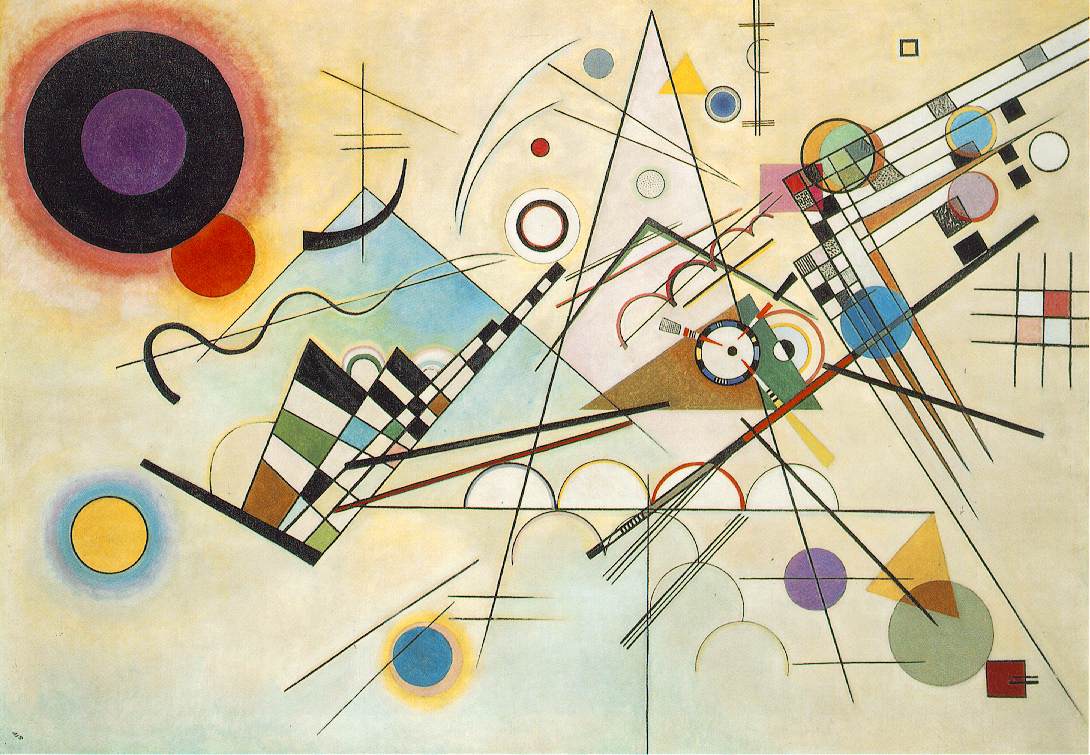
I suppose this could be some grand example of "beauty is truth and truth beauty" right? It is not the artist that makes the painting less valuable, but the deceit? I can see that perspective, but perhaps I'm too naive. I think something beautiful is beautiful. Wasilly Kandinsky is one of my favorite artists. I've seen a lot of his work in person and even more in prints and books. I absolutely love the unusual way his mind and design work - it strikes me as incredibly beautiful. I've also seen a few of his pieces, though, that strike me as downright ugly -
whether its the particular design or the color choices or what have you, I don't like them all simply because he created them.
I get that some Picassos are worth more than others, purportedly because they're better representative of a specific style or a difference in structure or technique - maybe they're even a little less beautiful. But I wonder how they'd be evaluated if the branding of a name weren't attached?
I suppose its impossible to do. Branding is important no matter who you are - JK Rowling continues to use her Robert Galbraith pseudonym for her adult mysteries long after the connection was unmasked. It's branding and removing it probably hinders the artist in some way. At the same time, I wonder how our understanding of beauty and value gets diluted and confounded by the economy of a free market that limits value to simply what money can buy.

Then, on Friday night, for just $10, I (and about 100 others) were treated to 90 minutes of musician Derek Webb, playing and talking from his living room via the interwebs. He took requests and interacted with the relatively small audience and is going to start doing similar broadcasts regularly. Derek Webb is a fantastic songwriter and one who inspires my own writing with his creativity and skill. He's an evolving spiritual thinker who provided and important soundtrack to much of my own growth and maturation during college years and after.
Both of these things are quite mundane for the world we live in now, but they're pretty revolutionary ways for artists and thinkers to not only have their work engaged and critiqued, but to make a living. Concerts are really starting to price out a lot of people (myself included) with their associated costs and expenses - this is a great evolution, allowing someone like Derek Webb to interact more directly with listeners.
For Rollins, who can only speak so often and in so many places, but perhaps has a widespread, eclectic audience, he can bring people together in ways that are mutually beneficial and cost effective for both parties. I'm not sure exactly what all these possibilities hold for the future, but it's exciting to know and experience the new possibilities.
It's gotten me thinking more about art and it's place in society. For a while now we've (the collective, societal 'we've') really only valued art for what it fetches in the open market. Someone may be very talented, but they're a good artist if they can sustain themselves with their art. It's led to this crazy market for fine art and, as mentioned, crazy expensive concerts. Even those artist who tour constantly or sustain themselves with niche communities of support, it's often a day-to-day, week-to-week existence often supplemented with something else they do.
We've lost the real, intangible value of art in society.

It doesn't always pay off. Sometimes good art isn't worth a dime because it's not entirely comfortable or welcomed. This means art is rarely appreciated for its own sake - for its contribution to society. When politicians talk about budget cuts, the Arts are often the first to go. Symphonies and museums are working hard to build self-sustaining endowments, expecting an inevitable end of public support.
The fact those endowments are, in places, succeeding is testament to the reality that some people still value art for more than it's monetary worth - and are willing to put some monetary value on the intangible benefit it provides to all of us, individually and as a collective. Hopefully this new direct connect-ability will provide a better way for our society to recognize and support the artists among us - that it becomes not just a benefit to me, sitting on my couch, but to the artists themselves and the larger world.
*I include Rollins in this conversation about art, because as much as he's incredibly intelligent and knowledgeable, he is ultimately a storyteller. His best work is framed narratively, using his extensive background to inform the larger art with which he teaches and attempts to live.

Producers have always won awards. The Grammys and Oscars for Best Album and Best Picture go to the producers of those works, the people who put the team together and guided the process. For a long time (and maybe still), they are not necessarily seen as part of the creative team, if anything they are the glue that holds the creative types together. Producers form the structure.
Lately, though, producers are becoming the artists - or perhaps they always were. This is more common with movies - Brad Pitt, Ben Affleck, and Reese Witherspoon all have successful production companies (it doesn't hurt that there's lots of money to be made there) - but it's happening more and more in music. Daft Punk won the Best Album Grammy last year for a record they essentially produced. Nearly every track has guest performers and much of the construction was collaborative, but they're given credit. EDM artists are doing the same thing - think Calvin Harris or Avicii - artists whose major work is compiling a track, often by sampling or combining the work of others. Sometimes the named artist on an album doesn't sing or play any instruments.
It's a different world, but there's also something viscerally familiar about it.
I had the opportunity to write for a book done collaboratively. A friend of mine started a publishing company, conceived of a book written by many authors, working in concert. This is not just a book pieced together from disparate chapters, but something with which each of us was involved from the very beginning. It was (and is) very much Keith's baby - he designed the parameter, the skeleton upon which we added our prose and editorial opinions - but it's certainly not his alone.
The publishing world hasn't quite figured out how to label something like this. They're still working in the real of authors and editors. The music business hasn't gotten it either, although there are enough rules about how to credit various contributors and the creative people themselves are fluid enough that recognition generally finds its way to the right people.
I am, from time to time, creative. I like to write. There is a real sense in which what I create is entirely mine (save perhaps the occasional divine inspiration). At the same time, my creativity belongs almost entirely to the people who, through relationships and shared experiences, have shaped who I am. I see the world in the way I do because of the people around me. I may individually express and nurture my ability to express myself creatively, but it would be foolish to claim any of that for my own.
This takes on a much deeper aspect when we consider our creation alongside the creation of the world. I'll never begin to grasp the intricacies of the universe or the ways in which it came to be what it is. I believe God created, although my understanding of scripture leads me to believe God involved the creation itself as collaborator almost from the very beginning. This tracks well with both our best understanding of creation from science and also from our own experience in life.
Creation is a collaborative endeavor. Even if we create just for ourselves, there is an added dimension which arises when others interact with what we've done. Creation is a form of communication. Help us to recognize the creative value of those around us. Help us also to recognize the importance those around us have in the ongoing creation of our lives.

Usually when I have this kind of lengthy anticipation, the end result fails to meet expectation (see the third Hunger Games book) or wildly fails to meet expectations (the movie version of Sphere). I went into Noah expecting to be disappointed. The run-up to the movie wasn't great and I didn't expect much.
What I really didn't expect was to have my expectations, as high and artificially inflated as they were, totally exceeded. I really think this is my favorite movie of all time (I've only had two others - Good Will Hunting as replaced by Wonder Boys in the early 2000's). I loved it. I know that without another fifty viewings I will not do the movie, or my impression of it, justice.
At the same time, there have been so many reviews and critiques from across the spectrum of viewers - most who hate the movie - that I feel like a more formal (and lengthy) defense is warranted.
To be honest, even in my wildest imagination for the movie, I expected something like what the scholarly community seems to have experienced: a film with biblical narrative and questionable theology. I was expecting Aronofsky to focus more on the likely historical and cultural aspects of the story and avoid the theology.
In truth, we worked the other way. The technology of the people in the story is most likely well beyond the capability of someone in prehistory (really the only time frame possible for a story like Noah). That being said, the historicity of the story is irrelevant; I'm glad Aronofsky understood that. The story of Noah is a story about God and God's relationship to creation (particularly humanity) - it's not intended to say anything about history or science.
Noah is a mythic movie. It tells a fantastic story for the purpose of a larger message. It is chock full of allusion, imagery, and metaphor. To take any of the events of characters within as concrete fact is misleading at best (and delusional at worst).
I keep hearing this notion that Noah was never intended to be a biblical account. I'm not sure where that's coming from - I've seen several places where Aronofsky speaks of his Jewish upbringing and his desire to be faithful to scripture. He would never included the scene of naked Noah at the end of the movie if he hadn't desired to include all the biblical references; that scene has no real place in the narrative he told and it could easily have been done without.
The biblical account of Noah is pretty sparse fact-wise. Most of what we know about the narrative came through interpretation as someone else fleshed out the details for our benefit in telling the story. Yes, there are things in this movie that are not in scripture - but that is true for literally every re-telling of the story that isn't a direct recitation of the Hebrew text. More importantly, there is nothing in scripture which is not included in the movie. Aronofsky doesn't leave anything out - even the complicated, mysterious parts that make understanding the story and its theology so difficult.
Noah is not a children's story, as much as we like decorating our nurseries with its images. It's dark and difficult and foreign. That doesn't mean it's unclear, just that it provides less specificity than we're comfortable with in our age of certainty.
I am of the opinion that certainty is the enemy of faith. I know others disagree with this notion, but I think the drive for certainty can blind viewers to the overall message of Noah - which is ultimately as faithful a representation of the gospel meaning of Noah's story than any other movie I've ever seen.
Yes, I know Aronofsky said on several occasions that he's an atheist, but he also speaks deeply about his respect for the idea of God and God's place in his cultural and religious heritage. He chose not to have God speak in the film because he felt those sorts of representations of God diminish who God is. Aronofsky might deny the existence of God with his words, but his actions speak volumes about his belief. He represents a deep respect for God and for scripture, perhaps more than some avowed theists I know.
I read one, well-educated, specific review contending the entire plot, imagery, and function of the film is to promote Kabballah-influenced gnosticism. This particular review, I think, overreaches it's own purpose. Yes, pointing out and understanding the Jewish mystical tradition within the movie is important - it helps to explain why the imagery and details used here might differ so drastically from what Christians expect (even I had to go back and read Genesis after the movie to disabuse myself of some faulty "facts").
I don't doubt there's some important influence uncovered in the review. Aronofksy's said on multiple occasions he used the mystic tradition to flesh out the story; it is as much a part of his culture and heritage as the Genesis account. I'm still not sure I see the gnosticism as clearly. The only characters in the movie who escape a physical existence are the angels - who were never intended to have one in the first place. The rest of the characters are stuck with their humanity for better or for worse; and despite the dim view taken through most of the movie, the resolution does affirm the goodness of creation.
I've also seen a lot of criticism that Noah is humanistic. I don't see that at all. Tubal-Cain is the villain in the movie. He represents humanism overtly, often saying humans are the greatest, strongest beings and will survive by their own strength. (He represents what has been called the "dominionism" perspective on creation which shapes a definition of human superintendency based on human authoritarian rulers rather than leadership in imitation of God.) Tubal-Cain loses. The battle over who is in control has a clear winner, even if the characterization of God (or lack thereof) is troublingly vague.
Which may really be the biggest problem people have with the film. God is absent. There is no description of God. This, quite frankly, fits the text as well. Noah takes place before there is an Israel, a law, a religious tradition of any kind. The first 11 chapters of Genesis are the most difficult to give historical or theological context. It's just a confusing portion of scripture. Yes, there are real and important truths about God to be received from these passages - and the movie covers (and affirms) them all - but these passages fall far short of providing the kind of detailed, thoughtful portrayal of God religious people have come to devise or understand over time. It's just not realistic to the story (and wouldn't be faithful to scripture).
Some respected Biblical scholars think Noah removes the heart from the scriptural message. I couldn't disagree more.
Noah presents a succinct and accurate biblical understanding of creation: God created the world for a purpose and gave humanity the role of care for and responsibility over creation. They act selfishly, separating themselves both from God and God's intentions for creation. The result is disastrous. The effect of human sin on humanity and creation has become so outrageously destructive that God decides to start over.
In the movie, Noah wrestles with the depth of human depravity. Are humans so bad that none (even Noah and his family) deserve to live? In the end, his daughter-in-law changes his mind, affirming that the human capacity for love and mercy reflect the goodness in which God created and, despite how awful humans are prone to being, that Godly image provides more than enough value for God continued faith and care.
I just cannot see how people object to this notion. God cares enough for creation, for humanity, that total destruction is not a possibility. God loves us too much for that. Yes, God could be nicer than God seems to be at times, but that only denies and negates the real consequences of human error in acting outside the intended purposes of creation.
In the movie, human depravity is depicted so realistically that, for me at least, I came to view the upcoming destruction as merciful. For a God to allow such violence to continue would have been truly unloving.
God is silent in the movie. The characters don't always hear from God in the detailed specificity which they so desire. I believe any Christian who doesn't recognize the reality of this depiction in their own life is fooling themselves.
Noah depicts life and God in ways that defy our desire for certainty and knowledge. There's a lot we don't know about faith - more than we do know - in this instance, I think, the focus on the unknown obscures the powerful affirmation of those few constants upon which faith is built.
Ultimately, I think there are two considerations that make it difficult for people to find beauty and truth in Noah:
1) For most of the movie, Noah gets the message wrong. He sees God as entirely consumed with judgment. People are bad and must be destroyed. He fails to see grace or mercy and thus the movie is devoid of either for 98% of the running time. That's troubling, but again, probably reflects reality. Our world is desperately short on grace and when it comes, it is usually surprising. The end of the movie is profoundly beautiful. The conclusion is redemptive, affirming, and gracious.
2) It rejects the notion of total depravity. I imagine this movie is much more difficult for Calvinists to stomach than it is for Wesleyans. The main struggle undergone by both Noah and Tubal-Cain is the notion that humans are evil, broken, violent, and selfish. Noah works as hard as he can to avoid these traits, but succumbs all too often anyway. Tubal-Cain embraces them as reality.
This means that both the "good guy" and the "bad guy" believe something that a certain segment of Christianity would affirm as correct. When the movie proves (or purports to prove) this notion of total depravity false, it can mess with one's theology. As a Nazarene minister, I come from a tradition that maintains while humans can never be the kind of people we were created to be in our own power, there is something valuable and worthwhile that remains within us by virtue of our creation in God's image.
The theological message of Noah is one with which the large majority of evangelical Christianity would disagree. That's potentially problematic. Much the same way that a depiction of the 13 billion year history of the world under a voice-over of Genesis 1 will be blasphemous to those who hold to a 6,000 year old Earth.
These are problems that will not be skirted. They're not problems for me (nor, would I hope, are they problems to you), but they are problems. People who don't like watching dark, often-violent movies aren't going to like this one. That doesn't make it bad, just not for everyone.
Some of the struggles I see in responding to the movie come from our perceptions. There's a ton of imagery and allusion. People whose minds don't ordinarily operate in creative or artistic ways may have difficulty cutting through what's on the screen to what it represents. I had difficulty and I think I'm a pretty imaginative person most of the time. You really have to immerse yourself in the world of the story and, even if you believe the story is historical and not mythological, you still have to recognize that a pre-flood world is not entirely the same world in which we live.
I also wonder if a person's attitude towards scripture makes viewing this film too difficult. Some people have elevated scripture to the level of deity; they, in essence, worship scripture itself or their particular interpretation of such. THerefore, a movie depiction of a scriptural event must, itself be treated almost like an extension of scripture. You see this in those who insist on Jesus movies using only scriptural dialogue, as if any alternative depiction is inherently blasphemous.
I have real problems with this as a preacher, since 95% of what I do in a sermon is tell the scriptural story in a different (hopefully faithful) way. I am entrusted with representing the truth of the Bible in ways that help us overcome our biases and comfort. Scripture itself is not the bedrock of faith; rather, it is the authoritative testimony of God's people to their interactions with a holy, living, active God.
I don't think of Noah as anything other than a rudimentary sermon, of sorts. Yes, it's constructed and presented by someone who doesn't inherently hold to all of the same theological and faith convictions I do, which means it needs to be approached critically. I'd love to watch it a bunch more times and to do so with other people because it was just so rich with thought-provoking ideas that once just isn't enough. (I talked about challenges to faith briefly in my pre-viewing post about Noah.) I loved this movie enough that I'm not even angry with people who disagree - I'm just sad they didn't enjoy the same kind of pleasure and satisfaction I found therein.
In the end, does it really matter what the intentions of the filmmaker were in constructing Noah? It is a beautiful, poignant, and breathtaking portrayal of profound truth. God has given humanity real power in the world, power we often use selfishly and with dramatic consequences for ourselves, the world around us, and for God as well. In spite of just how often we miss the point or downright ignore it, God still values us because of our construction in God's image. There is something worth saving in us and God continues to bring that value out through intense, world-changing love.
I suppose it's true that Noah is not a Christian movie, but the Jews probably have more claim over Noah than do we Christians anyway. Maybe the director didn't intend for the message I received to come across as I received it; maybe there are other ways one could twist the story and produce a troubling result. Maybe there is something insidious at work inside Noah. But the gospel story is there as well. The understanding of a loving, faithful God is present and alive and there is plenty of space for a powerful affirmation of faith. That's present, too.
I'm sorry if you didn't see it in this movie. I'm sorry if you were bothered by the violence or the darkness or the rock monsters. I am sorry if it didn't fit your understanding of scripture or creation or Noah, but there is real truth here. Darren Aronofsky has provided a valuable tool for exploring God, faith, creation, life itself - and the place of humanity within. I think perhaps the greatest gift we receive from Noah is the best of high art - a place for conversation, a movie that can bring people of different perspectives together to better understand each other and the world around us - even if we disagree.
Here's a great interview with Aronofsky about the movie, scripture, and faith. It's pretty good. Also, an interview with co-writer, Ari Handel - it answers a lot of questions, including "Why the snake skin?"

Daft Punk stole the show, by the way. They won almost every relevant category - and rightly so. If you're unaware, Daft Punk is a French electronica duo who, in those rare instances they appear or perform in public, wear elaborate robot masks that make them look like a Storm Trooper's cool older brother.
Since they're essentially producers, most of their album was collaboration with other artists. They didn't win any award just the two of them. As I was suffering through a second acceptance speech made impromptu on their behalf by the colossally awkward Pharrell, I began to wonder why they remained so silent.
It's not as though their faces are a mystery. They give interviews. They even did a photo spread for GQ, partly without the masks. They're not mystery men. It's a public image thing. While I wouldn't have expected them to perform without the helmets, I was surprised to see them wearing them the rest of the show (maybe it's just easier to recognize them that way?).
When they won Best Album, the Grammys' biggest award, Paul Williams took to the mic. Paul Williams has an interesting back story. He's no stranger to the Grammy stage, winning numerous times in the 1970's. He wrote Rainbow Connection. He was on Johnny Carson. He was a big deal. Then he disappeared until a year or two ago when a filmmaker did a documentary about just where he went. It's a story of addiction, loss, devastation, and redemption. If he'd only known, the film might have ended Sunday night.
It was touching that Williams got to speak on the Grammy stage one more time. That moment alone was worth the atrocious production they put together and I (willingly, I guess) sat through for four hours. It was a profoundly beautiful moment.
It wouldn't have been possible if Guy-Manuel de Homem-Christo and Thomas Bangalter hadn't decided to remain silent.
In a way it is the ultimate artistic expression. When people make public art, it ceases to belong entirely to the artist. People begin to interpret and take some measure of ownership. When you enter a partnership, if it is a true partnership, you give up your rights to power and control - some part of your life is now no longer entirely within your grasp.
Daft Punk had to stand there while Pharrell riffed and stumbled over two odd acceptance speeches. They seemed to do so happily, I suspect, because they were grateful for his collaboration. His part in the music made possible something they could not have done on their own.
Their silence also led to profound beauty.
I thought a little about God and creation. I am coming more and more to believe God created this world in partnership with creation. Not that God had to do things this way, but the overflow of God's love allowed us - and allows us - to participate in our ongoing creation.
For good or for ill.
There may be times of embarrassment or awkward moments, times when that decision for partnership looks like a poor one. There are also moments of pure beauty. In the end, though, neither moment is a bad moment. Neither moment is a mistake. Both are indicative of true creative partnership. They are the embodiment of public art.
What is the world other than a work of art? What are our lives other than a public statement of some core belief resonating out from inside us?
I need this lesson, perhaps more than most. I hate to give up control of anything. I'm that guy who always has to correct some factual error in an otherwise unrelated story. I pass it off sometimes as a mild neurodevelopmental disorder, and I'm only half kidding (I certainly have lots of Asperger symptoms). I have this ingrained compulsion to "make things right," a difficulty discerning the difference between fact and opinion.
It gets me into trouble.
So I am glad for these moments. These expressions of silence that allow for collaboration. So many artists and musicians hold tightly to their work and struggle for it to be seen the ways in which they intended. Daft Punk made their art and released it to the wild.
Perhaps creative partnership is the key. Perhaps becoming accustomed to outside influence births the capacity for letting go. Or perhaps they're just super-evolved, futuristic, French robots who have a lot of complex things figured out.
Either way, there's something to be said about the openness in which we live life and the ways we allow the genuine contributions of others to impact who we are.

I still can't get my head around people excited to see a stadium getting shot up having to endure the real terror of being shot at mercilessly in a dark theater. I understand we have a cognitive disconnect between pretend and real - and I affirm the need for art to depict violence as a way for us to process and deal with violence in healthy ways.
I'm struggling with the ways in which we process such art. Shane Claiborne wrote a great response on the Huffington Post about society's treatment of violence. One of his major themes (and one I've been on board with for a while) is that even those who believe violence is necessary in the world, still need to call it evil.
Violence is devastating, for the perpetrator and the victim. This is true whether its socially acceptable violence - like that on a battlefield, a home invasion, an execution chamber, or a schoolyard fight - or whether it's senseless, universally condemned violence - like rape, torture, or the shootings in Aurora. Violence hurts and mars people.
How does this apply to art, specifically to movies? First of all we have to be careful how violence is portrayed. Are we going to movies to be excited by violence or to be horrified by it? Directors have to take this into account as well. I suspect Christopher Nolan wanted people to resonate with scenes of violent terror at the football stadium in the Dark Knight Rises. He would like for people to think about what it means to be in that situation and to suffer in that way. Does his depiction on the screen make it easier for that to happen, or does it play into our morbid fascination with blowing things up?
Wouldn't action movies immediately become horror movies once we can empathize with the nameless, faceless characters in the crowd. Isn't that what makes a horror movie - we can see ourselves in the place of the characters on the screen? SAW is scary not only because of it's disturbing violence, but because it's personal - the torture victims are regular people.
Likely few of the victims in Aurora, or their families, will ever be able to watch Nolan's film without terrible memories. And while I would never want any movie connected with this kind of real violence, I think it would be more appropriate for us to connect with characters who are suffering rather than highlight the explosions and make the victims faceless, nameless.
To properly convey the message, a sex scene should not be arousing, it should be uncomfortable; the viewer is intruding on a private moment between two people. We shouldn't want to watch (there's a perfect example of this in Enemy at the Gates). In the same way, a violent sequence shouldn't excite us, it should scare us, or at least make us uncomfortable - we're witnesses the death and injury of real people in senseless ways, we should be able to identify more with the characters and less with ourselves.
This isn't a condemnation of explosions - they've been used effectively in movies almost to cliche - warehouses and tanker trucks, etc (the recent - and crude - 21 Jump Street made fun of these cliches in very humorous ways). There's something to be said for the bad guys getting blown up in the end (someone once said, "those who live by the sword, die by the sword").
I'm speaking specifically about how senseless violence is portrayed on the screen. Every piece of art is an attempt to manipulate the viewer's emotions for the sake of communicating a message. We have to be careful about what art we view and be conscious of how it affects us. Artists also have a responsibility to maintain focus on the message. In this day and age, it's easy to slip in gratuitousness because it breeds publicity and popularity.
I hope some of the good that God brings from tragedy, in this case, is a real re-examination of film as art and its connection to violence.

The chapter I read this morning talked about brand loyalty. Beginning with a look at the history of corporations in the US and the way they gained personhood shortly after the Civil War, he traces the movement of our lives from relationships with people to experiences managed by corporations. We don't have tailors, doctors, grocers, etc anymore - we've got Old Navy, Blue Cross/Blue Shield, Costco, etc. We no longer interact with people in relationships, but with corporations who have personified themselves in logos and brands. Image has become essential to our understanding of interaction in all aspects of life.
I tend to be very brand loyal. I blame it on my OCD tendencies. We remained with T-mobile for the two years we lived in NJ even though we couldn't get a cell signal inside our house. I feel guilty when I tell people I abandoned Apple just when it was getting popular. We own two Hyundai Elantras.
I remember (maybe its still current) the big wars between Chevy and Ford truck owners in the 90's - arguing over what amounted to near identical vehicles. GAP, Inc has an ingenious plan - they open a new "discount" chain every few years, where people can get trendy clothes on the cheap. First it was GAP, then Banana Republic, then Old Navy. People get tied to the brand and remain loyal even as the prices go up and its no longer trendy or discount.
As Jethani says, "Starbucks doesn't want you to buy coffee, they want you to buy their coffee."
I got to thinking about this idea of depersonalization and corporate branding in light of some of the discussions happening in my own denomination. The Church of the Nazarene has seen rapid growth in the past thirty years mostly by bending over backwards to welcome people in. We've done a great job of branding ourselves as a warm, welcoming place to seek after God. Not a bad idea. The problem is, we've now got several dozen different regional, social, political, and theological understandings of exactly what that brand means.
We get into heated debates and petty arguments over doctrine, scriptural interpretation, social norms, charitable work, political engagement, and the like, each claiming a deep connection to being "real Nazarenes." Like that old parable - everyone is looking at a different part of the elephant - and we'd rather rip it limb from limb than give ground to somebody else.
I wonder if Jethani hit on a simple solution. If the branding problem really arose because we've replaced personal connection with impersonal logos, brands, and institutions - then isn't the solution to bring people together? If we're really dealing with people, with each other, rather than nameless, faceless ideas - brands, whose feelings can't be hurt and who are incapable of nuance, then perhaps we can begin to reclaim some of our essence.
I frequent the local hardware store, driving by both Lowe's and Home Depot to get there. We buy produce from a farm down the street. Why? Not because its cheaper or more convenient. It's because there's real people there - and so often we yearn for a deeper connection. In the simplicity and efficiency of modern life, we lack something intrinsic to ourselves as human beings. I want to know the name of my bank teller and my mail carrier. I want to get beyond labels and stereotypes. I don't want every shopping experience to be the same - any more than I want to be treated exactly the same as every other customer.
If our world becomes a series of brands to which we're loyal, upon which we base, at least in part, our own identity, then we can never really know each other as people - only as competition. We cannot be friends, but rivals - or at best, potential converts.
I'll be honest, it's difficult for me to define myself in some way that doesn't involve branding. It's easier to say, "I'm the kind of guy who watches skiing all winter and cycling all summer; I care more about the EPL than the NFL; I've been known to wear a fauxhawk, actually distress my clothes through wear, enjoy humor without laughing, and correct other people's grammar." All of those things represent some brand in society - and it might be easier for you to understand me through those images than through a real relationship.
It could be a challenge, for my generation of brand-slaves, to envision a different way of relating to each other and the world. Then again, it could be a challenge.

Several years ago I was first exposed to a fantastic movie called Wonder Boys. I won't go into the whole plot synopsis, but it is essentially about the craft of writing, but the true genius of the movie is not in the plot or the acting or the story itself, although all of those elements are fantastic, the true genius of Wonder Boys is the screenplay. The writing is so masterfully crafted that the mere words coming out of the actors' mouths are a joy to the ear. Nothing seems so wonderful to me as a well crafted sentence and this movie is chock full of them. While I haven't read the book that inspired the movie, much credit can be given to the screenwriter (Steven Kloves) who parlayed this movie into a sweet gig adapting the Harry Potter series for the big screen.
During the course of Wonder Boys, there is a scene where a fictional best-selling author addresses a writer's convention with the simple line "I am (pause for dramatic effect) a writer," and is met with uproarious applause. That always puzzled me. It seemed too simple, too indulgent. Perhaps I wasn't a writer after all. I can't resonate with a ridiculous statement like that.
All of this has come to mind as I process the slow demise of our Saturday Evening Worship service. For the past eight or so months, I have been working with a small group of people to lead a rather non-traditional, traditional service at our church on Saturday evenings. Part of this responsibility required me to preach a sermon each week. (Before you all tune me out here, yes, I am a preacher, but every single negative thing that comes to your mind right now, is probably also something I hate about preachers. So hear me out.)
This service kind of arrived at a unique juncture in my life. I was given a chance to explore what I believe to be the call on my life, that is to preach. At the same time I am given this opportunity, I am also enrolled in my first "preaching" class. The combination of these two things has allowed me to explore vast corners of my life that would otherwise be left cluttered. I was able to use the non-traditional atmosphere of the service to expand my creative outlook on preaching and put into practice the theoretical elements of preaching I picked up in class.
Each week the sermon became a writing assignment. It fit far more naturally than anything else I had ever tried. You can ask Carl Winderl how well my foray into short fiction went (luckily I took the class pass/fail and he was gracious). I write poetry, but even I, in my arrogant haze, know it's more for therapy than show; and novels have always seemed so long and scary to me. I needed a creative outlet to express my usually non-fiction premises in a way that would impact people without bogging down the message.
Low and behold: the sermon.
Our service ended last week. In the vacuum of that time and effort commitment, I have been reflecting on its lost place in my life. While I am relieved to have the stress and pressure of the weekly service lifted for a time, I cannot help but desperately miss that outlet in my life. As the Rev. Dr. Larry Lott said recently, "Preaching is the hardest thing you'll ever do...but you love it!"
So as I reflect on this time in my life, the writing talent I have developed and the lack of belonging within the writing community, I have come to a stark, but satisfying realization. I can identify with that character (played admirably by Rip Torn, by the way; perhaps one of the greatest stage names ever conceived) in his statement. While I am not a writer, I am a preacher; it defines who I am. It is a big enough and comfortable enough role with me that it can define me, yet it is large enough and spacious enough that it will allow room for growth in all aspects of my life. I'm not sure if this is what people talk about when they find a sense of purpose, but it certainly gives me confidence. I am... a preacher.


