
I mean, we have the ability, but not in one word - not anymore. Perhaps Trump had trouble calling terrorism terrorism because he understood the humanity of the people behind the heinous acts. Well, not Trump, but perhaps a normal person, one capable of empathy and emotion, could understand the humanity and balk at labeling them terrorists.
We should be at a "people-first" place of description these days anyway, right? We should be beyond defining someone by their actions - a person who commits terrorism separates the action from the individual, at least a little bit. It helps us to value humans as humans before we judge their actions.
No doubt those blokes in Charlottesville were doing terrorism. Driving a car into a crowd is almost terrorism cliche these days. It's evil and intended to instill fear the same way a car bomb or a plane hijacking or a random shooting is. It shouldn't matter if it's Virginia or Paris or Baghdad or Manila.
Then I started thinking about the various people who resort of terrorism, be they white supremacists in the US or Muslim fundamentalists in the middle east. Generally these are desperate people, folks who feel left out. They lack options, often economically. They lack opportunity for education, work, access, and exposure to the larger world. It creates a myopic world view that, When pressed against the wall or backed into a corner (especially when those feelings of fear and desperation are cultivated and exploited through media, religion, or tribal connection), violence is often a natural result.
People who are used to being powerless attempt to gain power by scaring those who seem to have more options. It's not hard to recruit people into these armies when you provide an outlet for anger and frustration. We can all find ourselves in situations we'd never choose if we give in to our emotions to thoroughly.
That word "terrorist" gives us emotional license to condemn not just ideas or actions, but the very people behind them - it encourages the kind of emotional commitment that produces people willing to commit terrorism in the first place. When we dehumanize others, we dehumanize ourselves. That is the way of the world.
I don't mean to condone or excuse violence and evil. It's inexcusable and awful and damnable and wrong. That doesn't mean, though, we have to call it unbelievable or indecipherable. We ask, after every terroristic tragedy, "how could anyone do this," but the truth is, we should be able to understand, even if we don't agree or approve. If we really can't imagine how or why people would resort to such violence, we're either far too sheltered or we're lying to ourselves.
This is the real problem. We're always quick to justify violence when its in defense of our priorities. Anger clouds things, to be sure. We do things in anger or fear that we might not otherwise do. That's always going to be the fly in the ointment, so to speak. But when we justify violence - any violence - we're giving someone else license to justify any violence.
We have "rules" for our violence as some balm for our conscience, but "rules" don't exist in war - ask any person who's been in one. Violence is not something we can handle in moderation. We, as a human society, are (sometimes) functional addicts of violence. We demonize the terrorists who take things "too far" so we can justify our relationship to violence. "I'm not like those folks."
Guess what? "Those folks" don't think they're like you (or me).
We can point out the differences between the world "they" want and the world we're trying to make, but they can do the same thing. I'm not saying those visions are necessarily equal or that one side isn't preferable to another - just that so long as we back up "our" notions of right and wrong with violence, we're never going to find what we're looking for (and neither are "they").
If you export or enforce your ideas with violence, your only idea is violence - at least it's the only idea anyone's going to hear.
I got to thinking what would happen if we provided education and meaningful work opportunities for the people who committed terrorism in Charlottesville. Set aside whether these guys were really oppressed or forgotten or even if they were really representative of the rural white-working class that's fueled our current political climate. Let's avoid that argument for a bit and just imagine we could provide free college or job training and a place to work for all the southern, western, rust belt, and appalachian folks who got Trump elected.
There would still be angry, entitled, and racist folks out there, for sure. You'll never get rid of them. You'll probably have less, though.
The one (probably unintended) consequence of fixing this one societal issue that we don't think too much about is that you'll have real trouble recruiting soldiers for the military. The biggest draw for young men to sign up and fight is a lack of options. Military service provides the very things a stereotypical US terrorist lacks. We can have all the moral arguments we want about "us" and "them," "good" guys and bad, but at the end of the day we recruit the same group of people (poor, uneducated young men with a lack of options), in the same way (appeals to religious or patriotic duty, economic opportunity, or plain fear), for the same thing (a violent imposition of general societal norms).
It makes even me uncomfortable saying it, but I also can't get around it.
Do we really have "better" morals or more humane rules? We denounce torture and violence against civilians, but our track record on those things isn't the greatest. We fear nuclear war, but we're the only country who's ever used a nuclear weapon on anyone.
I'm not saying the US is the same as terrorists, not at all. I'm against war, but I'd rather live in the US than under Nazi Germany or ISIS Syria. It's not so much the moral arguments than the ways in which we're prepared to make them. I'm just not sure where we got the idea that if we believe strongly enough in an idea we should be willing to kill for it.
It seems to me if we believe strong enough in something, killing should be the last thing we need to do to defend it. Dying, maybe, but not killing. If our beliefs are really true, they will win out. If truth can be killed off or destroyed or defeated, perhaps this isn't a world worth living in to begin with, no?
In the end, I guess, it comes back to human nature. We try to demonize the practitioners of the most extreme actions because we want to pretend that we're not capable of doing what they do, when we are. We're all capable of tremendous acts of evil, given the right circumstances. It's part of being human.
As much as we want to say we're all one big happy family, there will continue to be disagreements, maybe even big enough that we can't live together - we just have to avoid getting to a place where we believe those horribly, dangerously wrong people over there, don't deserve to live at all.
That's when we're really in trouble. That's when we become terrorists.

I'm pretty sure I've talked about this before, but it struck me again this week, so here it is. TIME Magazine had an essay from an American writer living in France, talking about how her 9 year old son understood the Paris attacks. Ultimately, he was too young to really get what was happening and why, but she overhead him telling his friends, "they blew things up because they're stupid." Now that is a fine response from a nine year old. There's not a whole lot more this kid could to do process what's going on. At its core, violence like this is unfathomable. Adults aren't really equipped to process it either. At the same time, we are capable of understanding the people behind such events, if we make an effort to do so. I applaud this kid for making sense of things as best he could, but adults need to do better than, "they did this because they're stupid" (or evil).
We can't just take events or ideas we don't understand and make the people who espouse them "other." We call them stupid or evil. We differentiate them from ourselves, which helps us handle the trauma of an event, but it also makes "those people" easier to dismiss or kill. This very natural response increases the chasm between "them" and "us," rather than moving towards bridging it. We have to get beyond that first reaction - as humans, it's our unique gift to understand and override our instincts; it's what makes us human. Let's all try to be human as we deal with such horror.
Yes, there is a power dynamic behind terrorism, especially with a proclaimed group like Al Qaeda or ISIS. They want power and they're leveraging religion to do it. This is pretty much how religion has been used from it's inception, to manipulate and motivate people in power games.* Islam is not any more inherently violent than any other religion (they've all been used to kill - even Buddhism, which is pretty much built around not killing people) - the sins of explicitly Christian violence are deep and lengthy - but the terrorism we see in the news right now is carried out by some practitioners of an extreme interpretation of Islam. It's true that countries, mainly Saudi Arabia, where this interpretation is supported and revered are not as quick to address this violence as we'd like.
I don't believe this reticence is because they condone the violence (and we can't negate the reality that there's no reason to fight a war if the US will step in and do it for you), rather because they do, in fact, condone the interpretation that underlies it. Even extreme Wahhabism doesn't require violence, at least in the scale and scope we're seeing it from ISIS. It's a difficult proposition to oppose violence without opposing the rationale behind it. It's a tough spot.
I don't think Saudi Arabia wishes the western world didn't exist, but they'd certainly be happier if our culture was less materialistic, sexualized, and attractive. It's reductionistic and unfair to say Saudis don't want their women driving cars because they're afraid of Kim Kardashian, but I do think that statement begins to communicate the fear that fuels the religion that sometimes breaks out in violence.
The violence is wrong. The religion is difficult to understand, but the fear makes sense to me. I'm a parent. I get why freedom is scary. I'm terrified of my daughter making her own choices in the world because I don't want her to get hurt. I'd also be more comfortable with her making the exact choices I'd make, because that would solve a lot of tension in my life. This notion that the world and all its advantages will somehow make her life more painful or less content is terrifying.
We might see Miley Cyrus gyrating around the television and think, "how could her parents allow this to happen," or "what went on in her life that lead to this." But if we had the power to keep that from happening (not the causes necessarily, but the output, the effects) would we do it? And maybe not specifically that thing, but others - people who leave their dogs outside on cold nights or feed their children 68oz Dr. Peppers, what about people who picket abortion clinics or make it more difficult to own a gun? What sorts of freedoms would we curtail if we could. It's a moot question for us, sure, but it's not for the Saudi royal family. They can do just about anything they want. It's a really difficult power to have.
We know people who are ruthless with their children - maybe ruthless with love and grace, but allowing very little freedom and choice. It's certainly easy for me to shake my head at the parents of some of my college classmates, who found even a restrictive Christian college so liberating they made some really terrible choices. But then I look at my own kids and I have a lot of sympathy.
The first thing I thought when I picked up my newborn daughter was, "I'm responsible for this person," it was overwhelming, but it paled in comparison to the overwhelming feeling that came next. The second thing I thought when I picked up my newborn daughter was, "I have to give this person away." Our job as parents, from the very first moment, is to not hold on too tight. Our kids are human beings, individuals, and while we long to shape and form them over time, we have to work, VERY HARD to - gradually, mind you - give them away. We're responsible for making sure they can be self-sufficient, think critically, make sound decisions - but we don't get to determine what those terms mean. They don't belong to us.
This might seem way off course from a post about terrorism, but this is what I think of immediately when terrorists strike. They're trying to play on our fears, because those fears are so real for them. We think "they" don't understand freedom, but I believe they understand it very well, certainly as well as we do, if not more. They get what freedom means and it's scary.
I live in a western world and from my comments above, you can see where I come down on the freedom issue. I think letting go in love is the best way we can run a society (even if our western societies could improve the way we do it). But I've not so refused to examine that choice that I don't understand the other side of it. I get why some societies, countries, religions, people opt for control. It makes sense - it has to make some sense to any parent that's held a child in their arms. It's a tension parents live with every moment of every day.
Yes, this may not have that much to do with terrorism on the surface, but, I believe, deep down this is the divide between the West and the Islamic world. It's about fear. Our society gives the impression we're not afraid of anything - at least in the way we allow such reckless freedom - so terrorist try to instill that fear in hopes we'll change our ways. Perhaps they need to see more of the ways in which we do fear the freedom we allow; it would certainly provide a window into our world that could humanize us enough to prevent violence.
I just hope we can similarly see into the control they live out. It appears heartless and unloving (and maybe for those in positions of power, it is), but at the core I think there is genuine care and love there. No one takes such extreme action out of unfeeling. It's a choice. A different choice than I want to make, but a choice I do kind of understand. It's that understanding that makes truly different people human - and, hopefully, helps us understand enough not to answer violence with violence.
The problem with this back and forth between fear and freedom is that they're not operating on a level playing field. Fear breeds more fear; it's possible to share your fear with others and make them afraid; this is the point of terrorism. It's not really possible to make people free. We can't use force (violent or otherwise) to stop fear, to bring freedom. This is the folly of our "nation building" around the world. It doesn't work that way.
Only love drives out fear. The only effective response to fear is love. And we cannot love that which we consider wholly other. We can't treat people humanely who we've dehumanized. No one is truly stupid; that's just a cop out. People are simply misunderstood. We can disagree without dehumanizing and we can get beyond our fear reactions to love people to freedom. I really believe that. It's the only reason I think this life is worth living.
But we have to get beyond the separation. We have to know each other, or at least make the effort. We can't rely on making someone else evil or stupid to let us off the hook. We may have opponents or adversaries, but we don't have enemies. Life doesn't work that way.
*Now, this isn't the only use of religion, so my statement shouldn't been seen as a condemnation of religion. I do have real concerns about the place of religion in our lives and society and, if you're an avid reader here, am pretty sympathetic to the notion of "religionless Christianity" as expressed by Bonhoeffer and explored currently by people like Peter Rollins - but I don't think the argument that "religion hurts people," so often espoused by prominent atheists makes sense, at least not for the reasons they so often use.

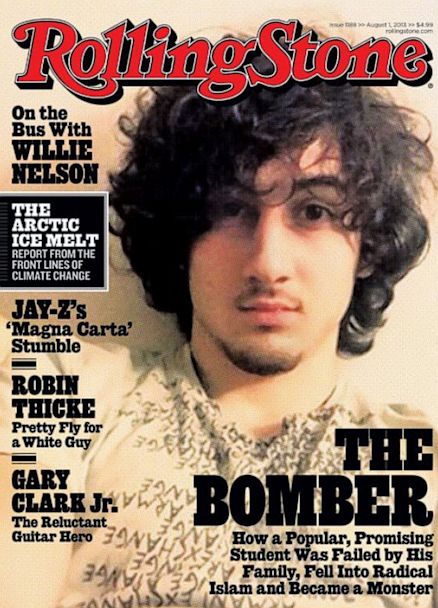
It might be that I'm from nowhere. I'll give you that. But if I am from somewhere, that place is Boston. Still, I'll admit, I'm having a lot of trouble with the furor over the upcoming Rolling Stone cover with Dzhokhar Tsarnaev on the cover. I've read TIME Magazines and Newsweeks (RIP) with Osama Bin Laden featured prominently. Is the issue more because it's a flattering picture and not dirty, bearded Saddam Hussein?
I read the arguments about not validating horrible acts with fame, although they're silly. Famously bad people get famous; you refuse to reward them by making sure they deal with the consequences of their famously bad acts.
I suspect it has more to do with the notion that Rolling Stone will feature a story, not about a cold-blooded killer, but about a confused kid that in way over his head. We're outraged by the sympathy - as if sympathy itself is finite and any sympathy given to "the bad guy" is sympathy taken from his innocent victims. I haven't read the story; I've not even read an account of anyone who's read the story. It may very well make Tsarnaev a victim alongside those people he hurt. I'm not sure what's wrong with that.
Not every victim is innocent. Not every terrorist is evil.
To be sure, there are plenty of innocent victims here. People were killed, maimed, injured, traumatized by the senseless, stupid actions of two disillusioned brothers. That's not up for debate. No matter how righteous our perceived cause or how serious our perceived indignities (and our causes and indignities are always perceived), violence is never the right choice. It just isn't. Ever.
But I'm troubled that our society so quickly condemns anyone willing to explore the depths of a complicated situation. We like simplicity. We like it a lot. But then again, simplicity is not real life (the same can be said for Trayvon and George).
We want to categorize people good and bad, usually so we can distinguish "us" from "them." We like the fantasy that some human beings are downright evil. It keeps us from facing the reality that, as humans, we're all capable, under the right circumstances, of all the evil any of us are capable of.
None of us should be defined by our actions. We can certainly be described by our actions, but that's a far cry from defining us that way. I've known people who grew up with absentee fathers who've really struggled with this distinction. When you've got a Dad incapable of anything good, it's tough to realize that this dispicability isn't genetic. They have to differentiate between the actions of their father (which are bad) and the person of their father (who is dad). The same applies to all our heroes and villains.
The homeless man with the golden voice, who made headlines, reunited with his family, and went on all the feel-good morning talk shows - he relapsed shortly thereafter, then again a few months later. He's got a job and a home and a future, but he's not perfect. He's a man chock full of good and bad; neither define him. They describe him.
Don't get me wrong, description is still important. People who have done a lot of stealing are likely not the best to hire as house-sitters. We must all live with the consequences of our actions. Those are real. I hope the Rolling Stone piece doesn't gloss over the tragedy that brought Tsarnaev to our attention. It would be unconscionable.
But actually exploring the forces in a person's life that lead them to evil (or to good) is interesting and valuable and far too rare in our world today.
It's way better than just guessing, which is how it normally works. We judge people based on gut instinct and any variety of subjective criteria. Howard Dean gets excited during a campaign speech, yells crazily, like Slim Pickins riding the bomb, and his political career is over. Anthony Weiner texts a picture of his junk to a woman who's not his wife and he becomes the next mayor of New York. Capricious.
We want to hate Dzhokhar Tsarnaev. He's done some bad stuff. The consequence of which is that his life ends at 19 years old, whether he's executed or not. Does that make him a tragic figure? I don't know, but I think it's fantastic that someone is trying to find out.

A tale has been told of a young boy, we’ll call him Amir, playing with some sticks he’s fashioned into toys and eavesdropping on his father, entertaining guests in a small house in the mountains of Afghanistan. Suddenly, there’s a bright light, a loud noise and everything goes black. When Amir awakes, he finds his home in ruins and all his family dead. At seven, he is the lone survivor and he is on his own.
The neighbors tell him it was a drone attack, that foreign invaders bomb their country to make the people afraid and take their resources. Amir has made an enemy. His journey begins slowly, running errands and cooking food. Soon he becomes a look-out, and a very good one. His stealth earns him a promotion and he begins planting roadside bombs, then helping to build them, then deciding where they will be placed.
A decade later, he is a man, even though he’s been an adult far longer than children should have to be. He’s moving along a mountain road from one village to another when he comes upon the remains of a recent ambush. A foreign soldier lies on the side of the road ahead, he must have been thrown from his vehicle during the chaos.
Amir ducks behind some rubble as the soldier’s unit returns, running quickly. They glance at their fallen comrade and then back at their pursuers and hurry on. Later, an investigative team arrives, checking the road for clues and unexploded devices. They too ignore the soldier on the side of the road.
Finally, when the coast is clear, Amir ventures out. This is a profound moment for him. Despite all of his experience, he’s never met an invader up close. Surely the soldier is dead or the others would have helped him. Amir will take no chances. The images of his parents, his siblings, their bodies broken, their funerals dance in his head. He gripes the knife inside his cloak. He will make sure this soldier is dead.
As he approaches, the man moans and begins to roll over, clearly badly injured, but alive. They make eye contact. Amir gasps, drops his knife and staggers backwards. The image in his head has been transformed. As he stares at the soldier, he see’s something familiar. The blood, running down his face, sticking in his beard, the pain in his eyes. Quickly, those eyes become the eyes of Amir’s father, the blood, his blood, the pain, his pain. Amir’s heart melts.
Amir could do nothing as a young boy, but he could do something now, as a man. Quickly his mind begins to assess the damage. He looks around – there’s a village not far, with some friends. He could hide the soldier in a back room until his wounds heal enough. His reputation and authority should keep the soldier hidden well enough. There is money and medical supplies stashed away. They should do. If not he could find more. This man must not die.
As Amir regained his bearing and approached the soldier, he saw the pistol. The soldier had retrieved it, with great effort, and was pointing it in Amir’s direction. The soldier was in no position to fight and his wounds demanded hurry. So Amir kept coming. The shot rang out and echoed through the valley, then another. Neither had hit Amir, but the look in the soldier’s eye had changed from pain to fear.
Amir did all he could to assuage that notion. But he spoke only his native tongue and there was really not much time. With his injuries, the soldier’s aim was terrible, but at close range it would be good enough. In the end, his bullets held out longer than his heart and by the time Amir was able to reach him, he was gone.

So, I heard an NPR story a few weeks back about this movie, The Reluctant Fundamentalist, which is soon out, based on a book by the same name. It sounded like a bit of a think-piece/thriller with international diplomacy overtones. Right up my alley!
The next day I saw the book for a dollar at the used book store. I finished it this afternoon.
The book itself was disappointing. The author can turn a phrase and it's interesting enough, but there wasn't the kind of pay-off I expected.
Basically, it's the story of a young Pakistani man who goes to Princeton and becomes a financial analyst in New York and his ultimate disillusion with American life.
If you can get past the often idiotic tropes (the dynamic main character is named "Changez," I kid you not), the core story is, like the Hobbit, one of there and back again. The strangeness of American individualism after a lifetime of group culture and socialization, the freedom and enjoyment of independence and liberty, followed by the hollow emptiness of the same.
The story serves, for most of the novel, as a great picture of the costs and benefits to our compartmentalized modern, western lives. There's a lot of good stuff there to both think on and discuss.
Towards the end, there is a fantastic quote:
Such journeys have convinced me that it is not always possible to restore one's boundaries after they have been blurred and made permeable by a relationship: try as we might, we cannot reconstitute ourselves as the autonomous beings we previously imagined ourselves to be.
At some point, as we seek to self-determine our future, we encounter the limitations of such a personal vision. I'm sure there's an equivalent in Pakistani society or anywhere else - it's not necessarily an American or Western phenomenon. In the end, we are in this thing together, whether we like it or not.
We are not just whole people (with permeable barriers between our physical, spiritual, work, home, school, family, private, and public lives), but we are part of a larger whole. The "fundamentals" in the title refer to the essential parts of a project or a person or a culture, the things that make it real.
In the midst of a world obsessed with every detail but the fundamental ones, there is a yearning for something different. I'm not sure what the book was trying to say in the end - I'm not sure there was ever any revelation of true fundamentals - but I do believe they're out there and they have to do with more than individual or cultural or political identities.
I can't say it any better than the quote does - so here it is again:
Such journeys have convinced me that it is not always possible to restore one's boundaries after they have been blurred and made permeable by a relationship: try as we might, we cannot reconstitute ourselves as the autonomous beings we previously imagined ourselves to be.

Yes, they aim to save lives not take them, which makes them different. I'm just not sure life and death are the terms by which we should live our lives.
I have a different perspective, I know. My faith affirms resurrection, that no matter how or when we die, it is not the end. Our bodies will be raised from the ground and remade. Our lives will go on forever, albeit with a little speed bump of death in the middle. Because of this belief, life and death are less important as motivators. I'm not claiming anyone should agree with me or should be forced to risk their lives against their will - what I am saying is that the response to this tragedy and the attempts to catch the bombers is not monolithic.
I'm merely stating a very unpopular opinion I happen to believe in deeply. I'm not attempting to influence anyone or represent anyone - I'm not even making a claim to a "Christian" position, although my thoughts are formed entirely from my Christian faith.
There are a lot of things to fear in life. There are lots of things we have we don't want to lose. There is pain and loss and those things make us feel terrible. We don't like feeling terrible. It makes sense to avoid them - we are evolutionarily hard-wired to avoid them. If I ran into a deranged terrorist on the street, I'd probably run like hell.
That doesn't mean I think it's the right thing to do.
I'd much rather ignore fear than protect my own life. The idea of sitting at home, disrupting my life while the city cowers in fear sickens me. If I were in Boston today, I'd be out walking the streets simply as a refusal to live in fear.
I'm happy the Boston PD announcement said, "if you value your own life" before listing the requests they made on residents. I just don't think my life is worth more than my integrity. I don't know how I could preach and believe what I do and still act out of fear. I suppose that's what grace is all about, because Lord knows I couldn't live up to my beliefs.
I'm not really afraid of death, but I'm terrified of pain, intense pain anyway. I've always chocked that up to being a rich, lazy, spoiled American - and there may be some truth there. Of course it could also be because I've never really experienced intense pain (maybe those are the same thing). Special Ops forces in the military go through training in such things. They endure pain to prove to themselves they can withstand it.
As a Christian, I should be engaging in something similar. Enduring difficult situations to better prepare yourself for them in the future. Practicing non-violence in routine situations, so it's easier to react without violence when things get hectic. Athletes exercise muscles to make them stronger and more capable in difficult situations. We fast from food and other things we don't believe we can live without to prove our resilience and our frailty.
I have to believe facing and ignoring fear is part of that process. As a parent, I'm terrified that my daughter will get hurt, physically and emotionally. But that's going to happen anyway - and I'm just doing her a disservice if I become so protective she never has the opportunity to face pain and learn from it.
Just as there is a fine line between being protective and negligent that parents have to negotiate - I imagine there's a fine line between facing fear and just being stupid.
You always have to ask the question - what is worth dying for? Some people are lauded for defending their home against intruders. The things we own are worth the fight and, sometimes, the life of a criminal. Someone else's life is worth my own - that's more than honorable. Should we also consider than refusing to let someone hold fear over us might be worth our lives, at the very least?
I'm certainly in a minority position - and I'm ok with that - but I object to the people who are supposed to protect us operating on the same fear as those they intend to stop. I'd love to hear things framed not so much in terms of "what you should do," but "if you value your life." It gives people a chance to decide.
We just have to remember that some people put less value on their lives than others.
I'm not willing to kill for anything, but I am willing (I hope) to die for what I believe. "There is no fear in love. A perfect love drives out all fear." 1 John 4:18. I'm not sure I'll ever mine the depths of that truth, but I do believe it.

Fear is the most efficient motivator known to man. We like fear, love it, in fact - except of course when we're the ones afraid. Once we begin down the pathway of fear it's exponentially more difficult to stop, let alone change course.
This isn't strictly about violence, although it seems we're most afraid of pain, and threats of pain work out most efficiently. I say pain and not death because I don't actually think too many people are afraid of death, so long as it comes quickly and quietly. Death used to be humanity's ultimate fear.
Death was top dog because life was full of pain. Today we've mostly insulated ourselves from pain - by outsourcing our manual labor, by surrounding ourselves with mindless entertainment, by feasting on painkillers. We've created a world where the end of life has very little difference from the living of it.
Nuclear war is only terrifying for the people who live outside the blast zone, those who might have to suffer through the terror of cancer, deformities, and disease. Economic collapse means, for most of us, nothing but a lower standard of living - in other words, a more painful life.
I am a terrorist because I fear pain and I am willing to inflict it on others to avoid it in my own life. I keep a reserve account in a bank vault "in case" something inconvenient happens in my life, instead of giving that money to people who already suffer. I buy the cheapest products to maximize the amount I can spend on luxuries or minimize the amount I have to work - regardless of the suffering of those who make the products.
I am a terrorist, but I have outsourced my terror to strangers in far away places. If there's a murder on my street, its a breakdown of order; two is an epidemic. If there's ten murders downtown, I just stay in the suburbs. I pay my government to train one group of people to think they're super-human, so they can fly around the world and do brave things that insulate me from pain - at the same time I pay them to train another group of people to think they're sub-human, so they can be locked up and forgotten without any mark on my conscience.
I readily support the battle between "us" and "them," so long as I'm "us." When I become "them," the war is immoral.
Too often I participate in a story where the hero is Power and the villain is voiceless - which means the hero always wins. Too often I embrace the suicide of individualism for the promise of immediate gratification. I live in a world where pleasure comes only with the absence of pain. It works well for those who survive, but it seems like there should be some other way.
I am a terrorist.
What do I deserve?

My first response to the news was awe that it actually happened. I, like a lot of people, felt bin Laden was going to die of old age. My second response was nervousness.
This death does indeed bring some closure to an unsettling experience that began with a terrible tragedy almost a decade ago. I am one of those whose life perspective has been shaped by dealing with 9/11 and its repercussions.
I was beginning my Junior year of college at ENC, just south of Boston. The planes took off from Boston. There were guys on my floor who, for a while, were worried their father was on one of them. A fellow student lost a father as he responded from his fire house to help evacuate the buildings. I was not disconnected from this tragedy. It was real. It felt personal.
Two years later God changed my life. The result was a shift, from preparation for a career in politics to enrolling in seminary and the process of preparing for ministry. My encounter with scripture profoundly changed my perspective on life. I found a gospel that demanded my full allegiance. It meant a departure from the story my culture was writing for me to participation in a story God has been writing since the beginning of time.
News I would have cheered in 2001 brings sorrow in 2011.
I say this with no affinity for Osama bin Laden. He dedicated his life and his considerable wealth to increasing fear in our world. Fear, which is directly counter to a gospel of love. In this case, I cannot think of a more appropriate word to describe his legacy than: evil.
That being said, Osama bin Laden was a beloved creation of God's and every death is tragic. We do not have the right to kill anyone, no matter how evil. Judgement belongs to the Lord.
There has been much talk of justice, when people really mean revenge. Justice would have been for bin Laden to express real remorse and for the victims of his aggression to express real forgiveness; justice would have been for us to create a society in which George W. Bush and Osama bin Laden could live in peace.
I am not so deluded as to think this is possible, short of a miraculous work of God. Yet that miraculous work is the vision of the future laid out in scripture. What else do the wolf and the lamb, the bear and calf, the child and the serpent represent than sworn enemies living in harmony?
The real issue today is not how we handle death and killing (you can read my previous blog entry for that), but how we respond to them. I take Jesus seriously when he says an "eye for an eye" no longer applies, but instead we're called to love our enemies. Even if one feels that killing is necessary at some point, it should be done with repentance and regret - never celebration.
I am sorrowful because I believe that celebrating death is destructive to people. We cannot control the emotions life brings out in us, but we must control our responses. Revenge feels good; we've made someone suffer in the way we've suffered. But revenge can never bring healing. It can never bring restoration. That comes from loving those who don't deserve to be loved. It comes from remembering that we are all, simultaneously, undeserving of the love we're shown and profoundly deserving of love.
God weeps for Osama bin Laden. I'm not sure I can muster that response, but I do weep for people who rejoice in death and I apologize for any arrogance that may communicate.




.jpg)


