I think we latch onto these stories in pop culture as a way of encouraging one another. We hold up heroes and explore them as people to remind each other that we're all capable of great things. I'm not sure that practice is doing us any good - in fact, it might be doing us harm.
Oh, I think it's wonderful to explore and highlight the humanity of our heroes, but it shouldn't be to challenge us to greatness, it should be to challenge us to ordinariness. People who set out for greatness rarely achieve it, but those content to humbly focus on the life in front of them with full hearts often find themselves in the midst of great things.
Now, of course, talent will rise to the top - talented people, coupled with determination, emerge as people who get recognized, but it doesn't make them less human. They aren't superheros.
Perhaps there is a part of us that latches on to such people (or fictionalized superheroes) because we recognize a lack in us - talent, drive, determination that will likely keep us from being "top in our field." If so, then heroes become nothing but an escape, further removing us from the lives we actually lead.
I think there is some underlying drive in each of us to be superheros - we want to be separated from the rest and bathed in applause. Who wouldn't? It gets compounded by millenia of societal reinforcement, celebrating the best and brightest, smartest and strongest - we've come to just accept that some people, fitting particular categories, are just better than everyone else. They're heroes and we should aspire to be them or something like them. In reality, though, this only reinforces the position of power those labeled the heroes enjoy.
I'm not saying, "don't do great things," what I am questioning is how we define greatness. We tend to use exceptional categories, highlighting people who look least like everyone else. There is some merit there, I suppose, but it's easy to fall into the superhero trap working that way. I wonder if perhaps, as we measure greatness, the greatest thing we can do is to simply be present in your own life - and the greatness of this can only really be measured by the people around you (and can't be compared with much of anything).
Using this measure, it's easy to be exceptional, but very difficult to actually be excepted - to be singled out for larger fame. After all, they sell "World's Greatest Dad" mugs at every souvenir stand.*
How many lives get derailed by trying to be "something" - the best lawyer, the best athlete, the smartest guy in the room? When we make those things the focus of our lives, we miss out on our lives. This notion that fulfillment and satisfaction exist somewhere out there rather than right where you are is the key to doom. Peter Rollins often says, "I hope you achieve your dreams... so you can recognize they're not the answer to your problems."
This is seen no more truthfully than in the superhero myth - the notion that some people can do more and be more. It's the justification for a comparison society.* And while it seems like this only works out for those people who fare well in the comparison, we have to recognize it doesn't work so well for them either. We exalt people we admire to superhero status and in the process dehumanize them. They're no different than our super-villains - isn't that the point of these new Batman movies? No one wants to be the Joker, but we don't really want to be Batman either.
The solution is not to ignore great things; we need to see examples of real love, sacrifice, and commitment in our world. The solution is to celebrate greatness for its mundanity. Mother Theresa is all set to be St. Theresa of Calcutta here in a few months. She is a hero of mine. Her life accomplishments seem super-human, in all honesty - but if we look at her that way, we miss out on the real testimony she provides - "not great things, but small things with great love." You can be as successful in life as Mother Theresa and never get one column inch of press - you may not even be fully recognized by the members of your own family.
That's the rub, really. There are no superheroes. There are only humans. We should work to be good ones.
*There's a whole separate conversation here about comparison and how that works - clearly some people are better father's than others, but we really get into trouble when we try to rank everyone. Yes, it's easy to pick out the drunk who skips Christmas to gamble, but it's more difficult to parse rankings of greatness absent these obvious flaws. It's better to judge individuals by the needs of the relationship their in, rather than in comparison to others. Even if he's the only Dad on the planet, a drunk gambler is not going to do well on a performance review.

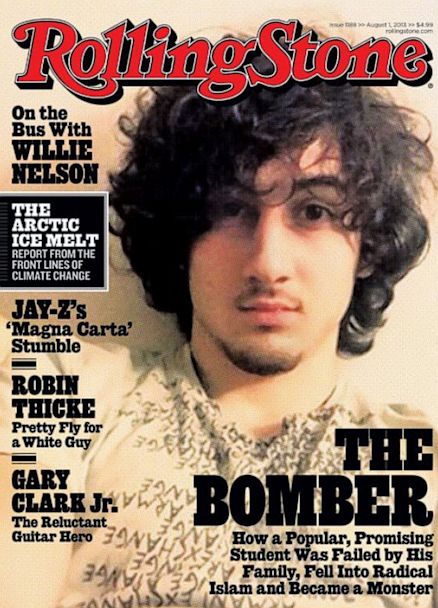
It might be that I'm from nowhere. I'll give you that. But if I am from somewhere, that place is Boston. Still, I'll admit, I'm having a lot of trouble with the furor over the upcoming Rolling Stone cover with Dzhokhar Tsarnaev on the cover. I've read TIME Magazines and Newsweeks (RIP) with Osama Bin Laden featured prominently. Is the issue more because it's a flattering picture and not dirty, bearded Saddam Hussein?
I read the arguments about not validating horrible acts with fame, although they're silly. Famously bad people get famous; you refuse to reward them by making sure they deal with the consequences of their famously bad acts.
I suspect it has more to do with the notion that Rolling Stone will feature a story, not about a cold-blooded killer, but about a confused kid that in way over his head. We're outraged by the sympathy - as if sympathy itself is finite and any sympathy given to "the bad guy" is sympathy taken from his innocent victims. I haven't read the story; I've not even read an account of anyone who's read the story. It may very well make Tsarnaev a victim alongside those people he hurt. I'm not sure what's wrong with that.
Not every victim is innocent. Not every terrorist is evil.
To be sure, there are plenty of innocent victims here. People were killed, maimed, injured, traumatized by the senseless, stupid actions of two disillusioned brothers. That's not up for debate. No matter how righteous our perceived cause or how serious our perceived indignities (and our causes and indignities are always perceived), violence is never the right choice. It just isn't. Ever.
But I'm troubled that our society so quickly condemns anyone willing to explore the depths of a complicated situation. We like simplicity. We like it a lot. But then again, simplicity is not real life (the same can be said for Trayvon and George).
We want to categorize people good and bad, usually so we can distinguish "us" from "them." We like the fantasy that some human beings are downright evil. It keeps us from facing the reality that, as humans, we're all capable, under the right circumstances, of all the evil any of us are capable of.
None of us should be defined by our actions. We can certainly be described by our actions, but that's a far cry from defining us that way. I've known people who grew up with absentee fathers who've really struggled with this distinction. When you've got a Dad incapable of anything good, it's tough to realize that this dispicability isn't genetic. They have to differentiate between the actions of their father (which are bad) and the person of their father (who is dad). The same applies to all our heroes and villains.
The homeless man with the golden voice, who made headlines, reunited with his family, and went on all the feel-good morning talk shows - he relapsed shortly thereafter, then again a few months later. He's got a job and a home and a future, but he's not perfect. He's a man chock full of good and bad; neither define him. They describe him.
Don't get me wrong, description is still important. People who have done a lot of stealing are likely not the best to hire as house-sitters. We must all live with the consequences of our actions. Those are real. I hope the Rolling Stone piece doesn't gloss over the tragedy that brought Tsarnaev to our attention. It would be unconscionable.
But actually exploring the forces in a person's life that lead them to evil (or to good) is interesting and valuable and far too rare in our world today.
It's way better than just guessing, which is how it normally works. We judge people based on gut instinct and any variety of subjective criteria. Howard Dean gets excited during a campaign speech, yells crazily, like Slim Pickins riding the bomb, and his political career is over. Anthony Weiner texts a picture of his junk to a woman who's not his wife and he becomes the next mayor of New York. Capricious.
We want to hate Dzhokhar Tsarnaev. He's done some bad stuff. The consequence of which is that his life ends at 19 years old, whether he's executed or not. Does that make him a tragic figure? I don't know, but I think it's fantastic that someone is trying to find out.

So I ask again, where are the truly great people in our world? I've heard it said that the constant media attention keeps anyone from appearing as saintly as Dr. King. Had he lived today, his faults and failings would have be exposed; we would not have seen him in the same light. I don't think that's true. We've recently learned some sad, yet incredible truths about the life of Mother Theresa that could potentially tarnish her legacy. I don't find this all that likely either. The sheer truth of the impact made upon this planet by those select individuals known, both formally and informally, as saints will outweigh any detractions we could ever discover. That is not to say that the ends justify the means in every instance, but that we will never cease to be amazed at the righteousness that can be wrought through the life of one committed, if flawed, individual.
But the question still remains, where are the truly great people in our world? In this age of increased globalization, in an era where the round world has suddenly become flat, in a time where people anywhere can communicate and collaborate with anyone on the planet, we may need to look at the work of great people in a different way. Perhaps the very scrutiny of society will force us to realize just how inadequate individuals are in the grand scheme of things. We are always amazed at the likes of Dr. King because we see ourselves as unprepared and unqualified to do anything of significance in this world of ours.
So to answer the question, the truly great people in our world are those around us. The age of great men (and women) is giving way to the age of great people. The time of one man making a difference has moved to a time where all of us must band together and take control of our world. It is no longer enough for us to sit back and support those natural leaders and innovators, leaving them to make all the difference. As this world becomes more and more a gigantic community, we must understand the increasing role we all play in the success of that community. We will continue to raise up those of us most able to articulate the message, but we must rely less on the profundity of their speech and more on the power of our reality. It takes not saints nor great men to make a difference; it takes those of us who care, united under the banner of peace and justice for all.

Vonnegut was a member of "The Greatest Generation," but one that bucked the trends. He was, at times, a socialist, an iconoclast, a visionary, and a prophet. He was unafraid to speak out and challenge the status quo, even when he was in total agreement with it. He wrote about the value and the vagueries of the human spirit in prose that embodied the hopelessness of a future in chaos.
Sort of a Marxist Jules Verne on acid, Vonnegut was never happy with anything and yet seemed cautiously joyful at all times. He made a mark, in his later years, giving brilliant commencement speeches at some of the finest universities in the land. As he grew older, it became tougher and tougher to fictionalize his thoughts (as if his fiction was ever all that fictional).
I remember Vonnegut from my first encounter with his first work, Player Piano. Here was an author, well, at the time he was just an average guy putting pen to paper, who just seemed to ramble on and stumble over plot in such a haphazard, yet consistently humorous, entertaining and engaging way. His books read like my thoughts; they gave hope to the lunatic fringe in all of us. He was Ernest Hemmingway for the non-machismo set.
Kurt Vonnegut, Jr. has been my literary hero and my teacher. I will forever be indebted for the example of freedom and bravery he blazed across the literary landscape. There's more length and depth and breadth to Vonnegut than I can subsume here. I'd ask, in the memory of this great writer, that you explore the world of Kurt Vonnegut. You will not be disappointed.