The simple answer is that God made all of us one way and expects us to act in another. We're all bent towards selfish, self-destructive tendencies in the name of immediate gratification and, at times, self-preservation. Everything from overeating to an almost constant need for sexual contact to a kill or be killed instinct in situations where our safety is jeopardized. We are ingrained with instinctive, natural responses that fly in the face of Christian morality.
Each and every one of us has to deal with the fact that "God made us one way and expects us to act differently."
But I'd like to posit the notion that God doesn't "make" us the way we are; God doesn't "make" people gay. Now I'm not going to argue that orientation is a choice. I don't doubt that a very few people might choose same sex relationships based on some severe trauma or other factors unrelated to orientation, but I don't question that people are born with a specific orientation. In fact, even my own, quite conservative denomination, seems to tacitly acknowledge that lots of people have an intrinsic orientation that is well beyond their control.
The question is not whether people are born with a homosexual orientation, but whether God made them that way.
You might respond, "God made everything," which is technically true, but I hope we're beyond the idea that God made things appear like Barbara Eden. God uses lots of complex systems to create and animate the world in which we live. The more we discover about this world, the more awed we become in its complexity and God's majesty within.
I believe quite strongly that God made a good creation, but I also believe God made a creation that was meant to be united to God, a creation that suffers when it acts counter to God's design, even if those actions are instinctive, inborn, and entirely natural. The point being that we discover the true beauty in self-denial, in thinking of others before ourselves. It's entirely counter intuitive, but, for me at least, based on my experience, seems to explain a lot.
Our best guess at why and how we've arrived at this point in history is the theory of evolution. Over time species have evolved into greater complexity through a natural selection of traits most fit for reproduction. Evolution is that drive for self-preservation deep within us. It is entirely natural, even as it runs counter to God's plan. For a while, I chalked up evolutionary outcomes contrary to God's purposes to the overall effects of sin in the world. Humanity, as a whole, corrupted itself over time, leading to the imperfections each of us possess. Of course this doesn't explain similar abnormalities in other species and evident long before humans showed up.
At this point, I don't really have an answer, but I'm playing with the idea that God's relationship to creation is even more complex that we could ever imagine. The explanations are beyond me, but I do believe we exist with a bent towards selfishness, but will find fulfillment only in denying that drive and committing completely to selfless living.
So, in a very real sense, we each have been "created" with drives and predispositions to things that are not part of God's plan for life.
Some of these predispositions are more obvious than others - dwarfism, albinism, homosexual orientation - all groups of people subject to derision and persecution over the course of human history, for things over which they had no control. It seems like much of the struggle for gay rights has simply been getting society to acknowledge "it's ok for me to be this way." Rolling Stone published an article about Peter Dinklage a few weeks ago, dealing with his struggle to be known as a person, not a little person.
This path has been tread (and continues to be) by people with different levels of skin pigmentation. We're working through this process for addicts and those with mental imbalances. Each of these traits that were likely inborn.
So often we attempt to apply a morality to such inborn traits, when in reality morality can only be ascribed to actions. This struggle is detrimental to everyone, but especially painful for homosexuals who end up hating themselves for nothing more than existing. It takes a monumental effort just to put everyone on the same footing before we can even get to ethics - a judgment of actions, which is really where people get hung up. Ethics and our understanding of how people act on their homosexual orientation is really where the drama occurs.
That depends much more on your understanding of God, humanity, life, and your place in the world than it does about your sexual orientation or the way God "made" you.

I was inspired this week by a more than intriguing article from a gay Mormon, who also happens to be happily married to a woman, has three kids, and just celebrated his tenth anniversary.
So often it seems like homosexuality and Christianity converge in one of two ways: either homosexuality is condemned and the one with same-sex attraction must either be healed or be celibate, or homosexuality is embraced as part of the human condition with gay and lesbian brothers and sisters incorporated into the life of the Church.
Most often the black and white morality of the first choice is panned as unloving, old-fashioned, and insensitive. It usually is. Less often do we say the same about the black and white morality of the second. The article above brings light to many people who embrace same-sex relationships as the natural expression of one's homosexuality and condemn all other life patterns as denial or substandard.
It has never struck me before how similar these reactions are in nature. Same sex relationships must either be universally right or universally wrong; there's no in between, at least in the public rhetoric.
I thought people were people. I thought we were unique individuals with subtle, but important differences from one another. How did we get to a place where everyone has to fit into tiny little boxes?
I wonder if it doesn't have something to do with relationship. We want people to be enough like us that we don't really have to get to know them, we can just relate to them. We want to define each other: black, white, hispanic, gay, straight, intellectual, blue-collar, christian, muslim, atheist, hipster, fan boy, guido - whatever.
Because if we put each other into these boxes, then we can skip some difficult, awkward, uncomfortable steps in the relationship. We can avoid really getting to know each other. We simply relate based on shared interests or stereotypes and never have to dig deep, get vulnerable, or make mistakes.
When people have the same background, history, upbringing as me, but make different choices in life... well, it can make me think about my own choices. Why am I where I am? Where am I headed? Who am I? What defines me? It can be uncomfortable, especially if we just haven't considered a certain position or we haven't had to.
There are strong, committed Christians who claim real "healing" from homosexuality. Others, like the guy in the article above, decided to choose faith over attraction. Still others have decided celibacy is the best way to live out their faith given their orientation. Still other, strong, committed Christians have chosen to enter lifelong, committed, monogamous relationships with people of the same sex.
We like to call BS.
Some of us want to say there's no possible way a gay person can be "healed" of something so intrinsic to their identity. It's a ruse, a sham, a lie. Others of us want to say that practicing gay Christians are just lying to themselves. They've compromised their logic, faith and reason as a way to assuage their guilt. We treat those options "in the middle" of the spectrum with some level of derision and grudging acceptance given our particular point of view.
For me (I won't pretend to include the rest of you) I find it easier to judge people I don't know. Why? Because people I don't know fit much better into boxes than people I know. Because people I don't know can't be hurt my words or my actions; they're nameless and faceless to me.
I wanted to say earlier than I know gay Christians who have chosen each of the paths I outlined above, but quite honestly, almost every gay person I know has pretty much rejected the Church because the Church can't seem to get past the need to find a proper box for them. I grieve that most of my gay friends and relatives don't even get a chance to wrestle with scripture, reason, tradition, and experience when it concerns the convergence of their faith and orientation - they don't get a chance because they're robbed of the faith community, the relationships that are so important to making any decision about life and identity.
What does it mean that there is no slave nor free, Jew nor Greek, male nor female (and with credit to Peter Rollins) no democrat nor republican, american nor iraqi, gay nor straight, christian nor atheist...
Do we call people to Christ or do we call them to the box we name Christianity that is really just our own comfortable decisions projected as the norm?
This isn't about gay or straight - that's just currently the hardest box to break.

I am realizing today just how wonderful this summer is for fans of sport in the US. We moved into a new house and had a baby right near the end of May. That was also about the time I found myself mostly unemployed. All of those coincidences converged to leave me at home often, generally with time on my hands.
These factors, compounded with our wonderful cable installer, Milford, leaving us with several channels we're not paying for - I have access to ESPN and the NBC Sports Network in addition to the regular broadcast channels.
I spent the final few days of May enjoying the French Open, the NBA conference finals and the Stanley Cup playoffs. I'm not a huge hockey fan, but I never miss a Cup presentation; they're even better if the last game goes into OT.
Now I'm enjoying nearly wall-to-wall coverage of the US (golf) Open, HD NBA Finals on ABC as well as two football matches every day in Euro 2012.
NBC Sports has better than decent coverage of cycling all summer - from the Giro to the Tour of Switzerland to the Tour de France in July.
The Euro Championship match dovetails nicely with the start of Le Tour, which will end with just a little breathing room before the Summer Olympics kick in to full swing. (This also means enhanced coverage of all the Olympic trials in various sports).
I've been looking forward, this summer, to a chance to relax, reset, catch my life bearing, and learn about what it means to live with a kid in a new house and a new town. While the wife believes my unhealthy fascination with sports of all kinds is some mental deficiency or categorized mental disorder, it really does bring me a great deal of joy and peace.
So, if you're a sports fan in the area - feel free to stop on by and catch something with me this summer. The line up looks great! Let's just hope I don't break both my legs tomorrow and have to re-learn how to walk.

I'll admit. I didn't take the time to watch the whole thing - or even read the transcript. Hey, we have a new baby; you're lucky to get a blog post at all this week.
Still, this speech seems to be generating some controversy (although I suspect this is due more to a slow news week than it is to people generally objecting to the content; I haven't found anyone who didn't see the redeeming value in this message).
Regardless, we do live in a culture where kids are babied and applauded by everyone for their entire lives. Parents do a lot for their kids and create an entitled atmosphere. We see it in college graduates who assume they should get paid big bucks to do whatever makes them happy to preschoolers who don't even know how to respond when some one tells them 'no.' I hear its even worse in China where most families live three or four generations together and have only one child.
This resonates with me - not because my parents were overly coddling (my brothers got much easier treatment than I did) - but because I've had this strange, deeply-held belief from a very early age, that there's something really amazing for me out there. For as long as I can remember I just assumed that I'd be the best at the world at something, I just had to find it.
This has led me to give up pursuits I might have enjoyed if I didn't take to them naturally or they required much work. It might have led to an inflated ego or a sense of entitlement. It's also led to some difficulty when I've proven to be less than the best at something I consider a talent.
We all want to be special and we all want to be rewarded; it's especially enjoyable to be rewarded simply for being who we are. You can't blame kids for embodying that idea. It's more the job of their parents, society, and the world around them to instill enough work ethic and humility to create realistic expectations.
We're not doing to well at that these days.
I've been thinking a bit about this - because the idea that we're valuable and entitled just for breathing is something that resonates with a gospel message. There is an inherent dignity in life; it's one of the reasons why we fight for the rights of even the most irresponsible, violent, nasty people. Being human means carrying some measure of God's image and identity; that alone is valuable.
The trick comes in understanding how that image shines through. For some people it just doesn't. We treat them with dignity because of our belief in universal human value, not because we always see a spark of the divine (although some saints are graced with seeing it in everyone).
Perhaps the message has become garbled. We've attached value and worth to our individual identity - no matter what that identity is. "Whoever you are is good enough." That's a fine starting point for addressing life, but you can't dwell there. A four year old should be celebrated for writing their name and not wetting their pants; you expect more when they're 18 or 35 or 50.
Internal and relational development should mature in the same way. Yes, you're special; you're wonderful and valuable and beautiful because of who you are. You unique qualities make you an individual and no one can be just like you. At the same time, your ability to grow and evolve and change is something that makes you special. You will be judged not on who you are, but on what you've done with who you are as you go through life.
From a Christian perspective, this means that one's own identity fades into the background and your life looks more like Christ. That the less you care about being special, the less you consider yourself special, the more special you become. Human beings were created to live in a specific way - every one of us has the capability to live up to that creative purpose (despite decided advantages and disadvantages we're born into). However, we're not able to find that created purpose within ourselves. We find it only within others and specifically as we model ourselves on the model human being: Jesus Christ.
I'm not sure the graduation speech was meant to be as deep or as monumental as all that. It seems like this teacher simply wanted these students to look outside themselves for something - understanding that this outward focus is the key to a real life. Its certainly a great start for self-discovery; hopefully my daughter won't have to wait until HS graduation to begin walking down that path.

It does seem like we take whatever we have for granted until someone tries to take it away. That seems like a natural reaction. I wonder how many things we only value when they're threatened? I could care less about 95% of the channels on my TV, but if only 5% of them were working, I would be upset.
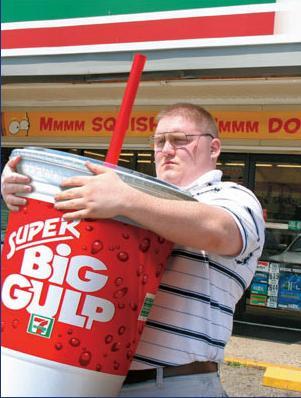
This week NY Mayor, Michael Bloomberg announced that they'll be taking measures to limit the size of sugary drinks available in restaurants in the city. Some people have responded with vigor and rage. While I am pleasantly surprised to see just how many New Yorkers agree with the ban, it's equally disappointing how seriously and tragically its opponents are reacting.
There are cries of freedom in defense of giant sodas; I think those people are a bit confused as to what freedom means. No one is making big, unhealthy drinks illegal - they're just making them a little more difficult to get. If Bloomberg was leading a group of crow-bar wielding thugs in handle-bar mustaches into secret basement warehouse and destroying kegs of Dr. Pepper prohibition-style, there might be a case for freedom violation.
As Steve Martin tweeted, "Use this algorithm to maintain obesity and get around proposed over-sized soda ban in New York: Buy two."
Freedom doesn't mean a right to laziness. The promise of the American Dream, I think, was that hard work pays off - not unlimited access to anything at any time. That's not freedom, it's gluttonous malaise.
Call me crazy, but I see the only useful purpose of government as an entity empowered to make us do good things we don't have the self discipline to do on our own. I recognize that it's unsafe to drive down a crowded highway at 90mph - but if I'm in a hurry, I might do just that to save time (what's more, some crazy incompetent driver in the next lane might do the same thing).
But that's a public safety issue - this is personal; I can be decide to eat terribly unhealthy things if I want to - it's my life. Of course that's not true. The defense of the idea of individualism is what I dislike most about US culture. None of us is an individual. We can choose for ourselves, but our choices never effect only ourselves. We were made to be in community. We have to live in community and sometimes let others decide for us - or else we're not being human.
The natural human inclination is to selfishness, usually for the good purpose of self-preservation. Of course, not every selfish desire will lead to our own preservation; we balance immediate gratification with long-term survival. We tend to do a poorer and poorer job of balancing with each passing year. I also recognize the fruitlessness of living 100 years if they're all mediocre.
i don't think Bloomberg is making this push towards smaller sodas because he thinks it will actually make people drink less (in fact, stubborn humans are likely to drink more out of spite), but this move will make us think about how much we're drinking - when we order two or three sodas at once, or when we go back for refills time and again.
If fact, I suspect, if people will move their pride out of the way, they likely won't notice much difference. Most of us drink what's in the cup and don't give a second thought when it's gone. Half the people up in arms have never even seen a super big gulp and couldn't tell you how big a "large" is anyway. This whole argument is more about perception than reality.
I don't much care one way or another, if there's a limit on soda size or not. I do respect someone who's trying to make us think about our choices. In the end, I just can't morally justify defending, "I can have as much as I want whenever I want it." I don't mind that reality existing - I just can't ever call it good.