Despite its complexity, a complexity that requires years of study to begin to understand, a complexity that has inspired months and weeks of intense debate, the US Constitution has some very simple functions. I have great respect for it in that way. Government, a complex institution, is boiled down some bare principles. The best is that it set itself up in such a way that the answer to any complex Constitutional question is simply the opinion of the majority of the Justices of the Supreme Court.
They rule; it stands. The same people so vindicated by Citizens United last year are up in arms over the recent ruling on the Affordable Care Act. Sometimes you hate the decision and sometimes you love it, but there's no recourse of disagreeing; the decision becomes definitive. I love that kind of forethought.
The other simple solution I love about the US Constitution is its basis on principle. Written and framed by a bunch of wealthy landowners, the principles of hard work, self-reliance, and individual liberty are squarely ingrained therein. These were guys who could take care of themselves and didn't want anybody telling them what to do. That's why they excluded most US residents from the voting process and completely distrusted the common man. We're a Republic, not a Democracy because the US Constitution was designed to benefit capable people over the less capable.
That's music to the ears of some today, who maintain such a legacy and insist the Constitution should continue to work under those principles. For others, it sounds terse and unfeeling, almost tyrannical in it's ironic attempt to escape tyranny. Here again, there is much room for debate, but the genius of the US Constitution is that the intent or principles of the founders don't matter to the function of government. They created a system whereby the government reflects the desires and convictions of the people. If those convictions become something other than the ones under which the Constitution was formed, it will cease to work as well. In other words: we get what we deserve as a people.
When society decried the greed, cowardice, irresponsibility, and downright contemptuous nature of our government, we are really heaping coals on ourselves. The people we elect reflect who we are and what we value. It's the way the system was set up. Again, I can't explain how genius this is. Truly a representative form of government.
Most of the political battles these days boil down to ideology. One side wanting to return to the ideals of founders and the other seeking to move forward towards progress and a new vision. Frankly, these are both far too grandiose of notions to ever be realistic.
The gradual progress of civilizations has improved some things for some people - that's true. The upward trend in history really just increase the distance between benefit and devastation. There is just as much sorrow as ever; we're just better at telling the story. In the same way, the founders of the US Constitution aren't all that enviable. Selfish, rabble-rousers mostly - certainly with a flair for the idealistic and an uncanny ability to motivate. History's demi-gods have always been that way.
What makes the most sense to me, in light of our genius Constitution, is a focus on the principles that actually work to produce a decent society. In this sense, neither side of the ideological divide is bereft of contributions. There is something to be said for responsibility and hard work, of course; there is also something to be said for compassion, empathy, and community.
I have no doubt that everyone engaged in US politics wants nothing more than to shape society towards a better set of values (in the hopes that those values would, in turn, shape a better government). The problem is that most people seem to think that values are instilled through education, logic, guilt, or force - that people adopt a new perspective because of something that clicks inside their head.
I just don't believe that. I believe people are transformed by experience. People are shaped to be responsible by being valued for who they are. I believe people begin to care about others when they've discovered human dignity in themselves. Despite our best efforts to instill our ideological convictions within us, I don't believe the path between our heads and our hearts is all that easy to navigate.
I don't spend a lot of time worrying about government or the future of our country. If they ask my opinion about something, I'm happy to give it - but ultimately what they do matters little to life, certainly less than our media and power obsessed culture wants us to believe. The government we have and the society in which we live is entirely shaped by the people of which they are comprised.
I know it's a novel concept and likely a fools errand, but my politics involves a real attempt to love, honor, and respect the people around me, even at the cost of my own comfort. I believe it is the only hope for a world worth living in.

I've been unable to get away from it. I'm fascinated by this story - not because they're so unusual, but because they're so completely normal. This isn't Warren Jeff's prairie dress posse. The Brown family is certainly conservative, but they're pretty regular, as far as US families go. They're devout, but not forcing religion on their kids.
Perhaps the most interesting part of the show is their perspective on marriage. As Mormons (albeit not the LDS kind) they believe that their marriages will last for eternity. The old story is that one day they'll have their own planet to rule over (I'm not sure if the planet thing is still en vogue; they don't talk about it on the show). They do talk often about how this polygamous relationship (or should I say polygamous relationships) is a spiritual practice, not a romantic decision.
The father, maintains four separate marriage covenants - and he's quite open that at least two of them came about without romance. Both husband and wife recognized people of character in each other and chose to join together to raise strong, moral kids. They stress over and over, this kind of marriage is difficult and not for everyone - they do it because it makes their faith stronger; it helps them to grow into better people.
As a Christian, I still can't get on board with the multiple wives thing. A heavy part of the Christian understanding of marriage is the particularity of it - two people choosing each other over all others. That's important.
At the same time, I resonate (in ways I'd never thought through completely before) with the idea of marriage as a religious and even formational choice. For Christians, marriage is a representation of God's love for God's people - an unconditional relationship that cannot be broken. Now, we try pretty hard to pick a spouse of character, someone worth entering into such an important relationship with - something who is likely to keep such a commitment. However, once married, you're really more faithful to the commitment than we are to the other person.
In a culture of immediate gratification marriage has been reduced to something self-serving. Relationships last only as long as they satisfy our pleasures and desires. They become all about the other person's ability to make me happy. Marriage was intended to be formational - through commitment, unadulterated commitment, without thought to personal needs or fulfillment - we become fulfilled, we become the kind of people God created us to be.
In polygamy, the women on Sister Wives have created an even stronger bond. They can't just take the kids and leave because the kids have a larger family - siblings and other mothers who care about them. The relationship becomes even less about one person.
For Christians, we should also have an extended family. The Church, our local congregation, are the people to whom we're accountable. At least it should work that way. We get married in public for a reason. These people, in a sense, approve our marriages - they know us and vouch for our ability to live out this marriage commitment. if we fall short, it's their responsibility to help us along, to strengthen us and support us. We are connected to our spouses not just for their sake, or the sake of the commitment, but for the sake of our community, which fosters and celebrates this love.
As for the Sister Wives, I've often asked myself why one can't make the sort of lifelong, God-modeled, self-giving, loving commitment to more than one person, if everyone is on board. The wrench in the works is really sex - and the place of sex in our life and beliefs. That's a post for another day - but, as much grief and abuse they take for flaunting convention, and as much as they fall short of what I believe to be the proper conventions for marriage, this family does seem to have a better handle on what marriage is all about than most of the culture around us.
That should count for something.

You can call me strange, sick, or misguided. I'll take it. My first thought when I read this was - "Sex offenders can't have Facebook pages - how do we expect them to reintegrate into society if we keep them out of so much of it?"
I understand that sexual predators are dangerous people. They've done terrible things and hurt people in unimaginable ways. My own family has been touched by this terrible crime. I'm not trying to ignore the acts committed or excuse anyone. I'm not even going to make a big push for forgiveness; I'm not one with the position to forgive.
What I am going to say is simply that such people, as much as we don't like them, are fellow human beings and as difficult as it is, our society is better off with them integrated into it than ostracized from it.
When things shock and scare us the way sexual abuse does, we want it to just go away. Our best solution for that problem thus far has been prisons where bad people can go to be out of sight and out of mind. We erase people. When and if they get out, we make laws to keep them out of our lives - still out of sight and out of mind.
I keep thinking about the character in Little Children, played so amazingly by Jackie Earl Haley. He was a paroled sex offender, living with his mother, out of work, alone. Clearly he was battling demons beyond his ability to control, yet he had no support system. There is a poignant scene in which he jumps into the middle of a public pool and the parents scramble to get their kids out of the water and out of the park as he's left alone again. The tragedy and the irony of the character is that society was more endangered by this man because it refused to embrace him.
I would never advocate we just pretend like nothing happened. Serial rapists and child molesters have some serious issues that don't just go away on their own. Boundaries are important, as are real, loving relationships and accountability with people who care. And caring doesn't mean you condone or ignore the wrongs committed - simply that you recognize the humanity in even the least humane person.
A Facebook page gives access to potential victims. It serves as temptation to a predator. Of course, likely that temptation exists with or without Facebook. It exists with or without human interaction of any kind. I suspect that's why so many end up back in prison or taking their own lives - it's soul-crushing to never know where the walls are.
I've had a glimpse into addiction - and I can only describe heinous sex crimes as an addiction. Whether its an unwanted sexual attraction or an addiction to power and control, rarely are these crimes motivated by pure choice. There's something wrong inside - we know it; they know it.
As you begin to internalize that message - you're not right, you're defective - it becomes more real. Society puts bad people away in prisons that, despite the stereotypes of cushy jobs and tv, are downright horrible places. They're designed to dehumanize. People who think they're nothing are easier to control. When you don't believe you're human or worth anything - and you've got these overwhelming, terrible drives in your head, "freedom" is often the worst thing for you.
Criminals, in this case, sex offenders - they need society to show them that they are, in fact, human. We, as a society, we don't like to do it - because that means we have a responsibility to them as fellow humans. We're just terrible at dealing with the downside of our pleasures. Gambling is fun - so is drinking and partying and sex - but we don't like to think about the ones who lose their homes, spend every night at AA or never learn about love outside of physical intimacy. We even put some of the failures on TV, so we can tell ourselves "at least I'm not him."
Is the easy way always the best way? Of course not. It almost never is. We pass these laws, like the one in Louisiana (which will be copied in many states and perhaps even nationally) because we just don't have the manpower to keep track of people individually. They have to remain a group, a class (an underclass) of people - nameless, faceless.
And practically, you can blame Louisiana. They don't have enough parole officers to provide the kind of relational accountability people need coming out of prison. If a PO had just one guy or three or five it might be possible; they have hundreds. We like out tax dollars to keep people behind bars, not facilitate their lives outside them.
I don't really know the solution. It's not like you can just walk up to someone and say, "Hi, I know you're a sex offender, but want to be friends?" I can't imagine a person so used to rejection would receive that message the right way. Still, there has to be something more. We should be thinking about this. We should be agonizing over our system - that while justifiable and necessary, just doesn't seem to arrive at the right conclusion.
Perhaps the answer is simply to work within the confines of the system. Find a way to reach out, to try, to send the message that we see humanity where society doesn't. Be prepared to fail, but do something. I have to believe, especially in this situation, something is better than nothing.
I wrote this post a few days ago, based on the article above and then found this piece on CNN. I wasn't thinking about Jerry Sandusky when I wrote this post (and obviously he'll never get the chance to be reintegrated into society), but the CNN article is quite interesting in connecting the two.

I don't have an issue arguing or debating this policy. I'm not sure this move best serves the public good. One thing I do know, this issue has nothing to do with religion freedom, at least not from a Christian perspective.
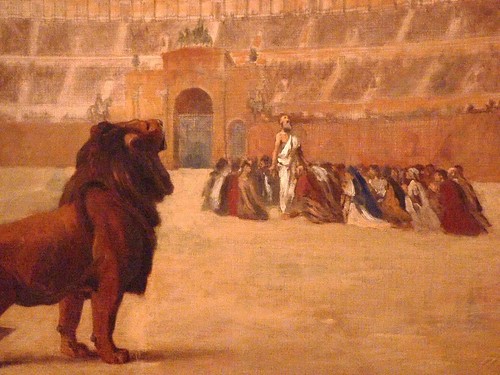
You see the freedom we're promised in Christ is a guttural, visceral freedom. It's a freedom bestowed by the Creator and cannot be infringed upon by anyone or anything. Sure, a government, an army, a church, or a guy down the street can make it more difficult to exercise that freedom in Christ - but they can never take it away. It is the freedom we see in the Roman arena, where Christians were roasted alive and torn to shreds by animals. Are you really going to tell me they were not free?
In The Lion, the Witch, and the Wardrobe - Aslan, the Christ figure is killed to pay the penalty of someone else's sin. He does this to appease the Deep Magic - sort of the overarching system under with Narnia operates. The beneficiary of this sacrifice was the White Witch, who used this Deep Magic to seize control. The only problem was, there was a deeper magic from before the dawn of time. It superseded the deepest magic of the world. It is through this deeper magic that Aslan returns to life and sets the world right.
So often the Church gets stuck operating under the Deep Magic of the world in which we live. That the authority structures around us actually control our freedom. We also get this mistaken idea that freedom equals ease. If all of our whims and desires are as easy as possible, then we're most free.
There is a deeper magic, from before the dawn of time - a way the world works which supersedes the way it seems to work. This way provides true freedom. And true freedom requires something of us - something quite costly: our very lives. Freedom in Christ is true freedom because our lives are already lost. There is nothing left on which to hold. No matter how difficult someone else makes my life, they can't ever take my freedom.
That's why the Christians who exercised true freedom were almost always killed. Being unafraid of death is dangerous for those in power. Death is the only weapon they have to keep people in line; it is the Deep Magic. The gospel, the Good News, is of a deeper magic, one in which the weapon of power is rendered powerless. It's not easy, but it is the only way to satisfy the longing deep within us.
True Freedom.

The simple answer is that God made all of us one way and expects us to act in another. We're all bent towards selfish, self-destructive tendencies in the name of immediate gratification and, at times, self-preservation. Everything from overeating to an almost constant need for sexual contact to a kill or be killed instinct in situations where our safety is jeopardized. We are ingrained with instinctive, natural responses that fly in the face of Christian morality.
Each and every one of us has to deal with the fact that "God made us one way and expects us to act differently."
But I'd like to posit the notion that God doesn't "make" us the way we are; God doesn't "make" people gay. Now I'm not going to argue that orientation is a choice. I don't doubt that a very few people might choose same sex relationships based on some severe trauma or other factors unrelated to orientation, but I don't question that people are born with a specific orientation. In fact, even my own, quite conservative denomination, seems to tacitly acknowledge that lots of people have an intrinsic orientation that is well beyond their control.
The question is not whether people are born with a homosexual orientation, but whether God made them that way.
You might respond, "God made everything," which is technically true, but I hope we're beyond the idea that God made things appear like Barbara Eden. God uses lots of complex systems to create and animate the world in which we live. The more we discover about this world, the more awed we become in its complexity and God's majesty within.
I believe quite strongly that God made a good creation, but I also believe God made a creation that was meant to be united to God, a creation that suffers when it acts counter to God's design, even if those actions are instinctive, inborn, and entirely natural. The point being that we discover the true beauty in self-denial, in thinking of others before ourselves. It's entirely counter intuitive, but, for me at least, based on my experience, seems to explain a lot.
Our best guess at why and how we've arrived at this point in history is the theory of evolution. Over time species have evolved into greater complexity through a natural selection of traits most fit for reproduction. Evolution is that drive for self-preservation deep within us. It is entirely natural, even as it runs counter to God's plan. For a while, I chalked up evolutionary outcomes contrary to God's purposes to the overall effects of sin in the world. Humanity, as a whole, corrupted itself over time, leading to the imperfections each of us possess. Of course this doesn't explain similar abnormalities in other species and evident long before humans showed up.
At this point, I don't really have an answer, but I'm playing with the idea that God's relationship to creation is even more complex that we could ever imagine. The explanations are beyond me, but I do believe we exist with a bent towards selfishness, but will find fulfillment only in denying that drive and committing completely to selfless living.
So, in a very real sense, we each have been "created" with drives and predispositions to things that are not part of God's plan for life.
Some of these predispositions are more obvious than others - dwarfism, albinism, homosexual orientation - all groups of people subject to derision and persecution over the course of human history, for things over which they had no control. It seems like much of the struggle for gay rights has simply been getting society to acknowledge "it's ok for me to be this way." Rolling Stone published an article about Peter Dinklage a few weeks ago, dealing with his struggle to be known as a person, not a little person.
This path has been tread (and continues to be) by people with different levels of skin pigmentation. We're working through this process for addicts and those with mental imbalances. Each of these traits that were likely inborn.
So often we attempt to apply a morality to such inborn traits, when in reality morality can only be ascribed to actions. This struggle is detrimental to everyone, but especially painful for homosexuals who end up hating themselves for nothing more than existing. It takes a monumental effort just to put everyone on the same footing before we can even get to ethics - a judgment of actions, which is really where people get hung up. Ethics and our understanding of how people act on their homosexual orientation is really where the drama occurs.
That depends much more on your understanding of God, humanity, life, and your place in the world than it does about your sexual orientation or the way God "made" you.