Babies, outside of the biologically obvious (when changing a diaper), don't have gender - not really. My daughter's hair has grown slowly; she's often confused for a boy. Everyone is really apologetic when they get it wrong. I'm not sure why. Outside of societally accepted color schemes, there's very little way to tell.
Prior to WWII, all babies essentially wore white gowns until they were three or so. Why? Because babies poop. A lot. If your baby poops and color safe bleach hasn't been invented yet, white is the easiest color to keep clean. It was a near universal attitude that during those first few years, they're babies before they're anything else.
It was only as the US economy transitioned to a consumption-based model, that pink and blue came into style. Clothing companies needed ways to sell baby clothes and compete for market share. Unisex white gowns wouldn't bring in the dough. Fast forward 70 years and we've got such differentiated clothes, even someone (like myself) attempting to keep neutrality in my daughter's wardrobe is completely befuddled (really, you take the same exact outfit with a bear on the front, but you have to put a bow on one and overalls on the other? Really?). The colors and designs of her clothes have been decided by someone else, some place else - and I'm told it only gets worse as they grow older.
We certainly have plenty of societal and historical expectations - and plenty of stereotypes - but what does gender actually mean? Are there things only men should do and things only women should do? What if you're a man who doesn't do "man" things or a woman who isn't down with the female list?
There is the obvious - men and women have different reproductive organs. There are clear delineations between roles in reproduction. Even the intersex (humans born with some combination of male and female genitalia) cannot be either a mother or a father (most are sterile). Women tend to be more physically capable of extremely long endurance activities, but lack strength and musculature to excel at shorter physical endeavors. Hormones are different for different people. But beyond the biological - is there a definable difference?
For thousands of years, the answer was, "of course, you silly, weak, dainty, intellectually inferior little girl." Gender tended (and still does tend) to be defined by power dynamics (and women's more complicated hygiene needs, coupled with the sheer dirtiness of the majority of human history didn't help either). But from Katherine Switzer, to Marie Curie to Queen Elizabeth, a lot of those misogynistic judgments have come into question.
In the biblical account of creation, "Adam" refers to a generic human without designation for gender. It is a collective noun. It is only after the infamous fruit-eating incident, that the man takes the title "Adam" (or human) for himself and relegates the woman to a lesser status.
Even the word translated "helper" in Genesis 2 can be confused easily without context. The Hebrew word here is often used as an attribute of God. We often read the female as "helper" and think subordinate or assistant or apprentice. It means the opposite - an indispensable partner. In God's understanding of humanity, humanity itself doesn't exist without men and women in equal and equally supportive roles.*
This might, I suppose, still lend itself to specifically defined gender roles - a sort of cosmic "separate, but equal" policy. (We all know how well that worked out other times we've tried it). Instead, I've come to think of gender as much more about complimentariness. We supply what others lack.
I'll be honest, I come to this from a selfish point of view. I have few of the characteristics typical of men - and almost none of those associated with "real men." (I'd add Tim Allen's signature grunt here but, typically or atypically, I find it off-putting rather than endearing.) My wife and I went to one of those all-day marriage seminars early in our marriage. We spent the whole day scratching our heads about how little any of it made sense, until, right before we left, the presenters said, "Oh, and if you're one of those rare couples where the gender tendencies are reversed, you work differently and none of this stuff will apply to you."
Comment Card: Maybe you should lead with that next time!
I'm enough of a man to admit I'm the wife. Except I have enough of the typically male traits not to be the wife. I cook most of our meals, but I'm not particularly good at it. I don't clean well. I watch a lot of sports. No one who knows my wife would suggest she's somehow mannish. We're very different people and we defy the stereotypes pretty firmly. Yet we're exceptionally complementary.
The stereotypes are important because they represent completion. Passive-aggressive, hefty-dainty, emotional-rational. Those are necessary opposites; one without the other is dangerous. Our society is made to work together. We literally can't function without complementary relationships. If any human interaction lacks any of these important elements, things will go wrong. Just because there is a tendency for one gender to do some of these things better than others, doesn't mean its universal - nor is it determinative.
I talk about marriage because that's where this is most clearly identified - our most intimate relationships require this essential human complimentariness more closely than others - but it applies to any scenario where people partner together. Marriage isn't for everyone, but we all have to work together. We were created as relational, interdependent beings. This is basic, foundational stuff.
I want to state again, I'm not saying that gender is only a biological determinant. Our biology is inextricably intertwined with our personality. You can separate soul and body. Certainly our biology dictates tendencies between the genders. Men and women are not identical, but then again, neither are any two individual human beings. There is a real place for gender as a collective and representative designation in some areas, but we need to move beyond gender as a fixed, definitive label to explain individuals. Man or woman, we're better than that.
*You can read more of the biblical exegesis stuff here.
I'm willing to buy completely that racism played no part in the tragedy of Trayvon Martin's death. Zimmerman was obsessed with policing his neighborhood and being the hero; he was bound to run into trouble at some point with someone he deemed to suspicious or someone who wasn't willing to humor his foibles.
Just because someone isn't thinking about race in a given situation, doesn't mean race isn't a factor. Racial stereotypes are a part of our culture, whether we like it or not. They shape the way we respond to each other - all of us. There may be fewer black people who agree with the stereotype of young black men as thugs, but those people are aware of and respond to the stereotype like everyone else. There may be fewer white people who believe southern whites are uneducated hicks, but that doesn't make the stereotype any less real.
I suspect more people are aware of such stereotypes and the influence of them on their own thoughts and actions than are willing to admit it. I spent quite a bit of time with black, urban youth - plenty to recognize the damage of such stereotypes. Still, I think differently when I see a group of black kids on the street than when I see white ones.
I hope being aware of the stereotype allows me to react purposefully and not reactionarily - avoiding bias in the way I treat people. I doubt I succeed all the time. Our minds are too hardwired for patterns to fully avoid it. We take experience, whether its ours or the experience we heard second hand through the media and we form generalizations. Kids these days are less likely to be victims of crime, but we're much more overprotective because a generalization of danger has built up.
Every sensationalized story in the media about a corrupt cop or violent terrorist pulls far above their actual weight in changing culture. Stereotypes affect the way people see those who look like them and those who don't. They permeate well beyond the capacity of even the most self-aware among us to decipher.
It's not just race, of course, gender, appearance, erudition, manner of dress, occupation, all of it affects our responses and actions based on generalizations that have little to do with reality. We are rational beings, but not entirely. We rely still a lot on instinct. In times of stress, even more so.
One of the most troubling images for me from this whole affair is this one:

I first saw it on a blog post from Bryan Todd, who talks about the flip side of the issue. My post deals with why things happen; his deals with why we're so outraged.
One of the most prominent arguments against the death penalty is the lack of ability our system has to dole it our fairly. I'm against the death penalty because I'm against killing, but most people are against it not because they disagree with it, but because there's overwhelming evidence we hand down a death sentence unfairly across racial and economic (and even intellectual) lines. It's a powerful practical argument, beyond any of the moral discussions involved.
Something similar can be said for these self-defense statutes, which came into play in Zimmerman's case. Beyond any moral argument (and for the record, I'm against killing in self defense, because I'm against killing), there is the overwhelming evidence that we give some people the benefit of the doubt because of their skin color.
Many out there say this is evidence of racism. I don't agree. I believe racism exists and plays a part in these numbers - I just think it's a negligible part. I think our stereotypes, those perceptions, generalizations we all create, have marred our society. I'm not sure anybody can be compared equivalently with those of a different skin color. We just don't see ourselves as equals - again, not that's we're consciously biased, but that our results betray the reality of the situation.
This is a systemic evil. I'm not one to go in for notions of demons and demonic activity in the world. I am, however, quite certain that some evils exist, which humans created through individual action, whose repercussions have grown beyond any human ability to stop. I have hope that, over time, in the same way individual actions can build systemic evil into something larger than our ability to control, that over time, our individual actions might just be able to do the opposite.
It takes looking at the big picture. We have to be able to say "race plays a factor" in things without necessarily subjecting individuals to charges of racism. Yes, we've all got racial bias that infects our lives, it's true. Some even have overt racist hatred and act upon it. I'm not denying racism. I'm saying we're never going to be able to address it without taking a broader view and trusting each other. Not trusting each other to be honest or fair or unbiased, but trusting each other to be flawed and biased and willing to overcome those flaws in exchange for grace.
No one is going to admit the bias they genuinely see in themselves, if they think they'll be vilified and raked over the coals. We're especially hesitant to talk to people about race who look different than us because those people have a genuine right to be offended by what we say. We're going to have to learn to let things go in liue of the greater good.
It takes looking at the big picture, but it also takes acting intentionally in small ways. I'm pretty convinced that Trayvon Martin and George Zimmerman would both be alive and happier today if they'd regularly spent time at a neighborhood cookout. If they knew each other outside of suspicious confrontations on the street. I'm really convinced that those public epithets being hurled around would not be so sharp if we knew the people to whom we've aimed them.
My neighborhood is racially diverse. Yet it's pretty clear that people who don't look line one another don't talk. At least not often and not easily. It's just more difficult for us to make friends and have conversation when we're terrified of saying something wrong, of playing into a stereotype of not having the other person understand our perspective. It just is.
We live in a diverse world, but we're awfully segregated when it comes to our serious relationships. Diversity doesn't mean much if we're not incorporating it into our lives. We've got to make the difficult effort to cross those boundaries on our own streets, so we can better address them in the streets (and in courtrooms, too).
I'm willing to give George Zimmerman the benefit of the doubt that race wasn't a factor in his analysis of Trayvon Martin's suspiciousness. I think it's silly to say race wasn't a factor, just because he may not have overtly or consciously broached the idea.
This story, the ballad of George and Trayvon, is played out in schools, businesses, streets, homes, and neighborhoods all over the world everyday. This particular interaction gets more attention because of the tragic loss of life. Yet it's all of those other interactions (or lack thereof) that feed into and produce the kinds of things we saw in Florida.
We've got to do better - and, please, let me know when you're free for dinner; we need to spend more time together.

I've never thought of myself as a stay-at-home dad. During the school year, my wife goes off to work and I take care of our daughter until she gets home. I guess that makes me a stay-at-home dad. I've really never thought of myself that way.
Yes, there was some mental and relational adjustment moving from a job with an office and responsibilities every day to something more flexible. Of course, that transition happened at the same time we moved to another state, bought a house, and added a baby to the mix. Everything was changing so perhaps the adjustment was a bit easier.
There is a bit of social pushback to something like this. Despite the growth of stay-at-home dads, most people generally expect the father/husband to be the bread winner. Of course, I've never been well aligned with gender stereotypes in the first place and, even when I was working, haven't made more money than my wife since she was in college.
I'm not one to suffer others' opinions. I don't like disappointing people, but I have very little problem confounding them. I recognize this trait is somewhat rare; most of us want to fit in.
I talked to a friend in town who also spends most of his days taking care of his kids. You can see the tension as we broaches the subject of "what we do." You're just never sure how people will react - or whether you're going to have to defend yourself. In both our cases, we're capable of getting and keeping full-time employment should that be our choice. That often makes it more difficult for people. You choose to do this?
News flash: Men love spending time with their kids (most of them, anyway). I get a little frustrated from time to time when I run out of things to do (my daughter doesn't yet walk, so our activity options are sorely limited - this upcoming school year should be a lot more fun), but I love being able to spend time with her. She already has a special connection to my wife - they were, after all, once physically connected - and spending so much time with her gives me opportunity for an equally strong bond.*
After this experience, it's really difficult to see where the mindset comes from that, "if you stay at home with the kids, you're weak, less of a man." It comes most often from men and often directed at themselves.
I think it has something to do with how we define ourselves. I'd say our purpose in life is our vocation; it's what we believe we've been put on the planet to do. For some lucky souls, that vocation is something people will pay them enough money to do that they don't need to do anything else. Vocation and occupation are the same.
For the rest of us, we have an occupation. A job. Something that if sometimes rewarding, often not, but something that pays the bills and keeps us moving.
Too often, the distinction between occupation and vocation just aren't made. This happens more often with men. Women have a much easier time making "mother" their vocation, even if they have a great, fullfilling, busy occupation. That's just how things work. Again, they had a living thing growing inside them that didn't require strong doses of antibiotics. That changes things.
For men, we define ourselves by our work. At least that's our default position.
I've worked really hard over time to change my perception of this. For a few years, it was simply saying the words to myself "my occupation is not my vocation." Eventually, it started to sink in. Now, I think, it's pretty well grounded in my head.
I don't consider myself a stay-at-home dad, because while I am caring for my daughter, I'm also actively pursuing my vocation. I exist on this planet to live into the already and coming Kingdom of God - to love people and prove their inherent value through my words and actions. I don't need a paycheck to do that.
Specifically, I've been called and trained to pastor. Pastor has become an occupational term and it certainly is an occupation, but it's also much broader than that. It's a helping role. As a pastor, I get to walk alongside people who are struggling and struggle with them. I get to be a sounding board and a loving presence. I don't need a church or a paycheck to do that. I love being a pastor to my neighborhood.
Being a father is part of that vocation. There is this little person who needs all of my pastoral and vocational skills and probably a few more skills I don't have or I'm not very good at. When we have people who rely on us, taking care of them is part of our purpose on the planet.
My denomination held a General Assembly a few weeks back. It's a giant gathering of crazy Nazarenes from around the world who meet to overeat and argue about relative minutia - and then overeat again. We also, during that time, agree upon new leaders (our denomination is led by six ministers called General Superintendents). The voting is a long process - an election requires 2/3rds of the votes.
At one point, a young, impressively capable minister from Africa, Dr. Fili Chambo, was rising up the ballot. He looked to be a good candidate for election. He approached the microphone and asked that his name be removed from consideration. He felt his place was still in Africa and especially still helping to raise his young children in the faith (being a General Superintendent requires an ungodly amount of international travel).
Here is a minister, turning down the chance to hold the highest office possible. It was a moving, humbling, and happy experience to witness. It is a great reminder that even in Christian service, something that is most definitely a vocation, there is still an element of occupation that can creep in. Dr. Chambo reminded us all about the priority of vocation.
I speak about pastors because that is contextual for me. Others are in helping professions where vocation and occupation can be difficult to discern - doctors, teachers, farmers. Still others are in professions where occupation and vocation are intentionally united as part of a pressure-to-succeed atmosphere - bankers, lawyers, salespersons.
It doesn't really matter where your checks come from (and I do make some money through writing, preaching, and teaching - all things I love), but it's very easy to think it does matter. We've also gotten very good at justifying our occupation as vocation. I can preach and teach and write a lot, and about good, Godly things - but it may be detracting from my vocation.
You were put on this planet to do something - something even beyond our general purpose of loving God and loving others. Vocation is real and important. It might take a long time to unwind yourself from captivity to occupation, but it can make a world of difference.
*Or something approaching equally strong. When summer first started and all through the school year, my daughter would generally reach for me first when she needed something. Somewhere around the third week of June, that all changed. I'm definitely second fiddle. Mom still has something I will never be able to possess, but that's ok.

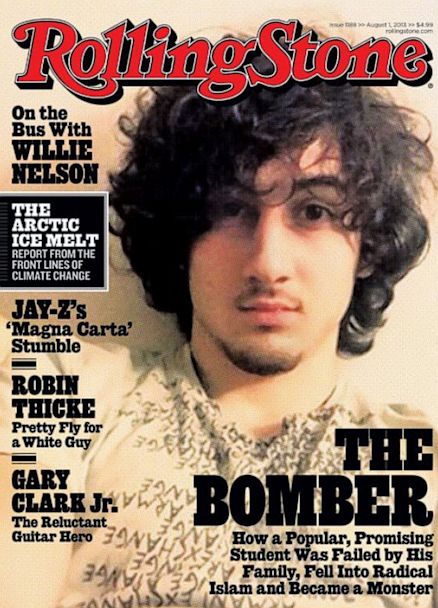
It might be that I'm from nowhere. I'll give you that. But if I am from somewhere, that place is Boston. Still, I'll admit, I'm having a lot of trouble with the furor over the upcoming Rolling Stone cover with Dzhokhar Tsarnaev on the cover. I've read TIME Magazines and Newsweeks (RIP) with Osama Bin Laden featured prominently. Is the issue more because it's a flattering picture and not dirty, bearded Saddam Hussein?
I read the arguments about not validating horrible acts with fame, although they're silly. Famously bad people get famous; you refuse to reward them by making sure they deal with the consequences of their famously bad acts.
I suspect it has more to do with the notion that Rolling Stone will feature a story, not about a cold-blooded killer, but about a confused kid that in way over his head. We're outraged by the sympathy - as if sympathy itself is finite and any sympathy given to "the bad guy" is sympathy taken from his innocent victims. I haven't read the story; I've not even read an account of anyone who's read the story. It may very well make Tsarnaev a victim alongside those people he hurt. I'm not sure what's wrong with that.
Not every victim is innocent. Not every terrorist is evil.
To be sure, there are plenty of innocent victims here. People were killed, maimed, injured, traumatized by the senseless, stupid actions of two disillusioned brothers. That's not up for debate. No matter how righteous our perceived cause or how serious our perceived indignities (and our causes and indignities are always perceived), violence is never the right choice. It just isn't. Ever.
But I'm troubled that our society so quickly condemns anyone willing to explore the depths of a complicated situation. We like simplicity. We like it a lot. But then again, simplicity is not real life (the same can be said for Trayvon and George).
We want to categorize people good and bad, usually so we can distinguish "us" from "them." We like the fantasy that some human beings are downright evil. It keeps us from facing the reality that, as humans, we're all capable, under the right circumstances, of all the evil any of us are capable of.
None of us should be defined by our actions. We can certainly be described by our actions, but that's a far cry from defining us that way. I've known people who grew up with absentee fathers who've really struggled with this distinction. When you've got a Dad incapable of anything good, it's tough to realize that this dispicability isn't genetic. They have to differentiate between the actions of their father (which are bad) and the person of their father (who is dad). The same applies to all our heroes and villains.
The homeless man with the golden voice, who made headlines, reunited with his family, and went on all the feel-good morning talk shows - he relapsed shortly thereafter, then again a few months later. He's got a job and a home and a future, but he's not perfect. He's a man chock full of good and bad; neither define him. They describe him.
Don't get me wrong, description is still important. People who have done a lot of stealing are likely not the best to hire as house-sitters. We must all live with the consequences of our actions. Those are real. I hope the Rolling Stone piece doesn't gloss over the tragedy that brought Tsarnaev to our attention. It would be unconscionable.
But actually exploring the forces in a person's life that lead them to evil (or to good) is interesting and valuable and far too rare in our world today.
It's way better than just guessing, which is how it normally works. We judge people based on gut instinct and any variety of subjective criteria. Howard Dean gets excited during a campaign speech, yells crazily, like Slim Pickins riding the bomb, and his political career is over. Anthony Weiner texts a picture of his junk to a woman who's not his wife and he becomes the next mayor of New York. Capricious.
We want to hate Dzhokhar Tsarnaev. He's done some bad stuff. The consequence of which is that his life ends at 19 years old, whether he's executed or not. Does that make him a tragic figure? I don't know, but I think it's fantastic that someone is trying to find out.

A tale has been told of a young boy, we’ll call him Amir, playing with some sticks he’s fashioned into toys and eavesdropping on his father, entertaining guests in a small house in the mountains of Afghanistan. Suddenly, there’s a bright light, a loud noise and everything goes black. When Amir awakes, he finds his home in ruins and all his family dead. At seven, he is the lone survivor and he is on his own.
The neighbors tell him it was a drone attack, that foreign invaders bomb their country to make the people afraid and take their resources. Amir has made an enemy. His journey begins slowly, running errands and cooking food. Soon he becomes a look-out, and a very good one. His stealth earns him a promotion and he begins planting roadside bombs, then helping to build them, then deciding where they will be placed.
A decade later, he is a man, even though he’s been an adult far longer than children should have to be. He’s moving along a mountain road from one village to another when he comes upon the remains of a recent ambush. A foreign soldier lies on the side of the road ahead, he must have been thrown from his vehicle during the chaos.
Amir ducks behind some rubble as the soldier’s unit returns, running quickly. They glance at their fallen comrade and then back at their pursuers and hurry on. Later, an investigative team arrives, checking the road for clues and unexploded devices. They too ignore the soldier on the side of the road.
Finally, when the coast is clear, Amir ventures out. This is a profound moment for him. Despite all of his experience, he’s never met an invader up close. Surely the soldier is dead or the others would have helped him. Amir will take no chances. The images of his parents, his siblings, their bodies broken, their funerals dance in his head. He gripes the knife inside his cloak. He will make sure this soldier is dead.
As he approaches, the man moans and begins to roll over, clearly badly injured, but alive. They make eye contact. Amir gasps, drops his knife and staggers backwards. The image in his head has been transformed. As he stares at the soldier, he see’s something familiar. The blood, running down his face, sticking in his beard, the pain in his eyes. Quickly, those eyes become the eyes of Amir’s father, the blood, his blood, the pain, his pain. Amir’s heart melts.
Amir could do nothing as a young boy, but he could do something now, as a man. Quickly his mind begins to assess the damage. He looks around – there’s a village not far, with some friends. He could hide the soldier in a back room until his wounds heal enough. His reputation and authority should keep the soldier hidden well enough. There is money and medical supplies stashed away. They should do. If not he could find more. This man must not die.
As Amir regained his bearing and approached the soldier, he saw the pistol. The soldier had retrieved it, with great effort, and was pointing it in Amir’s direction. The soldier was in no position to fight and his wounds demanded hurry. So Amir kept coming. The shot rang out and echoed through the valley, then another. Neither had hit Amir, but the look in the soldier’s eye had changed from pain to fear.
Amir did all he could to assuage that notion. But he spoke only his native tongue and there was really not much time. With his injuries, the soldier’s aim was terrible, but at close range it would be good enough. In the end, his bullets held out longer than his heart and by the time Amir was able to reach him, he was gone.