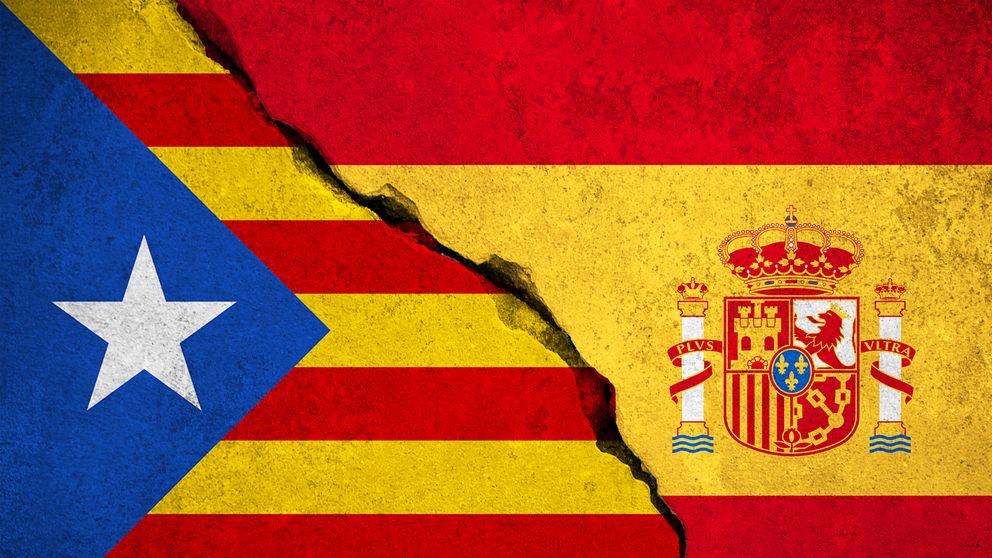
I don't know the ins and outs of this movement. I've been aware of the Catalan Independence movement for most of my life, but I don't have the background or understanding to really parse the facts of the issue. I tend to support movements towards independence on principle, but I'm simply ignorant of the specifics.
What interests me about this whole process is the civilized nature of the whole thing. Yes, there have been protests, a few riots, a little bit of physical violence, but overall this process of rebellion has looked very different from most fights for independence. Catalonia is trying to do things, if not by the book, at least with some respect.
Catalonia has its own language and culture and has long been at odds with whatever government happens to reign in Madrid. Support for true independence has never been more than a slight majority, with polls ranging all over the place. When Catalans make an argument for independence, it's largely on the basis of representation - Catalonia is a pretty rich area that doesn't get proper treatment from the national government. What's interesting to me is how the issues are really the same on both sides. Many Catalans feel they are a disrespected minority, but they've also got a large nationalist population within Catalonia who are scared of how they'd be treated in an independent nation.
This is the clarion call of democratic governments these days. The strongest case they have to make for their own existence is "to keep the mob at bay." Government presents itself as protector of those whose freedoms will be impinged by the will of the majority. We can debate the truth and value of that statement, but it does tend to be front and center in conversations.
In past situations like this one, war has been the answer. The side with the most power gets to make the rules, but that's precisely the opposite of how modern democratic societies present themselves, especially in Europe. The Catalan Independence leaders can't call for armed rebellion without looking a bit hypocritical (not to mention barbaric) and so they've tried to do things the "democratic" way - with civil disobedience, at least when necessary.
That this all comes sort of in the midst of chaos in the US is also fascinating. We've had discussions about gun laws that always involve an appear to our nation's founding, largely on the backs of regular people who took up arms to kick out a ruling power. American democracy came about in the most un-democratic of ways.
It's not as if either of these options makes much sense. Outside the benevolence of the Spanish government, it's unlikely Catalonia will get a democratic independence any time soon. In fact, the only way real independence ever happens without bloodshed is either outside nations coming to the aid of a separatists group (see South Sudan, which isn't really in anyone's "win" category, anyway) or it just becomes too costly or too bothersome for the ruling nation to keep ruling (most of the British commonwealth).
I've found the whole thing a quixotic case study in our desire to win. We like to get our own way - us and them (whomever us and them might be)- and we're generally far more prone to break our own rules if it results in us winning. When we believe we're in the right and the "other" won't or can't see it, we look for ways to shock them (or force them) into changing their mind.
It's an odd dilemma for the season of Easter, which calls and reminds us that great power is not overcome by greater power, but by patience and perseverance. I'm sure the current state of affairs is not what most in Catalonia would want to see, and there are certainly well-founded criticisms of how various parties have proceeded, but it's nice to know that somewhere we moved, if only slightly and certainly not entirely, away from games of force and power.
Everybody's playing by the same rules. As frustrating as that is for all involved, it's a sign that there might just be something more important in the world than winning. That's a lesson for all of us in this day and age.

I was struck this week, though, how it seems we may have moved our object of attention from Sunday to Friday and perhaps we need the reminder that as much as we shouldn't rush to Sunday, we also shouldn't rush to Friday.
I know a few communities that celebrate a service of worship every day of Holy Week - Monday through Sunday - it's a good way to keep the pace. I suspect this idea gives a lot of pastors the shivers - not only is that planning and leading a whole bunch more services, there's also the issue of what to focus each one on. When we're in that Friday-Sunday schedule, it's easy: death and life. But I'm pretty sure real life (and death) is a bit more nuanced. It's the same problem we have making Advent into "pre-Christmas;" we're terrified of the in between (you don't see many Holy Saturday services, do you?).
I've been to a number of Maundy Thursday services the last few years in a whole lot of congregations. Most of the time, though, it feels like Friday. They're different, for sure - often foot-washing and/or communion as opposed to the traditional Tennebrae of Friday, but the mood, atmosphere and focus is decidedly sad. This strikes me as the wrong tone.
I get that Good Friday is sad - it's like a funeral. We're mourning the death of God. I wonder if perhaps Maundy Thursday should be a bit more like a wake. It's heavy, yes - you can't dismiss the importance of all that's going on: Jesus serving the disciples, Last Supper, betrayal - the guy sweated blood for God's sake (well, for human sake, but you get it).
At the same time, I feel like it was a livelier gathering and ours should be, too - with an appreciation of the significance, but still a sense of celebration. Passover, which is what they're celebrating, is both somber and celebratory. People died - every firstborn in Egypt - but a people was born. Passover is as much about the formation of God's people as it is the spectre of death. The mood of the Thursday service should reflect this.
I'm thinking of the scene in Braveheart (that may not actually exist anywhere but in my imagination), where the Scots are preparing to fight the next morning; they sit up late around the fire talking and laughing, sharing thoughts and fears. Maybe a more contemporary idea: the night before a wedding. The rehearsal is over and the bride and groom have returned to their separate quarters with attendants, preparing for the big day to follow. There's nothing sad about those moments, but they are deep, meaningful, tender. There's a real importance in the air; this is not a normal service, but in a way it is, just with a little more heft.
Yes, Jesus death is sad, horrific even, but that's Friday. As much as we shouldn't rush past it, we also shouldn't rush to get there. Jesus was still alive on Thursday and it feels like Thursday should still celebrate his life. Jesus' life was about laying his life down for others - that's serious business, but it began well before his arrest. He began laying down his life for others the moment he understood and accepted his call from God - when he gave up whatever were his dreams of life or the expectations of his family to proclaim the gospel to the world.
Thursday is the culmination of all of that, especially for us still alive. Yes, Jesus death and resurrection are of utmost theological and practical importance, but it is his life that speaks most directly to our lives today. We see a group of people, disciples, who mean well, but don't always get it and certainly don't always get along, sitting around the table, eating and talking together. They're committed to each other and to Jesus, even without knowing all that this commitment entails. They know something big is on the horizon, and they might even know something will be demanded of them; choices will have to be made.
They don't eat and drink unknowingly, but in a sense they do. They don't know - not even Judas - what will happen next. It is the ultimate unknown, but they are being shaped and formed as people who can respond to that unknown - not always perfectly (for sure), but with grace and faith and love. This, too, is important.
We're a year away now, so there's time to ponder and think and dream. When celebrating Holy Week, by all means, don't forget Friday, but let's not rush to get there either.

A few years back I was helping to lead a weekly Saturday service at Victory Hills Church of the Nazarene in Kansas City. Obviously, with a Saturday service, we had a service scheduled for Holy Saturday. Since all of the other Holy Week traditions were also in place, I had to some up with something different for a sermon. That's when I had the chance to delve into Holy Saturday.
I called it "The Time Between the Times." You see, while Holy Week is a re-enactment of the past, a remembering of Jesus' death and resurrection, it is also representative of the future. We look forward (in the directional sense, not necessarily the emotional one) to our own death and mortality - and ultimately the bodily resurrection of all people.
Holy Saturday reminds us that we live in a limbo, of sorts. We remember Christ, who inaugurated the Reign of God that will last for eternity, but hasn't returned to finish the job just yet. So we live in the midst of a world that is dying and also in the midst of a world that is coming alive. There's a lot of tension there.
Tension between a world of universal love and acceptance and a world that routinely leaves people out and unloved. A world in which all life in precious and a world in which we justify killing in so many ways. A world with more than enough food to go around and a world in which hundreds of thousands starve every day. A world in which the Body of Christ provides an example of how God intended us to live together and a world in which the Body of Christ presents itself hateful, abusive, ignorant and selfish far too often.
On Holy Saturday we remember the disciples, lost and scattered. They never quite understood what Jesus was trying to teach them and now he was dead, like so many Messiahs who came before. Sure, he was different in speech and habit, but little good that did him on the cross.
The fear and terror of the upper room, as they wandered back from wherever it was they were cowering, is reminiscent of our own - a fear we try to ignore, defeat, and oppress most of the year. Holy Saturday is the day to let it out, to relax and stop repressing. It is a day to admit we're not good enough, we're not who we claim to be, we're weak and feeble and entirely incapable of being anything else. It's a day to be comfortable with the idea that all hope is lost.
In the back of our minds we know Sunday is coming, that resurrection has happened and our hope is in the resurrection to come. But there's nothing wrong with a day to linger in the time between the times, to recount the hope we had in Christ when he was preaching and healing and bringing good news, to recount the pain and fear and doubt that creeps in when we look at the challenges and failings of the world around us.
I am relieved to read Peter's words towards the end of John chapter 6. Jesus has some difficult teachings and many of his hangers-on have walked away. He turns to the Apostles and asks if they, too, want to leave. Peter replies, "Where else can we go You have the words of eternal life." I just love that Peter essentially says, "Yes, we'd like to go - we just haven't found a place better than here."
The question we face every day is, "Is our God really big enough?"
Today, of all days, we can and should be comfortable saying, "I don't know."
