
We have no real way of knowing if this is true. Even Snopes says it's anybody's guess, although the details are plausible. I believe the quote from the story is that his marine corps oath was "to one nation under God, which makes it as good as religion." Whether fabricated or not, it's a pretty telling statement about the perception of nationalism and the ways in which Christianity has been distorted to serve powerful and violent interests. We've essentially sanctified "common sense," when the gospel is foolishness to the wisdom of the world.
What's more telling, perhaps, is that this was designed to get people clicking. It's popular. It's the kind of feel good story people are willing to read and share. I sure hope my Christian friends are uncomfortable with it, but I've also seen plenty defend this kind of analogy. I've long heard people say you can serve God and country as long as you have them in the right order. Those are often the same people who say its un-American to welcome immigrants, for example - without much thought to Biblical teaching on the matter; who choose war over peace.
It's a broad brush and perhaps the characterization doesn't fit you - for that I'm glad - but it's been true in enough of my conversations to warrant comment. We simply can't combine nationalism and Christianity - even if there is some purported "right" order of allegiance, in any conglomeration of the two, Christianity always loses. Power is a wily foe - it's why Jesus says a man cannot serve both God and Mammon. We typically take that to mean "money," and greed is probably the best translation, but it's not always about money. Greed speaks to accumulation, typically at the expense of others. This is a power game.
When we seek to be "the best country in the world," there's tacit implications that this means others are less good. Perhaps we could be the best country in the world while also helping the rest of the world to achieve what we have. However, our typical fallback for maintain "greatness" is not magnanimous generosity and sacrifice; it's military might, force, and power. We hoard those things and in doing so, give worship and honor to Mammon.
The guy in the click bait, if he really exists, has nobly given his life to a certain set of principles and assumptions. They're "noble" in every sense of our vernacular, but they're not Christian values and the Church can't continue to strain between two pillars moving in opposite directions. That edifice, of God and country, is simply unstable. Better for it to fall and us pick up the pieces than to kill ourselves in an unwinnable task.
That's not to say nationalism or American patriotism doesn't have elements of true virtue embedded within it - just that they're in service to a worldview that's dead and dying. The sooner we cut the cord, the better we're all going to be.
I still don't advocate giving in to the clickbait - it's the surest way for your to spread fake news or contract a computer virus - but here's one, at least, that speaks volumes beyond simply the words on the screen. Our lives are telling; they reveal information about us we may never have intended or known. Let's serve God and keep Mammon out of it.
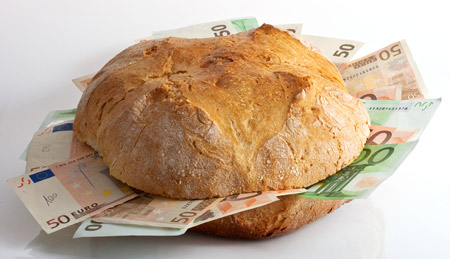
Most proponents of these economic systems believe there is some sort of natural state by which, if left alone (whatever that means) human society would naturally gravitate towards. In (very broad, overly generalist) terms, extreme capitalism is attempting to free people to interact in ways they would naturally, while extreme socialism is attempting to remove allegedly artificial barriers of historic development to return people to some natural state.
I suspect most anyone will tell you perhaps there is a necessary tension between these two ideas - which are really just competing notions of communal and individual responsibility. Again, crudely: "being selfish helps everyone" vs "being selfless helps everyone," when in reality human beings are neither selfish nor selfless. We tend to be both.
Underlying all of these economic theories, however, is one universal theme. They're consumed with more. the assumption of economics is the production of more wealth. It's the old, "bigger house, better car, more luxury" mantra of human society. Capitalism might use this drive to elicit competition, while socialism might use this drive to elicit compassion, but they're ultimately in search of the same thing.
I've been thinking about this in light of what I guess we call Biblical economics (although that's a pretty terrible term). I'd prefer to use "Kingdom economics," but that's entirely insider lingo and tough to access without help.
In any event, I'd describe such economics as Generous Simplicity.
God calls people to less. Use less, need less, be happy with less. God calls people to less so we can be givers and recipients of generosity. A people who need and want less, have plenty to give, but also receive simple gifts as great treasure.
We often simplify things to say, "God doesn't want anyone to go without," but fasting and sacrifice have always been a real part of God's formation of people. Those practices exist to show us just how little we really need. Of course, no one should be hungry or thirsty - but how few of us really know what those words mean? Especially those of us immersed in the economics of more?
God doesn't want anyone forced into poverty, but God does want us to desire simplicity.
Jesus, through words and example, calls people to be downwardly mobile. Our eyes and aspirations should not be on those above us in the prosperity ladder, but on those below. We should not be working to need more, but to need less. There are a lot of ways to interpret the literally meaning of those words; I believe all of them are correct.*
In truth, simplicity works against a capitalist system; it works against a socialist system, too. Perhaps when we talk about economics, the real inherent tension is not between which particular ism makes the most sense to us, but the tension between the drive for more and the drive for less.
This speaks powerfully to our understanding of "security." God speaks powerfully that our economic hope should not be in wise investments or proper planning, but in the provision of God - which is most real only when the cupboard is truly bare.
I can't tell you exactly what it means to live simply in the midst of our complex economic age. It seems straightforward that followers of the man with no place to lay his head, of the man who brought abundance from a severely lacking meal of loaves and fishes, of the man who relied entirely on the generosity of strangers - would embark on similar lives. It also seems straightforward that this lifestyle is irresponsible in our day and age (in fact we have a whole industry of non-profits built around helping people leave it).
So, I can't tell you exactly what it means to live simply in the midst of our complex economic age. And I'm not going to say that "less is more," because less is usually less and more is usually more - there's no deep paradox there.
I can say the real economics of life revolve around less, not more - and it's vitally important with wrestle with that notion as we seek to live well in the world.

I do, however, consume information. I read everything I can get my hands on. I've tried (and succeeded to some degree) in the last year or so to skip things that don't interest me. An obvious choice, I know, but a big challenge for me. I have a few blogs I read, a few preachers whose sermons I enjoy and a couple podcasts in which I regularly partake. I've got them all nicely organized and delivered to my Feedly page for efficient consumption.
I spend a lot of time reading and listening to crap. Interesting, often stimulating, occasionally important crap, but crap nonetheless.
I get Entertainment Weekly, which is a constant reminder of all the tv shows and movies I'm not watching, despite their obvious value and critical acclaim. I keep talking about getting netflix in the summer when our family has more free time - because that's exactly how we should be spending our summer: huddled on the couch watching TV!
I've only recently realized something that's probably been readily apparent to my wife for years: I'm never gonna catch up. There will always be more movies, more shows, more podcasts, more interesting, informative things to fill my mind and drive my imagination. That realization, in itself, is incredibly freeing.
I recognize it could lead to debilitating depression. There is so much out there I might know and never will. In a sense that's sad. In another sense it's wonderful. There will never be enough. The amount of things I won't experience is infinite - so if I add to it, it won't actually grow any (ask a mathematician if you didn't follow that).
I can chose, if I dare, if I have the willpower, to focus my attention on things vitally important to the rest of my life, not things that are self-important or portend some kind of intellectual completeness.
I'll be trying, over the next few weeks, to free myself from some measure of connection to my drug of choice. My Feedly link is tucked away nicely in an obscure bookmarks folder. Buried, for the time being. In a few weeks (months, maybe) I'll revisit it. There will be too much content to consume it all. I'll have to chose. I may chose to just ignore all of it.
Yes, I will be missing out on things I may never encounter. Interviews that will never happen again, words that will never be expressed in exactly the same way. But, in the end, when I really sit and think about it. There's nothing on those pages that will make any difference in my life - outside of my bizarre satisfaction in getting them done.
I shall not participate in the gospel of more. There is always more to know, more to be done, more to have. I will never have it all. As fun as trying is sometimes, it is detrimental to life - real life. Hopefully I can stop and smell the proverbial roses a bit this Spring...
...but not every rose, because that's obsessive and as satisfying as it is, it's also incredible stressful and will ultimately lead to me to shrivel up and die.
Happy Thursday!
