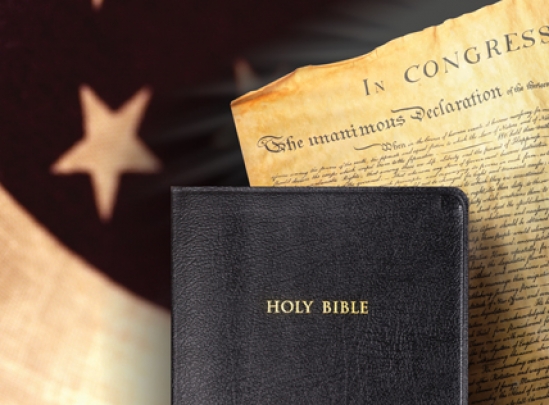
I find it curious that the debates over interpretation look virtually identical whether one is speaking of the Christian scriptures or the US Constitution. I hope it gives everyone who works with both some pause to consider their assumptions. We can make some distinctions, of course - a conservative faith statement regarding scripture is that it contains "all things necessary to our salvation." That happens to be the statement made by my particular denomination - it affirms that scripture is complete and foundational, but it leaves some wiggle room for wrestling with interpretation.
Personally, I have some issue providing even that much credence to the US Constitution. Constitutions, in general, are fallible, incomplete documents. Just because ours has lasted longer than most others, doesn't, to me, prove it's got some inherent worthy beyond the paper its printed on. I struggle to say "it contains all things necessary to our continued governance," with the same meaning I might talk about scripture. I can't/won't assume it's going to have all the answers, if we just look hard enough.
For me, that would put it on an equal footing with the bible. I'm not real comfortable with that.
At the same time, this debate also helps me to critically question even that assumption of scripture. If documents, divinely inspired as they may be, contain the words and interpretation of people - can they really be relied upon to provide a complete foundation? There are certainly some who look to scripture as 98% reliable - as the best foundation human beings could possibly have for living, but perhaps not as perfect as some would like to believe.
Others, of course, see both the Christian scriptures and the US Constitution as good, historical writing, with more than some important for our lives today. They can be taken seriously without being taken too seriously.
There's at least five streams of interpretation here. There's a dictation theory - that the words, scriptural or constitutional are set in stone and must be taken at face value. There's a strict constructionalist - who wants to understand the original intent of the authors, to get behind the words and make sure the meaning has not been warped or misconstrued by the passage of time. There's also the pragmatist - who looks at these documents as guides, but guides to be weighed and critiqued based on the realities of the world in which they function; there's also the reverentialist, who gives such documents great credit and stature, but will ultimately deviate on some matters, reluctantly and with great turmoil.*
This seems to be the battle between conservative and liberal. Of course, the stricter one's interpretation the farther to left or right one draws a line. Those who believe the Bible was dictated by God couldn't hold even the most conservative interpretation valid if it deviated from their own position. "All things necessary to salvation" is the conservative position of my own denomination - The Church of the Nazarene - but we're often challenged as raging liberals, just as anyone who believes some part of the constitution might evolve over time is lambasted as liberal, no matter how they approach legal interpretation.
I say all this, obviously, because the US is in a big, ugly mess right now. In the midst of a tense election year we've got a Supreme Court vacancy, where one of the most conservative justices in history must be replaced. There are legitimate debates to have over whether eleven months is enough time to make selecting a replacement prudent (although I think the majority of those debates are fueled more by partisan loyalties than any logical pragmatism). At the same time, I want to caution especially Christians, but certainly anyone who takes this seriously to think about the rhetoric we use when engaging in these debates and those to follow about what kind of justice should be selected.
One does not have to hold the same understanding of constitutional interpretation as they do for scripture. I am certainly more conservative in my understanding of the bible than I am in my treatment of the constitution. Regardless of where you stand on what - these are not the same thing. As I said, treating (even subconsciously) the constitution as a sacred document is a surefire path to civil religion; it's a dangerous position for Christians to find themselves in - not a necessarily disastrous spot, but certainly a high-wire act of self-awareness.
We have to be mindful of the way in which we treat the constitution and our comfort in elevating it the level of scripture. That's important.
Secondly, we've also got to be mindful of the way we use terms like conservative and liberal. We can't define those terms based on our own perception of reality. It's perfectly acceptable to say "Bernie Sanders is more conservative than me," or "Ted Cruz is more liberal than me," but to label them conservative and liberal, respectively, is confusing the conversation.
We do the same thing when talking about our justices. Antonin Scalia was very conservative; although he didn't hold to the most conservative possible position on constitutional interpretation, he was about as far right as one can feasibly be and still function in the legal community. At the same time, he can't be the measure of "true conservatism," that's language to avoid. It's perfectly fine to draw the line of personal acceptability at Scalia, but to say this line also defines conservatism will only make dialog more difficult.
This is the same problem we have when some say, "believing in a seven day creation is the only truly conservative position" on biblical interpretation. The debate them becomes about the definition of conservatism (and thus gets personal, especially for self-styled conservatives who don't meet your standard) rather than the substances of actual positions.
I'm being long-winded as usual, but the real message here is to be careful how we talk to one other. Be careful not to draw lines of comfort around terms we want to keep for ourselves. This kind of tribalism may help us feel secure, but it's a recipe for strife and disaster. It leads us to places of generalization and demonization. Even the most conservative person cannot allow themselves to get to a place where they'll rail against a judicial nominee simply because of the President who makes the nomination. This is the real tragedy. If everything conservative is bad and everything liberal is good, then nothing matters but our own opinion and nobody can survive that fight.
The bible and the constitution aren't the same thing. It's ok to understand and interpret them the same way (I think that's a mistake, but you're certainly entitled to make it), but we can't combine the two. That spells disaster. We also can't define reality by own our understanding. We are necessarily communal people. We have to have relationships or we become something less than human. Having a relationship means giving permission for someone else to think differently - and that means giving up control of how we define people.
Let's let everyone speak for themselves, about actual opinions and beliefs without lumping them, or ourselves, into pre-formed categories whose worth we've already determined. I'm not sure either scripture or the constitution would look fondly on that, no matter how you interpret them.
*There's also another school of interpretation that essentially says these documents point to some larger truth and our interpretation of them is only an attempt to reach that higher plane of mystical understanding - whether it be defined as "Jesus," "God," "freedom," "natural law," "human dignity," "democracy" or anything else. Some might call this a middle position, but it's really off the spectrum and, while interesting, not quite relevant to my point in this, already overlong, piece.

Now conservative, I think, is a more difficult position to nail down using the same terminology. I know few conservatives who think government (as an idea) is completely worthless, even if that is the stereotype. In that sense, I share with conservatives, the healthy skepticism that government can really solve social problems. At the same time, I tend to butt heads with many conservatives who seem to believe that government will inherently make any social problem worse. For the most part, I sense a belief that government is a necessary evil. I'm not sure I'd go that far.*
I tend to see government as a tool, not a solution. Just like the free market or private enterprise or non-profits or human responsibility, government is a tool society has at its disposal to address problems we see around us. I don't think it's always the most effective tool to use and its often simultaneously the easiest and least efficient, but it is a tool nonetheless. Because I hold this view, I don't see "government" in and of itself as good or evil any more than a hammer or a saw is good or evil - it simply is; judgement comes once we use it for something - AND, it must always be evaluated in context.
Now there are ideological arguments that arise - specifically "government is an inappropriate tool for that job." Some are willing to give up pragmatism in search of ideological purity. I applaud that notion; I might even share it in some instances. However, when it comes to government, I'm entirely practical.
If my choices for pounding in a nail are the blunt side of a wrench or my own hand, I'm gonna give the wrench a go and not worry too much about the appropriateness or efficiency of the choice (which seems to be a conservative tactic). Now I'd also rather not be so content with my ingenuity that I never buy a hammer or even look for a better wrench (which is often the liberal move). There's some sense of desiring an ideal solution so thoroughly that it paralyzes our system - either too stubborn to admit the solution we have is imperfect or too stubborn to admit a bad solution is better than none at all.
Now, I'm always the one screaming "there's never just two choices," so it's not as simple as I outlined above - creativity is good - but that also illustrates my complaints with the typical ways we handle government - it's either a solution or a problem. I'm not willing to call it either. I'd like us to see a more expanded society, in which we use whatever tools at our disposal to address needs. We can ask not, "should the gov't be involved in this or not?" but "in what ways and to what degree does gov't make sense to address this?" The answer might be, "a lot," or, "not at all," or something in between - I'd just rather we figure out something that works, not be satisfied with that answer and also not reject it out of hand for ideological reasons.
I read another lengthy piece about the problems of our prison (and court) system this week. It's an issue that needs addressed (and won, thankfully, members of both major parties want to address). So here, as part of the solution, I'd be fine with private companies and free market forces running the prison system, so long as the government incentivizes (ie, pays) them based on how few prisoners re-offend. I'm fine with prosecutors holding the reigns on prison sentences (as they do now), so long as their judged by crime rates, not conviction rates (and thus invested in long term solutions). To me, that's pragmatic and it makes use of every tool at our disposal, rather then fighting over one.
Portugal decriminalized all drugs for personal use and usage rates dropped (and drug-related health problems plummeted). They've given free methadone and clean needles to addicts in Switzerland for years - and outcomes continue to improve. It works. I'm all for stuff that works. Ideology be damned.
Of course, we can't actually remove ideology from the equation. Everyone believes something about the world and we all use these beliefs to inform our actions. We all have an ideology. We can't divorce our ideology from our participation in society. The point I'm more trying to make is that our government is a shared tool; it can't be governed by any one ideology. It's got to be pragmatic.
Some people believe individual freedom is the highest aim of society; others believe providing for the common good should be ideological aim of humanity. Those people are not likely to be reconciled, but they do have to live together. Thus we have government - the messy attempt to keep everyone from killing each other. People aren't going to agree on ideology, so government must be kept clear of adopting one - it's got to be pragmatic.
This disagreement, though, is also why we must work diligently to remind people that government is not the end-all and be-all of our interactions with each other.
The Church has a unique place in this process. The Church is called to be an alternative community, living out an example of how people can get along with each other in love and sacrifice. The Church should never be involved in running government - it's certainly not a Christian duty to impose beliefs or actions on anybody.** If there are problems the Church believes should be addressed ideologically (and, for the Church, all problems should be addressed that way), it's the duty of the Church to do it, not worry about trying to make the government do it. Yes, government can make the efforts of the Church to be faithful to its calling easier or more difficult, but government certainly can't prevent the attempt.
Any other ideological group is free to pursue the same alternative community. If someone wants to found a collective based entirely on individual freedom, they are, of course, free to do so. Yes, government might make that more difficult than we'd like, but if the ideology is strong enough, people will see the truth in it. That's the belief of the Church anyway; I find it odd anyone would believe in something they don't think could ultimately win people over without coercion.
The government can't be that avenue for ideology - mine or anyone else's - precisely because it's an involuntary organization. People could, I suppose, up and leave, if they were really fed up, but it's an unrealistic solution for most and, ultimately, if it's not this government it will be another.
I don't think it's wrong for people to voice their opinions - that's sort of the whole point of government in a democracy. We express our views on how things should work, hear competing views and try to figure out some compromise. It's this whole business of treating government like something we can win that's driving the problems. Ideology can only win out on its own merits. It can't be enforced.*** When there are different people involved, the opinions will be different.
Government is a tool. We can (and maybe should) have strong beliefs about the appropriate use of that tool, but, in the end, we're going to have to come to some agreement about how to actually use the tool. I might eventually convince you and you might eventually convince me, but it's not going to happen through argument and law, it'll happen through providing a credible example.
Let's use the wrench to drive nails for now, and work on a better hammer as we go along.
*Although I do see government as unavoidable, which is sort of like both "necessary" and "evil" in a different context. You're always going to have someone telling you what to do - whether it be an elected Congress or a guy with a bigger gun; whether you see them every day or just once every couple years, none of us will ever be left entirely alone. There's always going to be some type of government. I suspect, given that reality, it'll also always been seen by people as a means of power, rather than, as I say here, a tool. I tend, from this context, to look at government's necessary-ness and evil as simply a given and worry more about its function - pragmatically - as I outline here.
**There's still this undercurrent running through Christianity (even when it's not outrightly claimed) that our nation should be a Christian nation, governed by moral laws, informed by Christ. I wrote a lot about this last month, so I won't rehash it here - just to say I think this idea is a horrible corruption of the gospel of Jesus Christ as should be opposed as strenuously as possible.
***Unless your ideology is "everyone should do what I say without questioning," then, you know, I guess, good luck, Hitler.

My faith, at the time, was pretty securely encamped in the "fire insurance" department. I understood faith entirely in terms of afterlife. We are Christians because being Christians is how we get to heaven. If Jesus didn't rise from the dead, it seems very unlikely I will rise from the dead and that would make faith ultimately as pointless as all get out. Why would I give up sex and drinking and movie theaters and prom if I'm not getting anything out of it?
I look at faith quite differently these days. In fact, my faith no longer has anything to do with afterlife. Gospel, as I see it, is not "good news about heaven," but entirely good news about life here and now. The Kingdom of God has come, Jesus was its first citizen, and we don't have to wait to heaven to join in. My faith moved from something (at least intellectually) useless in the present, to something of utmost importance for the here and now.
I see the life, death, and resurrection of Jesus Christ as both teaching us and enabling us to live life as God always intended. Resurrection means that life will continue forever. Not in some disembodied heaven, but in a reconstituted here. I see death as merely a pit stop in the midst of life, not the end.
In fact, if I take stock of what are essential faith claims in my life, I have only two. First, God is at work in the world - active, not passive. The second, Jesus Christ was raised from the dead. If anything, the resurrection of Jesus is even MORE important to my faith now than it was as a formative youngster trying to make sense of those crazy liberal heretics way back when.
Now, though, my attitude towards them is a bit different.
I still disagree, although not with confusion and malice, perhaps with some grudging respect. I still scratch my head in wonder, but I wonder more if it's something I'm lacking as opposed to them.
You see I need resurrection. Not because it's essential to my explanation of God and faith, but because I'm a bit selfish. To me (and I imagine to most Christians out there), resurrection symbolizes confirmation that what Jesus was saying is really true, trustworthy. Jesus said and did some pretty crazy things: love your enemies, give to whomever asks without expecting anything in return, let the dead bury their own dead, don't worry about tomorrow (what you will eat or what you will wear). There's a really radical element of love and non-violence that works against everything our instincts and culture tell us about how to live. It's different.
What's more, it doesn't work out too well in the short term. Culture abhors distinctness. There's a lot of pressure to fall in line. People who refuse to fight often die, they're taken advantage of. Life isn't quite as easy if you go "the gospel way."
So I need resurrection, because then I can at least tell myself this is all for a reason. This world might seem to work one way, but Jesus is God and made this whole thing and it will all be different someday and for eternity; it's already different, we just don't always see it. That's what I believe. It's what I preach every time I step into a pulpit, it's what shapes my life (or what I hope shapes my life).
Now I don't think any of that would be less true without the resurrection. If Jesus is who he says he is and if what he offers as a lifestyle really does work best for life in the world (and I believe both of those to be true), then it doesn't matter if Jesus rose from the dead. It really doesn't. Truth is truth no matter what.
This is precisely the argument some of those magical liberals claim to believe - all the same stuff I do, but without any "proof." Resurrection is at least a hypothetical guarantee. Guarantees are comforting. But the guarantee is only as good as the product being sold. If the Jesus way isn't really the right way, the hope of resurrection is pretty worthless.
That's why I've come to admire those who believe without believing.
Peter Rollins tells a story (which, thanks to Google Books you can read here - starting on page 67 if it doesn't take you to the right place). It's about a group of disciples who leave Jerusalem immediately after the crucifixion, traveling to a far off place and establishing a society where they live in imitation of Christ, not because they believe anything will come of it after their deaths, but simply because they believe his way of life is beautiful.
Not everyone who claims Christ, but denies the resurrection are functioning on this sort of holy plane. Often a skepticism of the supernatural belies a real lack of commitment, rather than a deeper faith. At the same time, I see in myself a real deficiency when it comes to faith. I think I'm lazy enough and selfish enough to just skip the whole endeavor if it won't mean anything beyond this life. I'm sure I'd still be kind and considerate to people when the moment arose - we all want to believe ourselves "good" in that way - but I certainly wouldn't organize my life around a selfless pattern of living. I'd work to get mine. I'd want to do it in a way I could live with, but it sure wouldn't be gospel.
I believe in the resurrection. I'd have no faith without it. I believe the man, Jesus Christ, died and is now again living. I need the resurrection. I need it in so many ways. I just don't believe God needs the resurrection. I believe God used the resurrection for exactly the purpose of promise - showing us what the future entails. At the same time, I believe God could have done things differently and that the life of Christ would be worth the same, even if he'd never been raised from the dead.
I think we have to get there. Maybe not today, maybe not tomorrow, but someday. Because, in the end, if the life we're living only has meaning when it's over, there really is no meaning to life at all.
