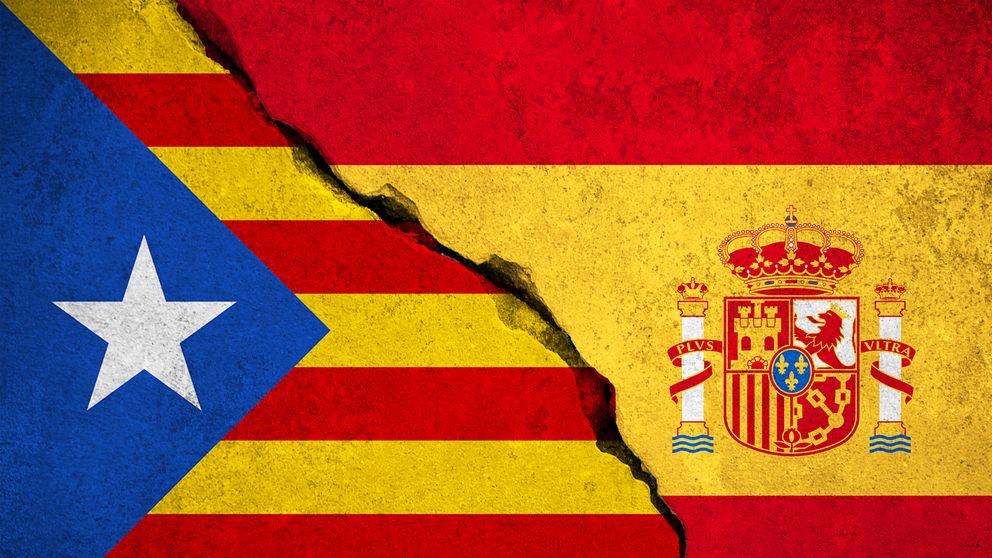
I don't know the ins and outs of this movement. I've been aware of the Catalan Independence movement for most of my life, but I don't have the background or understanding to really parse the facts of the issue. I tend to support movements towards independence on principle, but I'm simply ignorant of the specifics.
What interests me about this whole process is the civilized nature of the whole thing. Yes, there have been protests, a few riots, a little bit of physical violence, but overall this process of rebellion has looked very different from most fights for independence. Catalonia is trying to do things, if not by the book, at least with some respect.
Catalonia has its own language and culture and has long been at odds with whatever government happens to reign in Madrid. Support for true independence has never been more than a slight majority, with polls ranging all over the place. When Catalans make an argument for independence, it's largely on the basis of representation - Catalonia is a pretty rich area that doesn't get proper treatment from the national government. What's interesting to me is how the issues are really the same on both sides. Many Catalans feel they are a disrespected minority, but they've also got a large nationalist population within Catalonia who are scared of how they'd be treated in an independent nation.
This is the clarion call of democratic governments these days. The strongest case they have to make for their own existence is "to keep the mob at bay." Government presents itself as protector of those whose freedoms will be impinged by the will of the majority. We can debate the truth and value of that statement, but it does tend to be front and center in conversations.
In past situations like this one, war has been the answer. The side with the most power gets to make the rules, but that's precisely the opposite of how modern democratic societies present themselves, especially in Europe. The Catalan Independence leaders can't call for armed rebellion without looking a bit hypocritical (not to mention barbaric) and so they've tried to do things the "democratic" way - with civil disobedience, at least when necessary.
That this all comes sort of in the midst of chaos in the US is also fascinating. We've had discussions about gun laws that always involve an appear to our nation's founding, largely on the backs of regular people who took up arms to kick out a ruling power. American democracy came about in the most un-democratic of ways.
It's not as if either of these options makes much sense. Outside the benevolence of the Spanish government, it's unlikely Catalonia will get a democratic independence any time soon. In fact, the only way real independence ever happens without bloodshed is either outside nations coming to the aid of a separatists group (see South Sudan, which isn't really in anyone's "win" category, anyway) or it just becomes too costly or too bothersome for the ruling nation to keep ruling (most of the British commonwealth).
I've found the whole thing a quixotic case study in our desire to win. We like to get our own way - us and them (whomever us and them might be)- and we're generally far more prone to break our own rules if it results in us winning. When we believe we're in the right and the "other" won't or can't see it, we look for ways to shock them (or force them) into changing their mind.
It's an odd dilemma for the season of Easter, which calls and reminds us that great power is not overcome by greater power, but by patience and perseverance. I'm sure the current state of affairs is not what most in Catalonia would want to see, and there are certainly well-founded criticisms of how various parties have proceeded, but it's nice to know that somewhere we moved, if only slightly and certainly not entirely, away from games of force and power.
Everybody's playing by the same rules. As frustrating as that is for all involved, it's a sign that there might just be something more important in the world than winning. That's a lesson for all of us in this day and age.

I'm amazed how quickly she's progressing. From three steps and a lean into our arms to walking long distances over mildly uneven terrain in shoes less than a week later. I suppose we do need a sharp learning curve since the very physics of balance and bipedal motion is pretty complicated. I don't think we really give ourselves enough credit for walking most of our lives while falling over only infrequently.
My daughter is still pretty early in her walking life, though. She walks much quicker and more securely with a hand to hold. She'll practically run if you hold her hand. I really like walking, holding her hand; it makes me feel like we're going somewhere together, rather than me taking her places.
Pretty soon she'll be going most places all on her own. I'm already dreading it. I saw a friend, yesterday, who jut returned from taking his oldest child to college. I asked how it was. He said, "Tough. The house feels pretty empty these days." At another point in my life I would have expected more - a longer explanation. I have a daughter now, all I needed was the look in his eye. I knew.
We're preparing our daughter to walk on her own. Independence is important - especially when it comes to moving from one place to another. We live in a world that practically worships independence, self-sufficiency. There's something in us that feels sorry for people waiting at the bus stop - as if they're lacking something being so dependent on others for transportation.
People need to discover independence. It's an important developmental step, learning to do things on our own - my daughter's not yet 18 months old, but she hates eating anything she can't feed to herself. There's more to come.
People need to discover the importance and power of independence, but the greatest lesson we can and should learn from our experiments in self-sufficiency is just how fleeting and unrealistic they are. We need each other. We know that deep down inside, yet our society and culture tells us to let go, cut the cord, separate.
This is not to downplay the importance of our individuality, but just to recognize that independence, like dependence, is just a developmental stage. Interdependence is where we're created to be.
We're born selfish, although we don't know it. At some point we realize the things we do impact the people around us (and vice versa). We begin to differentiate. We discover our individuality and work on independence. It seems like a lot of us stagnate there. We exist in this realm where no one can tell us what to do and we're willing to do some outrageous things just to prove no one can tell us what to do. Our society doesn't help us any there; it just cheers us on.
We forget - or perhaps we never discover - that our lives aren't meant to be lived independently. We need each other. We need people to tell us what to do from time to time. Living an independent life is downright exhausting. It'll kill us (and if we're really good at being independent, no one will care)!
My daughter is learning to walk on her own. She's only going to get better at it. Still, I can't envision a time when I'll refuse to hold her hand. She'll refuse to hold mine - it'll happen a lot - but, of course, that's part of growing into our independence. If God grants enough grace, perhaps we'll have instilled the proper love and understanding in our daughter that she'll emerge from that independence and be willing to hold our hands again.
After all, if we're going on the same journey, we might as well go together.

So, my daughter turned one on Sunday. We had all the neighbors over and we ate in the backyard and watched the kids go nuts. At one point I embarrassed myself by freaking out when someone left our screen door open - I was worried one of our cats would get out. Now our cats are big, they're three years old now, and they have their full complement of defensive weapons; they would be fine outside. I've never let them out. Why? I'm overprotective.
I'm that guy. I'm pretty OCD. I've never lost my keys, never locked myself out of anything. I clean things as soon as they get dirty. I annoy my wife to no end.
So what if the cats would probably have a ball and enjoy life a lot more if they went out once in a while, they might get hurt and I'd rather not risk it. (Besides, we cheaped out and haven't gotten them rabies boosters lately.) Intellectually I know they're going to die at some point and keeping them indoors isn't going to magically make them immortal.
At the party, I explained my latest theory, that if I get all my obsessive over-protectiveness out on the cats, I'll be better able to let my daughter explore and experiment and get hurt. While I'm not proud of either, I'd rather emotionally scar the cats than my daughter.
Everyone was reassuring me that there's nothing wrong with being overprotective. They seemed pretty serious and strenuous about it. I suppose they could be compensating for their own insecurities, but I don't think that's it (or at least all of it). Since then I've been wondering if this is a difference in worldview or am I just strange. Usually I can pick up when I'm doing something, likely because of my faith, that sets me apart from normal society. I was not really aware that this might be one of those things.
It seems natural, for me especially, but for all parents, that we'd want to keep our children from harm. If we do it too much, we stunt their development and deny them some of the joy of life; if we don't do it enough, we alienate and injure our kids. It's a tough decision. Ultimately, though, I know we live in a world of pain and hurt. My daughter will experience that, whether I try to protect her or not.
I've always felt one of my most important parental responsibilities is allowing her to experience life - all of life, the good and the bad. Now, it's also an important responsibility to walk with her through those experiences and help her understand the world. I'm really concerned I'll be overprotective and keep her from something beautiful.
There is a lot of beauty in overcoming pain, perhaps the most beauty. That doesn't mean we seek out suffering. We don't have to; it comes whether we're looking or not. But I think it's important to embrace the pain and hurt in our lives, because grace and love and peace that come on the other side are much more beautiful than avoiding pain in the first place.
I guess, looking at it in words, this idea is pretty out-of-the-ordinary. And it's certainly something I arrive at because of my faith. I can't help, but believe it's true.
So, it may be my fault our cats are skittish and scared. I'm been overprotective. But I can't help but notice, since the weather has been nice and my daughter has been spending more time outside, crawling around on her own, she's less scared. She's more open to people, she doesn't scream when we run the vacuum, she's more likely to climb on things. The more she's allowed to explore the world, the more she benefits.
I sure hope I can handle it when she starts to walk.

I received a question about prayer this week. The age-old conundrum - if I pray for something and it doesn't happen do I lack faith? If God is going to do what's best all the time anyway, why pray at all? These seem like the core of our ponderings about prayer. Honestly, I'm hesitant to say anything because prayer is not something I've got figured out very well. What I will say is that I'm not very convinced that prayer has much to do with asking for things. Prayer is more about God shaping us than the other way around.
Questions about faith and answered prayer often operate on the assumption that God just pulls strings in the world - that God would just up and make cancer disappear. Now I don't think we can say God doesn't do that. God does intervene very specifically in the world and God does change God's mind, sometimes based on our input. Like everything else in the world, prayer is more complicated than we want it to be.
I believe God created the world to work a certain way, but God also gave imperfect creatures like us some say in how things work. Another way of saying that is to say God limited God's own options by allowing the creation to make some decisions for itself. That's a pretty awesome gift - and if God were to just intervene every time something went wrong, it would be disrespectful to us and the value God puts on us and the part we play in the world. God doesn't give us power and then take it away every time we use it poorly. God works to restore and resolve things through love and sacrifice, not might and force.
Of course, if God gives us power to determine some things and God respects our choices, that makes prayer almost scary - what if I ask for the wrong thing and mess up the world even more? That, I think, is when God's larger plan becomes evident. Christians, especially in the US, have done a very good job of making our faith individualistic. God is not at work saving individual people, God is at work restoring and perfecting the whole world. While we have individual parts to play and individual relationships with God, they only matter in the context of God's mission to redeem all of creation.
The problems in our world are a result of us ignoring God, not God ignoring us. Jesus said the man born blind was not being punished for sin, but it happened so God may be glorified. Our world is messed up, deep down inside. Our generations of sin have had a negative impact on God's creation and it results in pain and suffering. They're not directly correlated, but they're related. God is not out to punish anyone - judgment comes at the end of time - God is constantly calling and healing and fixing and redeeming.
I do think we should express to God our honest feelings. I was moved by the words of a father whose daughter lay dying. He was a learned man and knew to pray "God, your will be done," so as not to impose on God. His daughter said to him, "Dad, I want to live; and if God can do that, I'm going to ask." It changed his whole perspective.
We know intellectually that we want God calling the shots, not us, but we can still trust God to do what's best, even if we tell God what we want. I suspect many times God's mission will work well in any number of ways - why not let us have a say in the details when possible - we do it with our kids all the time. We don't give them whatever they want all the time, but we do it when it's not going to violate our dreams and desires for their lives.
Expressing our feelings is also important, because it helps to illustrate the distance between the world as it is and the world as it should be - which is also the distance between heaven and earth. Heaven really just means "the place where things are as God wants them to be." In prayer, we can, for a few moments, experience a little bit of heaven. We can mourn the pain and loss of our world, but also affirm our hope of redemption.
That last part is really where I find value in prayer. If we move beyond the idea of prayer as asking and hearing and more a state of focus on God, it becomes a means by which God shapes us into people who look more like Christ. We can say, "God, I'm not very happy with you right now, my friend is dying of cancer," but even our act of prayer shows that we believe God to be listening and caring.
I'm not an intercessor - some people are, they can pray for hours about specific people and requests and be refreshed by the process - I usually fall asleep after 20 seconds. I do find great communion with God in nature - there's something about looking out from a mountain or over an ocean that comforts me. It reminds me that despite the size of the world and its problems, there is a big God out there working for the good of all things.
I also find myself in prayer as I empathize with friends who are hurting - when I think or verbalize my frustration with the world. Most of the Psalms are laments - a naming of the problems around us.
I see prayer much more as being aware of my surroundings and conscious of my actions and thinking about how God's mission and love for the world is present or lacking in a given situation. Saying what we believe to be true both helps us believe it and helps us embody it.
In the end, we have to trust that God is loving and is constantly working for the redemption of the whole world. We have to remember that God's mission is much bigger than our individual life and the relationships around us.
I doubt that's a satisfying answer, but it's what I got. I find my most satisfying prayers are when I pray an historic prayer (something many people have prayed before) or when I'm praying on behalf of a congregation or group of people. In those times I am agreeing together with other people - we are affirming our beliefs and our hurts - and the humility to pray and pray together opens us up to be changed and transformed by God.

We're in a stage right now where she's very clingy. If we walk out of her field of vision, the tears well up. The wife had a rough experience trying to leave her in the nursery for worship last Sunday. She went all out waterworks when I walked into the other room yesterday, even though I was in full view.
These are times I'd expect a hug - some reassurance of closeness and protection. She'll often reach up her arms or tug on our pant legs, but as soon as she's being held, she's reaching and pointing for other things.
I do like it this way. She just needs presence. She trusts our love and protection enough that she doesn't need the full force of physical closeness. Once she's secure in our arms, she's ready to face the world. At this point, at eleven months, she literally believes she can do anything if she starts in my arms (including flying, I think, if I'd let her try).
As she grows older, she's not going to need or want to spend so much time being held (which will be wonderful for my lower back). She's going to venture out on her own and create her own independent confidence. At some point I will fail her and she'll realize my arms aren't always the safe harbor they seem to be. (I sometimes wonder if that moment happened Tuesday, when she launched herself off our bed and I didn't notice 'til she hit the floor.)
Perhaps that's when a hug will mean more - when we're not so necessarily connected. I hope she'll be able to know and remember the kind of support and confidence we instill in her now - that she'll be able to pursue the call on her life, to venture out and explore and try and fail and know our arms will always be waiting, even if she's too big to pick up anymore.

