
The first was the leaked quote from Houston Texans owner, Bob McNair, during the NFL protest conversations. McNair said he didn't want "the inmates running the prison." Now, he says he was referring to the NFL office employees dictating policy and procedure to the owners - and, in light of all the detailed reporting by ESPN and others on those meetings, this was a huge bone of contention for the owners and I rightly believe him - however, in a room full of concerned black men, specifically protesting unfair treatment of the black community by police, the phrase itself carried incredible consequence.
The reality of the situation is that African-Americans, and black males in particular, are more likely to get arrested and convicted for actions than white people who do the same things. The sentences are longer and they're less likely to get parole. Skewed numbers exist for interactions with police as well. We've seen scientific proof that there's a cultural and societal bias against dark skin - even by those with dark skin. It's a race problem, but it's beyond even the differences between different groups of people. It's an all of us issue (and one that I've written about here as best I can).
For today, though, the point is that words matter. I can understand what McNair is trying to communicate. I've used that phrase a time or two as a synonym for getting the cart before the horse - to indicate that motivation and control are coming from the wrong places. I tend to say inmates running the asylum, but, honestly, that's just as insensitive. The reason, though, why I or Bob McNair or any other privileged white guy can see that phrase as innocuous is because it's not real for us. I know very few people who've been to prison and the possibility that I, myself, might end up on the wrong side of the law is just so incredibly improbable that it doesn't feel real.
That's just not true, for even the most well-bahved, law abiding man of color in the US. The numbers vary from 1 in 3 to 1 in 5, for the most part, but the odds of a black man in the US spending time in jail is astronomically high - and the stories of unfair or incorrect imprisonment are too common to be taken lightly.
My privilege allows me to use words as analogy that have real meaning to others who don't enjoy my privilege.
I was hoping McNair would use his incident to make a similar statement. Privilege is one of the most difficult concepts to talk about for those of us who have it. It's the most difficult thing to get across to people; it's at the root of the argument around the notion of "all lives matter." Honestly, the conversation around privilege is probably the one our nation needs before we can ever get to a place where real discussion of race can happen.
It bleeds over into the words we use. For people at the top of the social heap, words are just words. They have meaning, but usually just in a representative way. I can say inmates and prison without ever really putting a face, experience, or reality to those ideas. That's just not true for everyone and we've got an obligation to be aware and sensitive to those realities.
Bob McNair probably got a little bit too raked over the coals in learning this lesson, but I do hope he's genuinely learned one and understands his players better than he did before.
The other incident, though, is one that didn't get the same kind of press. A few weeks ago, the University of Tennessee was looking to hire a football coach - Greg Schiano was floated as a possibility (in fact, basically as the choice) - he ended up not getting the job because a lot of alums and fans protested his involvement with Penn State and the terrible child abuse and inaction (if not coverup) that happened there over a period of years.
We can argue about Schiano's real involvement in the process, but it came up in a deposition that a coach had heard from another coach that Schiano had reported child rape during his tenure on the football coaching staff at Penn State and did nothing when nothing was done. He's denied those allegations and there's an argument to be made about the real power a person in his position would've had to change anything - and also an argument to be made about whether that should matter in an instance where a child was being abused.
That's a conversation for another day. My concern was the repeated use of a phrase, "lynch mob," to describe the Tennessee fans who most vociferously opposed Schiano's hire. There were some words of caution, but largely those words went unnoticed.
I get it, from one perspective, if the testimony is true, the guy did barely anything when he knew a child was being harmed, but there's a long way from third-hand allegations to proof or even criminal action. People have the right to make whatever judgments they want, but this one was quick and without a lot of support. That's where the lynch mob analogy makes historical sense - lynch mobs killed black people, without trial, often for very petty reasons or none at all.
Again, though, only white people can use a phrase like that without context. Privilege allows us to say criticism of Schiano looks like the lawless murder of black men. Of course it's not meant literally, but aren't the differences between the two enough to avoid that phrase? For most of my life, I probably would've said (as many have), "Get over it, you're being too sensitive." It's a position privilege allows us to take.
When language is disconnected from our real experience, we fail to recognize it's power. It's not just a racial thing - how often does the word "rape" get used to describe destruction? We might save the word "holocaust" for something truly awful, but is it really as awful, appropriately awful for what we're describing?
I was substitute teaching in an 8th grade class the other day. In an overheard conversation where one African-American kid was talking to the student sitting next to him. He said, "Sometimes, when I get angry, I feel it deep down, like I'm all white inside." Maybe I'm giving him too much credit, but if it bothers you that white is associated with hatred or darkness, perhaps ask yourself why you're only thinking about it now.
(The answer is privilege.)
Words matter - and some words matter more to some people. It might not seem fair, but it's real. It's the price of privilege and it's not much of a price to pay.

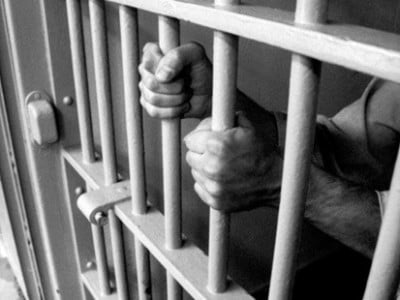
I'm really disturbed today. Yesterday, inmates at the James T Vaughn Correctional Center, a prison about 20 miles from my home, housing minimum, medium, and maximum security inmates, took several employees hostage and after the building was secured, one hostage was found dead.
I know several people who work in that facility. I don't think any of them were involved in this incident, but it certainly brings things home. I do not condone violence or kidnapping, threats or anything involved in this action. At the same time, it's not so simple as bad people doing bad things. It is part of this vicious circle. People in our society act out; we put them in jail - a system and process designed specifically to dehumanize them; they react, sometimes violently; they are responded to with violence. What I see here is: injustice; injustice; injustice; injustice. No one is right and everyone is wrong.
Prisons, like police, or the military play into a national (and probably human) narrative of good vs bad. The good guys need to beat the bad guys so order can be restored. Now most of the people I know who actually operate within those systems understand the real and structural problems that create this scenario - and if they can't see avenues for change, I don't want to presume to know something from the outside.
I do know it shouldn't be this way. I don't believe people change because they're punished; they change because they're loved. Consequences are a real part of life, society, relationships; I don't mean removing those, but we, as a human race, need to do a better job of addressing the real consequences of bad actions in redemptive ways.
I'm troubled by this because I abhor violence. I'm troubled because these inmates lacked the creativity to deal with their very real concerns in healthy ways. I'm troubled because our society, us, we lack the creativity to deal with anti-social behavior in healthy ways. It's a travesty, but a travesty all around.
I'm most troubled, however, by just how easily I'm willing to ignore the situation. When we first moved to Delaware, I worked to put in place what practices I could to shape and form my life in the image of Christ. Being of the Wesleyan tradition, I tried to use John Wesley's admonitions as a guide. He spoke often of spending time with the poor - for a time, I volunteered in a local organization, working with and for the poor; I need to do better there. He spoke of the importance of education. I've been involved with the local school district in a number of capacities: mentoring, tutoring, serving on committees, even substitute teaching. John Wesley all but demanded his followers go once a week to the prisons, as a way of loving and caring for those locked inside.
I'll admit I tried. I contacted the chaplain, twice, with no response and gave up. I looked for other volunteer opportunities, but the information was difficult to parse and I gave up. I called to see if I could visit inmates, but they don't allow even clergy access to prisoners without some prior relationship. I gave up.
If anything, this experience has shown not only how inadequate our human systems are at dealing with hurting people, but at just how inadequate I am at living the life I claim to live. I'd like to say I will change - that I will find a way to connect with the prison population and be invested, because there is no way to be a part of a change without being present - at the same time, I don't have a lot of confidence I will follow through all the way. I'll try, I'm sure, but will I fight for it? I don't know.
This is one of those times when spirituality makes total sense to me. When human systems and human beings lack the power and ability to do something right, our only hope is something greater than ourselves. I am inadequate. We are inadequate. I believe strongly, though, that the creator and sustainer of the universe longs to do impossible things through us, inadequate or not.
Lord, help my unbelief.
That's pretty sad.
It's sad, but it's sadly reflective of the way our society views prisoners. Honestly, it's pretty reflective of the way many prisons function. Society looks at prison as the place to put bad people. We want those who can't get along away from everyone else. It just naturally leads us to assume prisoners are bad people. We characterize them as "bad" and thus any behavior that looks remotely human is surprising.
Our prison system tends to set things up as "us vs them." Of course that's not true everywhere - not by a long shot. Many correctional facilities work against this model, but for many, prison is a place to dehumanize people. We send the bad people off to be treated like animals and then expect them miraculously to act human again when they get out.
If you read through the story you notice this incident was never going to be reported at all. Officers had to organize a makeshift strike, refusing to work until superiors named it a sexual assault, complaining that too many assaults by prisoners get covered up in the process.
The dichotomy is striking.
I'm not saying prisons are useless. We live in an involuntary society - no matter how much help, grace, assistance, and education we offer people, they may still choose not to participate in society fairly. Prison is sort of a necessary evil. But does it have to be so evil? We send tons of people to prison because its simply easier than dealing with them - or bringing to light the root causes of many of these crimes. It's a complex issue, with lots of unfair parts. Prison is used for people who aren't really a danger to anyone - it's just easier to lump people in together.
But people are people. It's good of these inmates to remind us of that. People are also different. Different problems require different solutions, yet we continue to operate under a "one size fits all" banner. It's not even a good one. We spend tens of thousands of dollars to keep people locked up, most of whom are worse off when they return to ordinary life. We're generally ok with it because these inmates generally come from small pockets of communities and don't affect the lives of most people.
One of John Wesley's early commitments (Wesley was an anglican priest in the 1700's, who founded Methodism and gave rise to the particular stream of theology from which I come) was to visit prisoners. It was on the "to do" list for all of his followers, along with giving to the poor and caring for the sick.
Our society makes it very difficult to even visit people - just part of the systemic means of dehumanization that occurs. I don't know what to do about it, really. Even as a minister, when its easier to gain access to prisons, it's pretty difficult to meet people you don't know ahead of time. The very people who most need connection to people outside the prison bubble.
This is sort of a failed blog post, since I have no neat conclusion. I'm happy some people have recognized prisoners as people. I wish we'd do it more often. Prison reform will likely not happen, since it effects the lives of so few voters and a few people make a whole lot of money keeping other people locked up.
It's not fair. It really sucks. We should be able to do better.

You can call me strange, sick, or misguided. I'll take it. My first thought when I read this was - "Sex offenders can't have Facebook pages - how do we expect them to reintegrate into society if we keep them out of so much of it?"
I understand that sexual predators are dangerous people. They've done terrible things and hurt people in unimaginable ways. My own family has been touched by this terrible crime. I'm not trying to ignore the acts committed or excuse anyone. I'm not even going to make a big push for forgiveness; I'm not one with the position to forgive.
What I am going to say is simply that such people, as much as we don't like them, are fellow human beings and as difficult as it is, our society is better off with them integrated into it than ostracized from it.
When things shock and scare us the way sexual abuse does, we want it to just go away. Our best solution for that problem thus far has been prisons where bad people can go to be out of sight and out of mind. We erase people. When and if they get out, we make laws to keep them out of our lives - still out of sight and out of mind.
I keep thinking about the character in Little Children, played so amazingly by Jackie Earl Haley. He was a paroled sex offender, living with his mother, out of work, alone. Clearly he was battling demons beyond his ability to control, yet he had no support system. There is a poignant scene in which he jumps into the middle of a public pool and the parents scramble to get their kids out of the water and out of the park as he's left alone again. The tragedy and the irony of the character is that society was more endangered by this man because it refused to embrace him.
I would never advocate we just pretend like nothing happened. Serial rapists and child molesters have some serious issues that don't just go away on their own. Boundaries are important, as are real, loving relationships and accountability with people who care. And caring doesn't mean you condone or ignore the wrongs committed - simply that you recognize the humanity in even the least humane person.
A Facebook page gives access to potential victims. It serves as temptation to a predator. Of course, likely that temptation exists with or without Facebook. It exists with or without human interaction of any kind. I suspect that's why so many end up back in prison or taking their own lives - it's soul-crushing to never know where the walls are.
I've had a glimpse into addiction - and I can only describe heinous sex crimes as an addiction. Whether its an unwanted sexual attraction or an addiction to power and control, rarely are these crimes motivated by pure choice. There's something wrong inside - we know it; they know it.
As you begin to internalize that message - you're not right, you're defective - it becomes more real. Society puts bad people away in prisons that, despite the stereotypes of cushy jobs and tv, are downright horrible places. They're designed to dehumanize. People who think they're nothing are easier to control. When you don't believe you're human or worth anything - and you've got these overwhelming, terrible drives in your head, "freedom" is often the worst thing for you.
Criminals, in this case, sex offenders - they need society to show them that they are, in fact, human. We, as a society, we don't like to do it - because that means we have a responsibility to them as fellow humans. We're just terrible at dealing with the downside of our pleasures. Gambling is fun - so is drinking and partying and sex - but we don't like to think about the ones who lose their homes, spend every night at AA or never learn about love outside of physical intimacy. We even put some of the failures on TV, so we can tell ourselves "at least I'm not him."
Is the easy way always the best way? Of course not. It almost never is. We pass these laws, like the one in Louisiana (which will be copied in many states and perhaps even nationally) because we just don't have the manpower to keep track of people individually. They have to remain a group, a class (an underclass) of people - nameless, faceless.
And practically, you can blame Louisiana. They don't have enough parole officers to provide the kind of relational accountability people need coming out of prison. If a PO had just one guy or three or five it might be possible; they have hundreds. We like out tax dollars to keep people behind bars, not facilitate their lives outside them.
I don't really know the solution. It's not like you can just walk up to someone and say, "Hi, I know you're a sex offender, but want to be friends?" I can't imagine a person so used to rejection would receive that message the right way. Still, there has to be something more. We should be thinking about this. We should be agonizing over our system - that while justifiable and necessary, just doesn't seem to arrive at the right conclusion.
Perhaps the answer is simply to work within the confines of the system. Find a way to reach out, to try, to send the message that we see humanity where society doesn't. Be prepared to fail, but do something. I have to believe, especially in this situation, something is better than nothing.
I wrote this post a few days ago, based on the article above and then found this piece on CNN. I wasn't thinking about Jerry Sandusky when I wrote this post (and obviously he'll never get the chance to be reintegrated into society), but the CNN article is quite interesting in connecting the two.
