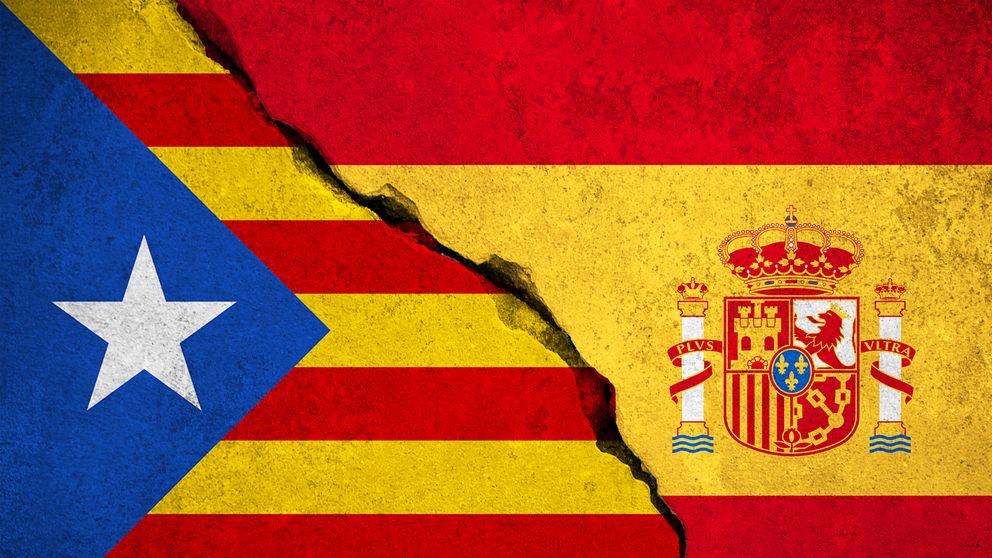
I don't know the ins and outs of this movement. I've been aware of the Catalan Independence movement for most of my life, but I don't have the background or understanding to really parse the facts of the issue. I tend to support movements towards independence on principle, but I'm simply ignorant of the specifics.
What interests me about this whole process is the civilized nature of the whole thing. Yes, there have been protests, a few riots, a little bit of physical violence, but overall this process of rebellion has looked very different from most fights for independence. Catalonia is trying to do things, if not by the book, at least with some respect.
Catalonia has its own language and culture and has long been at odds with whatever government happens to reign in Madrid. Support for true independence has never been more than a slight majority, with polls ranging all over the place. When Catalans make an argument for independence, it's largely on the basis of representation - Catalonia is a pretty rich area that doesn't get proper treatment from the national government. What's interesting to me is how the issues are really the same on both sides. Many Catalans feel they are a disrespected minority, but they've also got a large nationalist population within Catalonia who are scared of how they'd be treated in an independent nation.
This is the clarion call of democratic governments these days. The strongest case they have to make for their own existence is "to keep the mob at bay." Government presents itself as protector of those whose freedoms will be impinged by the will of the majority. We can debate the truth and value of that statement, but it does tend to be front and center in conversations.
In past situations like this one, war has been the answer. The side with the most power gets to make the rules, but that's precisely the opposite of how modern democratic societies present themselves, especially in Europe. The Catalan Independence leaders can't call for armed rebellion without looking a bit hypocritical (not to mention barbaric) and so they've tried to do things the "democratic" way - with civil disobedience, at least when necessary.
That this all comes sort of in the midst of chaos in the US is also fascinating. We've had discussions about gun laws that always involve an appear to our nation's founding, largely on the backs of regular people who took up arms to kick out a ruling power. American democracy came about in the most un-democratic of ways.
It's not as if either of these options makes much sense. Outside the benevolence of the Spanish government, it's unlikely Catalonia will get a democratic independence any time soon. In fact, the only way real independence ever happens without bloodshed is either outside nations coming to the aid of a separatists group (see South Sudan, which isn't really in anyone's "win" category, anyway) or it just becomes too costly or too bothersome for the ruling nation to keep ruling (most of the British commonwealth).
I've found the whole thing a quixotic case study in our desire to win. We like to get our own way - us and them (whomever us and them might be)- and we're generally far more prone to break our own rules if it results in us winning. When we believe we're in the right and the "other" won't or can't see it, we look for ways to shock them (or force them) into changing their mind.
It's an odd dilemma for the season of Easter, which calls and reminds us that great power is not overcome by greater power, but by patience and perseverance. I'm sure the current state of affairs is not what most in Catalonia would want to see, and there are certainly well-founded criticisms of how various parties have proceeded, but it's nice to know that somewhere we moved, if only slightly and certainly not entirely, away from games of force and power.
Everybody's playing by the same rules. As frustrating as that is for all involved, it's a sign that there might just be something more important in the world than winning. That's a lesson for all of us in this day and age.
We like to win so much that we're often willing to risk everything, including our own future, to do it. Our economy is messed up because the whole field of economics was once built on the notion that people will act in their best interests. We're smarter than that now - at least our economists are. The rest of us, though, we just like to win. Honestly, though, it's almost as if we like seeing the other guy lose more than we like winning ourselves.
It's political season here again (when is it not, though, really?) - which means all sorts of crazy, wacky things going on - largely because of our love of winning and preternatural desire for division. In the US we've really just got two camps - Red and Blue. Despite the problems it creates for us, both in the present and the future, we've decided to stick with this failed dichotomy for better or worse. We've found ourselves in a situation where nobody really likes Red or Blue, but both sides are too stubborn to give up and start over.
There is no bigger picture. Just the next poll. The next primary. The next news cycle. The next election.
In NC, we've seen the legislature double down on this bathroom bill that will almost certainly cost them the Governorship. Why do they do it? Well, the individual legislators who pass such bills are representing gerrymandered districts that largely keep their party in power no matter what they do. The real danger for these guys is someone attacking them from the fringe during a primary. So the GOPers have to run right and the Dems have to run left and the rest of the country gets left alone in the middle.
You're seeing it on the national level, too. Paul Ryan is trying his darnedest to be a good legislator. Like or dislike his policies, the guy really takes his job seriously and he appreciates the responsibility of governance. He reluctantly became Speaker of the House because his party was imploding and he's working hard to be a national leader. He spoke his mind about Trump, echoing what a whole lot of people think - that they're just not sure of this guy (like, as a human being, let alone a Presidential candidate).
This is what we want our politicians to do - be rational, think long term and inclusively. But, of course, his House compatriots are already running from him; the party whips - who are supposed to use those proverbial whips on his behalf - have distanced themselves and thrown him under the bus (or the Trump Train, as it were). It's for the same reasons as the guys in NC - they have safe re-election battles, so long as they don't appear to moderate, conciliatory, or, you know, distinguished, in their ideas.*
You can look at all this politically. The two party system leads to Gerrymandering, which leads to dysfunction and a run to the extremes. I don't want to diminish the real value that ridding ourselves of entrenched parties (and all the special favors they give themselves in the Congressional rule book) would do for our governance and piece of mind as a nation.
At the same time, this is really a deeper symptom of our desire for division, categorization - for winning. We like the way we think. Sure, some of us seek out critique and challenge from time to time, but usually it's in the hope that we'll strengthen our resolve and improve our ability to defend out own ideas. We like having predictable opponents, too - we like a familiar enemy, one who's weapons we know and expect, an enemy we don't have to pay attention to, so much as flick away like a mosquito or a moth.
In the end, though, despite our disagreements and engagements and downright fights, the real problems stem from inside ourselves. We're creating enemies where they don't exist and living into the false enemy narratives people try to pin on us. Yes, we've got different perspectives on things and those can't always be bargained or compromised into workable solutions. But we also lack a world in which there can be a winner. Short of genocide, you're not getting rid of disagreement. We still have to live together. Wouldn't it make sense to live in communication with each other? To work out our different perspectives on their own merits, rather than attaching them to demonized generalizations like Red and Blue?
Life is not a zero-sum game, neither is politics or society or really anything at all. A win-win scenario is not a mutual disappointment, no matter how much our political game wants us to believe it is. The same goes for the fights we have in churches and families, with neighbors and our spouse. No one can get everything they want, but no one would be happy if they did (despite dreams to the contrary). We need each other. We need our differences. What we don't need is the use of those differences to divide us. It hurts everybody and nobody wins.
We're all just people - unique, valuable, and defying categorization. If we'd just treat each other this way, I think things would be a good bit easier on all of us.
*Sorry to not be fair and leave the Dems out of this, but they're just not in control of enough stuff to really make a great case. They got the smoking age in California raised to 21, which is odd and certainly a liberal base-pandering maneuver, but, really, outside of RJ Reynolds, who's going to complain much about that one? It's also not going to cost them anything.
