
I'm no expert on Brazilian affairs, but this really isn't about Brazil - every community and culture create their own scapegoats to avoid dealing with real, entrenched problems (if you're looking for an easy example: the US scapegoats party culture as a way of avoiding our dysfunctional attitudes towards drugs, alcohol, and sex).
In reality, Rio isn't a very safe place. The government had to take extraordinary measures just to bring their security up to a minimum acceptable level for an international athletic competition. They mobilized reserve military officers, cleaned out favellas, and basically cordoned off entire neighborhoods to give the Olympics clear access to the parts of the city they needed access to. It was like they created a city within the city (or, more correctly, four small cities with dedicated road and rail ways in between) to ensure that the global generalization of Rio as crime-ridden wouldn't be the story of the Olympics.
That is part of the reason why this Lochte lie is so infuriating to them - here's an actual made-up story that reinforces the stereotype. People deserve to be mad. That sucks, especially after all the work they went to. But it's a bit hypocritical to say Lochte is creating a false narrative about the safety of the games when really he's just creating a false perception about the already false narrative Brazil itself took to present a different face to the world.
If Rio was as safe a place as we're led to believe, none of those pre-Games precautions would've been necessary. Lochte, as wrong as he most certainly was/is, just presents a convenient scapegoat to avoid the larger, uncomfortable truth. The entitled American. The beauty of a scapegoat is that they're rarely 100% innocent, which makes it easier to pin all the blame on them. Before Lochte, in Brazil it was the favellas - the famous Rio slums - thus justifying the displacement of poor communities. Prior to that, the ongoing class tussle over who's more responsible for the spiraling economic inequality.
We saw the same thing with the World Cup in Brazil just two years ago - and those street protests led to huge corruption probes and the impeachment of the President. I found it ironic that an official spokeswoman this week said in a radio interview that the World Cup went off without any incidents - but I remember reading multiple first-person accounts from journalists that involved sprinting down closed streets under armed police protection while angry crowds launched homemade Molotov Cocktails at the special protection zones set up for World Cup participants, journalists, and fans.
It's a "king has no clothes" scenario - and the scapegoat provides the out.
Yes, four drunk swimmers messed up a gas station, tried to buy their way out of it and told a lie assuming their credibility would hold up and Rio was too poor to have decent video surveillance? That's not good, but it's not the makings of an international incident - as the Brazilian government and the US media would have us believe. It's a diversion - and not an unfamiliar one.
Our real problems are buried deep, and addressing them requires facing and enduring pain we'd rather just avoid. Putting all that drama, junk, and responsibility on someone else seems like a great deal. They become the villain, we excise our demons; life goes on.
Of course it doesn't, though. Because the pressure will just build up again and we'll need another outlet. One scapegoat can only survive so long, then we'll go looking for more. And more. It's as if we're addicted to denial and, at some point, there's not even enough left to get us high.
In the end, the real mistake is pinning fault on one person or a group instead of people taking a collective responsibility for the problems we've collectively created. I still use, "we," even though I'm not Brazilian and have never been there, simply because there is no limit to the scapegoating. It would be easy to oversimplify the other way - say "Rio is unsafe," and move along. I made a stupid, snide comment on Facebook about the whole thing the other day that played right into the danger stereotype in a way that just scapegoated Brazil rather than addressing the issue (part of the reason why I'm writing this longer piece - I need atonement). It's the same problem created by making Lochte just another spoiled athlete or boorish American athlete; we avoid claiming responsibility for our own severe lack of global understanding, empathy, and cameraderie, as well as our severe wealth of arrogance.
Blame someone else, I can pretend it's not my problem. I'm not an alcoholic because that other guy beats his wife every time he comes home drunk. We make "him" the villain to keep fooling ourselves into thinking we're not so bad. It's all about perspective - are we looking at the world in the easiest way for us, in ways that make us comfortable - or are we genuinely interested in tackling the real, entrenched problems that tend to bring us (all of us) down?
Gosh, personally, I'm just not sure - but I think the best course of action is to take responsibility first and dole it out later.

I think we latch onto these stories in pop culture as a way of encouraging one another. We hold up heroes and explore them as people to remind each other that we're all capable of great things. I'm not sure that practice is doing us any good - in fact, it might be doing us harm.
Oh, I think it's wonderful to explore and highlight the humanity of our heroes, but it shouldn't be to challenge us to greatness, it should be to challenge us to ordinariness. People who set out for greatness rarely achieve it, but those content to humbly focus on the life in front of them with full hearts often find themselves in the midst of great things.
Now, of course, talent will rise to the top - talented people, coupled with determination, emerge as people who get recognized, but it doesn't make them less human. They aren't superheros.
Perhaps there is a part of us that latches on to such people (or fictionalized superheroes) because we recognize a lack in us - talent, drive, determination that will likely keep us from being "top in our field." If so, then heroes become nothing but an escape, further removing us from the lives we actually lead.
I think there is some underlying drive in each of us to be superheros - we want to be separated from the rest and bathed in applause. Who wouldn't? It gets compounded by millenia of societal reinforcement, celebrating the best and brightest, smartest and strongest - we've come to just accept that some people, fitting particular categories, are just better than everyone else. They're heroes and we should aspire to be them or something like them. In reality, though, this only reinforces the position of power those labeled the heroes enjoy.
I'm not saying, "don't do great things," what I am questioning is how we define greatness. We tend to use exceptional categories, highlighting people who look least like everyone else. There is some merit there, I suppose, but it's easy to fall into the superhero trap working that way. I wonder if perhaps, as we measure greatness, the greatest thing we can do is to simply be present in your own life - and the greatness of this can only really be measured by the people around you (and can't be compared with much of anything).
Using this measure, it's easy to be exceptional, but very difficult to actually be excepted - to be singled out for larger fame. After all, they sell "World's Greatest Dad" mugs at every souvenir stand.*
How many lives get derailed by trying to be "something" - the best lawyer, the best athlete, the smartest guy in the room? When we make those things the focus of our lives, we miss out on our lives. This notion that fulfillment and satisfaction exist somewhere out there rather than right where you are is the key to doom. Peter Rollins often says, "I hope you achieve your dreams... so you can recognize they're not the answer to your problems."
This is seen no more truthfully than in the superhero myth - the notion that some people can do more and be more. It's the justification for a comparison society.* And while it seems like this only works out for those people who fare well in the comparison, we have to recognize it doesn't work so well for them either. We exalt people we admire to superhero status and in the process dehumanize them. They're no different than our super-villains - isn't that the point of these new Batman movies? No one wants to be the Joker, but we don't really want to be Batman either.
The solution is not to ignore great things; we need to see examples of real love, sacrifice, and commitment in our world. The solution is to celebrate greatness for its mundanity. Mother Theresa is all set to be St. Theresa of Calcutta here in a few months. She is a hero of mine. Her life accomplishments seem super-human, in all honesty - but if we look at her that way, we miss out on the real testimony she provides - "not great things, but small things with great love." You can be as successful in life as Mother Theresa and never get one column inch of press - you may not even be fully recognized by the members of your own family.
That's the rub, really. There are no superheroes. There are only humans. We should work to be good ones.
*There's a whole separate conversation here about comparison and how that works - clearly some people are better father's than others, but we really get into trouble when we try to rank everyone. Yes, it's easy to pick out the drunk who skips Christmas to gamble, but it's more difficult to parse rankings of greatness absent these obvious flaws. It's better to judge individuals by the needs of the relationship their in, rather than in comparison to others. Even if he's the only Dad on the planet, a drunk gambler is not going to do well on a performance review.

Swiper is, as you might have guessed, a fox. He generally shows up to swipe things. He takes stuff and hides it nearby, thus requiring Dora (with help from kids watching at home) to find it. Sometimes Swiper is slow and Dora's mild rebuke, "Swiper, no swiping" helps him come to his senses and give up his klepto-quest.
Ostensibly, Swiper is a villain. But there are no villains on Dora. They're very good about separating people from what they do. Dora and her crew readily admit swiping is wrong, they continually reject Swiper's actions, but they never seem to reject him. He gets invited to parties, he gets cards like other people. When there are special cookies for everyone, Swiper's right on the list. There are no "good guys" and "bad guys" in Dora's world.
It would be easy for us to laugh and say, "what a wonderful childhood fantasy." I could even see some people upset we're not preparing these kids for the real world (as if this is the job of cartoon monkeys, et al). I find the opposite true. It's a beautiful depiction of the world as it is. Our society tends to send the message of "good guys" and "bad guys," because it serves the interests of power, but, in reality, we're all people. As much as we don't want to admit it, that makes us all essentially the same. The very best of our actions are possible from any of us; so are the very worst.
There are no bad people, just people doing bad things. Yes, our actions shape us and change us, but they only do so in how we respond to things. They change our actions and our inclinations. They don't change us. Deep down, we're still the same people, even if our humanity is lost beneath the effects of a lifetime of evil.
Obviously, Dora's world is far more simplistic than the real world. She doesn't face the sort of existential challenges that exist in ours, but her world does offer some picture of what the world could be. I say that with gospel hope. My faith tells me the future is a world in which we're all loved and valued as the humans we are. At some point, we may reach a world where bad actions are removed, but until then, we're still called to treat people like people.
Swiper gets to participate in the world of Dora, despite his propensity to swipe. He takes and hides and is cruel for no real reason, yet he's treated as one with a specific place in the system. That is not to say we need evil to emphasize good, but simply that all are welcome, all are included, all are loved. Exclusion comes from our own choice; it's not forced on us - at least in the world as it should be.
Dora might be seen as foolish. She continues to treat Swiper well, even as his presence tends to be bad news. She approaches him as if the past is no indication of the future (the story is a bit different when he approaches her, but then again, the challenge is only to his actions, not Swiper himself). I admire the lesson Dora is teaching my daughter. If we really believe that love will win, that love can change the world, it's something worth being foolish for. Dora gets that. I hope my daughter will, too.
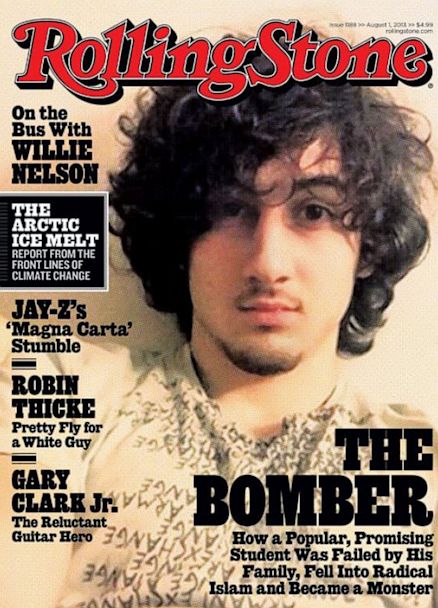
It might be that I'm from nowhere. I'll give you that. But if I am from somewhere, that place is Boston. Still, I'll admit, I'm having a lot of trouble with the furor over the upcoming Rolling Stone cover with Dzhokhar Tsarnaev on the cover. I've read TIME Magazines and Newsweeks (RIP) with Osama Bin Laden featured prominently. Is the issue more because it's a flattering picture and not dirty, bearded Saddam Hussein?
I read the arguments about not validating horrible acts with fame, although they're silly. Famously bad people get famous; you refuse to reward them by making sure they deal with the consequences of their famously bad acts.
I suspect it has more to do with the notion that Rolling Stone will feature a story, not about a cold-blooded killer, but about a confused kid that in way over his head. We're outraged by the sympathy - as if sympathy itself is finite and any sympathy given to "the bad guy" is sympathy taken from his innocent victims. I haven't read the story; I've not even read an account of anyone who's read the story. It may very well make Tsarnaev a victim alongside those people he hurt. I'm not sure what's wrong with that.
Not every victim is innocent. Not every terrorist is evil.
To be sure, there are plenty of innocent victims here. People were killed, maimed, injured, traumatized by the senseless, stupid actions of two disillusioned brothers. That's not up for debate. No matter how righteous our perceived cause or how serious our perceived indignities (and our causes and indignities are always perceived), violence is never the right choice. It just isn't. Ever.
But I'm troubled that our society so quickly condemns anyone willing to explore the depths of a complicated situation. We like simplicity. We like it a lot. But then again, simplicity is not real life (the same can be said for Trayvon and George).
We want to categorize people good and bad, usually so we can distinguish "us" from "them." We like the fantasy that some human beings are downright evil. It keeps us from facing the reality that, as humans, we're all capable, under the right circumstances, of all the evil any of us are capable of.
None of us should be defined by our actions. We can certainly be described by our actions, but that's a far cry from defining us that way. I've known people who grew up with absentee fathers who've really struggled with this distinction. When you've got a Dad incapable of anything good, it's tough to realize that this dispicability isn't genetic. They have to differentiate between the actions of their father (which are bad) and the person of their father (who is dad). The same applies to all our heroes and villains.
The homeless man with the golden voice, who made headlines, reunited with his family, and went on all the feel-good morning talk shows - he relapsed shortly thereafter, then again a few months later. He's got a job and a home and a future, but he's not perfect. He's a man chock full of good and bad; neither define him. They describe him.
Don't get me wrong, description is still important. People who have done a lot of stealing are likely not the best to hire as house-sitters. We must all live with the consequences of our actions. Those are real. I hope the Rolling Stone piece doesn't gloss over the tragedy that brought Tsarnaev to our attention. It would be unconscionable.
But actually exploring the forces in a person's life that lead them to evil (or to good) is interesting and valuable and far too rare in our world today.
It's way better than just guessing, which is how it normally works. We judge people based on gut instinct and any variety of subjective criteria. Howard Dean gets excited during a campaign speech, yells crazily, like Slim Pickins riding the bomb, and his political career is over. Anthony Weiner texts a picture of his junk to a woman who's not his wife and he becomes the next mayor of New York. Capricious.
We want to hate Dzhokhar Tsarnaev. He's done some bad stuff. The consequence of which is that his life ends at 19 years old, whether he's executed or not. Does that make him a tragic figure? I don't know, but I think it's fantastic that someone is trying to find out.

