Showing posts with label future. Show all posts

Thursday, April 07, 2022

A Spirit of Pain and Optimism


I spent the past weekend at Mid-Atlantic District Assembly - the annual gathering of Church of the Nazarene congregations from DC, Delaware, Maryland, the panhandle of WV, and Central PA.  It was our first opportunity to be together in person since 2019.  We were in a new location, with a new schedule, so a lot of the weekend was feeling things out.  I definitely didn't get to have the same kinds or the same number of conversations I've been used to in the past.

Those conversations I did have, though, were really interesting.  COVID has allowed a lot of congregations to break bad habits and engage in loving people creatively and with intention in ways that previous structures didn't allow very well.  I felt a real sense of emphasis and attention on connection - which makes total sense after a prolonged period of being separate.

I know the last two years were a real struggle for a lot of pastors.  There were internal battles over QAnon and mask wearing perpetuated by the continued alignment of fundamentalist evangelicalism and far right politics.  I heard very few of those discussions, though.  While that kind of conversation will not be going away any time soon, the pastors I call peers are really dedicated to the gospel and, as hard as it is, have generally found ways to speak into the encroaching cultures with gospel truth.

The place where that's not happening though, is in how we deal with LGBTQIA+ conversations.  It's an issue becoming increasingly relevant to Nazarene congregations, who have a pastoral necessity to engage in tough conversations about sexuality, chastity, and morality in an atmosphere that encouraged entrenchments on extreme positions with an existential fear that allowing for a consideration of the opposite position equals defeat or betrayal.

As I've explained to my local mainline protestant pastor friends, "The Church of the Nazarene can't even have calm, rational theological conversation about the sinfulness of consuming a drop of alcohol; we're definitely not ready for discussions of human sexuality."

We are, after all, an extremely conservative denomination (80+% of Nazarenes in the US voted for Trump - and many of our other world areas, where the vast majority of members live, are often even more conservative in both theology and politics), that only just recently removed the word "abomination" from our core language about queer folks - a statement that falls distinctly into "Side B" language, despite common practice that won't even allow that much leeway in most contexts.

I heard a number of anecdotal references to the conversation our General Superintendents have with candidates before they're ordained.  I'm hesitant to share them without real confirmation, but it's in line with the institutional shift, so I'll do it for now - but if any recent ordinands or General Superintendents want to disabuse me of this notion, I'll gladly apologize and amend.

I've been told the GS will make clear that ordinands can't drink alcohol and that they must be in line with the current statement on LGBTQIA+ issues.  This is interesting, because it makes a distinction between practice and belief.  They're not asking pastors to agree with the statement on alcohol (which could be much better, as I've discussed before), just to follow it.  They seem to be setting a higher bar when it comes to queer people.

I disagree with the position of the Church of the Nazarene.  I think it should be changed.  I've written about it before and will continue to advocate as we move forward.  I disagree with the position, but I've also committed not to perform a wedding my accrediting denomination doesn't allow me to officiate.  It's essentially the position they seem to be asking of clergy in terms of alcohol - you don't have to like our position, but you need to follow it.

That they're taking a harder line when it comes to LGBTQIA+ issues is completely in line with the institutional conservation model the Church of the Nazarene has been operating in for a while now.  They're doing and advocating for things that best aid the continued function of the denomination, even if they're going to make the far future more difficult.  Yes, its short sighted, but it's also about the only thing they can do without turning the whole thing into chaos.

It's a tough position to be in - just like the position of our Nazarene colleges and universities - stuck between an existential rock and hard place.  Offering grace and engaging publicly in conversations will create tears in the fabric and endanger the continued existence of Nazarene institutions.  That danger is real and scary.  I don't envy the people making those decisions.

At the same time, though, while this feeling of institutional retrenchment pervaded the weekend, I had conversation after conversation where pastors told me to keep pushing, keep asking questions, keep advocating for conversation and consideration.  Even those pastors who agree with the official denominational position understand the real complexities that exist in the practical living out of ideas in congregation and community and want to be free to talk about an issue that's long been a third rail.

From my perspective, it is an existential reality.  The only people I know who'd be comfortable with the human sexuality stance of the Church of the Nazarene are those currently participating in or who've been raised in conservative Christianity.  This group is growing smaller with every passing year.

I don't think we should change our position simply because its less popular.  If you know me, you know I gravitate towards unpopular ideas.  I go out of my way to find and embrace them.  I've changed my mind on the inclusion of LGBTQIA+ folks because of my study of scripture in an attempt to better defend the Nazarene position.

I've been converted by the Holy Spirit through the careful study of scripture.  I've been confirmed in my decision by working with a lot of really great, young pastors in my local congregation.  We've had a succession of queer pastors and pastoral students working in congregations in town.  Most of them have come from Baptist, Wesleyan, and Evangelical contexts where their ministry was not welcome.  They're some of the best example of holiness people I know - fervent in pursuit of the gospel and the Kingdom, willing to serve and learn and love like Jesus.

I still have great hope because the Church of the Nazarene continues to be full of similarly humble and committed servants - clergy and lay, young and old - committed to scriptural holiness and determined to live outrageously counter-cultural gospel lives in the world around them.  I know it's going to be a tricky process moving forward.  I don't know what the outcome will be, but I have great faith the God who has seen us this far will continue to lead and guide if we follow passionately and graciously.

I don't think the future is something to be feared, even if it requires difficult conversations.  Close relationships don't exist without tough and honest conversation.  I hope we continue to make space for them to take place - in our own homes, congregations, and lives, as well as in our communities, districts, and denominations.

Tuesday, May 04, 2021

Some Thoughts on ENC in a Particularly Troubling Week


I went to Eastern Nazarene College.  I really, really enjoyed my time there.  It was the perfect place for me to work out what it meant to be an adult in a supportive, but not overbearing environment.  I know that’s not a universal sentiment and there are lots of good reasons people have problems with whatever college they attend – ENC is definitely far from perfect – but it was a really great place for me.

I would really have liked to be more involved over the years.  I spent a lot of time halfway across the country at Seminary and now live six hours away.  I can’t be there for shows and games.  I can’t use the library or grab a coffee and sit.  I’d love to be a presence on campus and in the lives of students and I have some measure of envy for those who have that opportunity.

I long to be there, because it was the atmosphere, the people, the community that was so valuable to me – and I’d like to be able to give back.  My wife and I have given money, I think every year, for quite a while now.  Not a lot, for sure, but we’ve tried to be faithful in our support.  It’s been 18 years since I spent more than a day or two on campus – outside of those big, old, falling apart buildings, almost nothing is the same – but I do believe the community remains.

As in my time (although I was largely blind to it then), there are people who don’t feel welcome or supported in that community.  That’s truly, really sad.

Recently, it seems, the same tensions over LGBTQ+ issues that are roiling conservative Christians across the US have reared their heads again at ENC.  I won’t share the details, because I really only know them third hand, but whatever they are, they’re representative of dozens and hundreds and thousands of other details over the years, dating back to well before my time.

The fact is, there are lots of faithful queer Christians out there, people who take the Bible and the Kingdom of God as seriously as anyone else.  There are lots of congregations and denominations and traditions that are supportive and nurturing of these Christians and many of those are represented by students at ENC.

When most attendees were Nazarene, it was easy enough to toe the party line.  Even if it wasn’t the healthiest or the best for students, there was some logic to it – let the Nazarenes figure out their own junk – but that’s not reality any longer.  Most students come from non-Nazarene traditions and an increasing number have no problem with the idea that gay people could also be Christians; really, an increasing number have a hard time fathoming why anyone would think differently.

Even within the denomination, those views are changing.  I’m an ordained elder in the Church of the Nazarene and I would sure like us to stop using the gender of our spouses as some litmus test for faith.  That’s not a majority opinion just yet, but I know I speak for a lot of ministers who don’t feel safe expressing a real opinion on the matter, and for an increasing number who feel a moral compulsion to speak out for change.

Fear, though, is the other side of the issue.  The school relies on funding from congregations, many of whom already feel the school is “too liberal” and not accommodating to what they want for their kids.  The sad truth is: if ENC changed its stance towards gay faculty or students tomorrow, the school would close by Fall (if, in fact, there were a viable mechanism for change, which doesn’t really exist).

There is a growing gap between what students want out of a college and what parents and donors want the school to be.  That’s not just true at ENC, but at Christian colleges all over the country.  As generous and as hopeful as those of us who’d like to see change might be able to be, it’s VERY unlikely it would be enough to sustain the school outside of more conservative support.

This is where I feel the most conflicted: On the one hand, if ENC is not willing to step up and lead in difficult conversations about the theological and ethical formation of young people, then maybe it shouldn’t exist.  Advocating for the health and well-being of students in its care is certainly a worthy hill on which ENC could die.

On the other hand, there’s still a lot of great stuff being done in and through ENC.  The top evidence of this is that these movements towards change aren’t coming from outside the community; the very people ENC produces are those speaking and standing up.  The spirit of support and encouragement I so valued as a student must be alive and well, because ENC’s students and alumni continue to reflect it!

There’s always been a tricky balance between fear-based prohibitions and the risk of allowing students to fail in the pursuit of truth.  It’s especially true of sexual ethics in evangelical environments.  Fear usually wins out over hope.  Regardless of your beliefs on any controversial topic, we should all agree that fear reactions are not compatible with Christian life.

If the Spirit of truth guides us into all truth, we shouldn’t be afraid of asking questions.  I learned that growing up in the Church of the Nazarene and it was reinforced at ENC.  As a parent, I know we’re desperate to spare our children harm and pain in that journey towards truth, but as a former child, I’m not sure the harm of that protection was any better than the potential harm that protection avoided.

It’s a risk either way.

LGBTQ+  Christians probably don’t feel welcome in the Church of the Nazarene or at ENC and I don’t blame them for leaving or writing us off, but, for me, as a 5th generation Nazarene, as a straight white male who isn’t actually being harmed by the slow pace of change, sticking around and continuing to push in the right direction seems the only ethical thing to do.  I love both those messed up institutions; they are a part of me, and I cannot and will not abandon them.  I want to work to help make them places of welcome for more and more people (and more kids of people) than they’ve been before.

There are limitations and complexities and financial considerations.  There are legal and political and theological issues that just aren’t going to be resolved overnight.  I’m encouraged by the students and alumni willing to speak up and whatever happens, I’m here in support as we move forward together.

Because of my faith in Jesus Christ, I believe profoundly that wherever we’re going, we’re going there together, or we’re not going at all.  Loving your enemies is kind of what this whole Jesus thing is about.  You can’t browbeat your opponents into submission.  Shame and guilt and anger might work in the short term, but they’re poison down the road.

We may have learned this the hard way in the Church of the Nazarene, but I do think we’ve learned it.  Other denominations are tearing each other apart with anger and recalcitrance and lack of trust.  As much as we disagree, as much as “the other side” might seem backwards and sinful, we have, so far, managed to maintain a belief that we’re all pursuing God in the best way we know how.

ENC needs a little more of that belief at this moment – maybe a lot more – to recognize all the gifts possessed by all members of the community.  I may not be as connected or influential as I’d like to be right now and I may have leaked ignorance and privilege all over these pages, but I can’t remain silent.  We’ve got to do better and we’ve got to do it together, without fear, in the Spirit that leads to truth.

Lets include ALL members of the community and encourage them as they work out their faith in an environment like Eastern Nazarene College!

Tuesday, May 22, 2018

Back in the Groove

You may have noticed (or completely not noticed) a dearth of material on the ol' blog in recent weeks. As you may know, I write for www.d3hoops.com from November to March, which means a pretty lengthy basketball piece once a week, as well as other responsibilities. That, coupled with some other additions to my schedule made writing tough.
I managed to get one post a week out most weeks; it's only been in the last month or two, where things have slowed to a trickle, if at all.

There have been dry spells before and my schedule certainly doesn't lend itself to writing space right now. I tend to like solitude and a good chunk of time, even if I don't use it or even don't plan to use it all. I don't write well if I don't think I'll have enough time to do it.
In all honesty, though, that's probably an excuse. I graduated college 4th in my class and did almost everything at the last minute all four years and was consistently praised for my writing.

I'm guessing the bigger deal is passion. I still have a lot of things to say, but I think the season of my life where they come out in brief (or not so brief) little spurts may be over - at least for now. Typically, when I'd get passionate about something (either positively or negatively) I'd start a post. Sometimes I'd finish it; other times I'd leave it to finish later, but I usually had a wealth of material. In fact, I do still have a few unfinished bits lying around in the queue, waiting for inspiration to strike.

I've been a little less emotional lately, though. I gave up on being outraged at Trump in the fall. I wrote one last sarcastic tweet about how he's the kind of guy who needs to be ignored rather than challenged and I have felt perfectly fine following that advice since. I'll still comment on a issue or a topic here or there (I've been saying all along this meeting with North Korea will never happen and has been a sham since the beginning), but I think I pushed through the wall of expecting anything out of government. I've been saying (and writing here) for a long time that Christians need to be an alternative way of life and not get so caught up in the machinations of empires and elections - perhaps this is just my next evolution of trying to embody that idea.

I read the Jim Comey book last week. It was excellent.
I thought about writing a review* - and may still do it - but that kind of writing just doesn't have the same interest to me in this season of life. I had been trying to keep up the two post a week pace mostly out of pride. I wanted to prove I could do it - stick with something that's so hard for so many others (especially when I don't make any money doing it). In the end, I had to decide that life was a little more important than my ego.

I do still want to write for the discipline. I'm hoping to spend the next few months working on a book proposal - I feel a real calling at this point to explore a longer, more organized collection of my thoughts on theology, Christianity, and life; and I want to make a real effort at it - but I also aim to keep up a once a week blog pace. I think writing a short piece (without much editing) once a week is entirely doable and will accomplish all of my goals without stretching me too thin. I don't know if the tone or tenner will change much - and I'm publicly committing to this at the beginning of a summer where I'll be on the road and away from home for six weeks or more (check out Fastest48 and our website), but I'm going to try.


And, yes, I recognize this both counts as a post and a cop out, since I wrote about posting, but it'll have to do for now - my wife is a stressed out librarian at the end of the school year and she needs my help.


*I still love history and it's amazing how much of recent US history this guy was right in the middle of. The book is entirely without political bent or comment - he does tend to praise Obama and critique Trump, but it's more about how they build relationships and make decisions; it's very much a leadership book. While I suspect Comey glosses over his own faults a little too carefully, it's humble, straightforward, and well-written. The year isn't half over yet, but it's the best book I've read so far.

Tuesday, October 17, 2017

What in the Name of...

I spent the weekend driving up the east coast with my five year old daughter, headed to Homecoming at my alma mater - Eastern Nazarene College. It was an interesting weekend, to be sure. The college officially installed Dan Boone as President - a former professor of mine and also the President of Trevecca Nazarene University - he'll be overseeing a proposed merger between the two schools. It's magnanimous and appreciated, at least by me - Trevecca is growing and in great shape; ENC is in debt and struggling with enrollment.

Still, despite the difficult situation, there was nothing but optimism and good spirit at ENC. I'm excited that people seem to be on board with the uncertain future. Already great progress has been made to stabilize things at ENC and Trevecca has come in with lots of administrative and technical support. The various educational institutions of the Church of the Nazarene have long been duplicating services - it makes sense to have regional schools serving regional constituencies, but there is a lot of overhead that goes into running a college or university and I'm all for exploring how to do it more efficiently and effectively. If this merger goes well, there may be a few other schools eager to get in.

As I said, I heard nothing but optimism and well wishes for the school and Dr. Boone going forward. Perhaps it's a bit easier for me to understand that things are different, because I went to ENC during a time of transition. Half the professors I had in my first two years weren't there when I graduated and by my five-year reunion there were only two members of the faculty with whom I'd studied. Colleges are on pretty tight cycles; students typically stay only four years and things change quickly. But the spirit of ENC and it's mission seem pretty similar to what I know and love, regardless of the specifics. Outside of the financial issues, the student experience at ENC is ten times what it was when I attended; they've continued to make things better for students and that's one of, if not the most, important measure of success.

The one thing that did seem to be leaving people scratching their heads, though, was the recent move to re-brand ENC as simply "Eastern." As a pastor on the region, I got a letter about this move with a lot of sound thinking. "Nazarene" is a relatively unknown term that can be difficult for recruiting. People either know it as vaguely religious and their ignorance is a turn-off, or they know they're not Nazarene and assume ENC isn't for them. There can be debate about the value of the name (even though the education at ENC is thoroughly Nazarene and, I suspect, will be for at least the near future), but I totally get moving away from it in terms of branding. That makes sense to me.

"Eastern" in and of itself is not all that distinctive. Trevecca or Point Loma - other Nazarene schools that have moved this direction - have much more distinctive and individual names to use. I'll admit there's some level of emotional pushback on my part since I've literally spent my life (probably from the age of eight) correcting people who call it "Eastern," since it is most definitely ENC. I could get over that, though. I don't think I'd have too difficult a time hopping on board for the good of my school simply because they made a decision I didn't agree with (the new mascot comes to mind).

There's another issue, though, more directly related to the health and well-being of the school that's really given me pause. I hesitate to write all this publicly without having talked directly to Dr. Boone - I did see him twice this weekend, but he was busy and it didn't seem the right time - but I do also suspect he's heard this a time or two from other people. It was the most frequent topic of conversation I had at Homecoming and - oddly enough - I rarely brought it up myself.

You see, the reason I spent most of my life correcting people who call ENC "Eastern" (which is how most of the Nazarene world refers to the school) is because there's an Eastern University just outside of Philadelphia. It's also a small, Christian, liberal arts college with a very similar profile to ENC. If you're a Christian kid looking for a Christian school in the Northeast, you're bound to consider both of them. In fact, if you go to eastern.edu, you'll be at their website - something tomorrow's students might do by mistake for ten or twenty minutes before they realize this isn't the school they heard about in a commercial.

I live in the shadow of Eastern University - even with "Nazarene" in the name, the first part of my conversation with any kids who might be potential ENC students is usually to differentiate it from the local "Eastern" they know. I'd love to be wrong about this re-branding, but even if I am, I still don't know that I could ever call it "Eastern" simply for that reason - people in my area already have a small Christian college called "Eastern" in their minds and it's not the one I want them to attend.

You also have Eastern Connecticut State University - a much larger public school in Willimantic, CT. They've branded themselves "Eastern" for a very long time - in fact the "Connecticut State University" was so small on the billboard I almost couldn't read it as I drove by on Sunday. For kids in the New England area who aren't particularly looking for a faith-based component to their college experience, ECSU is a pretty major rival to ENC for enrollment.

I know Dr. Boone well enough to know he's not just some southern guy coming in without any real connection to ENC and making this decision willy-nilly. Although that was the general consensus from the alums I spoke with this week. They're happy to have him and Trevecca's generous support to pull ENC out of the water - so much that this name thing seems like a small price to pay (and maybe it is), but it's difficult to swallow.

If it were just about a name, I'd advocate swallowing it. Names are just names - the spirit will live on - but it seems awfully short sighted for a school already struggling with enrollment to brand itself in a way that could be confused with not one, but two rivals for various constituencies its trying to recruit. I know Dr. Boone expressed frustration at falling short of enrollment goals this year - I share that sorrow - but I'm not sure this particular move is helping any.

The easy call might be to just brand the place as "ENC" - stop saying the name in its entirety. "ENC" can be the passionate, innovative, Christian college option for New England just fine without a focus on what those letter stand for. I mean, it's likely very few of the current students at ENC even know that KFC stands for - it's a bit trite, but there's a business that found parts of its name problematic for sales and went in a different direction. They seem to be doing ok. ENC is what we call it. It's what people know - not to mention it is distinctive and a great way to solve the branding problems while also investing in the history of the school.

Listen, I'm going to be supportive either way. Dr. Boone asked people to give - give more and give more often - this year and we've done it. We'll continue to do it because we believe in the importance of Christian higher education and my experience at ENC, but I'd also like to give ENC the best chance to still exist in the future and while I see how the re-branding will be part of it, I just fail to see how "Eastern" will do anything but hurt.

I got so frustrated by the logic Friday morning, in yet another discussion, that I said, "I wish they'd just start calling it Trevecca already - it would be better than Eastern." Then it hit me - maybe this is all an elaborate ploy. Perhaps we're being asked to call ENC "Eastern" against all logic and common sense (not to mention tradition) so that, in a few years, when it's known as Trevecca East or TNU-Boston or whatever the merged campus will be, we won't feel so bad about losing our name since whatever it turns out to be will be an improvement on "Eastern."

(For the record, I'm not opposed to any of those names or changing to them now - it's the campus and the culture I hope to preserve and changing the name won't harm that - we should just pick a better name, one that's distinctive and not already taken - TWICE!)

This isn't the most important thing in the world. It's probably peripheral to all the other things that have to go on at ENC. But it's not unimportant and while there's been plenty of persuasive communication about why re-branding makes sense, there's been very little communication about why re-branding to a name that can only be confusing to almost everyone is the right choice. It would be good to know why "Eastern" as opposed to "ENC" or even "Trevecca" or some new name that's been focused-grouped like crazy - any of those seems a better choice.

Tuesday, July 11, 2017

Principles and Guidelines

A few weeks back, I wrote a little about the moralism with which my generation of Nazarenes grew up. It was a very specific way of life that focused largely on rules. We had a right and wrong for just about everything - and while there may have been grey areas, we tended to just avoid them as bad so as not to fool around with where the line might be.

It's been reflected in the way we view our constitutional document: the Manual. In fact, for a long time, the various sections of the Manual were labeled "rules." What we now know as the Covenant of Christian Conduct was the "Special Rules," specifically because it was a list of dos and don'ts. We got to be very good about our Manual legalism. As Wesleyans, we might've been a little less legalistic about the Bible, but the Manual was another story. I hear tales, these days, about families where the rules weren't followed to the letter - but you never heard about those families at the time (if they really existed), because rules were awfully important.

This past month, at General Assembly, was really the first time I saw any public acknowledgement that life is a little messy. Our delegates were willing to admit, from the floor, pastors even, that accepting into membership, even leadership, people who occasionally drink alcohol, is a pretty common practice. That's light years ahead of anything I would've expected, but it was truly refreshing.

I'm not saying that the most recent US Presidential election had anything to do with this (because I'm loathe to equate anything positive with that shit show), but I wonder if, give the realities of that last post I mentioned, we might now be a little more comfortable looking around the curtain of moralism at the pompous wizard running the show?

This new generation (mine, but really the one immediately behind me) seems unwilling entirely to play the old games. We're much more comfortable with both ambiguity and grace. We see the Manual as more of a guidebook than a rule book and it's throwing a bit of a wrench into things. This General Assembly had us asking, "Why not set strong standards and then hold to them with grace, rather than legalism?" Which might've been a slap in the face to old Phineas Bresee.

We'll get into an argument about that, too, because it seems to me each generation sees themselves in the old man - he possessed enough legalism, grace, social justice fire, and prohibitionist dominionism for everyone to have a piece. That's become our go-to perspective on the Church of the Nazarene as well; each generation makes the denomination into the entity most appropriate for itself. One generation, those spry, pesky Baby Boomers, held onto the reins of power for an awful long time, but that time does appear to be ending and what comes next is totally up in the air.

There's a generation in between that's going to have an unfairly small window out of which to operate - and they might want to have their say, but times are most definitely changing. Things will certainly get more complicated, but probably a little bit healthier, too. Of course, health in one area often leads to the exposure of dysfunction in another - some area our kids will grind against and reject when their time comes.

Regardless, the moment of change may have arrived. It came quickly and almost without warning, but the movement from rules and structure to guidelines and grace is inevitable, especially given the way my generation looks at and interacts with the world. Because of my experience, I have a real hard time calling the next phase "good" or "better," but it's certainly refreshing. The age of moralism might finally be dead in the Church of the Nazarene.

And that is undoubtedly a good thing, no matter how it came about, or what might be yet to come.

Tuesday, May 09, 2017

Should I Stay or Should I Go?

As a pastor in the Church of the Nazarene (and maybe other people are on this list, too; I don't know), we get semi-regular emails from the Board of General Superintendents, the six ministers who lead the denomination. They trade off writing little articles of interest that are, most of the time, of little interest. Still, it's a good way to keep communication with people who literally need to be in 200 places at once.

Last week sometime, there was an email from David Busic, one of our General Superintendents I knew and interacted with before his election to the office. I appreciated what he had to say and I agree with much of it. I think congregations would do well to discover what leads young people to leave regular participation with a congregation or faith altogether upon reaching adulthood; it's an important issue of which to be aware.

I'm not sure, though, that discovering and replicating the reasons young people continue with congregational involvement is the right approach. In fact, I suspect this is precisely what we've been doing all along. I tend to think that the things we do that keep some young people involved are the same things that make it easy for others to leave. I'm not sure its healthy for anyone.

Within pastoral circles, Moral Therapeutic Deism isn't even a buzzword anymore, it's a cliche. It's very much a description of our civil or cultural religion - God wants you to be happy and behave, if you do, you'll go to heaven. It's a faith, as Scott Daniels likes to say, that's like Parmesan on the pasta of life, rather than the meal itself.

This is the faith we have largely passed on to our young people. Not to keep quoting Scott Daniels, but it changed my life when I heard him preach one Sunday, "Our children are desperate for us to give them something worth dying for and we refuse to do it." I think this is the issue with young people leaving congregational life AND those who stay.

We've set up a system of rules, boxes to check to confirm morality and goodness and salvation. If people follow the rules, they get the reward. This segregates faith from a lot of areas of life that aren't specifically covered in the rules; sometimes it lets those outside influences create the rules. But the bottom line is the rules: this is how you're supposed to live and if you do, you're in God's good graces.

Many of the young people who move seemlessly from adolescence to adulthood in congregational life are doing so because the rules work for them. Those who leave often do so because they have questions about the rules or the lack of depth and meaning contained therein; sometimes, those young people study the scriptures and question why some of the rules even exist at all, given those things we claim to believe.

I'm not saying every person who stays or goes does so because of this, but it's a significant influence and simply packaging the rules more attractively or selling them better is not actually going to address the problem. In the end, Christianity is essentially counter-cultural, even if that culture is one that labels everything "Christian." The notion of "fitting in" or "following the rules" works against the personal formation to which Christ calls each of us to undertake - even if those are "good" rules.

The best thing you can do to encourage all your people, young or old, to participate in the ongoing body of Christ, is to be comfortable with challenge and questions and uncertainty and doubt. People leave because they don't feel welcome, because they don't "fit in." The gospel of Christ calls us to welcome all, to not have any standard but love. The bar for entry in the Church of Jesus Christ is inconceivably low.

I know that makes running an institution difficult, which in turn makes our General Superintendents lives difficult (you know, since they run an institution), but maybe each of us needs to hear that perhaps the ongoing functioning of our religious institutions shouldn't be the goal. I'm not saying we should work against it, but perhaps the best way to keep these religious organizations working in sustaining and healthy ways is to be a little less worried about their sustained success and a little more focused on embodying the counter-cultural love modeled for us by Christ.

Thursday, November 10, 2016

A Way Forward?

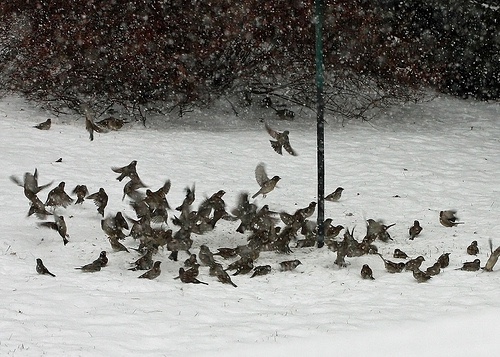
Paul Harvey told a Christmas story once on his radio program. My father uses it quite often in his Christmas Eve services; I've read it for him at least once. It's called "The Man and the Birds." The basic gist of the story is that a man stays home from Christmas Eve service because he just can't bring himself to believe in the incarnation - that God actually became human. While at home, a storm kicks up and he notices a flock of birds lost and weary in his front yard. The man has compassion on them and tries mightily to shoo them into the warm barn. Exasperated, the man wishes he could become a bird to lead the flock to safety - and the realization ignites within him this spark of faith.

I've been thinking about that story this morning, because I resonate with the desperation of the man. I'm not sure how to say this without coming off holier than thou (anyone who's read my twitter feed in the last 24 hours knows that's certainly not true), but part of claiming the title "evangelical" means one cares an awful lot about proclaimed truth. Instead of trying to herd a flock of birds into a barn, picture a man trying to guide trapped birds out of the barn to safety and freedom.

I believe with all my heart that the Kingdom of God is bigger, bolder, freer, more beautiful, and more expansive than any candidate, country, or campaign. I believe the good news of Jesus is that we don't have to get caught up in the machinations of power, choosing between flawed rulers and making due the best we can. When we're caught in this system is feels like birds bouncing back and forth between the walls of a barn they think encompasses the whole world, but is really a cage. Whatever floundering I do, waving my proverbial hands with exasperated one-liners, sub-par attempts at critique and satire, or wildly irresponsible mock presidential campaigns, is a desperate attempt to get the attention of my people who seem lost and unaware of it.

I know it makes me extreme and radical, but I do truly believe we shouldn't vote - not as Christians and at least not for President. As much as we try to hem and hedge and make excuses (and I'm just as guilty as anyone, see aforementioned twitter feed) our participation in that system is idolatry. It is a statement that the Kingdom of God is not enough for us, we must also have the kingdoms of this world.

When Dietrich Bonheoffer joined the plot to kill Adolf Hitler, he wrote, essentially, that he believed his actions were sinful and that they might earn him an eternity in hell, yet he willingly committed them anyway because he could stomach no other option. I try to take this perspective to heart when dealing with difficult issues (especially the taking of life), recognizing that we do not always possess the "right" solution in every instance. Similarly I recognize my tendency to do nothing over an imperfect something has not and does not always prove beneficial to me, my faith, or those around me.

At the same time, it feels as though Bonhoeffer's position is the only one that makes sense for Christian voters. If you're there, I might disagree, but I can understand. I just think we shouldn't be voting if we can, at all, help ourselves. There's nothing good in our preoccupation with power. It's dirty and messy and wreaks of lack of faith. We can't play pretend, saying we believe in a Kingdom ushered in by the life, death, and resurrection of Jesus Christ, then invest ourselves and our future in kingdoms that operate on an entirely different foundation.

I've written this before, but I know it gets trickier on a local level - since we have to get along with our neighbors. If there weren't a town council, we'd have to invent one, right? Or maybe we really could just live sacrificially for the good of the other? Maybe I'm just as trapped in the barn as everyone else, none of us really believing the door exists, or, if we do, not really believing we can ever find it.

I don't mean not voting for one person or another, but exempting ourselves from the conversation of us vs them (or even them vs them, with some obligation to choose sides). There is just us. As much as we'd like to say we can be loyal to our first allegiance and also take sides as Republicans or Democrats, we're fooling ourselves. Those identities in some way hinder us from being who we were created to be. The same is true for our identities as American or Arabian, Ugandan or Dutch. They seem convenient, but they just get in the way. Paul said neither Jew nor Greek, slave nor free, male nor female (boy, is it hard to let go of that one!), and I'm even starting to wonder if even our identity as "Christians" gets in the way of our identity in Christ.

I don't think I've handled myself well in this flailing attempt to point our attention towards the door. I sure hope I've not come off as demonizing "them" who might think differently than me. My genuine desire is to caution "us" about the dangers we have embarked upon - and they are quite likely the exact same dangers we'd've encountered if 80% of us had voted the other direction.

I think it's an emotional over-reaction to say last night's vote was similar to the ancient Church's embrace of Constantine, but that's how it feels. In the US, people who most overtly name themselves the people of God have sided with amoral people in an amoral system we are desperate to sanctify. No, I don't think the other outcome would have produced a different result. Hence my reluctant call to give up voting.

I recognize the great sacrifices that have been paid to secure voting rights for people - and I admonish us to continue that work. Every person deserves the right to voice their opinion through the ballot box, but, as people following in the wake of Christ Jesus, I suggest we give up those rights in favor of living out an alternative.

That same Bonhoeffer proposed the idea of religionless Christianity, but died before he could flesh out his vision. I believe the most promising path forward, for the Church and for the world, is to explore together what that means: namely a life free of dogma and power and being "right;" a life of love in imitation of Christ, trying, as hard as the Holy Spirit will empower us, to avoid sacrificing our vision of the Kingdom to the kingdoms of the world.

I can't say I've done this well in recent days. Certainly many of you have felt less than loved. I don't know what to say. I'm sorry. I'll try to be better. But I have to keep trying. Somehow, we've got to get out of the barn.

Tuesday, November 08, 2016

There Are More Important Things

This is a very unique election day - mostly because I'm running for President. I am on the ballot in Colorado and available as a write-in candidate in a dozen or so other states. I did this partly as a joke (outlined here), but largely because we take this whole process way too seriously and I thought this "campaign" might highlight that. I made silly videos and t-shirts and I'm really getting votes in more than a handful of states.

More than that, though, I seem to be a safe place for people who don't want to vote for a candidate they dislike, people who don't want to hold their nose and vote just to vote. I enjoy providing that option, but there's a larger message, too. People feel really obligated to vote. We've got people out there encouraging others to vote with words like "its the most important thing you can do today," or "its the responsible thing to do," or even "it's your civic duty." I get those are all in line with the public narrative of an election, but I don't think they're true.

The most important thing you can do today is love your neighbor, or, even better, love your enemy. The way we treat the people we interact with everyday has far more importance and a longer-lasting impact than any vote we could ever cast. Our government was specifically set up for the President to have as little real power as possible. Even in this day and age where the executive branch has more power than ever before, it's not much. Yes, a President can make life a little easier or a little more difficult for people - and voting for one or the other certainly makes sense.

Please, don't take it so seriously. I mean it. This is not the end of the world. In fact, the end of the world may only come when people put their faith in countries and governments to mediate our daily lives. The big lie of history is that power equals security; we are safe when we're in charge. It sure sounds and feels that way when you're scared, but the drive for power just leads to paranoia and the fear you don't have enough.

We live in a world with plenty. Everyone is valuable and there is enough to go around. I've dedicated my life to living into this truth and acting in ways that communicate it to other people. Fear and power and coercion are no way to live. There is always another option. Always. That's why I've tried to create on on the ballot, and I hope to always be a voice for another way in life and in my relationships with friends and neighbors.

Our culture drives us to imbue everything with as much meaning as possible. It's only true if you're trying to win ratings. The most important choices you make are usually the most ordinary. Do you let that guy merge in traffic? Do you bake cookies for the noisy neighbors rather than calling the cops? Do you spend an extra half hour in the midst of a busy day reading to a child or talking to your spouse?

Nothing that happens at the ballot box or in Washington DC could ever rival any of those choices. Even if your worst electoral fears are realized, those everyday decisions will still be more important.

I'm not saying "don't vote." People worked long and hard, sacrificed and sometimes died to provide the privilege. Most people in the world get no say in how their country works. We should use that opportunity as much as it seems valuable to us. But we shouldn't feel obligated. I left more than half the lines on my ballot blank today; there just weren't candidates I was comfortable voting for and there are more important things in this world.

I'm headed to Election Day Communion tonight at 6:30, where we'll gather around the table of God, a place where equality and abundance are joyfully proclaimed for all people, and I'll be reminded, both with words and actions, that there are indeed far more important things in the world.

No one will care about this election in 100 years (do you even know what party James Garfield represented?), what will matter is the kind of community we fostered with our lives and our love. I don't want elections and governments and nations to define that world. I believe there are much more important things.

Thursday, September 15, 2016

Wholly Other?

Trigger Warning: Theology talk! I'm going to try and bring it around to something practical, but no guarantees.

In a recent series of blog posts, Theologian and Philosopher Tom Oord discussed a book by Keith Ward and specifically his contention that the "social Trinity" is a bad idea. I have not read Ward's book, only Oord's take on it.

I won't comment on the book or Oord's argument - you can read all that for yourself, but I do appreciate his willingness to re-examine theological ideas that were developed in a more concrete, Greek-influenced time. I believe sometimes Oord tries to do this in ways that continue the more logical nature of theology that I'd like to critique, but, then again, he is a Philosopher, so it might be expected.

Regardless, this post came to mind as I found myself thinking about the phrase "God is wholly other," in some reading this week. It's a very common phrase, especially in theological circles, so common it's easy to brush over without giving it much thought. For some reason I thought about it this morning. Specifically, I thought about why I don't like it very much.

As Oord and, presumably, Ward, are challenging the notion of "social Trinity," they're not really challenging it. Neither man, I believe, fundamentally disagrees with the principles this theory is trying to maintain, what they do disagree with are the implications of expressing a particular combination of core beliefs in this way. There's no challenge to the idea of the Father, Son, and Holy Spirit being divine, but simply pointing out that this particular way of explaining how that works presents some extra-biblical problems as its worked into the larger corpus of theology.

I kind of feel the same way about God being "wholly other." This is a pretty basic tenet of systematic theology that speaks to the substantive difference between creator and creation. They are different in as many ways as two beings can be different. I'm not entirely sure, though, if we can't also say those two entirely different beings aren't also the same in some ways - or at least similar. Perhaps the notion of God as wholly other needs, if not theological, certainly grammatical reconsideration.

The very notion that humans are created in the likeness of God leaves some pause for how we understand "wholly other." I get that we're trying to prevent the assumption that God is some sort of perfected human (and thus nip in the bud the notion that humans can stumble upon salvation without divine help). But as a good Wesleyan (often called semi-Pelagian by my more reformed brethren), I can't discount the ways in which God has chosen to involve creation in the ongoing story of existence.

The whole of scripture, tradition, and experience testifies to a partnership between God and God's creation in the unfolding of reality. god has and does enable creation to participate in its own salvation. It sort of makes Pelagianism obsolete in that creation cannot do anything on its own since God has already been inextricably involved in the core processes that lead us to recognize the need for salvation.

I get that we want to emphasize a difference between God and humans so as to prevent us from getting grandiose ideas about our own abilities, but by engaging in incarnation, God blurs some of those lines beyond true definition. God became a human being; the creator became the created, and no matter how we want to define orthodoxy, that statement seems vitally important to Christian thought, even among those groups excluded by Nicaea. It seems difficult to claim God as wholly other when God specifically chose to become like us. Wholly other creates a distance between God and humanity that God personally bridged.

It shouldn't be that hard for us to say God is God and we are not, without creating these substantive categories that separate creation from Creator in sorely unbiblical ways.

The other element of this, though, is the understanding of purity. Holy means set apart - this is where "wholly other" comes from. A holy thing is consecrated for a divine purpose and must avoid co-mingling with the common to preserve its holiness and, in some sense, maintain universal order. This lead to the strict rules about contamination that existed throughout the Hebrew world. This notion protects us from a kind of casualness in relationship to God that leads to, say, modern "Christian" music that sounds more like love songs to Jesus and the immortal Buddy Christ.

That's an important, worthy goal, but it also needs to be kept in check by the witness of God in Christ - the one who moved through the crowd and instead of being corrupted by the touch of an unclean woman, reversed the process and restored her health and inclusion. This is certainly a God unlike anything we've seen in creation, but this God appears more concerned with removing the notion of "wholly other" and bringing reconciliation. The same Christ who prayed that his followers would be one as Son and Father are one.

I understand that in the end we're saying that there still remains a distance between creation as it is and creation as its intended to be. The great apocalyptic of scripture foretells a future uniting of God's realm with humanity's and an eternal joining of the created with creation. If this picture of reconciliation is both our foundation and our future, we must be more creative in the ways in which we talk about God and human.

Wholly other is wholly inadequate for a God of such great love and grace.

Tuesday, January 12, 2016

Wheaton College, the Nazarenes, and the New Reformation

I'm generally a realist about most things. I try not to get too caught up in idealism, because we live in a real world where ideals rarely play themselves out cleanly. At the same time, I try to recognize that ideals are important and do my best to live up to them. I try to give ideals the benefit of the doubt as much as possible. I'm loyal.

Despite all that, I may have reached a tipping point with this whole Wheaton College thing.* It's not so much the theology of the matter, although that bugs me, but because the theology seems to be more an excuse for institutional preservation than it is a legitimate theological argument.

We've seen this all over the place within evangelicalism in recent years - calls for theological purity that are far more about power and control than they are about genuine intellectual and theological inquiry. Beyond even theology, my own denomination, The Church of the Nazarene, has seen incident after incident where institutional cohesion, control, and continuity have trumped the basic tenets we claim to believe. It's undermined the authority of the institution and caused the exact divisive harm it was intended to prevent.

I've tried to be a big believer in the ideal of Christian community - that despite our messed up tendencies we can and should be together. I'm not rejecting that notion, either practically or theologically, but I feel like I've now abandoned the notion that our historic or traditional institutions have any real place in the future of Christianity.

The institutional church in America - at least the evangelical variety - is eating itself alive.** At the same time, I'm pretty certain any group of people must, in some measure, be institutionalized to remain cohesive in any way - not that it has to be done, but that it will inevitably happen. There will always be institutions when people try to live together - from communes to corporations, overt or unintentional, we all institutionalize, even the most radical revolutionaries. We're going to have (and need) institutions, but I'm no longer convinced those institutions we have are capable of being the institutions we need moving forward.

More and more I'm realizing that perhaps talk of a "new reformation" is not so far fetched.

You have the argument from history. As (the late, great) Phylis Tickle so eloquently laid out, every 500 years or so there are massive changes in both the form and institutionalization of Christianity. We went from a movement of loosely connected local cells, to an empire-influencing centralized body, to an almost brazenly political force, to a relatively disconnected conglomeration of competing denominations. None of these system looked much at all like the last. For years people have been foretelling a similar change (it is about time, after all) - I've resisted those calls, but my resistance is waning.

On a small scale, I can see in my own denomination the real dysfunction and purposeless that continues to radiate from the center. At the same time I witness a real vibrancy of mission by those on periphery.*** There is a hunger for living out the Christian life in creative, faithful ways among people that just can't be supported by the old structures of the institution. The two forces seem increasingly divergent - one pushing to fit new developments into an old structure and one marching forward with intention, ready to build whatever structure makes sense as we go along.

Our idealism as Christians tells us we should be able to reconcile these forces. I'm just not sure that's really possible anymore, especially as sustaining the institution becomes more and more important to those in charge. I get the tension there - being in charge specifically means care for the institution, but what I'm beginning to realize is that perhaps, in this rare and unique instance, caring for the institution might just mean tearing it down and working to rebuild something different.

I have a lot of fear in that statement. There's a lot of grief and sorrow. I imagine it's similar to the sorrow of Martin Luther, who saw much of his beloved catholic church deconstructed by the movement he started - not that he regretted speaking out and sparking a reformation, but that he felt genuine grief over the loss of something beloved and familiar. It's a difficult position to be in; I don't envy any institutional leader.

At the same time, those leaders must be willing to make difficult decisions, even if they're unpopular within the institution itself. That is sort of the point of leadership, right? To recognize when context is changing and lead people to change with it. Mission and ministry in the coming years will not be served by the structures and systems of the past. This isn't just a generational shift, I'm starting to think it's something bigger.

At the end of the last reformation, the catholic church was broken - broken to such an extent it's taken 500 years to begin to recover its footing. The idealist in me celebrates the re-emergence of catholic leadership in the world because it speaks of the real perseverance of the saints. Even if missteps are taken in dealing with a new reality, there is hope for the future. It's what keeps me optimistic about the old systems and structures I love, but often bristle against. The core goodness within them is real, even if it's not expressed in appropriate ways for a changing context.

Evangelicalism is facing a whole host of pressures from various forces and perspectives. It's not really about one thing. It's not just about theology, but also the place of religion in society. It's not just biblical interpretation, but how human society itself is evolving over time. It's not just about what science means for core beliefs, but how those new realities impact the way our very institutions are ordered and designed. It's not an easy picture.

I guess, in the end, I'd call on all of us - those who cling to institutions for security and safety and those who push boundaries almost by nature, and even those in the middle, like me, who see the real value of both - to maintain a vision of Christ. We do claim to be Christians after all, and even if we can't agree on theology or practice or organization, perhaps we can agree on the need for continued communication, charitable discourse amongst ourselves as we move forward with whatever comes next.

I really struggle with some of these incidents, like the one at Wheaton, the one before it at Northwest Nazarene, and many others - not because they're emblematic of some larger issue, but because they're precisely the opposite - they're distractions from more important conversations. They're side-skirmishes in a larger struggle to engage the changing global context with the grace and peace and love of Jesus Christ.

I'm loyal, probably to a fault. I love my denomination and my evangelical identity - even when evidence suggests I resemble those things less and less every day. I don't want to see us descend into the literally wars of religion that marked the adjustment period following the last reformation, I'd like to see us moving forward together, even as we're a bit wary of each other and what lies ahead.

So I guess we could say, there's still a little bit of idealism left in me, and I hope, with good reason.


*If you want further information about this issue, you can see both the professor's statement and the statement from Wheaton.

**The mainline version has pretty much marginalized itself over the past 60 years in a different, but no less effective way.

***I wrote a little bit about how that functions psychologically in a post a few weeks back.

Thursday, October 22, 2015

What Sort of Gift is the Present?

So there's this old corny saying you might have heard, "Yesterday is history, tomorrow is a mystery, today is a gift of God, which is why we call it the present." I've seen it attributed to both Bil Keane (who writes/wrote? the Family Circus cartoon) and Joan Rivers (so there you go). It was unbearably cheesy even when I was seven years old. I love a good homonym, but that's not exactly "good." I've honestly not given it a second thought since first hearing it, but it sprung to mind from the ether recently as I was reflecting on the present.

So much of religion seems to be caught up in the future (or maybe the past - here's lookin' at you, Ken Ham*) - people seem drawn to religious experience as a means of escape. Life is hard or inscrutable and spending time focused on something else, something different, something better, makes the less-than-bearable slightly less less-than-bearable. I suspect this is precisely what Karl Marx was talking about when he appropriated a phrase from the Marquis de Sade and called religion "the opium of the people."

I'm not sure Marx was meaning this as derogatorily as he's gotten credit for (certainly not as much as the German Romantic Novalis, who used basically the same phrase 50 years earlier), but it is an apt description. Religion has, in large part, numbed people to the world around them and greatly reduced the value we place on the here and now.

I listened to part of an interview with the musician Derek Webb a few weeks back. He comes from a pretty staunch Calvinist theological background, but he said something I hadn't quite put together from that perspective (at least seriously), although it's pretty simple. He said (and I'm paraphrasing, even though I'm using quotes), "If God has the end already determined. If we're already destined to be saved or not, then why not doubt? Why not ask questions and seek answers and try to figure things out?" I realized as much as I often take issue with the Calvinist position on things - at least here, we might have wound up in the same spot.

I'm a Wesleyan, with a real emphasis on free will - so much so I tend to fall into the camp that says the future isn't knowable at all. I believe and affirm God is capable of handling any eventuality and will bring everything to its intended redemption, but I happily believe the details are still to be determined. It never occurred to me, that despite the very real problems some Calvinists have with how I believe (and vice versa), we both really do affirm the sovereignty and justice of God as deeply as possible.

I'm real fond of saying, "God's got the ends worked out," and I really believe it. I believe the love of God will, in the end, conquer all - not because free will is a facade, but because eternity is a long time, but it's not long enough to outlast God's love.

What that means, though, is that we have to pay an awful lot of attention to the present. It's really all we've got. I suppose if what I said in the previous paragraph is true, I can just sit around doing nothing and eventually it'll all make sense, but, like Derek Webb, I want to ask the questions, mostly because I'd rather not take an eternity to figure out how to live in eternity. If the Kingdom of God is already here, if the way eternity works is already how the world works (even if that's not always apparent), I want to get to livin' that way now.

All of this is really prologue to the one simple thought that arose this week: maybe it's that desire to get things right that's really the problem.

Hear me out. If the end is not the goal, we're only left with the means. That's what I mean by focusing on the present. The end result of our lives is not the point, the way we get to the end is what matters. But once we adopt that philosophy, we've sort of created another end. Now it's not about getting to heaven when we die, it's about getting the next decision right - doing the right thing in the next moment. And that's still an end.

I've always been very envious of people who are comfortable with themselves. You know, those people who don't apologize for who they are? They might come back and make things right with you if they stick their foot in their mouth, but they're not going to apologize for speaking freely. These people own who they are, faults and all. That's really what it is - not that anyone is proud of their faults, just that they've accepted their imperfect people.

I am NOT like this. I'm constantly upset that I'm not more perfect. I want to give my Nazarene upbringing a pass on this, but I'm not sure that's fair. I think our theology is a bit more nuanced than the popular perception of "perfection" we started out with, but the culture and climate sure isn't forgiving. I had this notion of "always be better" drilled into me from birth (mostly without anyone ever saying those words - sometimes even saying the opposite). It's really stuck with me.

I am constantly measuring the me I am against the me I'd like to be. That makes sense, you know, if you're a clock, say, and who you are and what you do are completely linked. It doesn't work as well for a person. My reactions are my reactions. They are me. Now I can catch myself and evaluate those reaction and perhaps head them off, amending my actions to better reflect the person I want to be, but that doesn't change the person I am. I'm still focused on the ends rather than the means. I'm not being present-minded.

I do believe in transformation and I believe in planning for it. I'm fully supportive of instantaneous, miraculous transformation through the power of the Holy Spirit. I've seen and experienced enough to know that sometimes what changes a person really does come from outside themselves. Yet I also know that we can work to be different - not in the way I described above, simply assessing the output and altering it to fit the image we want to project. I believe we can alter who we are, over time, given dedication and love.

That's the rub. That's where the present doesn't feel so much like a gift. Because in each moment, we need to love ourselves.

I recognize how flighty that sounds (my wife might say "hippy-dippy"), but I think it's really true. People who are comfortable with themselves may still have a lot of problems (don't we all), but they've conquered one hurdle that constantly trips so many of us up: they don't let their own actions determine their self worth. They love themselves.

That's not something you can pretend or fake (at least not for very long) - and I'm not even sure exactly how to do it (sorry), but it seems vitally important to everything else in life. Maybe that's what takes an eternity for some people - just being able to look in the mirror and be ok with what they see?

After all, what we do in the present doesn't really affect the future - not the real future anyway. If Calvinists and Wesleyans agree, God's got the end figured out, the only thing our present can really affect is the next minute or month or year - which are really nothing in comparison to all of time.

Now, for the mea culpa: I've said all this and to this I give strong intellectual assent. The present should really be a gift. But I'll freely admit, I don't have this internalized well enough to live it out. I spend far too much time thinking about how my present affects my future and it keeps me from doing in the moment what I need to do to get things right. I have real difficulty being me and loving me, because I'm not really sure they're good enough for the future I want.

I have no answer here. No good news and happy ending - other than to affirm the ending is happy and we can start enjoying it now if we can just be ourselves in the present.


*Who I won't dignify with a link.

Thursday, July 09, 2015

Evolution and Sin (Part III)

In the buildup from Part I and Part II, we've sort of covered the introductory stuff to get to a place where it feels ok to explain what I've been really excited about - not so much because the idea itself is exciting, but more because it seems to explain things in a way that is a little more cohesive with scripture, the world around us, and the way postmodern theology is trending.

I was talking about some of the things I've covered so far in a Theology of Creation class I took a few years back and the professor (whom you can likely figure out, but will remain nameless here just in case he doesn't want to be associated with this crazy, crackpot idea) mentioned an old Rabbinic teaching about two forces at work in the world - not a "good vs evil" kind of thing, but two contrary, amoral forces underlying reality. (I wrote a paper for that course exploring the biblical and historical basis for this idea, which is long and pretty dense, but gives more detail.)

Ultimately, I decided the biblical basis for the notion was tenuous at best (and that's being generous), but the fact that people have been toying with this notion for thousands of years really sparked my imagination. It struck me how well this notion of two forces fit into the way I had already conceptualized sin and creation; it also made great room for evolution in the process.

Selfishness isn't good or bad - it's one of those amoral forces I mentioned above. Selfishness is what keeps a baby alive - if it didn't cry for food and attention, it would die. There's a sense that our self-preservation is essential to our survival. Now, obviously, selfishness can be really terrible and lead us to do terrible things, but the notion to self-preservation can't be condemned on its own. This is essentially what evolution is - an individual trying to survive and pass some part of itself on to the next generation. That's natural selection; it's survival of the fittest. You can even extend it back to the big bang. Even when the elements of the universe weren't sentient or alive, they were living in a process of continuing.

What if that was how God created? Just spoke existence into existence with the knowledge that things would continue to develop. God wouldn't have to plan out what specific things would evolve and arise, but putting the universe on a trajectory of self-preservation necessarily determined where things would end up. Eventually some specifies would arise capable of understanding this selfish force at work in the world, evaluating it, and potentially acting contrary to the very forces that provided for its creation.

I'm not sure God planned on relatively hairless, bipedal primates as that species (we could have been purple, globulous things with beaks for all it mattered), but we would have the ability to understand our natural inclinations and choose against them. That was the important part. From there God could enter into our existence in a relational way - choosing a specific tribe, for example, to pass on specific guidance for life - but even more broadly than that, the very reality that humans can think outside instinct and drive makes the God who inhabits all reality not only a possibility, but a force in the world we are aware of. The very nature of who we are as humans means we have some understanding of God - it's why we can see core elements of a very similar belief underlying the metaphysical understanding of every culture and religion. There's something deep within us as humans who understand at least the reality of God. The creative force of the universe - this amoral self-regard - demands it.

Now this force, on its own, it utter destruction, right? It's what leads a society to kill of its disabled members, it's troublesome. Those things make sense evolutionarily, but we naturally react against them because we also have within us this force of selfless love. This is the presence and action of God in the world. God is love. This force of selfless love works in tandem with the force of self-preservation, where they can temper each other and keep us moving forward towards God's end.

The way I'd describe the reality of this is simply that from the moment of creation, that self-preservation force "took the lead" (for lack of a better term). This force was the driving force that brought us to existence and drove the world to where it needed to be for God's big turn. That turn comes in the life, death, and resurrection of Jesus Christ. Creation has reached a point (in the fullness of time, as the gospels put it) where God could physically enter into the picture. We always talk about the cross meaning something - that it effects not just spiritual change, but real, permanent, physical change in the world. Theologically we might say Jesus was the "inauguration of the kingdom" or the point in which we start to experience heaven.

In this particular narrative we say this is where self-preservation takes a back seat to the selfless love of God. We talk about the defeat of death and the coming of eternity, in which there is no need for self-preservation because the self will be eternally preserved in resurrection. Death is the roadblock that drives evolution - without the reality of death there is no imperative to grow and change, to reproduce and survive. You can't start a world like our without death - it would change all the rules.

Now, however, we can build upon this world already created - with the rules already in place - and we can begin to work by a different set of rules, to change and shape the future into something that looks like the life Christ lead, the kind of hope and future most religions envision. We begin to work toward heave. Jesus is the turning point.

This leaves us with a future world in which we're being shaped and formed by different rules, moving again, without prejudice for specifics, into a different kind of people - no longer ruled by self-preservation, but by selfless love. This is what people talk about in the coming of the Kingdom. Just as creation could have taken an infinite number of paths to get to it's crisis point, so creation can again take an infinite number of paths to get to our final destination (which may, in itself, be an eternal, continual process - who knows?).

Everything in our world is changing - moving from one thing to another. It always works this way - in nature, within ourselves, and in the relationships we have. There's no reason to think, as the traditional narrative does, that God started with what he wanted, we screwed it up, and the purpose of all existence is to get back to what we lost.

No, rather, I'd argue we were created exactly as God intended - through a process that produces people with a distinct lack, a lack only filled by the selfless, mysterious love of God, exemplified in Christ, that will eventually provide us with the power and grace to become what we ere always intended to be. The story of God is one of things getting better and better, becoming more and more right, ever increasing in value and purpose. So, to address the second half of the title - sin is simply any action which works against this trend, some of it is accidental, some is intentional; some does real damage, some is merely a detour that slows us down, but all of it is covered by the love and grace of the God who designed and inhabits the whole thing.


Now this raises any number of questions - some I've thought through and many, many more that I couldn't even have imagined yet. I'd love to keep doing posts tackling some of those - likely not with answers, but with directions and ideas for further conversation. So bring on the feedback.

Thursday, May 14, 2015

The Powerlessness of the Resurrection

One of those church phrases we hear a lot - so much, likely, that we don't really register it - is the "power of the resurrection." Now that can be referring to a lot of things; the ability of God to raise Jesus from the dead, for sure, is a type of power. But I wonder how often we translate that notion into one of force and coersion - "A God who can do this can do anything." While we affirm a God who can do anything, we also speak of a God who does things a certain way for a specific reason. When we obsess over the power of God to do anything, we miss out on the context in which God actually works. When we talk about the "power of the resurrection," I wonder if we're not distracting ourselves from the gospel with a Christianized reflection of the world around us.

It's just too easy for us to view the gospel of Jesus Christ through the lens of power politics (a power politics which is the dominant cultural form in our world today). It's easy for us to think of the raising of Christ from the dead as the ultimate power move, a trump card. I'd like to argue the contrary, though. The crucifixion of Jesus Christ is really the ultimate act of powerlessness - God hanging helpless, lifeless on a Roman cross. The resurrection, while expressing the ability of God to overcome Rome and empire and force and might is also a direct counter to the very notion of power.

The gospel of Jesus Christ was and is a gospel of love. Jesus announces a kingdom for the powerless, lost, left out, and forgotten, a kingdom ruled by love and open to all, a place of acceptance and forgiveness - a place of sharing and selflessness, without force or coersion. This image is counter to the notion of human achievement, the ideal of self-sufficiency, of scarcity and competition. It's counter to the notion of power.

Which makes the response of those with power, those who embody and represent the power politics of our world, easy to understand. Someone comes at me (threatens me) with a Kingdom of love, peace, and understanding, it's easy to use my big guns and shut it down. "Jesus says blessed are the poor, but we'll just raise taxes. Jesus says turn the other cheek, but we'll hit you a second time." The dynamic of the world was and is a dynamic of power. Crucifixion is the ultimate counter to the Kingdom of God - it's a statement meant to illustrate the falsity of God's Kingdom, to prove that Jesus' gospel is a myth, a dream, a false hope - that he's out of touch with reality.

In resurrection, though, God changes reality - or perhaps more properly, God underlines a reality that has always existed despite the ways we organize ourselves in society. It's easy to see resurrection as a force response to the force response of power in crucifixion. "You kill my messiah, I'll bring him back to life - what are you going to do now?" It's real easy for us to see the resurrection as a power move in the same way those with authority in our world wield power. We tend to forget (or maybe we never really believe in the first place) that a life built of enemy love and turning the other cheek could actually win out against power, force, and violence.

We have to see it differently, though.

The resurrection is not a power move meant to trump Rome's power move of crucifixion. The resurrection is God removing the ultimate power move from the human arsenal. It's essentially putting the Kingdom of God and the empire of this world on equal footing. Jesus says, "Love your enemies." The world responds, "Kill your enemies." So in resurrection God says, "What if death is no longer a threat? How will you get along now?" Behind all force and coersion is the notion that death is final - I will bend you to my will or you will die in the attempt. Resurrection is like going behind the scenes at a magic show and seeing how the illusions are done. "You thought she was floating, but she was lying on a well disguised table the whole time." You thought death was final, but really it's just another bump in the road. There's no real threat there.

Yes, this is very much a theological statement. Death is still scary, especially a painful death as so many Christian martyrs endured. It's also painful for those left behind. It's not as though resurrection removes death from the equation, but it sure weakens the power of force. It makes the statement that power is not the way to win - certainly not when wielded for evil, but also not when wielded for good (if that's even possible). Power is not the way things work out well.

Only love can do that.

Resurrection is the ultimate statement of powerlessness, because it is the ultimate statement of love. Love gives all its power away. Love is putting all the power in the hands of another. In resurrection God does not force a new way onto the world, but simply dulls the weapons of the world Christ is replacing. Violence and coercion are still options, just options wildly weakened for those who see and live into this new reality. In resurrection, God has essentially put love and hate on equal footing - they become true rival options, equal choices for us in our action and interaction.

Sometimes I wonder if that's why we have eternity out ahead of us, if God didn't realize that some people might take a literal forever to come around to the notion of love over hate. Some people long for finality, for some grand gesture that proves which force is ultimately more powerful. But God doesn't work that way. There is no need to prove the value and power of love. The power of love proves itself.

Thursday, April 23, 2015

The Difference Between Hope and Optimism

I finished my first reading of Walter Brueggemann's Prophetic Imagination today. I know, it's a classic and I am embarrassed for not having read it before now. So much of my seminary education was influenced by people influenced by this amazingly influential little book. It's also very dense. So much so that I'll be diving in again once I bust through a book review book this week. There's so much to learn there - I need a second go 'round.

Towards the end of the book there's a little off-handed remark (it might even be in parentheses) that hope and optimism are not the same thing. He didn't even explain it, really, but it struck me as particularly profound. Optimism, as Brueggemann says often, is a pacification technique used by those in power - it is the notion that things will get better (especially if we hold the course). Hope, on the other hand, is a recognition that things, as they are, are broken. Hope looks outside ourselves to something (some one) else to make necessary changes. There is still a belief things will be different (better), but hope builds within us and motivates for change - change within, but change from outside. It is the instilling of hope that helps make the changes in action that lead to a different world.

We should not confuse optimism for hope, for there is little hope in optimism beyond whatever panacea brief, immediate peace may bring.

I'm sure I'll write more about the book as I tackle it a second time, but I'm energized by the notion of being a people of prophetic imagination - both unmasking the failures of the system in which we live and working to present an alternative more in line with God's intentions for creation.

Tuesday, April 07, 2015

Tom Oord

So, there's always the next controversy it seems, with the Church of the Nazarene. Maybe I just wasn't aware of things growing up, or, in a pre-internet age, it was just easier to keep things quiet, but it sure feels like our denomination is struggling with who it wants to be and whether it will still exist going forward.

That might sound a bit harsh or over-reactive, but more and more it feels like the leaders of the Church of the Nazarene are just completely out of touch with its next few generations of leaders.

Last week Tom Oord, a Philosophy and Religion professor at Northwest Nazarene University was told he'd be laid off at the end of the semester due to some financial changes to be made in the graduate program of which he is a part. There's been a pretty sizable backlash to this move, for a whole host of reasons. One is Tom's prominent place in the denomination, both as a thinker and as a lightning rod. He's a social-media savvy forward thinker, willing to challenge the bounds of traditional thought - a tough subject when it comes to the core doctrines of a conservative denomination.

There's a lot of speculation about the why and how of this decision. Tom's not had the best relationship with the University President and some measure of attempt has been made to challenge or take his ministerial credentials. There has been talk of attempts to silence him or buy him off, but I'm really not privvy to the ins and outs of all that.

It's an interesting situation for me since my dad is on the executive committee of the NNU Board of Trustees. I had a rather disjointed and emotional (from my end) talk with him briefly about this. As is his responsibility, he said only that it's a personnel matter and he can't comment - so nothing I say here should reflect on his views one way or another.

My personal perception of this situation is simply that NNU's President would have an easier time running his institution without Tom Oord around. It's a sad state of affairs, but between complaints and threats and whatever else, the truth is, Oord's presence makes things a little more difficult. The President certainly has the right to make a decision like he did.

I'm not an alum of NNU. I'm not on the region. I've never given a dime to the University. I have no horse in this race. I think any school is better off with Tom Oord teaching there, but I'm also not going to interfere with decisions made by a college President (a really, really difficult job to do, let alone do well).

I can say Tom Oord is a fantastic teacher (I had one class with him way back in January of 2000, when he was teaching at my alma mater, Eastern Nazarene College), who cares about students. I've never known him to impose his will on anyone, more often asking questions and helping students process a larger scope of information on their own. His theology is well within the parameters of our denomination and his commitment to our core doctrine, holiness, is unimpeachable.

I think his removal, regardless of the reasons surrounding it, makes little sense for the institution or the denomination. It's more the message being sent here - and with recent troubles at MidAmerica Nazarene University and at Olivet Nazarene University and at our denominational headquarters.

Difficult, diverse, and non-traditional approaches to God and theology aren't scary and they really shouldn't be, especially when they're engaged in the midst of a loving, affirming, committed, accountable system like the one set up through our Nazarene higher education system. These are the best places for our students to wrestle with difficult questions and explore the depths of mystery inherent in a life committed to Jesus Christ. I wasn't a religion major in my undergrad years. I took nothing more than the required course, but I was asking the same questions and it is certainly because of the environment at ENC, where I was free to ask them, encouraged to do so, and surrounded by supportive (not manipulative professors) that I am still a Christian today.

These kinds of discussions (and, for the record, in the grand scheme of Christian thought, Tom Oord is solidly, wholly, and completely in the conservative camp - even if he seems wildly liberal to those farther right) are not an issue to the next generation of denominational leaders (who are already 35-45 years old). What's more, this type of creativity and exploration is a bottom-line minimum requirement for engagement from the generation of leaders after that.

So many of my peers are just getting out - of ministry, of the Church of the Nazarene, of Christianity - because if we really can't handle the kinds of discussions we're having publicly, we're never going to be able to handle the discussions we need to be having publicly. Even if Oord's layoff proves entirely, 100% necessary and justified, the message it sends is worth more than any amount of monetary savings.

I wasn't able to confirm any of the specifics about challenges to Oord's credentials in recent years - I'll try to update when and if I do, but if even half of what I've heard proves right, it's an even worse problem for the denomination. I can get over the sacrificing of money for greed and power - I don't like it, but I can get over it - I'm not sure if I can get over sacrificing our polity and principles for power. That might just be a bridge too far.

I used to be angry about these types of things (even just last summer, for instance) and so I'm happy others have taken this as an opportunity for righteous indignation. I encourage students, pastors, and alums from NNU to voice your opinion, ask your questions, be heard. At the same time, it just makes me more sad. I'm incredibly optimistic about the future of the Church - perhaps now more than ever, I'm excited about what the people of God are ready and able to do in the world. I'm just less and less optimistic each day that my tribe, the Church of the Nazarene, will play much part in that future. I want us to be there. I think we've got the history and the theology to be front and center in whatever post-modern, post-Christendom movement the Spirit of God brings forth in the next generation - I'm just not sure we're actually going to live up to that promise.

Tom Oord will be just fine. He's an incredible teacher and a well-respected theologian. He'll likely have multiple offers with less headaches and troubles, like so many others before him who've been chased away by the Church of the Nazarene. It's a shame, though, if it comes to that, that's he'll have to leave the school he loves, the home he loves, the wild Idaho country he loves, to do it. You don't often get people willing to invest in walking the difficult road, taking the abuse, and persevering. Often even the most eager give up - and do so understandably. Tom Oord has fought hard to stay when it would be far easier to leave. For that alone, I consider him a hero and an example. I pray he will continue to be, wherever he is teaching in the future.