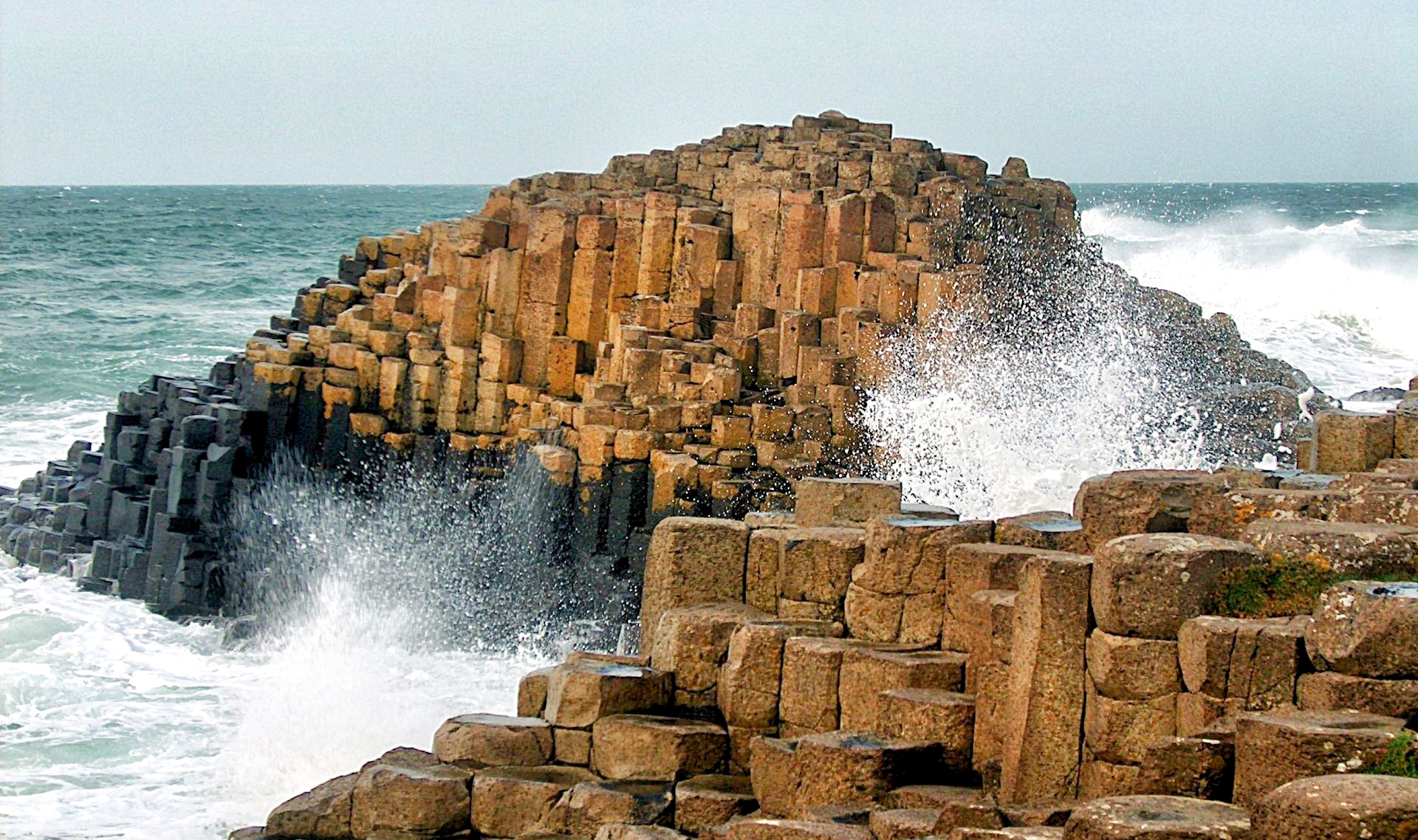
I've been a lot of places in the US, but I'm not otherwise well-traveled. I've left the continent only twice, but in both instances discovered one of these places of refuge. The Causeway in Northern Ireland and an ordinary, non-descript public beach on the Big Island of Hawaii. I'm not one for sun or sand, necessarily, but this beach was tree-covered and sheltered - as much as I have a long list of international locales I'd love to see, I might want to return and just sit on this beach more than any of them.
Previously, those feeling have not been associated with the places in which I experience them; they've felt more like participation is some larger truth. I've got profound memories of rightness sitting on a rock, near the top of Mt. Elbert, in Colorado, watching the morning fog stream up from the valley into the sky at almost impossible speeds; the same feeling in a similar spot on Mt. Katahdin, in Maine, viewing the vastness of untouched wilderness comprised of nothing but trees and lakes, the bright sun magnifying the colors and reflections. But those are simply places connected to connection; it doesn't feel like the places themselves are part of it.
I love those moments because they remind me of my insignificance and that is unbelievably comforting. All of my anxieties and stress melts away in the wild as I'm reminded that this vast, complex, unfathomable universe does not in any way require my participation. It puts things in perspective. I also enjoy the realization that such profound beauty - an experience, a reality beyond just the physical attributes of location and composition - is literally impossible without my participation. No one will see or experience exactly what I see or experience. That's also comforting.
So many things I do I do just to check them off the list. I've been to the highest point in 31 states now, but they're not all magical - most are pretty formal. That doesn't make those experiences less valuable, just different. Unless there's some real (likely unrelated reason), I probably won't go to most of them every again. I don't tend to read books a second time, even if they are profound or enjoyable or profoundly enjoyable, because there are always other interesting books to read.
Maybe it's because those two locations are so disconnected from my normal life - they are exotic in that they're far away from any place I ever reasonably expect to be. Perhaps they're special because they aren't places I ever planned to be. I was in Ireland for a work conference on ministry in places of conflict - our retreat center was rural and remote, but most of our time had been in the city. We took an afternoon whirlwind tour of the coast and snuck into the Causeway just before it closed. The beach was my wife's idea - the beach is always my wife's idea - I've never seen a beach I've particularly liked or disliked in any way save that one.
I don't know what it is that drives my desire to return to those places. I don't doubt that water has something to do with it. I've always found comfort in the crashing of the surf, in the cool cut of an ocean breeze, in the peace of otherwise silent nature. The steady rhythm of the waves, perhaps reminiscent of the heartbeat felt in that womb I don't remember, brings a calm and a peace no amount of psychoanalysis could ever touch. I wonder more, though, if my having experienced them before somehow adds to the beauty. There are plenty of beautiful places around the world I would love to experience, but perhaps its beauty already infused with experience that speaks more deeply to the heart and soul.
I do a lot of art - I can't draw or paint or sculpt, but words are my medium (or maybe my canvas) - rarely, though, do I create something that feels truly beautiful. When I do, there's a sense that it's not mine, that it's never been mine - and yet my DNA, my fingerprints are all over it. Beauty is a portal to something cosmic, something true on a level beyond our understanding, yet there is an element of beauty which cannot exist without our participation.
A great painting is not beautiful on its own; it is beautiful when someone recognizes within it both themselves and something so outside themselves as to be nearly unapproachable. Beauty is a connection between the impossibly immanent and the indecipherably transcendent.
I doubt my experience of beauty perfectly matches with the experience of any other - perhaps my experience is totally foreign to every other -
but I suspect that my experience of beauty is precisely what people experience when they experience beauty in whatever ways they experience it.
Whatever that looks like, it looks as it does because of our presence.
Maybe, just maybe, the key to seeing beauty in everything is just to be constantly present - not here, but present - and isn't that beautiful?

I didn't plan on the themes of these events dovetailing together, but they did. I suspect it's a subconscious effect of my current fascination with how our practices form us as people. At the youth retreat, we walked through God's plan of resurrection and redemption, talking about the hope and joy we have in God's continued creation in setting the world right. The final talk I gave began to deal with the ways in which we become the kind of people God can use in this mission of redemption. The Sunday sermon ended up in about the same place - with an emphasis on fasting, during this season of Lent.
Then I arrived home today and listened to the sermon from Pasadena First Church of the Nazarene and pastor Scott Daniels. This is a practice I try to maintain weekly - and he was preaching from an entirely different passage in the midst of a series on the core of our faith. However, he ended up in the same place. The things we do shape who we are - our practice, our physical action, have the most profound effect on who we become.
The things we do make us who we are. The things we believe only matter if we embody them in practice. An embodied gospel. That is the challenge I've been undertaking and avoiding in recent years. Undertaking because I believe it true; I believe my purpose on the is planet is to live into reality, into God's intended once and future way of life for creation. Avoiding because, well, it's dang hard.
I've always been an analyzer - I'm always asking why. I can be pretty stubborn if I don't see a good reason to do something. "We've always done it" or "everybody does it," are not going to help your case.
Why? Because what we do matters. Every little thing reinforces something within us.
I'm amazed how drastically, over time, a few little things have so damaged my discipline. There are so many things in my life I do without thinking. I am grateful for the practice of fasting - and for the season of Lent to show how much I need it the rest of the year.
Good intentions and right belief - even the best analyzed and thought out beliefs - don't mean much if you don't follow through.

And so...
I struggle with the liturgy/order of worship. I am talking about the commercialistic nature of it all and I'm sure you know what I mean... The whole mindset of, "let's have a 'good' service today" approach. I guess what messes with me is when you compare that to an Orthodox or RC mass, the mindset of most people is much different. It is purely to come to worship and receive Christ through the Eucharist. There is no evaluation of the band or if Father Joe 'connects with me or not.' At a gut level it just messes with me that the degree of people's worship has rests so heavily on a worship leader or a preacher. Again, it seems so Walmart-like... Who can present me with the best product?
My initial reaction is to say that high church traditions might be, to us low church evangelicals, a bit like the grass always being grenier on the other side of the fence. I've heard plenty of Catholics and Anglicans complain about the disconnect they have with the worship, that they don't, in fact, feel connected to anything beyond the level of familiarity.
In this, I think, we might find common ground in our complaints. It is our very familiarity with whatever liturgy our tradition embraces often leads to the desire to incorporate parts of other traditions (high church traditions can use some connection to the present and low church traditions can use some connection to the past). It is likely beneficial to broaden our horizons and include a wide variety of practices in worship drawn from beyond our own traditions. However, I'm not sure that really solves the problem expressed.
The deeper issue is likely engagement. Too often we feel as though worship is something we observe rather than something we embody. In a culture than functions to turn us from humans into consumers, it is our natural reaction to consume worship. We are defined by what we buy, eat, wear, use - and therefore our worship should be the most perfect and the coolest - so we can't do it ourselves; we're not good enough.
Despite a culture that forms us to consume, we do have an inherent, human need for connection - real connection, both with each other and with God. Corporate worship is the time we set aside to gather as God's people to be formed into the likeness of Christ. I take that purpose literally; the Church is the real body of Christ. It requires real participation - and, like our humanity, requires both physical and spiritual participation.
I think a lot of our issues in worship could be solved by honestly answering one question: what does our liturgy say about God? Not what we want it to say about God, but what our acts of worship really communicate. The answer is really into what we're being formed.

