Showing posts with label scripture. Show all posts

Saturday, April 15, 2023

The Gospel Changed Marriage, Not the Gays

The following is my essay, excerpted from the book: Why the Church of the Nazarene Should Be Fully LGBTQ+ Affirming.  A lot of people have asked me to explain, scripturally why I feel gender should not be a factor in marriage.  Well, this is it.  Hopefully you'll read it with the spirit of reverence and respect with which it was written.

The Gospel Changed Marriage, Not the Gays

by Ryan Scott

"Surprisingly, the most compelling scriptural argument for Christians to affirm marriage between two men is our understanding of women."


During my time in seminary, I dove deeply into the scriptures for support of our denomination’s stance on gay marriage. If I was going to be a pastor in the Church of the Nazarene, I wanted to be prepared not only with a statement, but with a solid explanation for our beliefs. I found, though, the more I studied, scripture gave me fewer and fewer reasons to oppose same-sex couples and more and more reasons to affirm them.

At the core of everything is our understanding of marriage itself.

When it comes to a theological argument about LGBTQ+ inclusion, you can throw out the issues of sex and biology—the Church of the Nazarene already affirms that the most appropriate context for sex is within a committed, Christ-centered marriage. The answer to who should be sleeping with whom is simple: spouses.

From there, the only remaining questions are ‘Who should be in a marriage and why?’

If you look at the history of marriage and the evolution of theology both in scripture and after it was written, you’ll see a stark difference in how God’s people have answered those questions. There’s an obvious movement from marriage as a social institution to marriage as a fully religious commitment, and it mirrors the movement of women as property to the recognition of women as full equals (at least in theory).

While our wedding liturgy talks about Genesis 2:24 as the foundation of Christian marriage, citing Adam and Eve becoming one flesh, it’s an interpretive leap that may not be wholly appropriate.

There’s no mention of marriage at all in Genesis 2 (there’s no separate word for ‘wife’ in Greek or Hebrew, it’s the word for ‘woman’ that becomes the English ‘wife’ when translators think it’s appropriate). In this passage we find only the kind of holy commitment to one another we now associate with marriage. But it took human society, as well as the Church, a long time to get from one to the other.

Early human marriage was a simple transfer of property. Women were objects to be owned—first by their fathers and then by their husbands. In fact, this social arrangement was so unseemly to God’s people that priests wanted nothing to do with performing or solemnizing marriages until the late Middle Ages, when the power of the Church was waning and requiring clerical approval of a marriage proved a particularly effective means of social control.

The religious rules around marriage all had to do with property rights. Fornication was a violation of a father by ‘defiling’ his property (daughter) and adultery was a violation of a husband by ‘defiling’ his wife—again, a property crime.

There’s no scriptural prohibition of extra-marital sex by men, so long as these other rules are observed. There was no written recrimination for, say, a man sleeping with a prostitute or his own servant girl, until Paul started calling it out by name in 1 Corinthians.

Modern conservative Christian sexual ethics essentially took the scriptural chastity rules for women and applied them to men, where it just as easily could’ve gone the other way (which is essentially what modern liberal Christian sexual ethics look like). In either event, things changed because we went from viewing women as property to viewing them as people.

Galatians says there is “neither Jew nor Greek, slave nor free, male nor female.” It’s not saying that these distinctions don’t matter, that men and women are the same; it’s saying these distinctions are not of degree. Jews are not better than Gentiles. Slaves do not have a different status from free people. Men and women are not fundamentally different in value.

Many use this verse to support LGBTQ+ inclusion. I do not. I don’t believe inclusion can be proof-texted, just as exclusion cannot be derived from any one or series of verses. Affirmation of gay marriage arises as the necessary theological conclusion of broader arguments made in scripture. Our understanding of marriage has changed because of the massive theological shifts made in the process of God’s people better understanding how God has called us to live.

We see, even in the Hebrew scriptures, the beginning of the marriage analogy for the relationship between God and God’s people that continues through the New Testament. The Church is the bride of Christ and God’s faithfulness to us becomes the template for our marriage relationships with one another.

Paul introduces the notion of mutuality in marriage that was earth-shattering for the time. 1 Corinthians 7 teaches that women share ownership, not only of their own bodies, but of their husbands’ bodies as well, and that sexual practice in marriage should be by mutual consent. He’s tearing apart the notion of marriage as property exchange and recognizing the relational aspect, something we take for granted today, but is a relatively recent development.

Up until the last 100 years, almost no one married for love. Sure, spouses might have loved each other and certainly love can grow in any relationship where it’s fostered. But love as a primary motivation for marriage wasn’t even contemplated at any point in the Bible’s writing.

The point of marriage was to solidify or improve social conditions, to secure peace between powerful families, or to enhance the economic status of one or both parties. This was built primarily around having children. The purpose of marriage was to produce heirs, which is why barrenness is seen as such a curse throughout the bible.

For most of human history, if you wanted love, you looked outside your marriage. This is, again, why Paul’s words are so ground-breaking: husbands love your wives as Christ loves the Church. For Paul, and subsequently for Christian theology, marriage was not just about meeting your wife’s physical needs to enable child-bearing, but to care for her as a person. Your beloved is God’s beloved, and you must care for them the way God cares for them.

This modern, thoroughly scriptural, thoroughly Christian understanding of marriage is then read back into Genesis 2. As God declares “the two become one flesh,” we understand a far deeper meaning than anyone at the time of its original writing could’ve comprehended.

Genesis communicates the human need for connection and community. We are not designed to be alone. We need partners. We need each other. Marriage has become our best earthly approximation of the connection we were created to have with each other.

We embrace Jesus’ teaching from Matthew that in the Kingdom “people will neither marry nor be given in marriage,” because we’ll be able to love everyone as God intends. Until that time, we commit to focusing on one relationship above all others.

Thus, our understanding of Christian marriage is about as far from the social regulation of female property transfer as it could possibly be. We have completely transformed the institution into something beautiful and important and good, but also something unrecognizable to the writers and first readers of scripture.

So, no, Paul doesn’t talk about gay marriage, likely because he couldn’t en- vision it. It wouldn’t make any sense in his social context. He was just beginning to apply Christian principles to what was an entirely secular economic and social system. At the same time, though, gay marriage makes perfect sense in our contemporary context, largely because of the ways in which Paul himself reframed the Christian understanding of marriage.

The final piece of this puzzle is gender. Genesis talks about a man and a woman. Male and female biology fit together for procreation in obvious ways. The analogies in scripture are gendered, referencing husband and wife. But, if Christian marriage, as we understand it, is two people committing to God, and to each other, to love their spouse as God loves God’s people, does it matter what gender those two people happen to be?

It can’t matter—not unless we’re willing to require men and women to inhabit specific and differentiated gender roles. If there is some innate difference (beyond our sex organs) that makes men and women truly unique from each other, then there’s some reason to make a gender requirement in marriage.

But scripture doesn’t support that differentiation, not anywhere from Genesis to Revelation.

Sure, scripture was written in the midst of a patriarchal society; but much like the theological evolution of marriage, it also challenges the faithful to a broader, more egalitarian understanding of men, women, and humanity in general.

There’s insufficient space here to fully explain the equality inherent in Genesis 2, but the literature is voluminous that the spouse God crafted for the first human was an equal and complementary being. For years, we’ve gendered this complementarity, relying on stereotypes that women are sensitive and men are strong, women are carers and men are conquerors, that women and men possess uniquely different traits that must fit together for marriage to work.

We don’t have to deny this complementary picture of marriage to expand its definition beyond a man and a woman. If anything, those gendered stereotypes limit both men and women from being the full, beautiful creation God intends them to be. How much pain and misery have we caused by communicating there are only certain ways to be “real” men and women?

Things are never that simple.

I do most of the cooking in our home. I do the shopping, and I stayed home when our daughter was young. My wife asks for power tools for her birthday, makes most of the money, and enjoys getting her hands dirty far more than I do.

Yet she’s also the decorator, finely attuned to aesthetics, while I spend much of my
free time watching sports. We don’t fit any gendered stereotype or its opposite. We’re unique individuals who happen to be male and female. What’s more important is that we complement each other in ways that make our marriage stronger than either of us could be on our own. We got married because we were convinced we could do more for God’s Kingdom together than we could do separately.

I know plenty of same-sex couples for whom the same is true, whose marriages are a blessing to them, to God, and to the world. I see no reason to deny them an equal place in the Kingdom of God or in the Church of the Nazarene. Christ calls us to break down barriers, cross lines of division, and embrace that self-giving love of God which is the only hope for the salvation of the world.

The Church should be at the forefront of recognizing, affirming, and embracing marriage for all people as it is the natural next step in the Spirit-led transformation of marriage from misogyny and oppression to freedom, equality, and love.

Adam, Isaiah, and Paul may not have understood what they were starting at the time, but God is always at work among the faithful to transmit and trans- form God’s world into what it was created to be. Recognition and affirmation of LGBTQ+ couples is not a capitulation to culture, but a gospel-infused counter-cultural movement to further welcome God’s coming Kingdom.

Sunday, June 20, 2021

Fraudulent Giants


This is a sermon I preached June 20, 2021 on the David and Goliath story.  I don't typically share sermons here, but I think this one came together particularly well and I've already heard positive comments about how it's helped some people with a new perspective - so here it is:

 The Israelites and the Philistines are in a stalemate. They’ve lined up on opposite ridges with a valley in between. Neither side can attack, because they’d be giving up the high ground – you just can’t win and uphill battle. They’ve been staring at each other for months – neither side can see a solution.

Goliath comes out and challenges any Israelite to single combat. Remember, he’s almost seven feet tall, which is more intimidating when you know the average height for a man of this time is just over five feet. In today’s equivalent, Goliath at over eight feet. And David is not an average man – he’s still a boy. Someone a head shorter than me up against a veteran Navy Seal who’s eight feet tall. Macaulay Culkin from Home Alone vs Andre the Giant – this is what we’re looking at here.

Goliath is a battle-hardened, proven fighter – wearing armor, the very best defensive technology – lightweight kevlar, head to toe. He’s also got a traditional sword, like you imagine from the movies – the blade might be five feet long, a spear with a razor sharp tip, the size of a softball – and a sharpened iron javelin, something he can throw a long distance – strapped to his back.

What Israel sees is almost no way out. It would take a miracle to beat this giant.

That’s what we face, sometimes. There are giants in our lives – cancer, unemployment, racism, loneliness, addiction – whatever it is, we see in front of us an insurmountable giant that can only be defeated by an act of God. It’s a problem too big and too tough for us to face on our own.

Although, maybe – just maybe – the problem is not the giant in front of us, but the way we see it.

Did you know we see things upside down? Our eyes invert what we see – when that data reaches your brain, it’s upside down. So why don’t we see everything upside down? Somehow, our brains have learned that we see upside down and they adjust for us. Our brains – and we don’t know how they do this – turn those images back over, right side up, so we can go about our days and live in our world.

Imagine how hard it would be for me to preach if the podium in front of me were actually right in front of me, but I saw it hanging from the ceiling. We don’t actually have to imagine. Some scientists made it happen in the 1920s. In what’s called the Innsbruck Goggle Experiment, a guy named Theodor Erismann had his research assistant, Ivo Kohler, wear glasses with special lenses that inverted everything we saw – his eyes saw what the brain sees: everything upside down.

At first, Ivo couldn’t do anything. He could function pretty normally if he closed his eyes, but with them open, that first day, he couldn’t feed himself, walk across the room or even sit down. Even if you can feel the chair, if it doesn’t look like its there, its pretty tough to sit down.

While we might take it for granted, how we see is far, far more important than what we see. This, I think, is the real lesson of David and Goliath. The writer Malcolm Gladwell wrote a book a few years ago – called David and Goliath – where he outlines some of the details we may miss in the story. I don’t have time to go into all the details, but there’s a 15 minute youtube video you can find about it.

Anyway, for a human to be so extraordinarily large, Goliath would almost certainly have to have something called Acromeglia – its a pituitary disorder that essentially makes you keep growing forever – or at least until you get too big for your body to support. When I used Andre the Giant before, that’s not too far off – this is the same disorder he had, which lead to his great size. One of the realities of acromeglia is that in your teens and early 20s, you’re bigger and stronger than everyone, but you age quickly. Your joints break down and your back gives out – Andre the Giant could barely move at 30.

You see where I’m going with this? Goliath had been the mightiest of warriors, but it was likely, by this point, that he could barely move, that his vision was nearly gone, that his strength was failing him. The spear and the sword and the armor were probably doing him more harm than good at this point. Yeah, if David got within five feet of the guy, it probably would’ve been curtains for him, but as we know, David never intended to get close to Goliath at all.

Yes, a young Goliath could have picked up his shield and fended off the rocks coming from David’s sling, getting closer and closer, until his sword or his spear or his javelin or his bare hands would’ve been enough. This is what Saul was thinking, when he tried to make David wear the armor – give the kid a fighting chance – but Saul is not seeing the right way.

But nobody saw what was right in front of their faces: the giants in our lives are not always what they seem. Don’t get me wrong. I’m not trying to say God can’t do miracles or that God doesn’t do miracles – I’m just trying to say that miracles are miracles because they’re rare. They don’t happen very often. More often than not, if we’re going to tackle the giants in our lives, it’s not because God takes care of them for us, it’s because God gives us eyes to see them differently – to see them properly.

Let’s go back to Ivo Kohler, wearing the inversion goggles. He can’t do anything for himself. He’s got to be fed and led around by the hand everywhere he goes. He experiences some pretty severe psychological trauma right off the bat – but he’s committed to the experiment and he continues. Within three days, he says he’s starting to see things right side up – not that he’s getting familiar with his surroundings or learning to deal with mixed up vision, but that his vision is actually changing.

You see, it takes only a short time, a few days, for the brain to recognize this change in vision and catch up to what our eyes are seeing. By the 10th day of the experiment, Kohler can tell no difference – he rides a motorcycle through the crowded streets of Innsbruck all on his own. His vision had completely changed. And when he finally took the glasses off, it was only another three days until he was back to normal. The human brain is one amazing thing. It can be wildly adaptable, but its also easily fooled.

The world we see around us is not as it seems. That’s the message of God’s Good News. Where we see might giants – eight foot tall, Kevlar-covered Navy Seals – God’s Spirit reveals half blind old man ready to fall over at the slightest push. Where we see brooding, dangerous strangers around every corner, the God’s Spirit reveals beloved children of God who only need one conversation to become a friend. Where we see need and poverty and desperation, the God reveals an abundance of resources if we’ll just trust each other and work together.

God is not calling us to sit back and let God handle the giants, God is calling us to step out on faith and see differently, to put on the inversion goggles of God’s Good News and look at the world upside down. Yes, its scary, and it can really mess us up for a while, but if we’re faithful to keep on it, despite bumping into furniture and spilling our dinner down our shirts, eventually we’ll learn to see this new way, God’s way, and those giants won’t seem so tough anymore.

The Good News of God is not the solution to all your problems. It’s not the path to an easy life or the answer to every question – but it is the path to engage the world in an open and life-giving way, to be human as we were created to be human, to tackle our challenges and setbacks by moving forward rather than cowering in the dark. So many of us spend our lives in a stalemate, staring across the valley at a giant we think is unbeatable, when God calls us to see differently, to live differently – and those giants may not always be what they seem.


Monday, August 10, 2020

The Faulty Evangelical Hermeneutics of All Lives Matter

This was originally published at Misfits Theology Club.


You’ve heard it. Probably from a particularly active aunt on Facebook. The out and out opponents of racial justice tend to avoid the phrase in favor of more inflammatory statements that demean the movement as a whole, but lots of well-meaning white folks insult the cause of racial justice and simply don’t understand why “All Lives Matter” is so problematic.

As an evangelical pastor, though, I understand. In fact, it’s time for me and my compatriots to take responsibility for the “All Lives Matter” blind spot that’s so infected our ranks. A lot of it is a direct result of our carefully curated theology and the way we interpret scripture to avoid the pitfalls of “dangerous” heresy.

Evangelicals have always been leery of “works righteousness,” the notion that something we do could somehow earn our salvation – that salvation could be a transaction instead of a no-strongs-attached gift from God. In trying to avoid this false doctrine, we’ve made Christian faith about nothing more than what we think in our heads and the ideas we affirm as correct.

We cling to Romans 10:9 – “If you declare with your mouth, ‘Jesus Christ is Lord,’ and believe in your heart that God raised him from the dead, you will be saved.” Intellectual assent – a thoroughly modern, western concept – has become the end-all and be-all of evangelical faith.

We’ve done this without acknowledging that a Greek conception of “belief” inherently involves action. For the language and culture into which scripture was written, you did not “believe” anything unless you acted upon that belief. Intellectual assent is entirely foreign to scripture or the earliest Christian traditions.

We’ve traded one form of works righteousness for another. Instead of something we do providing salvation, we earn our salvation through the power of good intentions. It sounds sacrilegious, but it’s how we operate.

When faced with the failures and shortcomings that clearly expose the gaping chasm between who we are and who we’re supposed to be, we cling to “Jesus Christ is Lord.” We’ve said the right things and believed the right things, which trumps whatever actions we’ve done or failed to do.

“All Lives Matter” is our disembodied affirmation of truth, regardless of the physical reality around us. It is more important to evangelicals than recognizing the reality that black lives clearly don’t mean as much as white ones, because our theology has taught us that intentions trump actions.

Yes, yes, “faith without works is dead,” but we treat those actions more like a bonus – extra credit on the quiz of life. Optional.

How can we get away with that? How could so many be convinced that merely stating an ideal (like “Jesus Christ is Lord” or “All Lives Matter”) could be more appropriate than addressing the very real ways those ideals are not born out in the world around us?

Simple, we’ve also been taught that Jesus came to save us.

While it’s true that the life, death, and resurrection of Jesus Christ does provide salvation for you and for me, our salvation was not the point of God becoming human, walking among us, submitting to death, and being raised to new life.

Your individual salvation is not worth all that.

Many evangelicals have been told that even if they were only one who would ever believe, Jesus still would’ve died for them.

I’ll agree that if you were the only thing that existed in the universe, floating around in the vacuum of nothingness, that God would love you enough to die for you alone.

That’s not reality, though. The universe exists, with all its multitudinous and complex creation. You and I don’t exist in a vacuum. We exist as part of a gigantic, infinite reality, which God loves so thoroughly and completely, down to the last quark and atom, that God’s sole purpose is to love that reality into its created purpose.

Your salvation and my salvation are made possible in Jesus Christ, but only as means to an end. We are saved so we may participate in the salvation of everything. We are saved to be part of a world that operates as God intends it to operate.

When we say “Jesus Christ is Lord,” we’re merely asserting a future reality and committing to work so that future reality becomes a present reality.

Jesus tells a story about a rich man who leaves various servants in charge of various sums of money. Two of them go out and use the money to make more; one servant hides the money, saving what he has so nothing will be lost when the rich man returns.

For too long, evangelical theology has condemned us to be that risk-averse servant. We’ve taken the good news of the gospel and we sat on it, afraid to lose it by engaging the messiness of the world and seeking to participate in its transformation into God’s Kingdom. We were welcomed into the front door of heaven and we’ve camped out there, afraid to explore the house, for fear of breaking a lamp or tracking mud on the carpet.

All Lives Matter is a future reality; it is entirely consistent with God’s intentions for the world and Christian faith is confident it will come to be made evident to everyone at some point.

We will never realize that future reality, though, unless we are obedient to the God of our salvation and invest the gospel gift we’ve been given in real, tangible action to combat the lived reality that, today, in our world, our country, our neighborhood, our church, some lives – black and brown lives – do not yet matter as much as other lives, as much as they deserve to matter, as much as they will matter once the investment of this gospel comes to fruition in the promised and certain future.

But for now, saying “All Lives Matter” is like hiding the gift of God away, afraid to invest it for fear of loss. It is a rejection of our scriptural mandate to believe (not just intellectually assent) that Jesus Christ is Lord. That belief must be manifest in action. Our salvation is not our own; it is an investment, on behalf of God, for the redemption of the whole world.

It is time to escape the evangelical hermeneutics that have for so long held us back from this reality!

Tuesday, November 14, 2017

Real Life and Real Life

So, last week was a crazy busy one. Not only that, but the business required a level of creativity that's difficult to sustain. I feel pretty taxed. So, because I missed last Thursday's post and I've got no time or energy to write one for today, you get my sermon from Sunday.

It was partially inspired by chapter eight of Empathy for the Devil by JR Forasteros, which came out last week (and which I reviewed in my last post). I struggled mightily with how to make sense of the parable of the wise and foolish bridesmaids, but the idea of psyche and zoe that he elucidated so well in the book framed what I was trying to say quite nicely.

Anyway, here's my take on Matthew 25:1-13:


There was a guy, we’ll call him Fred – an ambitious young man with lots of potential. He joined the military out of high school and stayed in long enough to pay for college and an MBA. He got the education he wanted, but when he hit the work force, he was already years behind his peers. So he worked extra hard, burning the candle at both ends – and within five years he was the youngest executive in the history of his company. A great success story.

He got there the right way, too. People genuinely liked him. He was tough, but fair. Fred was everybody’s image of a go-getter. Along the way he’d even managed to marry a wonderful woman, and after five years, they were starting a family – with his new position, they thought it best for her to take time from work and stay at home with the kids.

So Fred just kept going. He continued to work harder than everyone else and now he coached his daughter’s soccer team and made it home for family dinner at least once a week. They took the right vacations to the right places and his wife never felt like an outsider when she got away with her friends. They had anything and everything they wanted.

Fred and his family went to church, too – religiously, even – spent every Thanksgiving at the soup kitchen, serving turkey and eating with folks who just weren’t as fortunate. Will was one of the other volunteers – he and Fred knew each other from church and their families ended up sitting together one Thanksgiving. Will invited Fred to his pick-up basketball game.

“Oh man, I haven’t really played basketball since high school,” said Fred, “It was absolutely my favorite thing in the world; I’d love to come. You said 5:30 on Thursdays? I’ll be there.”

So Fred got up a little earlier, sent his secretary an email that he’d be in late and entered the middle school gym. The guys were going back and forth, maybe a dozen – running up and down the court in a way that was simply nostalgic. The smells, the echoes, the squeaks on the floor.

Fred jumped into the next game and started running. Most of it came back – his shot was a little off, but he hit one or two and no one was really young enough to play defense anyway. By the end, though, his lungs were burning and the lack of sleep couldn’t just be covered up.

As Fred heaved on the sidelines, Will came over. “We won, Fred, we have to play again.” Fred responded, “Sure thing, can I buy some of your stamina.” Will began laughing and started to play along, but then he saw something in Fred’s eyes, “You’re not serious, are you.” “Of course, I’m serious,” says Fred, “I need more stamina to play. I’ve got the money. What does it cost?”

Will’s a little taken aback, “Fred, you have to know it doesn’t work that way, right? We’ll just get somebody else.” He called to another waiting player and they started a new game. Fred was left, breathing heavy, voice sounding desperate, “C’mon guys, let me play. I just need a little energy, a little more oil for the fire. I’ll pay whatever it costs. Please, I need to play.”


I grew up going to church. I heard the parable of the wise and foolish bridesmaids any number of times. They’re all waiting for the groom. It’s getting late. Some run out of oil and ask those with oil to borrow some. I always wondered why they couldn’t just share the oil? If the groom is coming, that means they’re not going to need much more – surely there’s enough to give the foolish ones a little bit to tide them over, right?

The best answer I can come up with is that it’s a parable, an analogy for life and in real life, it doesn’t work that way. Like Fred, we discover there are some things we need we just can’t buy.
I can give you the best running shoes in the world, give you all the water and nutrition and maps you need – professional level marathon support – but if you didn’t train you won’t be able to run the race – it’s as simple as that. Some things in life require preparation.

You might say, like Fred in the story, I’m working so hard, doing all the right things, just trying to find happiness or fulfillment, or to appease my guilty conscience, and it just doesn’t seem like enough. We’ve all been there: desperate for just a little more oil. One more hour, one more dollar, one more prayer, one more date – just one more and I’ll have what I need to be happy.

Satisfaction is always just over the next horizon – and that’s what makes heaven such a hopeful proposition. We slog through life the best we can, then finally, someday, we have what we need.

If you come to adult studies you’ve heard this a whole bunch, but we get heaven wrong. The Kingdom of God is not about the fulfillment of all your desires; it’s about being content without them. The Kingdom of God is not some far off future event, it came with Jesus and while it’s not fully realized yet, we can begin to live into the Kingdom of God right now.

In the parable, the foolish bridesmaids didn’t have what they needed to enjoy the party, because they were waiting for the party, rather than preparing for it. They were looking for some far off heaven, rather than seeing the Kingdom of God all around them already.

It’s a confusing parable for us, because in our world things are reversed. The people we call prepared are the ones doing everything. Like Fred, they’re working hard, taking care of their families, and checking all the boxes of success. Jesus is saying, though, that these are the fools, the people who think they can work their way into the Kingdom by doing everything right.

In the end, though, they just end up desperately looking for more oil, because they never arrive. They never find what they’re looking for, just more pressure to do even more.

That sneaks into the Church as well. Too often we’ve made Christianity about checking off our own list of requirements. As much as we say we can’t earn our salvation, that’s what it sure looks like we’re trying to do. Church becomes a scary, unwelcome place precisely because we greet desperate, overworked, unhappy people at the door and hand them an additional list of things they need to do. Our solution to the problem is to do more of the same.

So it ends up that Christians look no different than the rest of the world. We might have a different checklist, but we’re still running ourselves ragged trying to get it done and desperate for just a little more oil to see us through the day. That’s not really a life any of us wants to live.

The good news of the gospel, however, is that the Kingdom of God is not some far off heaven. It’s not something we have to wait for or work for or discover the secret to get in. Jesus invites all people, the lost and the least along with the best and most prepared. He invites the wise and the foolish alike to enjoy the eternal benefits of true life in Christ. He even says, “my yoke is easy and my burden is light.”

However – and this is the hard part for us – the invitation is not for a destination. The Kingdom of God is not about arriving some place, or achieving some goal. The Kingdom of God is a journey. It’s a path we have to walk. You can join anywhere and at any time – and it doesn’t matter if some people are farther along than others; we’re all in. You can be prepared or you can be totally winging it, but you have to understand it’s not about where we’re going, it’s about how we get there.
You ever wonder about the Sermon of the Mount? We read those chapters from the beginning of Matthew where Jesus teaches us to love our enemies, to give to anyone who asks without expecting anything in return, to not worry about what we’ll eat or wear – we read those chapters and our first response is “wouldn’t it be nice to live in a world like that?” We think, “maybe someday our world can be like that,” and then we go right back to doing things the same way.

These “judgment” parables always scare people, as if Jesus were saying, “Do this, or else,” but really Jesus is saying, “Life is short, here’s how to live it well.”

The wise bridesmaids are the ones who do life differently. They’re the ones who live not for the destination, but the journey. They’re prepared for life if the goal we so desperately seek never comes to fruition. They’re happy in all circumstances and always ready to respond with love and grace. They look like Jesus and there’s no reason we can’t look like them.

Yes, the Kingdom of God requires us to give up our goals, to let go of this desire to feel safe or happy or secure. I think we know, in our heads, those pursuits won’t really bring us what we want, but our hearts still believe they will. Guess what? Jesus is in the business of changing hearts.

Living into the Kingdom of God does cost us something, because we won’t look like everyone around us. We won’t be seeking after the same things. There is tremendous peer pressure in our society to live by a certain set of ideals and values all of which are designed to bring fulfillment and yet never will. People who step out of that life or approach things differently get labeled – and those labels are never good. Why? Because we all want the same things, but most of us are too scared to try a different way.

Some of you here are old enough to remember the Apollo space missions. NASA made those first astronauts huge celebrities. Neil Armstrong and John Glenn and all the rest were all over TV, with their crew cuts and their perfect American families. They didn’t look like hulking superheroes; they looked like regular guys.

It’s easy for us to watch videos of them floating around in space and think, “that looks like fun; I’d love to do that,” and forget the years and years of intense training that went into those space visits and the real, constant, inherent danger involved in every one.

What’s more, we see space as this exotic, attractive destination, where people like us can have the time of their lives. But I’ll tell you what, those Apollo astronauts did not see space as a destination; for them it was just something they had to do in order to get back home.

There’s a blessing I love, although I’m rarely brave enough to say it people: “May all your dreams come true tomorrow, so you can discover they aren’t all they’re cracked up to be and you can get on living.”

We’re constantly in search of more oil to keep the lamps burning, because we desperately want to find peace, solace, comfort, greatness. The message of the gospel, though, is that you’re already home – the Kingdom of heaven is here! The key is to learn to live in the moment, to love the people around you, to give up the search for something great – and surprisingly, unbelievably, impossibly, you find what you’re looking for in the most unexpected of places.

In the name of the Father, the Son, and the Holy Spirit, amen!

Tuesday, September 12, 2017

Love Like Family

I was listening to Scott Daniels' recent sermon from Romans 12. The version of scripture he used translated one line as "love like family." That really struck a chord with me. It seems like we have a wholesome image of family in our minds, even though most people don't have the most functional or idealistic relationship to their own family.

When we think about the "love like family" line (as a way Christians should treat each other, by the way), we tend to go towards one idealistic extreme - a sort of utopia, where stress and anger and dissent are absent, replaced with nothing but warm fuzzies and lots of affection. That's not how real families function, though, is it - people who have actual family relationships understand that things aren't always easy or rosy or particularly fun. We commit to them precisely because there's something about family that means something to us. Even when you don't have any real relationship with your relatives, we tend to form families anyway - people we treat the same way, people we're committed to despite whatever roadblocks or disagreements might arise. While those are powerful and meaningful, they're not perfect either.

As I was thinking about this analogy of "loving like family," I'm wondering if the idealistic extreme that comes to mind oughtn't (that's a real word, I promise) be more like Game of Thrones. I'll admit some bias here - my wife decided to start watching the show very recently, so I've seen something like 40 episodes is three weeks - it's on my mind a bit." The show is full of regal families, reminiscent of the nobility of European past - people whose family name means something - something valuable that they're trying to protect.

Now, I'm not suggesting that we should be callously marrying off children to fulfill social or economic purposes, and, obviously, secretly plotting to kill each other whilst publicly displaying loyalty and honor seems a far cry from anything remotely Christian, I wonder if the concept of family that underlies the dysfunction isn't a more apt analogy for what Paul's trying to convey.

There is a duty present that overwrites any personal emotion; a communal consideration that outweighs individual preference. This is important. I don't want you to hate your fellow Christians - far from it - but I think Paul's calling us to respond to them with the same kind of Christ-like selfless love, even if you do.

We're certainly not going to feel ecstatic love for one another all the time - real relationships exist within the entire gamut of emotions - and we obviously disagree about all sorts of things. Love like family should trump all of that, though. In Game of Thrones, everything is a means to an end (the characters for whom it's not almost always find themselves unceremoniously dead) and if you've read just about anything I've written, you know I don't look kindly on that way of viewing the world. This is why it's an extreme - it's one thing to sublimate your own happiness for the greater good; it's quite another to force those whom you purport to love to do the same (often against their will).

Our preferred extreme isn't any better, though. Envisioning a world in which everyone loves each other so much there's never any conflict denies people their humanity in the same way. It respects no individuality or choice - it's also only imaginable in a world where our preferences are everyone else's. We've essentially composed our ideal in our image and just image everyone else in total agreement. That's as arrogant and selfish as anything done on TV.

As with most things we'd prefer to be black and white, we have to find our way in the murky middle. Obviously either extreme is problematic, neither one is "right" or desirable or something to aim for - one of them, however, is others focused. If we see family as the move towards kumbaya serenity, any disruption is going to feel personal - we're all supposed to be happy; why am I not happy? If we see it as duty, as an obligation we have to others above and beyond our own happiness, disruptions become externally focused - why is she not happy; how can I make his life better?

I suppose the gospel answer to all of this is that we find whatever "fulfillment" we need by not seeking it. We are satisfied by forgetting satisfaction. The real ideal is, in fact, an oxymoron. There's no guarantee we will be rewarded for loving others above ourselves, but there's some beauty in the logic of everyone doing it; it just seems like that would create the kind of family that both reflects reality AND our desires.

We all fall short of that, of course, but in doing so, let's remember that "loving like family" is most certainly not about our happiness -
and let's try real hard not to chop off anybody's head.

Tuesday, September 05, 2017

The North Korean Cop-Out

With all the troubling threats coming from the 'hermit kingdom' these days, it's easy to get worried. I mean a third-generation madman has nuclear weapons and seemingly no incentive not to use them. I don't appear too concerned about any of this - something that came as a surprise, even to me. Maybe part of it is living on the East Coast, where Kim Jong Un's missiles are unlikely to fall - I know, how selfless and caring of me, right? I think mostly, though, it's the knowledge that the US government, which has spent close to 50% of its annual budget on military preparedness for decades now, will likely just blast it's way out of this problem, regardless of the consequences.

Now, I don't think that's a wise solution for any number of reasons - the most being my general opposition to violence and war. However, I've been trouble by how easily I'm willing to let someone else do my dirty work in this instance. The number one critique of non-violence is that it's easy to do when someone else will do it - it's a typical retort from police officers or soldiers - and one I am generally challenged by. I work hard not to use that excuse, to be prepared to put my life in danger for peace, if need be, specifically because it's a valid critique. It's not really non-violence, if you're counting on the violence of someone else.

Yet I still find some measure of comfort if the notion that the US army could utterly reduce most of North Korea to rubble, if need be? It's a contradiction one doesn't have to ponder much when it's just a far-off possibility - however, as in recent weeks, when it looks like a more and more likely solution, it's an obstacle that must be faced.

I don't think it's likely that any world government will choose an alternative to violence, especially if other options have been tried extensively, so as much as I've been thinking and researching non-violent ways to potentially deal with the North Korean crisis, that's not really what this is all about.

How do I look at a situation in which people are almost guaranteed to die in large numbers with just about any outcome and not choose utility?
It's that means to an end thing, again - something I decry over and over again here - something I am absolutely opposed to on philosophical and theological grounds. The ends aren't ever ends. History is linked - stopping the madman today has influence on what happens tomorrow. Abandoning principles for a momentary victory might feel good to me and the people who are alive today (rather than dead) because of it, but is that reallt a better solution than choosing death now in the hope of a greater peace down the road?

I don't honestly know the answer to that question, because there's no evidence by which to make a decision. Violence has always been met with violence - at least on a national and international scale. The large-scale non-violence that characterized the Church in the first few centuries after Christ were not in the realm of global politics - it was not nation vs nation. The closest you might find is when Russia burned Moscow and withdrew from Napoleon's invasion, knowing he could never maintain supply lines through a harsh Russian winter - but that was really more tactical than noble; it was being willing to live with a problem, so long as the problem was far away.

Here, I think, it's important to point out the problems inherent with associating ourselves with a nation. The underlying Christian doctrine has always seen the people of God as an alternative nation, a separate construction, a different people. We get into trouble when we begin to associate ourselves with more than Christ. Being an American Christian (or a German Christian or a Korean Christian or a Christian from Lesotho, for that matter) is automatically a conflict. It might not always show up in our day to day lives, but we can't just let the passive be passive,
for passivity is a lie.

That's the real issue - we want to know how the US or China or Nigeria or Europe of whatever nation we associate ourselves with should address the problem in North Korea. For Christians, the prior issue is that we really shouldn't be associating ourselves with those nations in the first place. 1 Peter 2:9 call's Christians "a chosen people, a royal priesthood, a holy nation." We've too often taken that metaphorically, rather than quite literally, which is the alternative way of life proclaimed by Jesus and reinforced in the practice and teachings of Paul. It is not that we should become a nation to rival other nations,
but that we should avoid falling into the trap of nationalism.

The US may very well enter into war as a means of keeping North Korea from using nuclear weapons. Christians must mourn this - and any other violence - for war and violence are not part of the Kingdom of God. The very rational response from the US might be, "what else would you have me do?" Christians reply, "Love your enemy and pray for those who persecute you. If your enemy is thirsty, give them something to drink; if they are hungry, feed them."

I don't know if that's a rational or even feasible option, especially given the history between the US and North Korea, but it's the only answer I know how to give - and it's the national call of God's people.

I'm not sure what that means for my initial problem? Does it mean being willing to die rather than kill? Yeah. But it can't mean being willing for other people to die so I don't have to. On the other hand, I don't think, say, moving to the west coast so as to be more in the path of any rogue North Korean rocket really makes much sense either - it's not going to guarantee my sacrifice any more than staying here - no should looking to die really be the way to deal with such a situation.

In the end, I believe the answer is not looking to avoid suffering. That's really at the root of this reliance on someone else's violence to spare me my own. So what if millions of impoverished, suffering North Koreans suffer even more - I'll get to keep my way of life. That's the mindset we need to fight. The reality is, I am safer and better off than most people in North Korea could ever dream to be. Even living simply,
being sacrificially generous, and avoiding the trappings of the typical US way of life will not change the disparity between us and them.

Maybe my call is to go - sneak into North Korea and simply suffer with the suffering. It's a holy, noble, and worthy act, perfectly in line with scripture and the witness of the Church. I suspect the world would be better off if we were all able to do it. We're not. What we can do,
though, is live in peace - active peace - here and now. Love people. Give to those in need. Suffer with those who suffer in our backyards and around the block. Be the people God has called us to be with the sincere hope that this war will be the last one.

What we can't do is avoid the problem. We can't continue to live in our isolated peace and quiet, just expecting things to change on our own.
The comfort we have was not one by righteous means, no matter what the national myths around us say. Christians are called to live into a different story - it's one of love and grace and peace for sure, but one achieved through sacrifice and suffering. If we're not committed to those things, we can't really enjoy the benefits.

Thursday, July 27, 2017

Bernie and Condemnation

In my long tradition of dealing with contemporary issues long after they've fallen by the wayside, I'd like to weigh in on the confrontation between Bernie Sanders and Trump nominee Russ Vought from early June. It made a lot of headlines at the time, with people drawing lines and choosing sides and lobbing bombs back and forth at each other.

A transcript of the exchange can be viewed on any number of sites I'd rather not link to, but here's one anyway, since you need context.

The crux of the matter is Vought's comment, in support of his alma mater, Wheaton College, that people of non-Christian faiths (specifically Muslims in this particular case, but it's expanded to all) "do not know God" and "stand condemned." Sanders uses this statement as a means of rejecting (or voting for the rejection) of Vought in a government position because this view might be offensive or fear-inducing in people whom he's referenced.

In my view, both of these guys made real fools of themselves.

Sanders is easy - he falsely equated personal opinion with action. You need to show actual discrimination to justify denying someone a position of power, at least in the US government. Vought's belief that some people are condemned is just a belief, unless there's proof he acted on it. Shoot, this is a position in the Office of Management and Budget, for crying out loud, are there even religious issues that this guy would have power to rule on in the first place? Even if Sanders thought he might act prejudicially, he would be hard-pressed to come up with a scenario where such prejudice could even be possible.

People have rightly pointed out that this is, essentially, making a religious test for office - something the constitution forbids. Of course, what we conveniently never talk about in those scenarios are the ways in which our laws already impinge on the freedom of religion for things like child brides or abusive corporal punishment, to name a few. It's not outside the realm of possibility that "condemnation" on the basis of religion, might be one step on that same train Sanders would like us to pursue.

All of those are interesting, but what I didn't hear too much of is criticism for this notion of condemnation coming from Vought. It's terrible theology, to begin with, and just over-archingly anti-Christian to make such a statement. I could see justification, perhaps, for the condemnation of specific actions, but to condemn not just individuals, but whole groups of people, simply for a theological difference, feels like precisely the kind of thing Jesus denounced the Pharisees and religious leaders of his day for doing all the time.

In fact, I feel like Jesus said, at one point, "God did not send his son to condemn the world, but to save the world through him." Time and again Jesus failed to condemn anyone, except those claiming religious authority. We miss that boat a lot, as Christians, and maybe it takes a wildly over-zealous, secular Jew to get someone to notice.

I don't think Sanders was remotely right - at least constitutionally - in his statements and his badgering. In fact, it sounded an awful lot like condemnation in its own right. At the same time, Vought shouldn't be defending those words; he should be profusely apologizing for them.
To use the name of Jesus, the Church - his followers - as the means for doing it just makes me sad. The people most committed to the name of Jesus Christ don't appear to know Jesus at all. Rather they've bought into a dogmatic theology that serves its own internal logic more than the God it purports to represent.

It's intellectual assent taken to its logical conclusion - a person's acceptance or rejection of the idea of Jesus overrules individual action.
No one is saved or condemned based on their religious affiliation - we're saved or condemned by our commitment to love and selfless service -
you know, living in the way of Jesus Christ, whether you're in a position to admit that's what you're doing or not.

Neither of these guys did much to advance their cause in this matter. Neither one showed any real understanding of honor or respect. I'd say those actions - the words and actions of both men - are embarrassingly counter to the message of Jesus. Fortunately, that doesn't devalue them or their identities in any way. There's still plenty of love and hope and grace to go around.

At our very best, we're still more prone to condemnation than grace. I'd say the best we can hope for is to recognize it in ourselves, admit our failings, and work to be different moving forward. The intractable positions we see here are far more alike than they are different and we deserve better than either one from people we've placed in positions of power.

Tuesday, June 13, 2017

Rob Bell Comes Home

Rob Bell wrote Love Wins, in which he dared to make a theological and scriptural case for considering a kind of Christian universalism that has always been a part of the Christian tradition. He was generally cut-off and condemned by the American evangelical community that values predictability and stasis above just about everything else. It changed his life. He moved to California and stopped working at churches (although he's continued to be a pastor to a pretty diverse group of people, include Superbowl MVP,
Aaron Rodgers and comedian Pete Holmes). He's dabbled in TV, started a podcast, holds a regular slot at Largo in LA - and, most importantly,
continued writing.

Things got a little wonky there for a while. He showed up on Oprah and some of his writing started sounding more generally spiritual and less specifically Christian. People assumed he'd just gone off the deep end, so to speak - in evangelical cultural terms, just another lost soul seduced to collusion with the ways of the world.

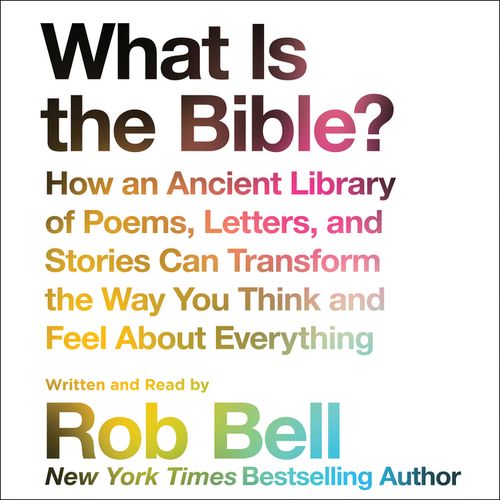
That makes it sound a bit worse than it is - you can read the Christianity into Bell's most recent book, How to Be Here, even if he doesn't use the language. That being said, his newest book, What is the Bible?, was not the avenue I expected him to turn down next. In typical Rob Bell style, it's a short, quick, direct, and accessible look at a particularly complex topic. He addresses the Bible, it's creation, development, and purpose - as well as approaching technical issues of genre, culture, interpretation, and language with specific examples rather than jargon and prose.

I know many Christians are skeptical of this treatment, fearing that Bell has moved beyond where most people are comfortable. If you're a straightforward, typical American evangelical, particularly one who's not too uncomfortable with the fundamentalist label, that might be true. I doubt all of what Bell has to say would please those in the tradition from whence he comes. However, he clearly explains how that tradition provided the pathway to ask questions and discover answers leading to where he is. There's nothing in this book that would contradict anything I heard or learned in seminary or would be outside the bounds of my tradition in the Church of the Nazarene.

Does he ruffle some feathers around the edges? Yeah, especially in the final section of the book that serves as a sort of Q&A, particularly geared around difficult and controversial questions. I'm not sure I appreciate the casualness with which he deflects questions of biblical authority and inerrancy - I certainly agree with what he has to say, but perhaps not in the way it's done. Yet this book is clearly for his "new" audience.

It is not at all written for people within the camp who embraced his early work. What is the Bible? presents a healthy, responsible, in-depth, engaging understanding of the Bible to people who are searching for meaning and may have otherwise written it off.

If I were teaching an Intro to the Bible course at some Christian college, I'd put this on the textbook list. I think it would work equally well in a congregational setting where people are prepared to be stretched and challenged and willing to talk about complex issues. I've read just about everything Bell's published and this is among his best work. There's more scripture, exegesis, research, and gospel than you'd find in 99% of sermons out there (mine included).

It's a presentation of living, active, meaningful scripture that speaks to the world with honesty and grace. Bell's freedom from the moralistic tyranny of a Christian publisher allows him to be both reverent and irreverent, but most of all real. It's a great read and I couldn't be more pleasantly surprised.

Thursday, May 18, 2017

Nazarene Catechism, Part 3

Based on the drop off in page hits from part 1 to part 2, I want to thank the 13 of you reading this third part of my response to the Nazarene catechism document that's come out recently. Part 1 dealt with the overall format and perspective of the piece and Part 2 addressed the false sense of unity into which it plays.

In Part 3, I'm hoping to just address some specific problems, questions, and disagreements I have with what was expressed. This is essentially a catch-all and very personal. I would expect anyone reading the document to have similar, if not the same, issues with any number of answers. I am not attempting to make argument, but simply express my opinions as a member of the Nazarene clergy in response to what was presented. I think this goes chronologically through the piece, but I apologize if I got something out of order.


In the answer to Question 11, the catechism states that God creates "motivated by holy love." This is problematic because it separates God from love; I'd argue the witness of scripture says God is love. There is nothing else that can motivate God, using the verb in that way implies otherwise. This answer specifically separates love from both God's perfection and creative activity.

I'm pretty uncomfortable with how Question 15 is answered. It's awfully, uncomfortably presumptuous for us to claim that "human authors of sacred scripture... wrote down what God wants to teach us." It might be an attempt to skirt verbal inspiration, but it does an equally adequate job of removing the human element from the process. "What God wants to teach us" implies interpretation and doesn't directly address the text itself. I'd argue God continues to teach us new things through this living and active text - things that previous generations of Christians may never have or been able to know. Similarly, future Christians will undoubtedly discover and learn more than our accumulated knowledge - and thus, what we know from scripture, cannot be all God wants to teach us. We need to keep our answer to these kids of questions to statements about the text itself - "it is sufficient" being the primary descriptor - instead of making claims about the interpretation of such.

Not to be entirely critical, I think this project does a pretty good job of addressing original sin (Question 35 and some around it). These days, I prefer talking about sin as lack and I don't think our traditional conceptions of "Fall" adequately reflect scripture or reality, but an emphasis on self-centeredness and alienation are both strong and consistent starting points.

That being said, the answer to Question 45 talks about "restoring the image of God in humankind." I don't believe that image is or can be lost. I know at some point I heard theological arguments about a strong reformed position (wherein the image of God in humanity is completely lost) versus a moderated position in which it's partially lost, but I don't find either of those options particularly compelling or very Wesleyan (let alone scriptural). It's much more appropriate to speak of humanity, and creation in general, as moving towards something - that creation begins perfect (in the Hebrew sense of the word: fit for a purpose) and continues to grow in perfection as it moves towards completeness or fulfillment. I think this "lost image" business plays into a notion of "Fall" that's not very reflective of scripture or reality. This comes up again in the answer to Question 71.

The Ephesians passage used in the answer to Question 56 is a quotation of Psalms to talk about the ascension of Christ, but that passage makes no mention at all of other people (or "souls") also ascending (which the answer includes with Christ's ascension). This is irresponsible exegesis and irresponsible theology - no matter how popular and common the idea might be.

The answer to Question 64 talks about an eternal separation from God, which is certainly possible given our Articles of Faith, but is not a required belief.

In the answer to Question 72, it speaks of individual Christians as "temples of the Holy Spirit," when the scripture itself clearly speaks collectively of the Church as THE temple of the Holy Spirit. I get that we, in the Western world, are perilously stuck in our individualism, but this is basic Biblical scholarship. It's fairly frequent mistakes like this (or, worse, playing fast and loose with scripture to preserve commonly held beliefs) that make it difficult to trust this document as a reliable source of theological instruction. It causes me to doubt the vigorousness (vigorosity?) of its theological review process.

I mentioned it in Part 2, but I want to reaffirm my approval of the answer to Question 91 and its strong implication that no one should be "re-baptized." I happen to believe no one CAN be re-baptized, but this is as clear a statement on the matter as we've ever had. It's still probably inappropriate for the piece to do so, give our polity and practice, but at least its a mistake I agree with this time.

The answer to Questions 111 and 141 imply that love of God and love of neighbor are somehow different. Why would we do this? Jesus holds them together and scripture routinely connects them. The very fact that we affirm a relational God of self-giving love should precipitate the affirmation of our role as relational, self-giving creatures. We cannot be individual Christians any more than we can be individual humans. Perhaps there's some nod to the old hierarchy of God, Family, Church, World, etc - but there are far more scripturally aware and creatively constructive ways (check this book out for one of them) to talk about priorities without sacrificing this pretty important theological concept.

In the answer to Question 120 we use a Torah reference to describe the new covenant in Christ. Why? If that reality was already revealed to God's people at or around the same time as the original covenant, why is there a need for a second? Obviously we do need a new covenant or we wouldn't have one, but this answer doesn't really address the question (and sort of creates a new one); it's more an issue of confusing wording than real theological problems.

We should not make the fifth commandment (Questions 133 and 134) about the nuclear family, but remember the tribal culture in which it was given. This enforces a faulty priority system (mentioned above) that doesn't properly reflect scripture or theology very well.

The sixth commandment (Question 135) says "thou shalt not kill." Translating it as murder is a terribly irresponsible theological interpretation that allows many to justify evil in the name of God (which is, itself, a violation of the third commandment).

The answer to Question 136 compares homosexual acts to rape. I recognize I'm in the distinct minority in the Church of the Nazarene in advocating for treating each person as a unique individual, ignoring categories of gender and sexuality as means of categorization, however, this is still a pretty uncharitable means of dealing with an issue that is far from definitive and probably worth more than a throwaway question towards the end of a giant document like this.

The legalistic weaseling in the answer to Question 137 is staggering. We've somehow made this broad, complex commandment into a defense of modern, western notions of private property (including an overt reference to 'intellectual property,' which doesn't actually mean anything outside a contemporary legal context). I believe a scriptural position might define stealing as a child of God claiming ownership of anything.

The answer to Question 140 restricts coveting to thoughts and desires that lead to stealing or adultery - which unnecessarily limits the notion of discontent inherent in the commandment. Coveting is anytime we're unhappy with our situation or find ourselves deserving of something better - it's a lack of humility and an abundance of self-centeredness.

As mentioned before, the answer to Question 141 says, "Our most ardent desire should be a longing for God alone." I disagree - our most ardent desire should be fully giving ourselves to the other in love. Which might be solved if we didn't separate love of God from love of neighbor. They've made this sentence a full-page graphic in the catechism; I think this is full of good intentions, but theologically and practically problematic. A document of this nature needs to be beyond good intentions.

The spiritualizing of "give us this day our daily bread" (Question 159) is offensive to Christ. It drives our attention from the realities of our physical world and distracts us from genuine trust in God. It lets us off the hook for trusting ourselves for everyday needs. Yes, a balance of idealism and realism is required for Christian ethics in this time between Kingdom's institution and fulfillment, but we must continually challenge ourselves to live into that Kingdom, not make excuses for those injustices in which we have almost no choice but to participate.


I'm really not sure what to make of this document over all. At the beginning of Part 1 I talked about how I don't feel like we should be content with efforts like this, which are well-intentioned, but almost completely useless. Yes, you might be able to use some of these questions as starting points for discussion on various theological themes, but this is no better a document than dozens of others out there which could be used for the same purpose. Furthermore, it just so infrequently feels like genuine care is put into the theology behind these attempts, at least less care is put into theology than packaging or simply the internal drive to create them.

Then again, maybe I'm just screaming into the void. If so, well, that's really all I ever intended this blog to be anyway. Sorry to have wasted your time.

Tuesday, May 16, 2017

Nazarene Catechism, Part 2

This will be Part the Second of three outlining my response to the Nazarene catechism document that's been floating around the last week or so. Part 1 can be viewed here. In that post, I talked about how the format itself and much of the perspective of the writing were really not appropriate for theology in present and future days. While I applaud the effort, the result seems a bit short-sighted and short-lived.

This post is more a reflection on the influence of what seems to be a concerted effort from our Board of General Superintendents to push 'unity' throughout the denomination. Not that I believe unity is bad - quite the contrary - it's just that this push for unity seems more an effort to silence discussion on things in which people are very much in disagreement about. Rather than stress those things which arise from and promote actual unity, we tend to provide a party line and then act as if everyone is on board. That's troubling, if not unexpected.

The catechism document, "One Lord, One Faith, One Baptism" has this notion infused throughout. One of the most innocuous examples is the continued references to "unfermented grape juice" when discussing communion. I know 99% of Nazarene congregations use unfermented grape juice, but the Manual says "unfermented wine," which is actually different. They've basically just interpreted the Manual to say what they think it means - not a problem on the grape juice front, but more troublesome when issues are of greater import.

The best example of this is the answer to Question 123, dealing with our core theological distinctive: sanctification or holiness. The answer here is simple and defensible, but it seems to work against the traditional Nazarene position that something happens in sanctification that is different from salvation. This answer talks about a journey that starts on the cross and culminates at the resurrection, which doesn't sound much different from those other non-holiness explanations of sanctification.

I think this presentation is better than what we've done before, which leads to a sort of nebulous sinlessness, no matter how much we renounce the word. At the same time, I wouldn't want to stop wrestling with the difficulty of communicating a second work of grace, which is a real danger in this presentation. I appreciate that this answer provides cover for the proposed Article X changes at the upcoming General Assembly (although I wish we could avoid wording that basically marginalizes crisis entirely), having this answer in this place feels like putting the cart before the horse. Just because this answer maybe seems more appropriate and responsible than what we've said in the past, doesn't mean it isn't glossing over real differences among our membership - about our most central theological doctrine!

I'll include a few more examples of these at the end of this post, but the unity problems in this catechism run a bit deeper than just internal disagreements about interpretation or practice. There's a stronger undercurrent of forced unity and overgeneralization that's real problematic for scriptural and theological discussion.

Page 15 of the document gives an almost full page quote from one of the answers on scripture: "The Holy Scripture offers us a unified understanding of God's self-revelation to humanity." I guess I get what that is supposed to mean, but, in reality, the lack of unity is one of the important hallmarks of scripture. Our tradition has given us diverging voices specifically so that we remain in dialogue with each other, build a relational theology and don't get too comfortable (or propositional) and assume we've mastered Truth.

The very fact that different denominations exist is pretty strong evidence scripture isn't "unified" in its understanding. Even at its very basic levels, there's going to be disagreements on interpretations and, more importantly, implications for life. This statement, and its prominence, is just not a great start.

Continuing, I don't know how many theologians would agree with the answer to Question 25 that "'I believe in God' is the source of all other truth about humankind and the world." I'm almost positive Truth has to begin with Jesus - and probably more about his life and example than his identity. Again, Christian faith is a lived faith, not a propositional one. It's only from God's self-revelation and interaction with humanity that we could understand anything about God.

However, it also feels like theological overreach dressed up in grandiosity to make such a statement. I'd be down with saying that any truth people discover about humankind or the world is because of God - but that doesn't require belief. God's existence is often one of the last things people are willing to accept on a journey to faith. This answer is very confusing; It's almost as if the true complexity of reality leads us to put on a show - Wizard of Oz style. "Big words and firm declarations! - pay no attention to the complexity behind the curtain."

I think the answer to Question 26 is great, but it doesn't really make sense in the context of this piece. We're using God's own words to define God, which is a logical fallacy. Plus, while I love, will defend, and joyfully affirm Tertullian's statement that "If God is not One, He [sic] is not God," that statement itself is based on the assumption that unity is a universal good, which is not an opinion all people share and really an opinion one can only come to through experience.

Maybe what bothers me is that this answer treats Christianity as a particular truth, rather than a universal one. True Christianity explains a reality above, outside, and beyond itself, inviting all people to rid themselves of religion and embrace the Kingdom of God. Institutional Christianity tries to create a specific, self-sustaining reality and invite the whole world into it. Stealing from Bonhoeffer's idea of religionless Christianity, I'd argue that just as the Council of Jerusalem held that you don't have to be Jewish to be Christian, the message of the gospel for today's world is similarly that you don't have to be Christian to be Christian - there's a divinely revealed universal truth beneath the dogma that doesn't invalidate the dogma, but should call us to hold it in a specific way that invites both unity and diversity. This answer is good, but it's closed off, rather than open and inviting.

It's as if the creators of this catechism were looking to reign in discussion, setting artificial (but comfortable) boundaries around which we can talk. It feels like a fear reaction that unnecessarily chokes off real discussion and doesn't trust the Holy Spirit to guide our conversations. I'd like to see us welcome perspectives even far outside our comfort zone, but we don't seem to be able to abide even differences that have long been part of who we are as the Church of the Nazarene.

Baptism is a great example. The catechism refers to both infant and "believer's" baptism. The name of the piece itself includes the words "One baptism," yet we maintain this long-held dichotomy that contributes greatly to our inability to articulate a real, consistent, scriptural theology of baptism. On top of this, there's a strong statement, in this catechism, that people should not (and theologically cannot) be re-baptized.

I believe baptism is a symbol of God's saving grace - it applies to all and is NOT contingent upon our acceptance; we should celebrate our acts of commitment to God, but baptism is not the way to do that. But this is far from a universal perspective within the denomination and the discussion can't simply be glossed over because the powers that be finally found it appropriate to agree with me.

In reality, if we're supposed to be learning about the basics and essentially of Nazarene theology here, there are just way too many questions. Or at least way too many answers. We could simply say "The Church of the Nazarene includes members who believe a variety of things on this issue, here are some of the ways our people answer this." I know it might get repetitive, but I think this comfort with diversity would really help our unity.

Here are a few head-scratching examples:

The answer to Question 97 unnecessarily provides day-of-the-week details on the Last Supper and crucifixion even though the historicity of those details don't matter theologically and the gospels don't even all agree. It seems like a strange choice to be included and completely unnecessary.

In answer to Question 79 on who has authority to forgive sins, there is no mention of John 20, where Jesus gives such authority to the disciples. This is a difficult passage to understand or explain in light of traditional protestant theology - probably a reason to address it, not ignore it.

The answer to Question 125 references the rich young ruler, but conveniently neglects Christ's command to sell all his possessions. It's very disingenuous to use this reference without including all of it. Maybe there is a better way to answer this question? It seems "What must we do to gain eternal life?" is a pretty important question to answer thoroughly and well.

I know I'm getting real nitpick-y here, but there's a couple pet peeves that just seem unnecessary for a document meant to teach:

Different sects hold different divisions of commandments in the Decalogue (I did a lot of research on this when writing a book about it) - why would we bother choosing one definition over another, AND, if we do choose, why not provide rationale for the choice?

Sunday is not the Sabbath; Jesus didn't change the Sabbath day. We traditionally gather for corporate worship on Sunday to remember the resurrection of Christ; it has nothing to do with "keeping the sabbath" as much as we like to appropriate it that way.

What all of this says to me, beyond just the desire for people to be unified when they're not, is that this whole catechism was put together more because someone felt like it should be done than because there was a real desire to provide guidance in growth. It just doesn't seem super helpful and perhaps its more likely to work against its stated purpose than for it, because it embraces an artificial unity.