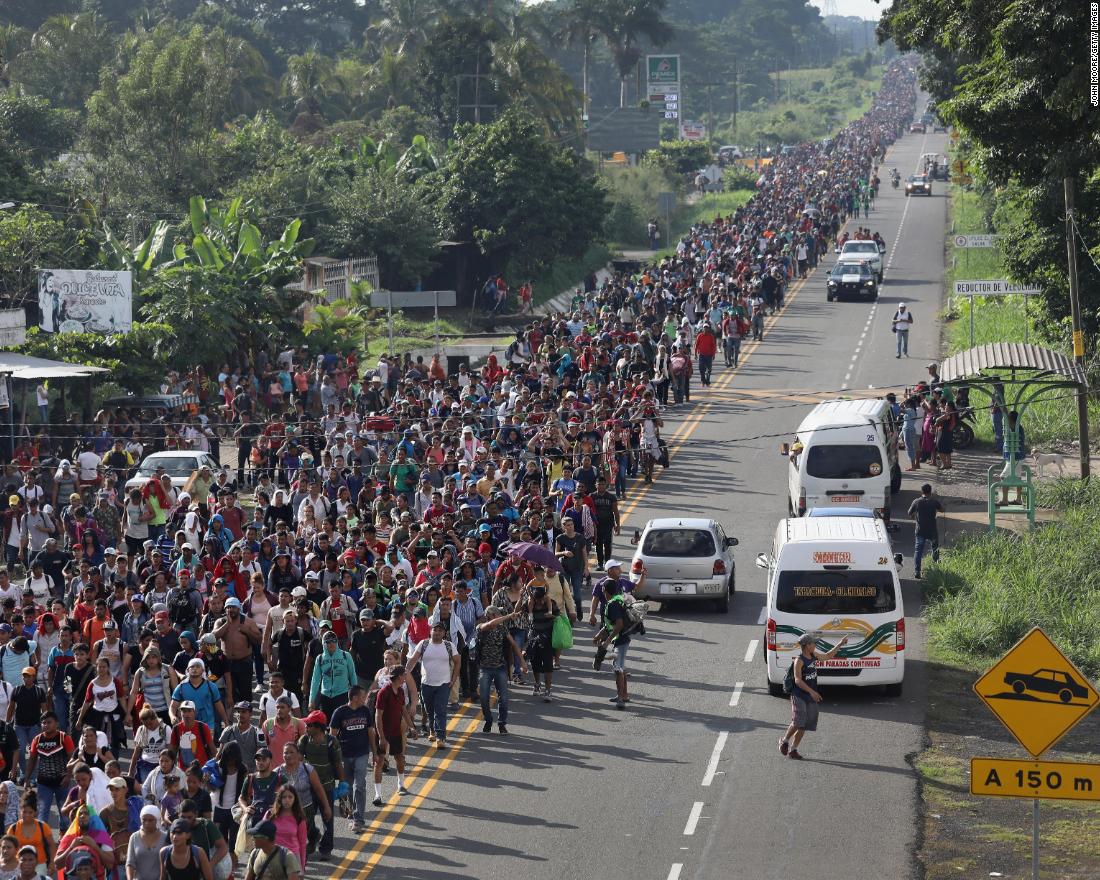
I think about being the Samaritan today, as the plight of thousands of refugees and immigrants is systematically weaponized and ignored in our media. The left, apparently, doesn't think immigration polls well and the right sees the thousands of desperate people trying to reach the unwelcoming, relative comfort of the US as something to be feared. I don't watch cable news, but CNN and Faux are next to HGTV and ESPN at the gym, so I can't help but catch the headlines for an hour or so 3-4 times a week.
I've struggled with how to address the issues beyond simply the religious approach. As a follower of Jesus Christ, I can't see the world through the eyes of an American citizen, but only as a citizen of the Kingdom of God. Thus, borders and documentation don't mean much to me. People are people and we all deserve the same treatment no matter where we are or how we got there. Immigration isn't really a "debate."
Not everyone begins from the same perspective, though. US civil religion has infiltrated our culture enough that many people see themselves as US citizens first (or, worse, no difference between being a Christian and being an American - maranatha). Is there a way to approach this situation that goes beyond legalities and borders and fear - fear is the key element, as always, that we fight. We're challenged to be afraid of the other, of the sacrifice that loving someone else might mean for us.

When we see desperate people fleeing for their lives - whether it be in Guatemala or Syria or those dark-skinned neighbors moving in from the city for a safer neighborhood and a better school district - our reaction cannot be "there might be a few bad apples mixed in, so I better avoid the whole lot." That's what our culture is doing right now. Better safe than sorry is an extreme reaction to fear. It might keep us physically safer, but it's killing our souls, diminishing our humanity, and literally costing thousands of vulnerable people their physical lives.
We must be moved with compassion - not just the heart-wrenching pain of seeing suffering. I suspect the left-leaning channels avoid the story because real relief for refugees in the US just isn't an immediate reality (not to mention it's a losing issue most places in the upcoming election). We don't like to feel sorry for people when there's not much we can do to alleviate the pain.
Compassion is something deeper - not just feeling another's pain, but identifying with the other in their pain. Until the plight of those refugees is our plight, until their future is inextricably tied up with our future, we are not truly seeing them, valuing them as humans of equal importance. I am guilty of this sin, of omission, or lack. I'm no better than CNN - "poor them; if only there was something we could do."
I don't think it's enough - not by far - but it's better than what we've been doing. Let's, all of us, people of faith or none at all, Democrats of Republican or those fed up with anything red and blue, let's pray or focus or meditate or whatever practice we employ to help form and shape ourselves into people different than we were this morning. Can we beg to be broken? Can we ask or strive to or be transformed into the kind of people who not just notice the plight of others, but internalize it?
We must see ourselves in the suffering, not on some superficial level, but deep down, intrinsically. They are us, not metaphorically, but quite literally. They are us; we are them. That is the hope for a bright and beautiful tomorrow. It seems impossible, but it is not.
May it be so.
Amen.

The ends cannot justify the means, because, for Christians, there is no "end." It doesn't matter what the "right" goal or outcome from a particular policy might be, if it's abusive or un-loving or harmful to peace, it's wrong. "We can't get to ________ without _________" is not a valid argument for doing the wrong thing.
I'm pretty sure I've written about this very thing recently, but I can't find it, so I assume it would be hard for you to track down as well. The idea that we have some obligation to offer alternatives for what the government is doing just flies in the face of Christian action. We're taught and trained to be "citizens" of the US from an early age - most of the time in ways we don't recognize. One of them, though, is this obligation we feel to provide a government solution to everything.
We must have an opinion not just on immigration or gun control or taxes, but on how the government can regulate these things within the Constitution. Why? Why do we feel that obligation? We're not elected officials? We don't have to pass laws or defend them in court? We feel an obligation because we've bought into the American narrative of democracy. A good Libertarian will always tell you, the US isn't actually a Democracy, but a Republic - which means we elect people to speak for us, rather than actually speaking for ourselves. We're not actually part of the process, as much as the narrative says otherwise. The only thing that keeps a Republic from becoming an Oligarchy is the consent of the people.
Outside of that, though, why does the government response to anything dictate our understanding of it. I believe people deserve healthcare and education and a warm place to sleep and nutritious food and meaningful work. I don't have to provide some blueprint for the US government to provide those things (if it even ever could), because politics is more than elections and laws. Politics is the way a society functions, the way people engage with each other. It encompasses everything. Yes, laws and government are part of that, but they are not "politics." Politics is much bigger.
The Bible is pretty clear that there's no special treatment for God's people - the "us" and the "them" are one and the same, in our attitudes and actions, at the very least. There is no argument from citizenship or safety in the Church of Jesus Christ, because citizenship in God's Kingdom doesn't come with any special rights or privileges; there is no promise of safety (in fact, actually a promise of the exact opposite).
I get that not everyone is a Christian and that citizens of the United States have different rights and expectations. I know no earthly government can or will operate on a Christian perspective. I would never argue for such a thing. Just because not everything a government does is inherently evil, though, doesn't mean, however, that Christians should compromise their beliefs or principles to accommodate or participate in the empires of the world. A "Christian nation" is just a myth and we've got to put myths to bed - you can't play both sides.
Immigration is only complicated if you're working from a Constitution or the electoral realities of a nation state. If you're a Christian, those things are quite simple. The problem only arises when you try to hold them together. Christians should have already made a choice - if you haven't, now's the time.
Applaud the good done by the nations of the world, oppose the bad; there is no obligation to offer a compromise - indeed, a compromise does not exist.
