
I'm no expert on Brazilian affairs, but this really isn't about Brazil - every community and culture create their own scapegoats to avoid dealing with real, entrenched problems (if you're looking for an easy example: the US scapegoats party culture as a way of avoiding our dysfunctional attitudes towards drugs, alcohol, and sex).
In reality, Rio isn't a very safe place. The government had to take extraordinary measures just to bring their security up to a minimum acceptable level for an international athletic competition. They mobilized reserve military officers, cleaned out favellas, and basically cordoned off entire neighborhoods to give the Olympics clear access to the parts of the city they needed access to. It was like they created a city within the city (or, more correctly, four small cities with dedicated road and rail ways in between) to ensure that the global generalization of Rio as crime-ridden wouldn't be the story of the Olympics.
That is part of the reason why this Lochte lie is so infuriating to them - here's an actual made-up story that reinforces the stereotype. People deserve to be mad. That sucks, especially after all the work they went to. But it's a bit hypocritical to say Lochte is creating a false narrative about the safety of the games when really he's just creating a false perception about the already false narrative Brazil itself took to present a different face to the world.
If Rio was as safe a place as we're led to believe, none of those pre-Games precautions would've been necessary. Lochte, as wrong as he most certainly was/is, just presents a convenient scapegoat to avoid the larger, uncomfortable truth. The entitled American. The beauty of a scapegoat is that they're rarely 100% innocent, which makes it easier to pin all the blame on them. Before Lochte, in Brazil it was the favellas - the famous Rio slums - thus justifying the displacement of poor communities. Prior to that, the ongoing class tussle over who's more responsible for the spiraling economic inequality.
We saw the same thing with the World Cup in Brazil just two years ago - and those street protests led to huge corruption probes and the impeachment of the President. I found it ironic that an official spokeswoman this week said in a radio interview that the World Cup went off without any incidents - but I remember reading multiple first-person accounts from journalists that involved sprinting down closed streets under armed police protection while angry crowds launched homemade Molotov Cocktails at the special protection zones set up for World Cup participants, journalists, and fans.
It's a "king has no clothes" scenario - and the scapegoat provides the out.
Yes, four drunk swimmers messed up a gas station, tried to buy their way out of it and told a lie assuming their credibility would hold up and Rio was too poor to have decent video surveillance? That's not good, but it's not the makings of an international incident - as the Brazilian government and the US media would have us believe. It's a diversion - and not an unfamiliar one.
Our real problems are buried deep, and addressing them requires facing and enduring pain we'd rather just avoid. Putting all that drama, junk, and responsibility on someone else seems like a great deal. They become the villain, we excise our demons; life goes on.
Of course it doesn't, though. Because the pressure will just build up again and we'll need another outlet. One scapegoat can only survive so long, then we'll go looking for more. And more. It's as if we're addicted to denial and, at some point, there's not even enough left to get us high.
In the end, the real mistake is pinning fault on one person or a group instead of people taking a collective responsibility for the problems we've collectively created. I still use, "we," even though I'm not Brazilian and have never been there, simply because there is no limit to the scapegoating. It would be easy to oversimplify the other way - say "Rio is unsafe," and move along. I made a stupid, snide comment on Facebook about the whole thing the other day that played right into the danger stereotype in a way that just scapegoated Brazil rather than addressing the issue (part of the reason why I'm writing this longer piece - I need atonement). It's the same problem created by making Lochte just another spoiled athlete or boorish American athlete; we avoid claiming responsibility for our own severe lack of global understanding, empathy, and cameraderie, as well as our severe wealth of arrogance.
Blame someone else, I can pretend it's not my problem. I'm not an alcoholic because that other guy beats his wife every time he comes home drunk. We make "him" the villain to keep fooling ourselves into thinking we're not so bad. It's all about perspective - are we looking at the world in the easiest way for us, in ways that make us comfortable - or are we genuinely interested in tackling the real, entrenched problems that tend to bring us (all of us) down?
Gosh, personally, I'm just not sure - but I think the best course of action is to take responsibility first and dole it out later.
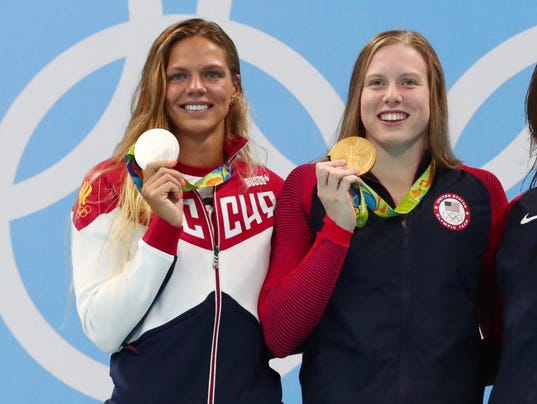
There was a little trouble with Lily King and her comments on doping becoming a new Cold War, USA vs Russia thing, but those blew over pretty quickly. I'm glad a young athlete has the courage to speak out and make a statement - it's exactly the kind of thing we want a 19 year old to do. I was a little troubled, though, that nowhere, does it seem, is NBC going to address the complexity of issues that come along with this Russian doping problem.
It'll likely come up again as Track and Field takes off in the second week, since Russia's entire track team was banned from the games. I'll say up front, I was and remain supportive of the move to ban all Russian athletes from the Games. Yes, it is an unfair punishment for athletes that were never involved in doping, but really Russia was the one making it unfair for them - and bland punishments like this one do nothing to discourage the same kind of thing going forward. The IOC left it up to individual sporting federations to rule on Russian participation. Most sports, like swimming, reviewed athletes on a case by case basis, with some pretty nebulous criteria, before allowing participation. The ambiguity is troubling.
At the same time, the ambiguity of a state-sponsored doping program is troubling, too. Julia Efimova, the Russian swimmer King picked her verbal fight with has been banned twice for doping offenses. King made the case that no one (including US track star, Justin Gatlin) previously caught doping should be able to compete ever.
It's a harsh, but certainly understandable position. Especially in a modern athletic environment where most legitimate supplements have third-party testing and verification so those "it must have been contaminated" excuses we've heard from baseball players over the years don't hold weight anymore. At the same time, a situation like Russia is complicated. Again, King is 19 - she's supposed to think in black & white; I'm just glad she feels bold enough to speak. She's also spent her life in the US athletic environment, which is the most democratic in the world. Usain Bolt was injured for the Jamaican Olympic trials, but they still put him on the team - US athletes never get that special treatment, even the biggest stars; you have to perform to earn your spot.
It's not the same in other place. Russia, especially, as we've seen, has a large state presence in sport. Athletes are chosen, sometimes, for political reasons over performance. In the instance of a state-sponsored program like this, the ultimatum of "take this supplement or never compete for Russia again," isn't all that far-fetched. Efimova and any of the other Russian athletes involved didn't exactly have the clear cut choice PEDs are so often made out to be.
We laugh about the long-standing world records set in the late 70's and 80's by eastern bloc athletes - especially female track athletes and how they're so nearly impossible to break because of the state sponsored doping programs at the time. The athletes become the villains in those stories like Drago in Rocky when more than likely they were taken from their families at a young age, when athletic aptitude was first spotted, and had their lives run for them as they rose to prominence. I'm not saying that Putin was holding a gun to someone's head and forcing a strange powder into their smoothie, but it's also not like an after-school special. Things are complicated.
You can add to that the very real belief by not a few people that everyone is still doping, especially track sprinters, and when coupled with national pressure, there's very little incentive not to go along.
You can make the ambiguity argument for Gatlin as well. He got caught twice, served a long suspension, but seems genuinely the victim of ignorance and bad coaching. His offenses were at the height of widespread doping and well before athletes had real tools for taking responsibility. That doesn't mean he's clean, though - he may simply be doping because it's the only way for him to win and make a living. We just don't know. No one thought cyclists were doping either, right up until they found out literally every single one of them was doing it. It's this ambiguity that makes modern athletics so beautiful and terrifying.
NPR had an author on this week, talking about how performance enhancing drugs were considered a normal and necessary part of professional athletics right up into the 1960's. To do amazing things, people expected athletes to use as much science as was available - and trusted them to judge for themselves how they treated their own bodies. Yes, this was before TV and money was really involved, and it was prior to understanding the long-term effects of these substances - but that only adds to the ambiguity, it doesn't lessen anything.
On top of all that, you have the delineation of what's ok and what's not. Laser eye surgery can correct vision beyond "perfect," improving sight beyond what a "normal" person would have. Is that an unfair advantage? The same might go for advanced blood transfusion techniques - which some sports ban and others allow. What about gene therapy and medical science coming down the road?
It's never, ever going to be cut and dry. Shoot, the boxing, rugby, and the NFL have to worry about whether playing the sport itself is too great a danger to athletes, let alone any of the other additions or performance enhancers that might be involved. We're all going to draw a line somewhere - and I want Lily King to keep doing it and talking about it - but we need to be very careful about making heroes and villains out of this whole thing. We've got to have rules - I think Russia got off too easy in this whole mess. At the same time, we have to remember: in sport, we want things to be simple and definitive, it just never is.
Athletics and ambiguity always go hand in hand.
