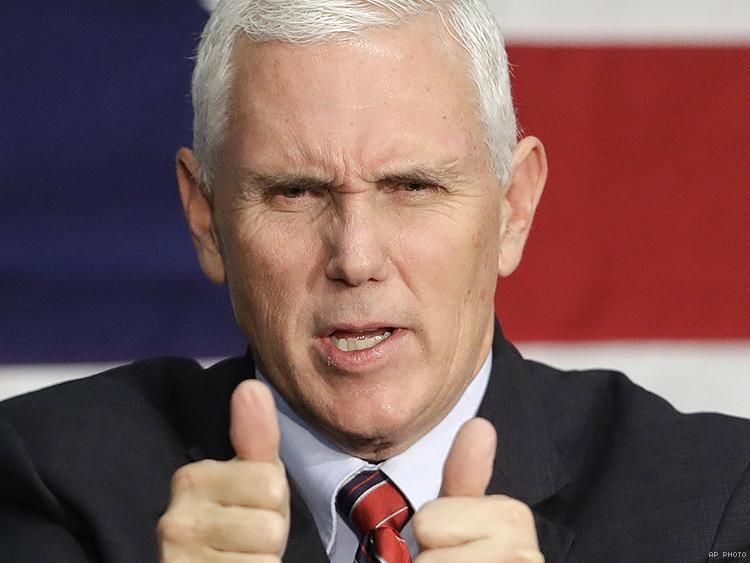
I cannot bring to mind a policy position of Mike Pence's with which I agree. There may be some, but they're not prominent. I find his political philosophy to be odious, ill-conceived, and frankly, dangerous. Shoot, having run and now serving with Trump, there's a whole lot of reason to question his once potentially upstanding moral character. Needless to say, this is not a guy for whom I've ever had much sympathy.
However, I read the big attack piece from Rolling Stone that came out after the inauguration and I find myself deeply on Pence's side. This is entirely the fault of the author, whose practice here is pretty common, but really offends me as, I guess, a working journalist.
Rolling Stone is provocative and unconventional; they push the envelope in a lot of ways, but, in my experience, they have a long reputation for really good work. The place might have its eccentricities when it comes to style and approach, but I've always found their standards to be above those of perhaps similar publications.
This is a long piece. It details a whole bunch of things Pence has done or said that are probably offensive to the general readership of Rolling Stone. As I said before, I'd likely agree that a lot of his past is not something for which I'd be proud. What irks me the most, though, is that when you've got such a plethora of topics to cover - legitimate topics that Pence himself wouldn't quabble* with on a factual basis - there is absolutely no need to delve into the sketchier issues that could easily be framed in multiple ways.
I get it if you need to pad the story - either it's not long enough or the angle you're going for isn't as well supported by the juicy stuff as the periphery and you need cover. That makes sense. It's less than ideal, but sometimes, with deadlines, you have to make do with what you've got and not with what you'd want. But this piece is long and full of substance, yet they still have to pile on with claims and issues that are more likely to distract from the overall strength of the piece than help it.
It reads like a hatchet job. It reeks of angst and bitterness. It's the kind of thing you write solely for people who agree with you. Maybe that's what Rolling Stone has become, but this would upset even if it were self-published on an angelfire blog (which, apparently still exist).
Again, I'm not objecting because I'm a fan of Mike Pence or believe that the tone and message of the piece are necessarily wrong. I don't. I'm offended because it's an example of shooting yourself in the foot, argumentatively. It's bad logic; it's bad case-building; and it's mean. I don't like meanness - and it certainly has no place in reporting.
The biggest issue I took was with the narrative surrounding his campaign spending early on. They do make sure to say that what Pence did wasn't and isn't illegal - he used campaign funds to pay personal expenses, bills and the like. Yeah, it's bad optics, sure, but it's a terrible argument that the guy is somehow hypocritical or crooked. More likely, he was a young guy who couldn't afford to both run for public office and also support his family. That happens. Campaigning, even for small, low-level positions, can be a full time job. As someone who's never made much and occasionally contemplated public service, money is the number one concern. You can't win without it and I don't have it.
Why would we want to make this fact of Pence's past some giant bogeyman just because we don't like the guy? This scenario could and does literally happen to anyone, of any party or no party at all. It's an economic issue that pales, pales, pales in comparison to the giant, clear-cut case you've already made in the same piece. It's like you're saying poor people shouldn't run for office when I'm guessing our government would be far better off if our elected representatives included more people who couldn't afford to be there on their own dime.
This article doesn't bother me on a political level - I have no inclination to really side with either the author or the subject (although, as I've said, I'm no fan of the subject - and I've never heard of the author). It's just bad, inefficient, poorly constructed argument and that offends me as a person with a brain. Why, when there are so, so many legitimate critiques of a public figure, would a writer feel the need to shoehorn manipulated narrative into an already incredibly long piece?
It's not like the article hasn't proven its point well before this point. People are either going to agree or disagree, but that will have nothing to do with the persuasiveness of these last few paragraphs. It just makes you look petty and vindictive and hurts your credibility.
Maybe it's a lesson for all of us. Think, people. Let's not let our emotions or our subjectivities cloud our reason, judgement, or kindness. People are far more divided right now by the way in which we talk to and about each other than any actual policy or ideological difference. Let's not feed the beast. You can be serious and assertive without being mean - in fact, it'll only help your standing and reputation, at least among other people who can see through the junk.
Rant over.
Aren't you glad I waited almost three weeks to put this up. Imagine what the post would've looked like if I'd done it right away! You're welcome.
*No, I meant quabble. I really and truly did. Quibble doesn't cut it here.
Chris Rock is a comedian. He's also a really smart dude. He comes to things from an interesting perspective and he's always got something to say that's been well thought out. He doesn't shoot from the hip. I really enjoyed this recent interview with him. They cover a lot of things (including his new movie, that I think may be very good) like politics and race.
He's got a great line when asked about the difference between the black civil rights movement and the one currently happening with the LGBT community. "I always call Ellen DeGeneres the gay Rosa Parks. If Rosa Parks had one of the most popular daytime TV shows, I’m sure the civil-rights movement would’ve moved a little bit faster too."
There's a lot of good stuff there about Obama and politics in general. I've seen a few places pick up his take on racial progress.
Here’s the thing. When we talk about race relations in America or racial progress, it’s all nonsense. There are no race relations. White people were crazy. Now they’re not as crazy. To say that black people have made progress would be to say they deserve what happened to them before.
So, to say Obama is progress is saying that he’s the first black person that is qualified to be president. That’s not black progress. That’s white progress. There’s been black people qualified to be president for hundreds of years. If you saw Tina Turner and Ike having a lovely breakfast over there, would you say their relationship’s improved? Some people would. But a smart person would go, “Oh, he stopped punching her in the face.” It’s not up to her. Ike and Tina Turner’s relationship has nothing to do with Tina Turner. Nothing. It just doesn’t. The question is, you know, my kids are smart, educated, beautiful, polite children. There have been smart, educated, beautiful, polite black children for hundreds of years. The advantage that my children have is that my children are encountering the nicest white people that America has ever produced. Let’s hope America keeps producing nicer white people.
Chris Rock doesn't do interviews unless he's promoting a movie (even though he barely talks about the movie), so enjoy it while it lasts. You can find lots more Rock at Grantland, the New Yorker, Rolling Stone, and Hollywood Reporter. He can do whatever interviews he wants because he's so unavailable, but also because he's one of the few celebrities entirely free to speak his mind. He's made tons of money and his audience won't care what he says. He's also got five lifetimes worth of street cred, so he can speak honestly both from and to his place as a prominent African American.
Another person in a similar position is Killer Mike, a rapper (currently of Run the Jewels). There's a great podcast with him on Grantland. Here he engages on topics of importance to the black experience, but not in the sort of monolithic way so many of us (white people) are used to hearing it. There's only a few minutes at the beginning about music, the rest (and it's more than an hour) is unique, intelligent, and challenging for anybody.
When speaking of racial progress, I have to agree with Rock: it's about white people changing. One of the things I notice about racial discussions in this country is that they're less about race, especially among younger people. This is not the old trope about class being the new race (class will always be a divisive topic), but something different about the motivations behind our discussions of race. This is really in the generation behind me (and although I'm 33, there is at least one, if not two full generations of adults, distinctly different, younger than me), but race seems less about race. We can't deny the shocking numbers of racial disparity, but in the end, when (younger) white people are upset about Ferguson these days, it's not because a black man was denied justice, but because a human being was.
That's not to say race isn't a component and an important one (white human beings still have a better time of it in the justice department), but I think white people may actually starting to view people who look different as people first. I think (hope) this will allow for us to hear and express a true diversity of opinion. So that when Chris Rock or Killer Mike speak to the public, they can do so AS black men, but not ON BEHALF of black men.
When a black man in a suit is on CNN, 95% of the time, the audience assumes (or is supposed to assume) he's speaking on behalf of black people. It's the black opinion. That doesn't happen with white men - we all assume they speak for themselves or perhaps a specific group with whom they hold a position (like the NRA or Greenpeace). Obviously, the hope is for that to change. I'm sure even Al Sharpton would love (well, wouldn't totally mind, might be more like it) to fade into a chorus of diverse black voices with access to mainstream media.
I share all these links today in the hopes more people can gain access to the kind of perspective we don't always hear, especially in a world where everything is condensed into soundbites. There's no "us vs them" stuff here. It's two men, with their own unique identities, expressing their own individual opinions in public forum. I wouldn't necessarily agree with everything said and they certainly don't necessarily agree with each other. Race is a part of who they are, it informs their perspective and opinions, but they don't allow it to be the defining aspect of what they have to say.
Neither should we.
If we manage that, well, then it might just be some small step on whatever Chris Rock will call racial progress.
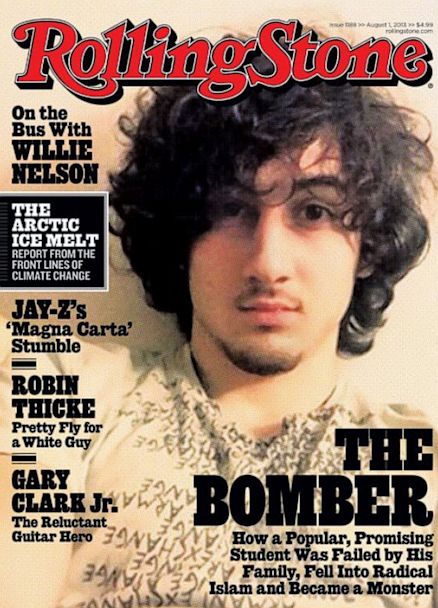
It might be that I'm from nowhere. I'll give you that. But if I am from somewhere, that place is Boston. Still, I'll admit, I'm having a lot of trouble with the furor over the upcoming Rolling Stone cover with Dzhokhar Tsarnaev on the cover. I've read TIME Magazines and Newsweeks (RIP) with Osama Bin Laden featured prominently. Is the issue more because it's a flattering picture and not dirty, bearded Saddam Hussein?
I read the arguments about not validating horrible acts with fame, although they're silly. Famously bad people get famous; you refuse to reward them by making sure they deal with the consequences of their famously bad acts.
I suspect it has more to do with the notion that Rolling Stone will feature a story, not about a cold-blooded killer, but about a confused kid that in way over his head. We're outraged by the sympathy - as if sympathy itself is finite and any sympathy given to "the bad guy" is sympathy taken from his innocent victims. I haven't read the story; I've not even read an account of anyone who's read the story. It may very well make Tsarnaev a victim alongside those people he hurt. I'm not sure what's wrong with that.
Not every victim is innocent. Not every terrorist is evil.
To be sure, there are plenty of innocent victims here. People were killed, maimed, injured, traumatized by the senseless, stupid actions of two disillusioned brothers. That's not up for debate. No matter how righteous our perceived cause or how serious our perceived indignities (and our causes and indignities are always perceived), violence is never the right choice. It just isn't. Ever.
But I'm troubled that our society so quickly condemns anyone willing to explore the depths of a complicated situation. We like simplicity. We like it a lot. But then again, simplicity is not real life (the same can be said for Trayvon and George).
We want to categorize people good and bad, usually so we can distinguish "us" from "them." We like the fantasy that some human beings are downright evil. It keeps us from facing the reality that, as humans, we're all capable, under the right circumstances, of all the evil any of us are capable of.
None of us should be defined by our actions. We can certainly be described by our actions, but that's a far cry from defining us that way. I've known people who grew up with absentee fathers who've really struggled with this distinction. When you've got a Dad incapable of anything good, it's tough to realize that this dispicability isn't genetic. They have to differentiate between the actions of their father (which are bad) and the person of their father (who is dad). The same applies to all our heroes and villains.
The homeless man with the golden voice, who made headlines, reunited with his family, and went on all the feel-good morning talk shows - he relapsed shortly thereafter, then again a few months later. He's got a job and a home and a future, but he's not perfect. He's a man chock full of good and bad; neither define him. They describe him.
Don't get me wrong, description is still important. People who have done a lot of stealing are likely not the best to hire as house-sitters. We must all live with the consequences of our actions. Those are real. I hope the Rolling Stone piece doesn't gloss over the tragedy that brought Tsarnaev to our attention. It would be unconscionable.
But actually exploring the forces in a person's life that lead them to evil (or to good) is interesting and valuable and far too rare in our world today.
It's way better than just guessing, which is how it normally works. We judge people based on gut instinct and any variety of subjective criteria. Howard Dean gets excited during a campaign speech, yells crazily, like Slim Pickins riding the bomb, and his political career is over. Anthony Weiner texts a picture of his junk to a woman who's not his wife and he becomes the next mayor of New York. Capricious.
We want to hate Dzhokhar Tsarnaev. He's done some bad stuff. The consequence of which is that his life ends at 19 years old, whether he's executed or not. Does that make him a tragic figure? I don't know, but I think it's fantastic that someone is trying to find out.


