
One of the interesting subplots in the show (and I don't think I'll give a ton away here, but if you're a super stickler for spoilers, you might want to have someone else read it first) is the daughter, Paige, who ends up rebelling against her parents by joining a church and becoming a Christian. It's difficult for her atheist, communist parents to deal with (the same thing every teenager and parents deal with, just interesting particulars). On a show filled with metaphors and allusions, this subplot is ripe for many of them.
We've just finished season three now and, as we've all been expecting, Paige finally finds out what her parents do. They've told her they're spies from Russia and if she tells anyone (even her younger brother), her parents will probably go to jail forever. It's a lot for a 15 year old to process. She has a really tough time. She always felt her parents were hiding something, but she never expected this.
There's a couple episodes where she's struggling with her identity - trying to figure out who she really is and what it all means. What's so fascinating to me, though, as a Christian, is that Paige's identity crisis is not about whether she should be loyal to Russia or the US, but whether she can deal with the reality of what her parents are/do and still be a Christian.
I mean she's a teenager, growing up in a house where, let's face it, her parents were not super patriotic. Now she's in a situation where her whole life, essentially, is a lie - and if she's going to continue to live it, she'll also have to be a liar. It's in direct contradiction with the faith she's chosen (and a faith that's provide some real depth and stability in her life).
As a pastor, it's this sort of decision about allegiance I try to communicate to people as necessary to wrestle with. The way of Christ is inherently different than the way of the world and culture around us (whether its Soviet communism or American free-market capitalism) - there are real choices we're forced to make revolving around what we believe and how we'll act in response.
To see this sort of identity crisis played out on TV is pretty profound. It's probably the most authentic representation of Christian faith you'll see anywhere on TV (including the "Christian" channels or all those bible-based miniseries out right now). This is what the gospels are all about - Jesus preaching a new way, something different from what we've come to expect. This is what the letters of Paul are all about - how to live differently in the midst of a contradictory culture. It's the sort of question our generic, americanized version of Christianity seems to be squeezing out of public (and Christian) discourse in recent years.
I'll be interested to see how much of this faith conflict makes it onto the screen in future episodes of The Americans. Based on how they ended season three, it looks like it'll be pretty important to the start of season four. This decision between finding identity in Christ and finding identity in family is an issue with a long, complicated history. One of the best books I've ever read When the Church was a Family by Joseph Hellerman, delves deeply into it. I've loved this book for a while, recommended it to many and passed my own copy on as often as I can. I just quite expected The Americans to become a case study for the ideas therein.
Just another good reason to spend some time watching TV.

In respect to those who disagree, I do have a pretty strong stance. I can't see any way to justify killing anyone without violating the core Christian claim that Jesus Christ is Lord. There's a much longer post about that somewhere - maybe I've already written it (you'll have to check). This week, I've become more curious about why and under what circumstances Christians became so assuredly and avowedly supportive of capital punishment.
It used to be a topic on which Christians were either adamantly opposed or seriously conflicted. It's been a relatively recently (recently in a historical sense, not a personal one) that the inverse position arose so strongly.
I wonder if it has something to do with the rise of democracy and the subtle, but definite loss of Christianity as an alternative community.
Early on, Christians were an alternative community by necessity. Their refusal to worship the emperor and the proclamation that Jesus Christ is Lord (and thus Caesar is not), led them to be excluded from society and often killed. They had to look out for one another, because no one else would do it.
Ultimately, they grasped onto the notion of God's people - as Paul teaches, Christians are grafted onto the tree of Israel and remain a community "set apart" for a different life - an example to the world of how God created us to live.
This became slightly confused when the empire adopted the faith. It's only slightly confused because, while everyone was baptized from birth, the idea of fervency or serious faith existed mostly in the monasteries. There was still a set apart community. There was also still an empire. They may have been Christian in name, but the empire operated in the same manner it always had: control through coercion and power.
This separation, though, is quite necessary. While Christianity is a voluntary community (meaning the is free entry and exit), society is involuntary. As much as we'd sometimes like to live in the woods, off the grid, that existence doesn't exempt us from the rule of society. Everyone is necessarily involved. Being expelled isn't an option.
Well, expelled from society means killed. Empire has always practiced capital punishment, and no one has ever really objected to it. It is a necessity of societal rule, a requirement of empire. And empire has always been the counterpoint to the Church. Our prisons have "cells" because one of the early forms of societal punishment was for criminals to be sent to the monastery (where monks live in cells). It was thought that the rhythms of service, discipline, and devotion found there could help people to learn the ways of humanity from those dedicated to practicing forgiveness and humility. It was an attempt at reformation.
Of course, this often worked so well because the alternative was the empire. If you didn't learn the rhythms of the monastery, you were sent back into "the real world," and left at the mercy of society, which often meant death. Even before we had formal societies, when we were roving the hills as bands of hunter-gatherers, the threat of expulsion was real and life-threatening. As individual could literally not survive in the wild without the help of a tribe.
I used quotes for "the real world" above, because one of the tenets of Christian practice is that God's way is indeed the real world - the narrative of empire is fantasy. It is love, not coercion that changes the world. Discipline, in Christian practice, is one of sacrifice and patience. It may cost us something, perhaps our own lives and definitely suffering. An angry person may steal or injure or kill; our response is love and self-sacrifice. They may steal or kill again. Our response remains love. We do so in imitation of the God who allowed us to kill him, rather than force change upon us.
It's a strange notion for the world in which we live, but it is the very alternative-ness of the Church that allows it to thrive. You see, Christianity works on the concept of eternity. This life is not the end. If loving people, even difficult people, requires our lives, while it is a difficult and tragic sacrifice, it is not the end of the story. We can have patience because we have literally all the time in the world. We can toil away at seemingly fruitless love of enemies because we have faith that God will bring all things to completion in the end.
Society doesn't have that luxury. It is required to keep the peace now, since now is all it has. We may live 80 years if we're lucky and there is some urgency for society to get those 80 years right for the largest number of people. Society is unwilling to sacrifice for the possible redemption of a criminal. Instead, society locks people away, thinking a few years of dehumanization will suddenly make people more human. If all else fails, we kill them. Time is just too short.
What I fear, though, with the advent of democracy and especially the merging, for many Christians, of the Church and the State at least ideologically (the US as a new Israel, the religious undercurrents ascribed to the founding of the US, etc) is that we've lost (or given away) the Church as an alternative community.
Most people think the notion that society can be perfected (the Social Gospel movement) died out with the horror of WWI, but it remains alive today in the hearts of so many Christians who expect empire to operate on "Christian" principles. We merge the necessity of empire with the hopeful ideology of the Church and produce some bastardized version of life.
This replaces the stark contrast of Empire and Church with what amounts to the deification of sanctified practicality.
There is a real difference between saying "society is justified in executing people" and saying "Christians can and should justify this behavior as right." For many modern, Western Christians, we've ceased to treat our faith as primary and relegated it to one aspect of our lives, thus making the Church and society indivisible in our minds and lives.
Our churches have largely become one thing we do in the midst of our life in the world. We are subject primarily to the structure and authority of the society in which we live; the Church is secondary. It is one aspect of our lives; it no longer defines our lives.
With this comes our own association with the requirements of power. It's not just "them" who have responsibility for peace keeping, now it's us. We're included. We take on this mantle and necessarily revoke our ability to be an alternative.
I am not saying we must divest ourselves entirely from "the system" to be an alternative. Christians can advocate for more human responses to crime, but we must do so from a position of alternative. If we're not offering other ways of being in the world, we have no right to speak to changes in the world around us.
We must reclaim the notion of Christianity as alternative community. Yes, it is difficult to live in a society that willingly asks us to participate, without forgoing our allegiance to Christ - but it is not impossible. The ultimate message of the cross is that the way of the world, the way of empire: violence, coercion, selfishness, is not the way to live. Christ overturns those notions with radical self-giving and proves them in resurrection.
We participate in society, but our allegiance lies elsewhere. That's often been a dangerous position (which is why we've largely abandoned it), but when lived in peace and with patience - it has the power to change the world. The alternative way of Christ may not work out well in the world of empire, but it is the only way to live in an eternity which has already begun.
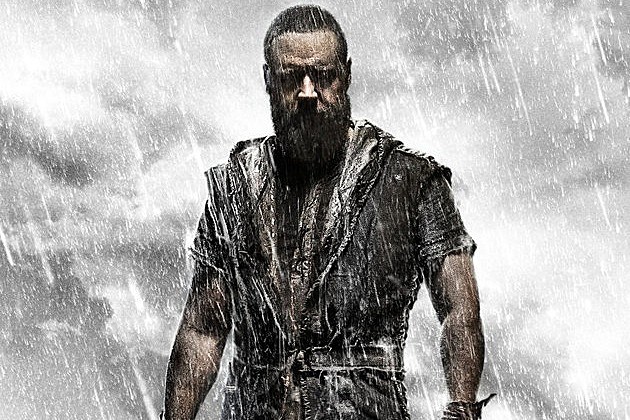
There's so much to the Noah story that can be explored. It's set well before there is an Israel or even really much defined relationship between humans a God. There's so much history and mythos and speculation about even the reality or extent of the flood. The story crosses cultures (there's a flood story among the ancient tales of Peru, even) and Aronofsky is also a smart, creative, unique mind - raised Jewish and steeped in Hebrew Scripture. Noah's been his favorite biblical character his entire life.
I'm less than impressed by the trailer, but I still have high hopes for this one.
Then, of course, Entertainment Weekly came in the mail. There's a pretty lengthy (for EW)story about the biblically themed movies coming out this Spring (also Son of God and Ridley Scott's Exodus). Much of the article centered around the controversy Aronofsky is sparking among "Christian" moviegoers (whatever that means) and the ways in which movie studios have (successfully or otherwise) attracted Christian viewers.
Everyone's making nice now, but they screened five different cuts of Noah and it sure sounds like Aronofsky is walking the company line. I hope they release the movie he wants to make.
The main objections are the extra-biblical elements that necessarily have to go into a Noah movie. Scripture says scant little about Noah - and the things it says are less than flattering. Aronofsky has to make things up to flesh out the narrative. A lot of Christians don't like this.
I get the perspective that says "the Bible is perfect and if we touch it we're being sacreligeous," even if I don't necessarily agree with it. It's even more complicated with Noah, who exists, essentially, in pre-history. There's a lot of anthropology and history that can be brought to bear - stuff that often challenges the traditional interpretations of Bible life.
"Christian" at the movies seem to like very simple things. They want a story that affirms what they believe - and there is very little demand for quality film-making. I can't begin to tell you how terrible most of the movies that get pitched to churches really are. Awful, unbearable things - that most people I go to church with seem to like just fine. I'll never get that (and it's why I'm scared to death of Son of God).
I want movies that challenge my faith. I want to be exposed to different approaches and perspectives on biblical stories and themes (so long as their done intelligently - looking at you, Ridley, and your rock-star, Christian Bale Moses who might have been "cynical about the idea of an afterlife," - and all the Hebrew scholars groan). I like to challenge my thinking, my perspective. In my view, that's what faith is all about.
A faith that doesn't want to be tested is no faith at all. Maybe that's the real problem with mainstream evangelical culture - perhaps its more participation in a system of belief than any actual faith at all? Do we really lack security of our beliefs to such a degree that we're desperate for any sort of confirmation, even if it's weak and shallow? I sure hope not.
Yesterday, when I was sending out feelers for topics for this post (sorry I didn't actually take any of them), my cousin suggested "why old-school Christians aren't the enemy." I didn't follow up on that because I wasn't sure exactly what he meant by "old school." I'm not sure it's a matter of old-school vs new school, because our preferences always change and we tend to rebel against what's gone before out of sheer novelty. I see "modern" Christians and "traditional" Christians operating in this same mindset with a different kind of window dressing.
I don't see more or less value in modern or traditional or whatever accountrements we use to dress up our faith. I'm primarily concerned with a faith that means something, a faith that has been tested - a faith that is willing to be tested. Whether that hesitancy to question and challenge faith comes in fancy new packaging or entrenched in the "old-school," I hope it gets called out and confronted. Real faith is an unwavering belief that things will work out in the end. Being scared of every movie coming down the chute just doesn't match up.
I could care less if Noah is faithful to the modern, Sunday School version of Noah - with the cartoon animals having a grand old ball on the wooden cruise ship of a hardworking, upstanding citizen - because that version is mostly crap. I'd love for Aronofsky to infuse some cultural elements into the narrative that more appropriately place it in the proper historical context than in our modern-revisionist view of the Bible.
Because, in the end, my faith is stronger than a cinematic expression. It has to be able to stand up this kind of challenge (if indeed there is any challenge at all) or it's not really faith.

I've been putting off this third installment of the Marriage, Gender series for a while (a year), mostly because I suspect everyone who reads this will be disappointed in some way. But, given the news of UMC minister Frank Schaefer recently, and a host of other similar conversations, it seems like the right time. There are at least a dozen of you to whom I promised a more in depth answer. Well, here it is:
This will not be a post with in-depth discussion of the various biblical passages addressing homosexuality. There aren't a lot of them and you can find intense dissections of all of them with varying conclusions at the drop of a hat. I find many arguments compelling, but none compelling enough to settle the matter resolutely. Like most attempts to find answers in scripture, we get more guidance than command. We have to delve the depths of conscience and context and make judgments. Scripture is not a list of rules and laws, but an authoritative narrative pointing to relationship with God. Things are not always so simple.
I have no problem believing people are born gay. Why? Because I'm not gay and I have to accept the word of those who are - honestly and openly, no matter how dubious the claim or how skeptical I might be. I have no other choice. At the same time, I have to accept the word of those who claim miraculous changes in sexual orientation, no matter how dubious the claim or how skeptical I might be. I believe that it's likely a trauma or abuse in childhood could affect someone's sexual orientation - psychological crap does crazy things to people all the time. I also think it's silly to assume every gay person was somehow abused into it.
All that being said, we need to make clear that reparative therapy - essentially attempts to undue perceived trauma or abuse with further trauma and abuse is categorically evil and should be condemned, even if it's entered into willingly. If indeed an individual believes their orientation is changable (and needs to be changed), there are healthy, therapeutic ways to approach counseling, you know, overseen by trained professionals.
The bigger question for me, especially as someone who takes the Bible seriously, is whether God intended gay people to be that way, or if there was some problem. I don't think there is anything wrong with gay people, nothing less than ideal or sub-optimal - at least not any more than any of the rest of us.
If you're looking from a purely evolutionary perspective, homosexuality is an anomaly. Evolution is driven by a desire to pass along DNA to a new generation. Breeding that produces offspring is important to that end. Homosexuality is both natural and unnatural. Natural in that it is largely genetic, unnatural in that it doesn't line up with biological determinism.
I don't believe God designs any individual. I don't think God chooses our hair color, eye color, our addictions, our immune system, or our sexual orientation. I believe God created the world in the same way I can be said to create cherries by planting a seed. I believe God set in motion various forces in the world that led to creation as we have it. More and more I believe God intends for things to be different, even counter to what might be called ideal precisely because God wants to communicate love to all creation regardless of individual merit. I wrote more about this here.
I don't think God makes us in any particularity, but that God loves all of us equally, regardless of any preconceived disability or deficiency.
As humans, some of us are naturally cautious. We were born that way. Others tend to act before they think. There may be some evolutionary advantages to both inclinations, but it seems like our society favors the former. Evolution favors the cautious - or at least it did when we were mostly prey. I'm a cautious person and I understand completely why it's better to be cautious and I can provide you any number of reasons to back that up - because I have a lot of time to think about such things while I'm not having the kind of fun the adventurous types have most of the time.
I'm not about to say, though, that either of these inclinations is anathema, unintended, inappropriate. The point of life is not to be the right way - to become cautious or to be less so - the point of life is to figure out how to live in spite of (or because of) who you are.
I recognize that people have many different definitions of what it means to live rightly in the world. I want to affirm everyone's right to figure that out and decide for themselves what it means to live rightly. I have no desire to impose my perspective on anyone else in any way. I will defend the right of any adult to make their own decisions for themselves and I believe any discrimination, public or private, based on sexual identity or orientation is a terrible tragedy. From here on out, I speak from my perspective as a Christian about how I think Christians should answer these questions.
As a Christian, my purpose is defined by the life, death, and resurrection of Jesus Christ, whose message of self-giving, sacrificial, radical love shapes and informs everything I do. Because of that, I look to the history and tradition of God's people to figure out how to live. Scripture, the Bible, is the main way in which I do that.
When it comes to homosexuality, there is just one question for the Church to answer: Can people of the same sex participate in marriages that reflect God's love and faithfulness in the same way heterosexual people can?
You see, I still believe (as explained more deeply in the Marriage post) that lifelong, committed marriage is the only proper, healthy avenue for sexual expression. So the question is not "can a person act on their attraction to the opposite sex," but "can gay people get married?" The rest sort of takes care of itself.
As to marriage, yes, Genesis says a man shall be united with his wife and they shall become one flesh, but to read modern concepts of marriage into verses like this do disrespect to history.
Throughout history, many societies have had accepted, if never mentioned examples of homosexual relationships. Men would often take younger proteges as lovers. This partly developed because of the oppression of women, who were never considered equal and were (are) treated as sub-human in many places - a regrettable necessity for procreation. We must remember that marriage, for most of human history, had nothing to do with affection or love, it was designed for social stability, for making babies, and for consolidating status and power. In societies where male-male relations were the norm, usually for the elite, these were occasionally the most affectionate and loving relationships men had.
The Judeo-Christian ethic of marriage arose in counter to these societies. Scripture is pretty clear that the sexual ethics of God's people are specifically to set them apart from the societies around them. I'd argue though, as I have in the Marriage post, that primary among this counter-example was chastity and fidelity. You marry a wife and you stick with her, care for her, and turn - neither emotionally or physically - to anyone else.
Obviously the people of God weren't great at learning or keeping these values. There was a lot of polygamy and prostitution was as rife in Israel as anywhere else. But the principle remained the same - and eventually was (mostly) adopted by God's people.
In neither case was gay marriage even a matter of thought. You married for procreation, for social standing (maybe to ensure the continued subservience of women), but not for love. You married a women because you needed kids - life could not exist without offspring - they were the essential lifeblood of society.
Things are different now. There are plenty of offspring in the world. We've also vastly changed the criteria by which we choose marriage. It's almost exclusively based on affection, at least in the Western world (the only world I really know). Which is why we face such a dilemma.
Can people of the same sex participate in marriages that reflect God's love and faithfulness in the same way heterosexual people can?
Some Christians answer no and ask gay Christians to remain celibate. Others say yes, and call those gay Christians who believe marriage is part of God's call on their lives to marry with the kind of self-giving, radical love to which we (often poorly) call all people. The gay christian world has named these two responses Side B and Side A, respectively.
I recognize the importance for an organization to have such an opinion - a general guidance for members, but for individuals, I'm not sure such categories are helpful. Each person has to navigate the challenges of integrating their sexuality and their faith. People are different. We're all different. We will (and should) have different ways of working life out - hopefully with the guidance of a loving community.
Some gay Christians will seek and receive "healing," others will choose marriage to a member of the opposite sex (hopefully with the full knowledge and support of their spouse), others will choose to remain celibate, and still others will choose Christian marriage. Hopefully these choices are reached at the end of a thoughtful process of discernment and supported by the Christian communities around us - communities who challenge us to reconcile our conclusions with reason, tradition, experience, and scripture.
I believe there's a scripturally consistent defense of either answer - Side A or Side B - although I do think many of the most vocal supporters of both sides should be furthered challenged to do a better job of their defenses.
My denomination has chosen side B, at least in theory. We've affirmed that sexual orientation is not a choice (at least for the most part), but we've called gay Christians to celibacy. However, we've done a terrible job of actually living that out. There are few Churches of the Nazarene where even a celibate homosexual would be welcomed and included. I doubt many pastors would take such a person into membership and I suspect an openly gay pastor, committed to celibacy, would not find work in the denomination and would likely have their credentials challenged. Our attitude and our actions do not match up. If we're going to take the position we've taken, we need to really take it - as uncomfortable as it might make us.
Part of our difficulty comes because we've not addressed marriage and sexuality well in relationship to the call of God on our lives. I believe firmly that a Christian's commitment to God trumps everything else; there's nothing we shouldn't be willing to sacrifice if we believe it necessary to fully participate in the Kingdom of God. We've rarely included marriage as part of this teaching.
If we're adamant that God created us human, that there is no distinction between male and female (outside the biological, which is what I argued in the Gender post) - then it really doesn't matter who you're attracted to. It matters whether you're willing to give up the right to partner and marry if it serves the Kingdom of God.
I am extremely committed to the authority of my denomination. The Church of the Nazarene is the tribe that birthed me and raised me. I am committed to her core idea of holiness - that we can have the kind of relationship with God that we were created to have right here and right now - that we don't have to wait for heaven to fully be the people God has called us to be. That's what my denomination is about and I am excited to be a Nazarene.
I won't leave my denomination because of our stance on gay marriage. But I also wouldn't leave if it changed.
Quite frankly, it's really only a matter of time anyway. It might be fifty years down the road, but I think it's coming whether anyone around today likes it or not. I don't know anyone under the age of 35 who's really passionate about defending our current position. There're certainly lots of Nazarenes who agree with our stance, but I don't see (m)any who are really going to make keeping the Church of the Nazarene Side B a priority in life. I see a lot of young Nazarenes who are exceptionally passionate about changing our position. In the end, I think passion will win out.
Regardless, I'm here for the long run. I'm sticking with my denomination because I believe God is in control. I believe that the Holy Spirit of God is living and active. I believe that if someone is following Christ honestly, in communion with brother and sisters who all declare together "Jesus Christ is Lord," that God will work it out in our lives. We will receive guidance and direction and discernment and we'll figure it out together. Even if we end up some place totally different than we thought when we started.
As for me, personally - there are a lot of heterosexual couples I would not marry. I'd want to know them in a pastoral way - to know their lives as they live them and not as they present them to me in a few meetings. I'd want to know they are committed to the radical love Christ calls us to in marriage. I'd want to know they could or least wanted to live out marriage as an example of God's love for God's people. I'd need to be satisfied they'd wrestled with the call of God to give up everything - even marriage - before I'd feel comfortable marrying them.
I'll gladly pray at any wedding at which I'm asked to pray. People can always use prayer. I want to pray blessings on every wedding and every couple; marriage isn't easy and we need all the support we can get. I'd pray at a wedding I'm diametrically opposed to happening; I believe that much in prayer.
I also believe I have no right to marry a gay couple, even in protest. This could, of course, be challenged in court, I suppose, but if the denomination who gives me my credentials tells me I can't marry certain people, I'd have to forsake those credentials to do such a wedding - and thus would no longer have the credentials to do it.
Sadly, as a minister in a conservative, evangelical denomination, I've not come across many gay Christians. Our paths don't cross much. Most of the gay people I know have been so hurt by the Church they want nothing to do with Christ. For them, this is a moot issue.
I know it's a cop out, but I don't see much point in answering a hypothetical question when I don't face the real situation. I can't marry a gay couple, nor do I know any who want a Christian wedding well enough to even consider it. I'm not in a position to vote for any sort of change in my denomination and I don't expect I ever will be. I'm not even entirely sure we should be making straightforward designations at the denominational level: we marry these people and not these. I'm perfectly happy to be part of my tribe while we do the hard work of figuring things out. There's a lot to figure out and a lot I just don't know.
What I do know is that God loves everyone. Jesus Christ died to show unconditional love and forgiveness to all people. I know there is peace and joy in our future and I long for each and every person alive to experience those things here and now. I know that we're called - all of us who claim Jesus Christ as Lord - to walk together in love and grace, when we agree and when we disagree.
My denomination must live up to its words and embrace gay Christians as brothers and sisters. We all need to stop demonizing and condemning those brothers and sisters who disagree with us about the place of marriage in the life of gay Christians. Whether we agree about marriage or not - we agree about Christ - and I have faith God can work out these differences. In fact, my faith depends on it.

So, way back a few months ago, there was an article in Relevant Magazine in response to an interview given by the one and only Marcus Mumford, in which he distances himself from the label "Christian" because of the difficult connotations it brings in today's society. He's a big fan of Jesus, but the idea of labeling himself a "Christian" was a bridge too far.
As one who's said the same thing myself from time to time, it's easy to sympathize. It's also easy to be hurt by those, like the author of the article, who imply if not openly state, that such a claim is disloyal or inappropriate for a follower of Christ.
I find myself agreeing with both statements.
I've been mulling this quandary for quite some time now. It's come back to the forefront of my mind in recent weeks with both Fred Phelps and Mark Driscoll making headlines for difficult statements (again). I wrote about the idea of Christian identity earlier this year, name-checking both gentlemen in the process. There's no need to go back there.
I call myself a "follower of Christ" which is essentially what Mumford says in the interview and what the word "Christian" really means anyway. I'm not sure that's the issue. The issue is about disassociating one's self from God's people (Christians), something that's really not OK to do. If God trusts God's people, as cowardly, heretical, and wart-riddled as we are, it doesn't look so good if I can't trust in the same way.
Still, at some point we have to make a judgment as to who is authentically claiming Christ and who isn't. Without a unified body, that is very difficult to do.
We can claim the historic creeds all we want, but there are plenty of Christians who would affirm them and still say all kinds of troublesome rubbish (or write them off entirely because of the compromising influence of Catholicism*).
Martin Luther made the big break, reacting to overreaches by Church leaders. His "sola scriptura" has been turned into a clarion call for individualism. Really, it gets trotted out to allow any person to claim or deny any religious claim based on their understanding of interpretation.
Of course in Luther's time, most people couldn't read, let alone possess a bible. I'm not sure he ever intended for people to "decided for themselves" or ask "what does this scripture mean to me." He just wanted to make sure you didn't need an advanced degree to ask informed questions or participate in accountability.
Most everyone has moderated their position pretty well since then. Protestants, for the most part, recognize the need for authority, while catholics have developed better accountability and openness. I think everyone has sensed a need for at least some chain of authority from scripture to our ethical/theological proclamations.
We're just not in this alone. That becomes no more apparent than when someone spouts off. We decry their claims and denounce them as part of "our faith." In the end, though, without some authoritative body, we lack credibility. Majority doesn't rule when it comes to right and wrong.
What I see from Marcus Mumford (see, it all came back around eventually) is a real and honorable desire to avoid the pitfalls of the past (and present). "Christian" doesn't mean much to people for whom it's just a label. Only those of us who have our identity partially or entirely wrapped up in Christ, really value the label as significant. Mumford is saying that Christ is about more than a label. That's true.
At the same time, we have to recognize that Christ is also more than willing to absorb our failures and prejudices and sins. He's done it before and it hasn't seemed to phase him at all. We can wear the badge "Christian" proudly because it doesn't end with our worst; it promises our best.
Sometimes we react so defensively when people question what it means to be a Christian because we're stuck in our individualism. Who is to say what's wrong with Fred Phelps? Well, he doesn't represent me! Great, but that doesn't mean anything if you both claim to be Christian.
Whether we like it or not, there is an anchor, a root, a tradition, that binds us together. Not just people of faith or people of Christian faith, but all humanity. We do have the individual right and responsibility to figure out what we believe. It just doesn't end there.
*I was going to say "we can deal with that historical anachronism later," but really, it doesn't deserve dealing with, unless you're part of the Eastern Orthodox tradition.
There's been a bit of hubbub surrounding a proposed LGBTQ club at Point Loma Nazarene University. As an ordained Nazarene minister, a fifth generation member and a graduate of two Nazarene institutions of higher learning, this has been an interesting story to follow.
The group was founded in 2009 by a student leader who used an invitation for dialogue to challenge and undermine the school. They got burned and it's not difficult to see how the administration could be leery of the same group, albeit under different leadership, seeking a similar platform.
With the back story (and my lack of knowledge beyond what's been made public), I have to applaud the mission statement this group submitted:
We are aware that LGBT students are a suffering population on the campus of Point Loma Nazarene University (PLNU), and we have realized that the common exclusiveness of the Christian community can overlook the spiritual and interpersonal needs of LGBT community. Through entering this place, we hope LGBT students at PLNU can share their neglected stories, lingering questions, and increasing trials with their Christian comrades, and together, we can learn what it means to practice listening to and dignifying your political or theological enemy and actively learning to live and love in real-time. We hope to seek reconciliation not based on a change of belief system but rather from a commitment to live in relationship with opposing worldviews while seeking to understand and dignify the humanity of the “other.”
This is a pretty powerful statement of charity and reconciliation, one that dovetails pretty well with what I've often used as an ethical motivation - we have to live together. If we believe in a future of peace where the world is as it's intended to be, then we're all going to get along. We might as well start now.
I don't think this means we have to agree. I think things work better when we come to different conclusions about things. I think things work poorly when we refuse to listen and learn from one another. I happen to believe that God's Holy Spirit is at work in the world, speaking and shaping us, even if we don't know it.
I am grateful for a school (Eastern Nazarene College) that created a supportive Christian community without dictating belief. I struggled mightily with issues of faith, belief, and ethics during my college years. I am convinced that were those struggles not undertaken within the context of a Christian community, I would not be a Christian today.
I said, did, and believed a lot of things that I disagree with today - but I did so in the midst of a community drenched in a commitment to God's prevenient grace. My peers and professors, for the most part, trusted that sincere questions of faith would be answered. People prayed for me and with me.
I didn't have a lot of direct conversations with people about faith - but I have a strong group of friends and a wonderful chaplain who were merely present and provided the kind of atmosphere necessary for me and the Holy Spirit to work things out.
Mike Schutz was the chaplain most of my time at ENC, but I don't recall having very many interactions with him during those four years. I do count his influence upon my life as extremely great - mostly because of the spiritual atmosphere he fostered and the space it provided me to grow without pressure.
I'm not sure Point Loma needs a group like this - I'm not really in a position to have an opinion one way or another - I do think the conversation suggested by the mission statement is a necessity. Conversations on faith and sexuality will take place, formally or informally. I think a Christian college does a great disservice to its mission and purpose by ignoring them or limiting them.
I think there's still some perception that we send our kids to a Christian school to protect them from the dangers of the world. Those dangers are just as real at a Nazarene school as they are anywhere else. We shouldn't be fueling this idea that our schools are bastions of purity. They're colleges with a specific mission to serve God and help young people learn to think critically. Refusing a group like this, at least from my perspective, fails to represent both Christian love and our confidence that God is bigger than theological differences. It makes us look scared - and we should be exhibiting a perfect love that casts out all fear.
If we are convinced of the Truth of Jesus Christ, the sufficiency of atonement, the grace of God and the work of the Holy Spirit, we don't have anything to fear from honest (and by that I mean openness and a willingness to be affected by the other) dialogue.
We're going to lose a whole generation of young people in the Church of the Nazarene, not because of our positions or doctrines, but because we seem unwilling to allow a new generation to contribute to our understanding and actually participate.
I have said time and again that our position, at least the position officially outlined, is perfectly defensible and a responsible interpretation of scripture. I think there are reasonable and defensible positions on both "sides" of the debate (just as I think there are unreasonable and indefensible positions on both "sides"). If people who disagree (meaning both sides) are willing to have honest discussions, there is no reason why there can't be a building of respect, even if the end result continues to be disagreement.
Ultimately, I do think the problem is one of fear. We're afraid that people who accept even committed, monogamous homosexual relationships (marriages where denominations allow) might end up in hell - and if we're party to a discussion where even one person changes their mind from our position to the other, that we could be responsible for their eternal damnation.
I don't think that's an irrational fear at all.
I disagree with that line of thinking in a number of ways, certainly, but it does make sense to me. I can see were any kind of open engagement would be difficult to swallow.
I welcome this kind of dialogue because I don't share that fear - and what's more I see every day more and more young people I care about who are questioning faith altogether because of the fear inherent in that mindset. I welcome this kind of dialogue because I believe in hell - that it is full of selfishness and anger and fear all of which lead to pain - and that we experience hell when we allow any of those things to control our lives.
I cast no aspersions on anyone but myself here. I don't want this to sound like an attack. I am merely trying to illustrate the journey I've taken.
I faced down the fear I outlined above - what if I get swayed from the right path, what if I inadvertently sway others to their detriment? I've wallowed in that fear often. In the end, I had to make a choice not to let that fear or any fear - even a well-intentioned fear, hold me captive.
I believe God is in control and that God is big enough and smart enough to handle any problem we might create, but I have to move forward boldly without fear and in love.
Finally, (and I'm sorry this post is so long, but I've taken more than a month off, so you get what you get) I've been processing this alongside an investigation into why this kind of dialogue - not just about homosexuality and faith, but about anything - appears dangerous to many. I wonder if there isn't a bit of a modern-postmodern disconnect at work.
I do think the generation emerging is more comfortable with disagreements if relationship is strong - there's sort of an idea that if I can be confident you're earnestly seeking God, I can trust the Holy Spirit to work things out. It doesn't work so well for building and maintaining institutions, but then again the generation emerging doesn't care much about that either. I do think Nazarene higher education is as best placed to tackle this problem as anyone else. I have hope.
I'm not sure exactly what the solution is - beyond grace and love - but I do think it says something about the way we process and dialogue. I've been taught and value the idea that you enter every conversation willing to be changed or it isn't a real conversation. I want to hear how others have answered tough questions differently than I answered them. I want to share ideas or perspectives someone else might have missed or not considered and I want a light shined on my blind spots as well.
I'm excited about the possibilities that lay beyond the comfort and security of my decided opinions. I'm excited about people who wish to engage diversity of all kinds beyond our own labels and definitions, united solely in Jesus Christ.
Yes, the "other side" might be lying. They might not be willing to commit to the same honesty. They might be up to dirty tricks and sneaky schemes - maybe. I am willing to get burned a thousand times rather than be false myself.
*Big thanks to the community at Naznet for helping me formulate these thoughts - much of this post is adapted from my comments there.

Those of us who have embraced the fulfillment of God's Kingdom attempt to live into a world that is just beginning to ripple. The Kingdom is coming alive, while the former world, the world that seems most real and firm and predictable around us, is dying slowly - a world not long for this world.
Like sunbathers on the beach, unaware of just how quickly and extremely their world is about to change, most people sit calmly, going through the motions. It's an imperfect metaphor, but I feel like Chicken Little - running around like mad because the wave of the Kingdom is coming. That's the sort of urgency that makes us evangelicals.
For me it's not an urgency to avoid hell or even to embrace heaven. It's an urgency that all people, all of creation, embrace the life we were created to live, to find our place in this crazy world.
It's that sense of mission that spurs an alternative lifestyle. You see, screaming about the coming tsunami while sitting on the beach with everyone else doesn't bring with it a lot of credibility. Sort of like Noah building a giant boat in the middle of the desert, a strange request requires a strange lifestyle from time to time. Either we're crazy or we're on to something.
There's really no in between in the Kingdom of God. We're fruitlessly hoping in old wives tales and idealistic dreams or we're ahead of the curve. In my saner moments I embrace the later; in my more radical, I appreciate the first. I don't mind being the dreamer - John Lennon is good company.
I like the fact that God's Kingdom comes in ways that make no sense, defy logic, and frustrate the realistic parts of ourselves. I can give you an explanation of the rationality of belief - and I can make a pretty good case; I just don't like to. The Kingdom is the outrageous notion that life is more than just an average existence punctuated with flashes of brilliance.
I'm not willing to settle for flashes. There's a world of love, justice, peace, joy, forgiveness, and grace. It's just over the horizon and the flashes are just the beginning. It's not enough to simply believe.
There's a big wave coming; we gotta be ready to ride.


