Here's a story for you:
A woman meets a man (think your typical RomCom meet cute) - he loves her from the first moment. Nothing obsessive, just perfect - the way anyone would want to be loved (again, think RomCom). He cares for her needs and puts her above himself and works hard to make sure she's fulfilled in every possible way. He loves her so much the story becomes literally unbelievable, because the guy just seems too perfect.
Eventually, she wakes up one morning in a state of dread and knows precisely what to do. After dinner that evening, she breaks up with him. "It's not you, it's me," she says, "I literally can't wrap my head around why you love me. I'm just not capable of believing I deserve it. I need time to work on myself and reach a point when I feel worthy of this love."
He responds in the best possible way - not pushy or getting upset, but understanding - he says he'll move away and not contact her, but always be waiting for whenever she's ready. "That's not good enough," she says, "I couldn't live with myself if I knew you were not living your life. Please, move on; find someone new."
For fifty years they don't see or hear from each other. Neither one ever finds anyone else, but she's so fulfilled with the healthy life she builds, she never thinks of him again. He doesn't intend to wait for her - he tries to pursue his life and has other relationships - but he never stops loving her.
One day, decades later, both are going into the same cafe in Budapest. He holds the door for her and their eyes meet. They instantly remember each other and sit down together to catch up. He doesn't tell her all the time he spent loving her from afar, knowing it will only make things difficult. He does suggest they continue to see each other and make the most of their remaining years. She declines again - their life would undoubtedly be great together, but she's had such a wonderful life without his love and she doesn't want to change.
As they get up to leave, he leads her to a back door, with a staircase, where he's prepared a torture chamber for just this moment. Using the best advancements in medical science, he keeps her alive for years and years, indefinitely, really, and all the while he tortures her - painful, brutal torture as repayment for rejecting his love. She pleads for him to stop, agreeing to spend eternity with him if he will, but it's too late - and the torture continues to this day and probably will go on forever.
I know it takes a bit of a gruesome turn there at the end, but it's supposed to catch you off guard. I thought about writing the whole thing up like a movie script, but I think there's enough here to get the idea. I came up with story while I was pondering heaven and hell. This feels like the traditional evangelical conception of God - at least in the way it was colloquially communicated to me growing up.
I know that the woman in the story is perhaps a little to good to be true. There's no way she could really have a happy life without God and all that, but she's not really the point. In fact, she's not the point at all. I'm more concerned with how we talk about God. Is God really someone who would bend over backward for a period of time to express selfless, perfect love only to entirely change personalities at an arbitrary hinge point? It just doesn't make sense - on any number of levels.
It's a bit sacrilegious (in some directly literally sense, in that it's only really offensive to a particular kind of religion) to ask questions about judgement, eternity, and the end of the world as we know it. At the same time, those questions have always been asked and debated, if also suppressed. Things are just not ever as neat and tidy as we'd like them to be.
One thing I don't think, though, is that God would change who God is simply because some new era has begun. I know dispensationalism is pretty popular (even if people don't know they've embraced it), but I don't think it holds mustard scripturally or logically. I hope this story illustrates that in some way. Perhaps it makes more sense (and a better Lifetime movie*) if it ends this way.
As they get up to leave, the man vows to himself to change the very fabric of time, to seek out ways to both keep his beloved alive, well, and healthy, but also to stay out of her life, as she requested. He succeeds in his endeavors, spending his life, and eternity thereafter, simply keeping her happy and alive from afar, all the while hoping one day she'll come around.
*Let's be honest, Lifetime would make it with either ending - or maybe with both. They're pretty shameless.
Disclaimer: I was given a free copy of this book for the purpose of review. My integrity is not for sale. Those who know me well are aware a free book isn't enough to assuage my cutting honesty. If I've failed to write a bad review, it has nothing to do with the source of the material and only with the material itself.
Randy Frazee is a good pastor. I've read a number of his books and I'd characterize him, above all, as someone who loves and cares for people. He's not an ideologue or someone in search of fame. I've also dedicated most of my theological exploration in recent years to issues of afterlife and scripture. So seeing a book called What Happens After You Die by Randy Frazee was an easy choice for review.
Frazee addresses this looming question in a loving, careful and personal way. It's rooted in the narrative of his mother's death and both her questions and his explorations relating to what happens when we die. He sets the book up as a biblical exploration of the matter and I'm certainly glad to see a popular pastor and author talking about resurrection vs afterlife and new creation vs disembodied heaven. We need more access to such important, foundational scriptural concepts beyond what's available from NT Wright.
However, I was a bit disappointed in the way Frazee goes about structuring the book. Rather than actually present texts dealing with various issues of life, death, afterlife, resurrection, and new creation, he more explains his conclusions on the matter and provides some scriptural support to back them up. In most cases, his interpretation is certainly not the only reliable and orthodox opinion; it would be better to deal with the passages themselves and guide people through possible answers, rather than supplying the answers and ignoring differing opinions. In this way, readers of this book will not really be able to internalize and process the very questions he hopes to answer. A theologically conservative approach that leaves conclusions open to the reader can be found in Steve Gregg's All You Want to Know About Hell.
I disagree with some of the specifics Frazee presents as "biblical" fact, although certainly he nails the basic outline from scripture with great ease. Frazee essentially lays out a traditional, systematic system of answers for the questions he poses from with the framework of penal substitution theory. Essentially he's working under the assumption that "justice" is God's core character trait - specifically a kind of justice that's informed by our treatment of justice in human society today.
While I won't take a ton of time to present alternative interpretations and conclusions in this space - Rob Bell's book Love Wins deals with the same material in a different way. It's not exactly how I'd answer the questions, but I think it's a much better framework.
Frazee does not beat people over the head with his opinions, while he takes a perspective on eternal destiny that offends my understanding of God and the world, he does it with great sincerity and utmost care. My disagreements are with the substance and not the style of a well-written book that comes off genuine, positive, and encouraging.
I think his lack of symbolic treatment where the specifics of resurrection and new creation are concerned probably creates more problems than it solves. Issues of the cubic footage of the new Jerusalem of how one might be marked on the forehead are simply unnecessary at best and distracting at worst. It provides an incorrect perception on what is an entirely symbolic book - and one already difficult for Christians to understand.
Similarly, I find his picture of heaven far too indulgent to be reflective of Christ or the Kingdom of God. Frazee did not put in enough effort (or explain that effort well enough) to wrestle with the call of God to sacrifice and selflessness in terms of heaven and resurrection life. To say heaven is where our dreams come true without doing the hard work of examining what our dreams are and whether they might be righteous in the first place, is to leave untouched the most difficult aspects of heaven and hell.
I've written plenty of other places, and would be happy to speak personally at more depth, but I just don't believe a future in which some are forever lost, punished, or destroyed accurately represents the God revealed in Jesus Christ. Similarly, a God who lets us off the hook is also unworthy. But a God who loves us unendingly and allows us to be shaped and formed and transformed by the love of God into the beings we were created to be over whatever time it takes is surely the kind of God to whom I can commit my life.
Frazee takes a decidedly hopeful position on the future and the present, but I think there is even more cause for optimism and celebration to go along with our good struggle to be more like Jesus. For what it is, What Happens After You Die is well-written and compassionate, but I'm not sure it adds much of anything to the conversation besides pointing the cultural searchlight to important topics that need more attention.
Disclosure of Material Connection: I received this book free from the publisher through the BookSneeze.com® book review bloggers program. I was not required to write a positive review. The opinions I have expressed are my own. I am disclosing this in accordance with the Federal Trade Commission’s 16 CFR, Part 255: “Guides Concerning the Use of Endorsements and Testimonials in Advertising.”

The idea of Resident Aliens is primarily that the Church is a "colony of heaven," in the way that conquerors (they might call themselves explorers or liberators) develop colonies in new lands, which are reflective of the home culture, so the Church is called to be a colony of a different world in the midst of this world. A Greek colony in Egypt would've maintained the Greek attitudes towards education, commerce, and social relations, despite those things being at odds with the larger world they find themselves living in.
Christians are called to live differently - not to make the world in which they live more Christian, but to present an alternative means of living - one reflective of God's intentions for the world as revealed in Christ. Christ then becomes the key to all this. The book says that when Christians look a the world, we see something that cannot be seen without Christ - the story of Jesus' life, death, and resurrection provides a lens by which we see the whole concept of life differently.
I was reminded of a song we sung in worship a few weeks back. It's entitled "Hold to God's Unchanging Hand," and contains a line that really caught my attention: "Build your hopes on things eternal," which I imagine has traditionally been looked upon as escapist. There's a long modern Christian tradition of viewing the world as imperfect and temporary, thus the common advice when things go poorly is "don't worry, there's another world out there somewhere; think about eternity."
I see this line more in terms of what Hauerwas and Willimon are trying to say: that there is an entirely different way of looking at this world, an eternal view, a "heavenly" view, something more reflective of what God has in mind, as revealed in Christ.
This difference shows up in the second challenge of Resident Aliens' first chapter: to ask the right theological questions. The authors argue that we typically engage the politics of the world on their own terms - this stretches all the way back to Constantine, the Roman Emperor who first embraced Christianity as a unifying force. Since then we've largely asked "how can we run this world in Christian ways?" It's become a political preoccupation that's gotten us nothing but trouble. Instead, what Willimon and Hauerwas propose is that we ask "What would the world look like if it reflected the gospel?"
This is what I think of when I hear, "Build your hopes on things eternal." We don't have to take the systems and structures we have as inevitable. God calls us to build our lives on a different set of principles and realities, to be a true alternative to the way things seem to work in the world around us. This is the colony concept; the Church's purpose is to be something different, not take the world around us and make it different.
I know the immediate "but" in this is "but if you succeed in building an alternative, won't that just attract 'the world' to join, thereby changing the world into something Christian?" In a sense, yes, of course that leads into conversations about HOW precisely that is done - through an actual attempt to change or through a faithful representation of an alternative - but even that is getting ahead of ourselves, right? We're assuming that living faithfully into an alternative is easy - that establishing and maintain this colony of heaven is a given. It's hard work.
The book goes on to talk specifically about how our politics (in whatever way we've worked them out) have failed us and challenging the Church to a new kind of politics, one that operate on its own system, rather than trying to co-opt the systems around us. There's plenty to delve into there, and I'd love to have those conversations if you want to dialogue about them, but I think this first notion is a really important start.
Build your life on things eternal is not about spiritualizing everything, but it's also not about digging in to physical-ize everything either. We've had quite enough of activist Christianity already. I think rather the call is to have our foundational understandings shaped and formed by the gospel rather than by the world in which we live. We have to stop taking for granted the "realities" we're presented with and imagine our realities in light of God's revelation in Christ.
Well, just some random thoughts on a Thursday. Cheerio.
Disclaimer: I was given a free copy of this book for the purpose of review. My integrity is not for sale. Those who know me well are aware a free book isn't enough to assuage my cutting honesty. If I've failed to write a bad review, it has nothing to do with the source of the material and only with the material itself.
Nothing is Wasted by Joseph Bentz opens with seven chapters about redemption. This is the stated point of the book - to encourage people that tragedy is not the end of the story, that the narrative of the world is one of redemption, that God brings beauty from even the ugliest of things. In these chapters, he uses stories, both modern and ancient to illustrate both the tragedy of the world in which we live and the beauty of redemption. Bentz, a literature professor at Azusa Pacific, is a talented writer. His prose is warm and inviting; he paints a great picture.
It's also a vital topic. I believe redemption to be the highest form of love, the purpose for existence itself, and the highest of beauty. THe first half of Bentz's book provides a powerful and forceful picture of the importance of redemption. He talks about how God is always at work making good out of bad. When I picture the beauty of redemption, I most often picture undeserved redemption - when goodness and mercy flow to me even after I've created my own tragedy. Bentz focuses more on undeserved tragedy and the universal human deserving of redemption. This is probably more interesting for the reader.
People question why bad things happen to good people; it might be the defining question of faith and human existence. Bentz tries admirably (and wisely) to stay out of that debate, focusing more on the redemption which God can bring from tragedy, but it's an impossible task. Those early chapters fall short in not addressing the underlying unspoken "why?" Bentz puts the notion that God does not cause tragedy in the mouth of one of his story subjects, but also gives indication that God uses tragedy for a purpose in the explanation of others. There is some talk of free will, but also determinism and it's pretty unclear how exactly Bentz wants us to view God role in tragedy.
I get why an author (and publisher) would seek to avoid what can be a controversial topic - it might slice up the readership for the book and detract from the univerally acknowledged reality of redemption. Still its hard to manage one without the other and that's a real problem in Nothing is Wasted.
The other issue is the second half of the book. A book that begins with sprawling, contagious narratives of hope and redemption ends up in a very narrow, conventional folk theology about Christian life and afterlife that really puts a damper on the wonder and beauty of the opening chapters.
There are several chapters that speak to the notion God might use tragedy to wrench us out of an unhealthy existence, but there's no real care to parse the difference between God using tragedy for this purpose and God planning tragedy for this purpose. At times, these chapters come off as laying guilt on people for not accepting the adventurous challenge of a Spirit-filled life with the gusto they probably should. It seems a far cry from the good news of redemption in the midst of pain and struggle - almost as if he's trying to cram too many objectives into one text.
One of the most joyous results of redemption is the peace and beauty it can provide for people in this life, yet the final chapter of the book talks about how this life is relatively unimportant in light of eternity. This seems to be the opposite of Christian teaching, in which the eternal life of Christ can begin here and now. On page 172 he writes, "Eternity is the fulfillment of the good things our earthly life promises but never quite delivers. It is not simply more of what we have now; it is a life of an entirely different character." I'm not sure I could disagree more; in fact I said pretty much the opposite in a Sunday School class I taught just two weeks ago.
I believe scripture teaches eternity will look very much like the life we live now - yes, there are some redemptive differences we don't fully understand, but we understand that the love, redemption, grace, and peace of eternity is possible here and now. This is the very heart of what makes the Church of the Nazarene distinctive. I'm unsure if Bentz is a Nazarene (although he did go to Olivet Nazarene University for undergrad), but certainly the publishing company is and it seems silly to miss the opportunity to reinforce this point in print.
Finally, the last chapter further talks about how our lives here and now are a constant struggle to find fulfillment. Bentz paints heaven as the thing which will fulfill that desire - even using the extended analogy of medically procured long life to illustrate the failures of the life we're living in comparison to eternity. This is a dangerous notion, in my view. I agree that we're constantly looking for fulfillment, but I think the solution in this life is the same as the solution for eternity: it is recognizing that this desire is a false desire. Self-fulfillment is a dangerous myth. We find our purpose, peace, and place, both in this life and the next, through selfless care and love for others.
The redemption painted in the first half of Nothing is Wasted is really powerful and good. It's a beautiful picture of eternity accessible now through the love and grace of Jesus Christ. One of the benefits of having a talented, professional writer do this book is that these narratives are incredibly well constructed and thoroughly enjoyable. The downside is that the theology is weak and sporadic and muddles the message. If it were just these first few chapters, I'd recommend the book for anyone, especially those struggling with depression or dealing with loss - Nothing is Wasted can be a real source of comfort - but with the second half of the book tacked on, there really isn't enough positive here for me to recommend it overall.

That's the kind of paradox a good Christian can get behind.
Our tradition looks at eternity the same way (at least our theology does; common practice may be a different story). Jesus talks about a never-ending kingdom - this is what scripture means when it talks about heaven, not a fantasy world up in the clouds, but real life done right. There's no end to the kingdom of God, no "point" to heaven. This is pretty much the same thing Buddhists call Nirvana - a place of enlightenment, peace.
But Christians continue to seek after heaven as some sort of goal. Scripture teaches pretty plainly that there is no end (death is just a bump in the road); resurrection means life goes on - it may be a changed life, a transformed one, but it's a life everlasting. We need to stop thinking about "this life and the next." There is just one life and the good news of Jesus' gospel is that we can live into this life now; we can have access to God's never-ending Kingdom right now, before we die. This really is like reincarnation - at least the underlying principle. It's not about dying and coming back (although that happens once), it's about living well as an end in itself. That's how we find purpose in life, it's how we encounter Christ's kingdom, it's how we discover enlightenment. It's how we get to heaven, even if we're not yet dead.
Even the concept of purgatory plays on the same theme. Purgatory is this limbo state in which people wait out or work out or suffer through all the sin and junk that keeps us from being the people God created us to be. The end result of purgatory is heaven. In some sense, we could say the Christian belief is that all life is purgatory. This process by which we live and love and grow and learn is a process by which we discover our purpose: to live - and, in doing so, find transformation.
This is the reason Jesus is so important - because in Christ you find not only the words of life, but the example of life. This embrace of living (even unto death) is how we figure out what it means to live into this eternal kingdom. In Christ we see the fulfillment, the coming together of everything God has revealed from the beginning of time - life lived rightly, embodied in one man.
I think it's easy to pick these connections out across all human beliefs, because I strongly believe that God has been revealed to all people in all times. By that I don't mean all roads lead to God, but that all roads come from God. I also believe all roads lead to Christ, even if you never know the name of Christ or the story. All truth is God's truth and discovering the truth means discovering Christ. Now, as a Christian, it seems especially helpful to have a whole body of teaching laid out to direct and challenge us to right living; it seems preferable over a couple millennia of essentially trial and error - at the same time, I think it's really valuable to have such diverse perspectives on truth. To me, it's even more evidence of a God involved with creation when we see the same core notions of life and eternity emerging from different cultures and locations.
I affirm Christ as Truth and the only means by which we find God. But I'm also not willing to dent the possibility that while all roads may not lead to God, they all, if pursued honestly, lead to Christ, or, more specifically, the Truth Christ embodies.
In the end, it is not the Christian culture that sets the standard for others, but God's creative purpose in the world that transcends all cultures and religions. This is the message of Christ, who came no to start a new religion, but to put an end to all religion - to unify all people in the transformative power of love and to shift our focus from the ends to the means: living life well, for it's own sake.
It's there we find heaven, and life everlasting.

In the buildup from Part I and Part II, we've sort of covered the introductory stuff to get to a place where it feels ok to explain what I've been really excited about - not so much because the idea itself is exciting, but more because it seems to explain things in a way that is a little more cohesive with scripture, the world around us, and the way postmodern theology is trending.
I was talking about some of the things I've covered so far in a Theology of Creation class I took a few years back and the professor (whom you can likely figure out, but will remain nameless here just in case he doesn't want to be associated with this crazy, crackpot idea) mentioned an old Rabbinic teaching about two forces at work in the world - not a "good vs evil" kind of thing, but two contrary, amoral forces underlying reality. (I wrote a paper for that course exploring the biblical and historical basis for this idea, which is long and pretty dense, but gives more detail.)
Ultimately, I decided the biblical basis for the notion was tenuous at best (and that's being generous), but the fact that people have been toying with this notion for thousands of years really sparked my imagination. It struck me how well this notion of two forces fit into the way I had already conceptualized sin and creation; it also made great room for evolution in the process.
Selfishness isn't good or bad - it's one of those amoral forces I mentioned above. Selfishness is what keeps a baby alive - if it didn't cry for food and attention, it would die. There's a sense that our self-preservation is essential to our survival. Now, obviously, selfishness can be really terrible and lead us to do terrible things, but the notion to self-preservation can't be condemned on its own. This is essentially what evolution is - an individual trying to survive and pass some part of itself on to the next generation. That's natural selection; it's survival of the fittest. You can even extend it back to the big bang. Even when the elements of the universe weren't sentient or alive, they were living in a process of continuing.
What if that was how God created? Just spoke existence into existence with the knowledge that things would continue to develop. God wouldn't have to plan out what specific things would evolve and arise, but putting the universe on a trajectory of self-preservation necessarily determined where things would end up. Eventually some specifies would arise capable of understanding this selfish force at work in the world, evaluating it, and potentially acting contrary to the very forces that provided for its creation.
I'm not sure God planned on relatively hairless, bipedal primates as that species (we could have been purple, globulous things with beaks for all it mattered), but we would have the ability to understand our natural inclinations and choose against them. That was the important part. From there God could enter into our existence in a relational way - choosing a specific tribe, for example, to pass on specific guidance for life - but even more broadly than that, the very reality that humans can think outside instinct and drive makes the God who inhabits all reality not only a possibility, but a force in the world we are aware of. The very nature of who we are as humans means we have some understanding of God - it's why we can see core elements of a very similar belief underlying the metaphysical understanding of every culture and religion. There's something deep within us as humans who understand at least the reality of God. The creative force of the universe - this amoral self-regard - demands it.
Now this force, on its own, it utter destruction, right? It's what leads a society to kill of its disabled members, it's troublesome. Those things make sense evolutionarily, but we naturally react against them because we also have within us this force of selfless love. This is the presence and action of God in the world. God is love. This force of selfless love works in tandem with the force of self-preservation, where they can temper each other and keep us moving forward towards God's end.
The way I'd describe the reality of this is simply that from the moment of creation, that self-preservation force "took the lead" (for lack of a better term). This force was the driving force that brought us to existence and drove the world to where it needed to be for God's big turn. That turn comes in the life, death, and resurrection of Jesus Christ. Creation has reached a point (in the fullness of time, as the gospels put it) where God could physically enter into the picture. We always talk about the cross meaning something - that it effects not just spiritual change, but real, permanent, physical change in the world. Theologically we might say Jesus was the "inauguration of the kingdom" or the point in which we start to experience heaven.
In this particular narrative we say this is where self-preservation takes a back seat to the selfless love of God. We talk about the defeat of death and the coming of eternity, in which there is no need for self-preservation because the self will be eternally preserved in resurrection. Death is the roadblock that drives evolution - without the reality of death there is no imperative to grow and change, to reproduce and survive. You can't start a world like our without death - it would change all the rules.
Now, however, we can build upon this world already created - with the rules already in place - and we can begin to work by a different set of rules, to change and shape the future into something that looks like the life Christ lead, the kind of hope and future most religions envision. We begin to work toward heave. Jesus is the turning point.
This leaves us with a future world in which we're being shaped and formed by different rules, moving again, without prejudice for specifics, into a different kind of people - no longer ruled by self-preservation, but by selfless love. This is what people talk about in the coming of the Kingdom. Just as creation could have taken an infinite number of paths to get to it's crisis point, so creation can again take an infinite number of paths to get to our final destination (which may, in itself, be an eternal, continual process - who knows?).
Everything in our world is changing - moving from one thing to another. It always works this way - in nature, within ourselves, and in the relationships we have. There's no reason to think, as the traditional narrative does, that God started with what he wanted, we screwed it up, and the purpose of all existence is to get back to what we lost.
No, rather, I'd argue we were created exactly as God intended - through a process that produces people with a distinct lack, a lack only filled by the selfless, mysterious love of God, exemplified in Christ, that will eventually provide us with the power and grace to become what we ere always intended to be. The story of God is one of things getting better and better, becoming more and more right, ever increasing in value and purpose. So, to address the second half of the title - sin is simply any action which works against this trend, some of it is accidental, some is intentional; some does real damage, some is merely a detour that slows us down, but all of it is covered by the love and grace of the God who designed and inhabits the whole thing.
Now this raises any number of questions - some I've thought through and many, many more that I couldn't even have imagined yet. I'd love to keep doing posts tackling some of those - likely not with answers, but with directions and ideas for further conversation. So bring on the feedback.

So, from Part I we've established the theory that God always intended Adam and Eve to sin. Free will requires an exploring of options, even those that aren't ideal for the world as God intends. Perhaps that first sin wasn't what John Wesley would call sin (even if they knew it was disobedient, they really couldn't have understood the consequences and implications), but in any event it created a rift in God's purposes and in the relationship between Creation and Creator. The tragic problem arises as these humans reject the reconciliation God has waiting for them, thus expanding the rift and the consequences of their sin.
I came to this belief (and when I say "belief" I don't mean so much a necessary tenet of reality so much as perhaps my best explanation for things we may never truly or fully understand) mostly as an attempt to avoid explaining the incarnation of Jesus Christ as a response to human sin; I don't think it should be seen as an afterthought and this better keeps that from being the case.
But, as I've gone through life, it really seems this fits better with what we experience. I've come to view the message of scripture concerning our eternal destiny a bit differently that it was explained to me as a child. I don't see our purpose here on Earth as escaping the world. Whatever heaven awaits us will most certainly be here, on Earth, when it's remade as God intended - or perhaps, when it's become all God intends.
Our experience as people is one of growth and development. As Christians we believe God works in our lives and through our lives to make us into something more than we once were. Our process of spiritual development and discipline brings real change in our lives - but it's not a reclamation of something we lost, but a growing into something to which we're destined.
There is a lot of debate these days about how judgment and eternal life work. The traditional view held our development to end at the end of the world - those worthy at this point would move on to heaven, those unworthy to hell. There's been a recent re-emergence of the notion that those who choose not to be a part of heaven (however it's defined) may simply be vanished, disappeared, eliminated - they might simply cease to exists, since a loving God couldn't rightly torture anyone for life (and also that torture might not be the most God-appropriate way to "encourage" someone towards repentance.
This last point hints of a notion that I tend to believe is best, even though it works against our traditional theology and reading of scripture. What if our chance to follow God, be holy, become the people we're intended to be doesn't end when our "regular" life ends. Someone once asked me, "What if the world to come is the same for everyone, but for those who've been touched and changed by the love of God find it heavenly, while to those who remain in their selfishness, it's hell?" I don't know the specifics of such a world - and I wouldn't want to venture a guess - but the idea that life will continue after resurrection much the way it does now (but with a the full reign of God's love in and through the world) makes a lot of sense to me.
It also brings with it, though, the notion that people might have eternity to come around to God's way of love. People might get forever to be rebellious and chance after chance after chance to reconcile. If it really is an eternity, then there's plenty of time for God's love to win over everybody. I still believe strongly in those scripture passages that seem to indicate not everyone will be saved (so maybe annihilation is the best option), but I'm also willing to admit I don't quite get the ramifications of eternity. An eternal world, ruled and infused with God's holy love and going on without end sure seems like the kind of place that will eventually win over everyone.
I'm not sure that isn't the best way to look at the world.
What this means, really, if we put both Part I and Part II together, is that God created a world in which people would choose selfishness as part of their inherent nature, but would, over time, given eternity, eventually learn to embrace the reconciliation offered by God, fully realized in Jesus Christ, and eventually become the kind of people who reject selfishness for an ongoing life of mutual, interdependent love. That's certainly a faithful, coherent, beautiful description of life that both maintains God's non-coercive love and human freedom.
That's a little shorter than Part I, but it seems a good place to stop for now (I promise, we'll really, actually talk about evolution in Part III).

It's just too easy for us to view the gospel of Jesus Christ through the lens of power politics (a power politics which is the dominant cultural form in our world today). It's easy for us to think of the raising of Christ from the dead as the ultimate power move, a trump card. I'd like to argue the contrary, though. The crucifixion of Jesus Christ is really the ultimate act of powerlessness - God hanging helpless, lifeless on a Roman cross. The resurrection, while expressing the ability of God to overcome Rome and empire and force and might is also a direct counter to the very notion of power.
The gospel of Jesus Christ was and is a gospel of love. Jesus announces a kingdom for the powerless, lost, left out, and forgotten, a kingdom ruled by love and open to all, a place of acceptance and forgiveness - a place of sharing and selflessness, without force or coersion. This image is counter to the notion of human achievement, the ideal of self-sufficiency, of scarcity and competition. It's counter to the notion of power.
Which makes the response of those with power, those who embody and represent the power politics of our world, easy to understand. Someone comes at me (threatens me) with a Kingdom of love, peace, and understanding, it's easy to use my big guns and shut it down. "Jesus says blessed are the poor, but we'll just raise taxes. Jesus says turn the other cheek, but we'll hit you a second time." The dynamic of the world was and is a dynamic of power. Crucifixion is the ultimate counter to the Kingdom of God - it's a statement meant to illustrate the falsity of God's Kingdom, to prove that Jesus' gospel is a myth, a dream, a false hope - that he's out of touch with reality.
In resurrection, though, God changes reality - or perhaps more properly, God underlines a reality that has always existed despite the ways we organize ourselves in society. It's easy to see resurrection as a force response to the force response of power in crucifixion. "You kill my messiah, I'll bring him back to life - what are you going to do now?" It's real easy for us to see the resurrection as a power move in the same way those with authority in our world wield power. We tend to forget (or maybe we never really believe in the first place) that a life built of enemy love and turning the other cheek could actually win out against power, force, and violence.
We have to see it differently, though.
The resurrection is not a power move meant to trump Rome's power move of crucifixion. The resurrection is God removing the ultimate power move from the human arsenal. It's essentially putting the Kingdom of God and the empire of this world on equal footing. Jesus says, "Love your enemies." The world responds, "Kill your enemies." So in resurrection God says, "What if death is no longer a threat? How will you get along now?" Behind all force and coersion is the notion that death is final - I will bend you to my will or you will die in the attempt. Resurrection is like going behind the scenes at a magic show and seeing how the illusions are done. "You thought she was floating, but she was lying on a well disguised table the whole time." You thought death was final, but really it's just another bump in the road. There's no real threat there.
Yes, this is very much a theological statement. Death is still scary, especially a painful death as so many Christian martyrs endured. It's also painful for those left behind. It's not as though resurrection removes death from the equation, but it sure weakens the power of force. It makes the statement that power is not the way to win - certainly not when wielded for evil, but also not when wielded for good (if that's even possible). Power is not the way things work out well.
Only love can do that.
Resurrection is the ultimate statement of powerlessness, because it is the ultimate statement of love. Love gives all its power away. Love is putting all the power in the hands of another. In resurrection God does not force a new way onto the world, but simply dulls the weapons of the world Christ is replacing. Violence and coercion are still options, just options wildly weakened for those who see and live into this new reality. In resurrection, God has essentially put love and hate on equal footing - they become true rival options, equal choices for us in our action and interaction.
Sometimes I wonder if that's why we have eternity out ahead of us, if God didn't realize that some people might take a literal forever to come around to the notion of love over hate. Some people long for finality, for some grand gesture that proves which force is ultimately more powerful. But God doesn't work that way. There is no need to prove the value and power of love. The power of love proves itself.

My faith, at the time, was pretty securely encamped in the "fire insurance" department. I understood faith entirely in terms of afterlife. We are Christians because being Christians is how we get to heaven. If Jesus didn't rise from the dead, it seems very unlikely I will rise from the dead and that would make faith ultimately as pointless as all get out. Why would I give up sex and drinking and movie theaters and prom if I'm not getting anything out of it?
I look at faith quite differently these days. In fact, my faith no longer has anything to do with afterlife. Gospel, as I see it, is not "good news about heaven," but entirely good news about life here and now. The Kingdom of God has come, Jesus was its first citizen, and we don't have to wait to heaven to join in. My faith moved from something (at least intellectually) useless in the present, to something of utmost importance for the here and now.
I see the life, death, and resurrection of Jesus Christ as both teaching us and enabling us to live life as God always intended. Resurrection means that life will continue forever. Not in some disembodied heaven, but in a reconstituted here. I see death as merely a pit stop in the midst of life, not the end.
In fact, if I take stock of what are essential faith claims in my life, I have only two. First, God is at work in the world - active, not passive. The second, Jesus Christ was raised from the dead. If anything, the resurrection of Jesus is even MORE important to my faith now than it was as a formative youngster trying to make sense of those crazy liberal heretics way back when.
Now, though, my attitude towards them is a bit different.
I still disagree, although not with confusion and malice, perhaps with some grudging respect. I still scratch my head in wonder, but I wonder more if it's something I'm lacking as opposed to them.
You see I need resurrection. Not because it's essential to my explanation of God and faith, but because I'm a bit selfish. To me (and I imagine to most Christians out there), resurrection symbolizes confirmation that what Jesus was saying is really true, trustworthy. Jesus said and did some pretty crazy things: love your enemies, give to whomever asks without expecting anything in return, let the dead bury their own dead, don't worry about tomorrow (what you will eat or what you will wear). There's a really radical element of love and non-violence that works against everything our instincts and culture tell us about how to live. It's different.
What's more, it doesn't work out too well in the short term. Culture abhors distinctness. There's a lot of pressure to fall in line. People who refuse to fight often die, they're taken advantage of. Life isn't quite as easy if you go "the gospel way."
So I need resurrection, because then I can at least tell myself this is all for a reason. This world might seem to work one way, but Jesus is God and made this whole thing and it will all be different someday and for eternity; it's already different, we just don't always see it. That's what I believe. It's what I preach every time I step into a pulpit, it's what shapes my life (or what I hope shapes my life).
Now I don't think any of that would be less true without the resurrection. If Jesus is who he says he is and if what he offers as a lifestyle really does work best for life in the world (and I believe both of those to be true), then it doesn't matter if Jesus rose from the dead. It really doesn't. Truth is truth no matter what.
This is precisely the argument some of those magical liberals claim to believe - all the same stuff I do, but without any "proof." Resurrection is at least a hypothetical guarantee. Guarantees are comforting. But the guarantee is only as good as the product being sold. If the Jesus way isn't really the right way, the hope of resurrection is pretty worthless.
That's why I've come to admire those who believe without believing.
Peter Rollins tells a story (which, thanks to Google Books you can read here - starting on page 67 if it doesn't take you to the right place). It's about a group of disciples who leave Jerusalem immediately after the crucifixion, traveling to a far off place and establishing a society where they live in imitation of Christ, not because they believe anything will come of it after their deaths, but simply because they believe his way of life is beautiful.
Not everyone who claims Christ, but denies the resurrection are functioning on this sort of holy plane. Often a skepticism of the supernatural belies a real lack of commitment, rather than a deeper faith. At the same time, I see in myself a real deficiency when it comes to faith. I think I'm lazy enough and selfish enough to just skip the whole endeavor if it won't mean anything beyond this life. I'm sure I'd still be kind and considerate to people when the moment arose - we all want to believe ourselves "good" in that way - but I certainly wouldn't organize my life around a selfless pattern of living. I'd work to get mine. I'd want to do it in a way I could live with, but it sure wouldn't be gospel.
I believe in the resurrection. I'd have no faith without it. I believe the man, Jesus Christ, died and is now again living. I need the resurrection. I need it in so many ways. I just don't believe God needs the resurrection. I believe God used the resurrection for exactly the purpose of promise - showing us what the future entails. At the same time, I believe God could have done things differently and that the life of Christ would be worth the same, even if he'd never been raised from the dead.
I think we have to get there. Maybe not today, maybe not tomorrow, but someday. Because, in the end, if the life we're living only has meaning when it's over, there really is no meaning to life at all.

Disclaimer: I was given a free copy of this book for the purpose of review. My integrity is not for sale. Those who know me well are aware I would relish the chance to give a bad review in exchange for a free book. If I've failed to do so, it has nothing to do with the source of the material and only with the material itself.
Skye Jethani has a unique way of approaching faith and life. I appreciated greatly his perspective in The Divine Commodity and eagerly anticipate his important contributions to public faith. Futureville is an exploration of human purpose in the context of God's overall purpose for creation. Jethani examines the whole scriptural narrative and helps reclaim the biblical concept of vocation - finding responsibility and purpose in everyday life. Futureville is a stand in for the cosmic conclusion, heaven, paradise, whatever comes next. Futureville argues that by properly understanding God's purpose and desired end for creation we can more appropriately live within it. Jethani guides the reader away from the false hopes of humanism and escapism that so captivate Christians and resets the frame on redemption and resurrection; a move I wholeheartedly support and am excited to see more often in print.
Some chapters and some sections of chapters in the book are well written, poignant, and powerfully effective. The book as a whole, however, seemed disjointed and unconnected. It likely needed to be longer or separated into two volumes - one discussing the theology and interpretation of Futureville and the other elucidating what those conclusions mean for Christian life. The two are not well combined in Futureville and the reading experience suffers.
There are some key, if common, mistakes that fall below expectations for a thinker and writer of Jethani's abilities. In explaining the shortcomings of humanism and escapism (dubbed evolution and evacuation for prime alliterative effect) there is too much of a straw man built up. The targets are too easy precisely because all of the positive elements of each belief system are saved for incorporation into "Resurrection," Jethani's third way. I like the third way and I am happy it's included, but there has to be a better way of investigating alternatives than the clumsy manner pursued here.
I really did find the book helpful and positive. While not the best example of what it's trying to do, it is a prominent example and the good parts are surely good enough to make up for the shortcomings.
At the same time, one section in particular really upset me. In the section on humanism he plays up the notion of evolution - primarily social evolution - and the idea that humanity will continue to improve and get better, more moral, more peaceful, more successful as time goes along. He calls the evolution of men to supermen a natural outflow of Darwin's chain of evolution from bacteria to jellyfish to minnows, mice, monkeys, and men. He then proceeds to announce his book won't discuss those kinds of scientific controversies.
There are just better ways of making this point. Again it seems like lazy construction. Even if you're among the disbelievers of biological evolution, a responsible party would take pains to represent the idea in a responsible manner, not playing into the "we came from monkeys" stereotype that's already ingrained in the minds of your largely evangelical audience.
That may be an odd soap box on which to stand and shout, but I'd hope leaders, like Jethani, would take seriously the responsibility to bridge such divides rather than perpetuate them.
Normally, I'd give Futureville 4 out of 5. It's got some very good parts, with a solid focus, with some awkward writings and poor construction. However, there are just too many shortcuts and examples of literary laziness to move it above mediocre.
There are definitely better books with a similar message out there. They may be a little more technical and not quite as accessible, but they're far more straightforward and connected. If you're really just interested in the author, he's got better books available as well.
Disclosure of Material Connection: I received this book free from the publisher through the BookSneeze.com® book review bloggers program. I was not required to write a positive review. The opinions I have expressed are my own. I am disclosing this in accordance with the Federal Trade Commission’s 16 CFR, Part 255: “Guides Concerning the Use of Endorsements and Testimonials in Advertising.”

Later on, in Seminary, as I began to explore the broader tradition of the Church, I came to understand Advent in its uniqueness. It has always been my favorite time of the year (not least because it almost always includes my birthday). I like the anticipation of it. I'm an anticipation guy. I'm usually much more excited for the build up than the event - and that doesn't just apply to Christmas, but to almost anything. I'm far more excited about the road trip than the destination.
Advent is a time of anticipation.
Part of that is recognizing the world around us. I often preach from the Old Testament passages during Advent because I like being reminded that the world is imperfect, that we're waiting for something. The problem is, often these sermons can be a bit of a let down. Too much focus on hope and fulfillment and it feels like I'm shortchanging the unsettledness, the anticipation of the season.
I think I've been missing a step. To those who've sat through those often conflicted sermons of Advents past, I apologize. I will get it better next time.
You see, I've always tried to make Advent special, to set it apart from Christmas - and that's important - but what I've failed to do is place that special, separate season within the context of the larger Christian narrative. We have a "Church Year" for a reason - because the individual seasons are a part of a larger story. I've often missed that.
Advent is about digging deep into the well of sorrow, about recognizing the pain and confusion and hurting and wrongness that exists in our world. That's absolutely true. But it is also, absolutely, about taking that depth of pain and from it painting a glorious picture of hope. We all have an idea, even if it's vague and shadowy, of what the world should be.* Advent is a time to immerse ourselves in the yawning gap between reality and possibility. We're intended to use this season to create a vision of hope, peace, and love so impossible large it overwhelms the senses.
This is a season for dreaming big - about all the things we're too scared to dream of the rest of the year. This is when we dream of families reunited, of wounds healed, diseases cured, hunger satisfied, and abuses reconciled. Advent is the season of impossible dreams, dreams we believe possible only by the thinnest, most outrageous strings of hope and faith.
We do this in preparation for Christmas. So that when we encounter a crying baby, in a cold crib, in a forgotten house, among lowly animals, we are bowled over by the juxtaposition.
We need a grandiose Advent to prepare ourselves properly for the shocking revelation of Christmas - that this giant, impossible dream of everything set right, hopes fulfilled becomes possible because of an impoverished infant, born in a lowly manger, two thousand years ago.
The contrast is jarring, especially in a world where power gets things done. To think that God's plan for bringing earth-shattering (literally) transformation is the weakest, most impossible little baby. It's such a confusing reality that we spend the rest of the year attempting to wrap our heads around this apparent paradox.
Advent is already half over this year - but fortunately it keeps coming back around. Remember, as you struggle to slow down, relax, and wait at a time when everyone is rushing to Christmas, that love really does beat power, weakness tops strength, that beauty really does save the world.
Be present this Advent and don't forget to dream big!
*My friend Justin McRoberts wrote a great piece about Advent Hope this week - check it out.

This notion easily gets merged with Nationalism in unique ways. I've seen in play out in the US, but I haven't really been exposed to other countries - it may be the same there or manifest in different ways.
The US is pretty divided these days between conservatives and progressives - people who want to "get back to when things were right" and people who want to "get on to when things can be right." They might not agree this describes the opposing position, but both are examples of Patriotism in their own right. I think they're both examples of this search for Paradise as well.
Our nostalgia of the 1950's is very strong in this country. The place where Mom kept the home in order and Dad came home on time everyday from a fulfilling job that provided well for the family. Throw in two, mostly well-behaved children and you've got a Normal Rockwell painting. It's an idealized paradise we create in the past. Others go further back, to the founding of the US and all the democratic, capitalist ideals those Founding Fathers planned for this great nation. In either case, the "conservative" patriotic paradise tends to be in the past - something we must reclaim.
Others recognize the very real injustice that has always existed, whether in the US or some other idealized state earlier on (Christians are fond of treating the "early Church" the same way), and they reckon that the true destiny of this country lies ahead and they strive to create the idealization they see in their heads. This, too, is Patriotism - a patriotism of the progressive variety, but one, again, based in this search for Paradise.
Part of this is the Nationalist mechanism through which we see the world. The powers that be recognized at some point that keeping people in competition with each other was better for the powers that be and worked hard - and quite successfully - to limit our understanding of public life to government and rule of law, shutting out other avenues of public discourse (like the economic unity envisioned by Marx - and obscured by Lenin).
These alternative views - which recognize, at their core, that no political entity can every be the foundation of Paradise, can ever provide the Shalom which we all seek - simply do not fit into the tight little box contemporary society has constructed.
The idea being that humanity itself is at the center of our ideals. Marxism, at its core, is one of human egalitarianism - the people, if given the right conditions, can create Paradise. I'm not sure anyone's really give that a fair attempt, but I also suspect a fair attempt won't work out too well.
I am more and more enamored with what is known, for better or for worse, as the Anabaptist tradition - one in which the Body of Christ, Christians, exist as an alternative political entity - not an alternative government or an economic class, but simply as a companion to the other formations of society.
This is also a humanist philosophy - but humanism through the lens of Jesus Christ, the infusion of deity with humanity that embodies Paradise in a person. Figuring out how we relate to and then live in response to that person is a whole separate adventure in itself, but one that makes more sense to me than the well-meaning, but ultimately fruitless versions of Patriotic Paradise we see played out around us everyday.
This difference is that Patriotism tends to be shaped by our own ideals. We imagine the past or the future in ways that make sense to us. In essence, we build our own Paradise and become offended and defensive when others don't share our vision. This is why Patriotism itself can be both a powerful motivator (when it brings unity) and a deadly diversion (when it causes dissension).
Now I am not so naive to think our Christian conceptions of life and society are free from our own inclinations, ideals, and preferences; we can't ever escape our biases. I do hope, however, that there is some measure of selflessness in building an ideal around the life and teaching of someone else, in this case a someone else who was all about selflessness.
Even amongst us Christian alternative politic folks, it's real easy to allow our conceptions of Paradise to creep in - to accentuate the history and scripture with which we resonate and to marginalize those we find untidy or inconvenient - much the same way the Constitution is held up only insomuch as it reflects our Paradise.
The answer, and it's not much of one, I suspect - for both Church and State - is to be constantly incorporating the competing vision into our own. If conservatives are actively seeking to include progressive visions of the future into their own conception and progressives recognizing the value if history and tradition in shaping the future, we become less likely to see ourselves on different teams, as opponents.
If the Fundamentalists and the post-Christian dreamers would stop trying to eradicate each other and attempt to live together, we're going to find more space for everyone. It may not be pretty - in fact it will likely be real messy - but I suspect we'll be a lot closer to Paradise than we could ever imagine (and it probably won't look like any Paradise we've ever seen).
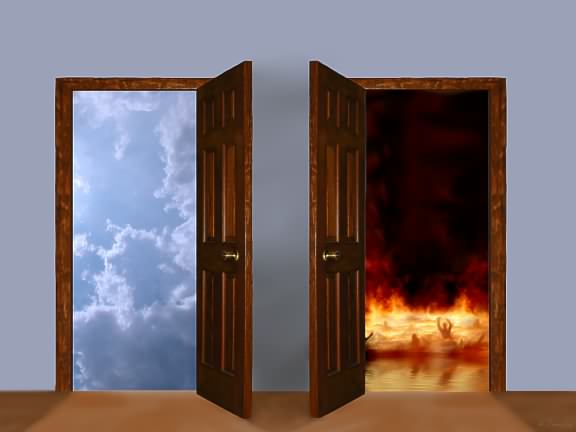
These passages often terrify and/or anger people. I'll admit I'm still occasionally scared that I won't measure up to God's sense of justice, which is, I suppose, a cut above being constantly scared, so I've got that going for me, which is nice. We always seem to be our toughest critic. I know I beat myself up for not living up to this ideal I've got planted in my head. Yeah, I'm not as terrible as some people, but I'm pretty pathetic most of the time. Sometimes it's tough to think God's going to see me and think, "this is what I'm looking for."
Of course, when I think like that, I'm substituting my own sense of what God's justice should be for what God's justice actually is. We're scared or angry with the concept of judgment because we just assume God is going to get it wrong. We might not think that consciously, but we're so accustomed to what passes for "justice" in the world around us, we just assume justice is not all that close to just. We've seen how tough it is to apply a strict set of expectations across the board without getting someone unfairly convicted. These experiences really throw off our perception of God.
In the end, though, God is going to get it right. That's what justice means. Just because what appears to be justice in our world is often wrong or corrupt or unfair, does not mean "justice" in general behaves that way. It's a bit of a nebulous concept and there's some measure of circular logic involved: God will get judgment right... why... because God is the kind of person who gets judgment right.
That's just how it work, though, at least in the intellectual exercise of predicting the future. I'm not sure of the details, of course, but I suspect real judgment and real justice are more about relationship than rules and laws. We humans have this innate desire to treat everyone as if we're all the same. The same crimes deserve the same punishments, every kid gets the same education, every person in the same job deserves the same pay. That kind of thing.
We're all different, though. And while we humans may not be able to appreciate the full nuances of our fellow human beings, I suspect God will. In the end, I don't believe anyone will have any problems with where they end up.* People who don't end up in heaven will really not want to be there.
That's not to say hell is an enjoyable place, but I suspect the misery of heaven could be worse than the misery of hell, to the right kind of person anyway.
It's not just paradise vs punishment after all. That stuff comes from popular religion, weak generalizations, and our tendency to make our theology reflect our culture and not the other way around. If you read scripture closely, heaven is not "whatever you love best in the world," it's not a self-indulgent, individualized Utopia. It's just not like that.
I'm not sure exactly what it is like. I'm not someone from one reality can fully appreciate another. Between here and now, something changes. I can make a lot of guesses, but they won't really get us anywhere. Whatever happens, it's going to be what we deserve and we're all going to be ok with that. I imagine, in some form, our future is going to be an extension of our present. That's why it seems pretty imperative to get our present right.
There's a lot of be said about what exactly those options are - heaven, new creation, hell, annihilation, etc - but for the purposes here we're going to say heaven and hell in the classical sense.

I know it gets a bit kitchy to keep doing posts based on my adorable daughter, but it's fertile ground and we do spend a lot of time together, so it is, I suppose, inevitable.
I love this response and I hope it doesn't change. At some point it will be important for her to provide additional detail about potentially broken bones or bloody gashes, but I hope her first reaction is always to say "I hurt."
The truth is, we're not parts. We can't be split. We're not really us unless we include all of us. There's no division between our body, our mind, our emotions, our soul. This is a false dichotomy (or quadrichotomy, if you prefer).
We talk about someone dying and going to heaven. It's not that simple, though, because their body is in the ground. We're not exactly sure what happens when we die because people stubbornly refuse to come back to life - scripture talks about being present with God, but we're not sure what that means.
We do know, however, that the Hebrews and most other ancient peoples, saw themselves as whole - no divisions. A spirit is not you, just part of you - without the body you're not you. It's why the concept of resurrection is so important to Jewish (and later Christian) faith. Only in resurrection are we fully restored to who we are - complete.
We live in a world where everything is divided. We divide our spiritual lives from our physical, our work life from our home life and our church life, our friends from our family from our co-workers. We divide money from morals and politics from ethics. We're divided. Which means we're not whole. We're not us. We're operating like ghosts or zombies or whatever sub-human analogy you want to hold onto.
We're not us without all of us. We like to think we can take the best parts of ourselves and say "this is the real me - the rest is just dragging me down." It leads to depression and hurt and broken relationships; it leads to us being less than complete.
We are not us unless we're all of us. When one part hurts, we're hurt. When part of us is broken, we're broken. When part of us fails to live up to our expectations, we fail to live up to expectations.
The thing is, it works in reverse as well - whatever part you consider good or pure or right or wonderful, that makes you good and pure and right and wonderful. God made each and every one of us good; God made everything together good. We are good. Yeah, the rough parts, the disappointing parts, the broken parts - they leave something to be dealt with, obstacles to overcome, speed bumps to navigate. Our problems are real, but they don't determine our value.
If my daughter skins her knee, her knee needs help, a band-aid, some lotion. But she's hurt - her emotions need comfort, her spirit needs confidence to overcome the fear of pain, of being hurt again. She needs healing, not a part of her.
We are not split personalities. We're not going to be separated from our problems someday. We can't pretend they're not real or not us or that they'll go away. We just have to embrace them and recognize that we are good despite our frailties. We must remember that we're meant for redemption, reconciliation, healing.
We are good and we are loved - all of us. No split personalities.