
Max Lucado, if you don't know, is a pastor from Texas, but one of the more prolific evangelical authors of recent times. He's published 40 some books and the jacket of this one boasts 130 million total books in print. His writing is basically a Christian version of self-help, with lots of bible verses and basic affirmations. It's not terrible. I don't always (or often) agree with his theology, but I have found his writing helpful from time to time (especially when I was younger and less confident in my own beliefs).
I don't want to trash it, but it's not my thing.
As I read through the book, some chapters seem really good - like they'd be incredible helpful to people who need a dose of hope. Others (far fewer) seem problematic, like they're going to provide a short term fix, but make things worse in the long run. These tend to be over-spiritualized chapters. It's not surprising; one of the hallmarks of evangelical theology is a tendency to downplay or ignore humanity. Modern evangelicalism was birthed out of a theological divide that, in shorthand, led to liberals being associated with social justice and real-world problems, while conservatives became associated with eternal destiny and spiritual health. These are just stereotypes, but they're important.
In one chapter, Lucado talks about how the Devil is the embodiment of evil and selfishness and those people who deny the real, personal existence of a devil are just playing into his schemes for damning our souls. This is very typical evangelical fodder (although a bit dated) perfectly appropriate for someone Lucado's age and for his core audience. I'd argue this kind of talk ends up letting us, as people, off the hook. We blame the devil for our sin and it creates a layer of separation from responsibility. Evangelicals have been trained to take the shame and guilt of sin on ourselves (sometimes too much), but we struggle accepting responsibility, which, in my view, is a real key to overcoming and redeeming our faults and failures.
The most recent chapter I read started and ended with the powerful story of a college softball player who injured her knee rounding first base on a game-winning home run. The rules prevented her teammates from helping her to reach home plate, so the opposing team decided to do it, even though it meant them losing the game. It's a profound story of compassion and selflessness - the kind of thing that can bring a tear to the eye and stir the soul.
Lucado uses it in an interesting way, though. The softball story is bookended around an extended explanation of Jesus' humanity. (Lucado's real talent is somehow extending what should be a paragraph of information into a chapter; that's how you write forty books while working full-time as a pastor.) He talks about how Jesus experienced life as we do, understands our suffering, and offers a solution.
All of that is great. He ends the chapter, though, after revealing the conclusion of the story, by saying what that opposing team did for the injured player in what Jesus wants to do for us. We're stuck in the failure and inadequacy of life, incapable of doing what we need to do and God makes up the difference. That's all true, but it missed the actual, practical point: that we're called to do for others what those players did for their opponent. We're called to be the difference for each other.
Now, I grew up hearing that kind of argument refuted as humanistic. God does for us; we don't do for ourselves. Ultimately that comes back to the Calvinist idea of total depravity - that sin completely removed the image of God from humanity and we're incapable of doing good without God.
That's not the foundational argument for over-spiritualizing, but it is a contributing factor. Many evangelicals want to be careful not to attribute anything good to humanity.
I don't think that's a real worry, because I don't believe in total depravity. I certainly affirm that people are incapable of being good on their own, but I wholeheartedly believe God has always intended to make us partners in the redemption of the universe. God works with us and in us - sometimes before we're even aware of it - to bring good to the world. It doesn't diminish the power of God to say that we can be agents of grace and salvation to one another - so long as we recognize the work of God underneath and within it all.
The real issue evangelicals struggle with - at least in this instance - is the notion that this life doesn't matter. We get so focused on being "in the right place" when we die that our lives become a means to an end. I don't know whether Lucado himself would say it (I don't like putting words in someone's mouth), but many evangelicals would say that grand gesture in the softball game doesn't mean squat if the people involved haven't prayed the right prayer and committed their lives to Jesus Christ.
That's far too dichotomous for me. It's a simplistic separation between the physical and spiritual - something the New Testament and the earliest Christians fought tooth and nail against. Jesus profoundly merged the physical and spiritual; the Jewish tradition (of which Jesus was deeply a part) says we are not us without both elements. The Lord's Supper, the center of our faith, makes it very clear how these two things are completely intertwined.
Yes, Jesus wants to do for us spiritually what those players did so graciously and self-sacrificially for their opponent. We can be lifted up, made whole, healed, and redeemed by the love of Jesus Christ. But that love was manifested in a physical act: suffering and dying out of love for the world. That love continues to be manifested in physical acts, like the one in question and a billion others around the world every day.
In fact, Jesus tells his disciples they will do even greater things than him. Maybe, just maybe, some of those things are fallible, sinful, dysfunctional human beings responding to the love of God by being agents of salvation to each other in the midst of the world. I don't believe eternity is some far off place. I don't believe "afterlife" is the best way to talk about heaven. Eternity begins here and now. God's redemption is happening as we speak. Our call is to be part of it as God calls an enables.
I believe strongly the condition of your soul has far more to do with the condition of your hands and heart than most evangelicals have been led to believe. I suppose there's some danger out there that we could focus so much on humanity that we forget God. I don't think it's likely, though. After all, no one has put more faith in humanity than has God. We'd do well to follow that example.
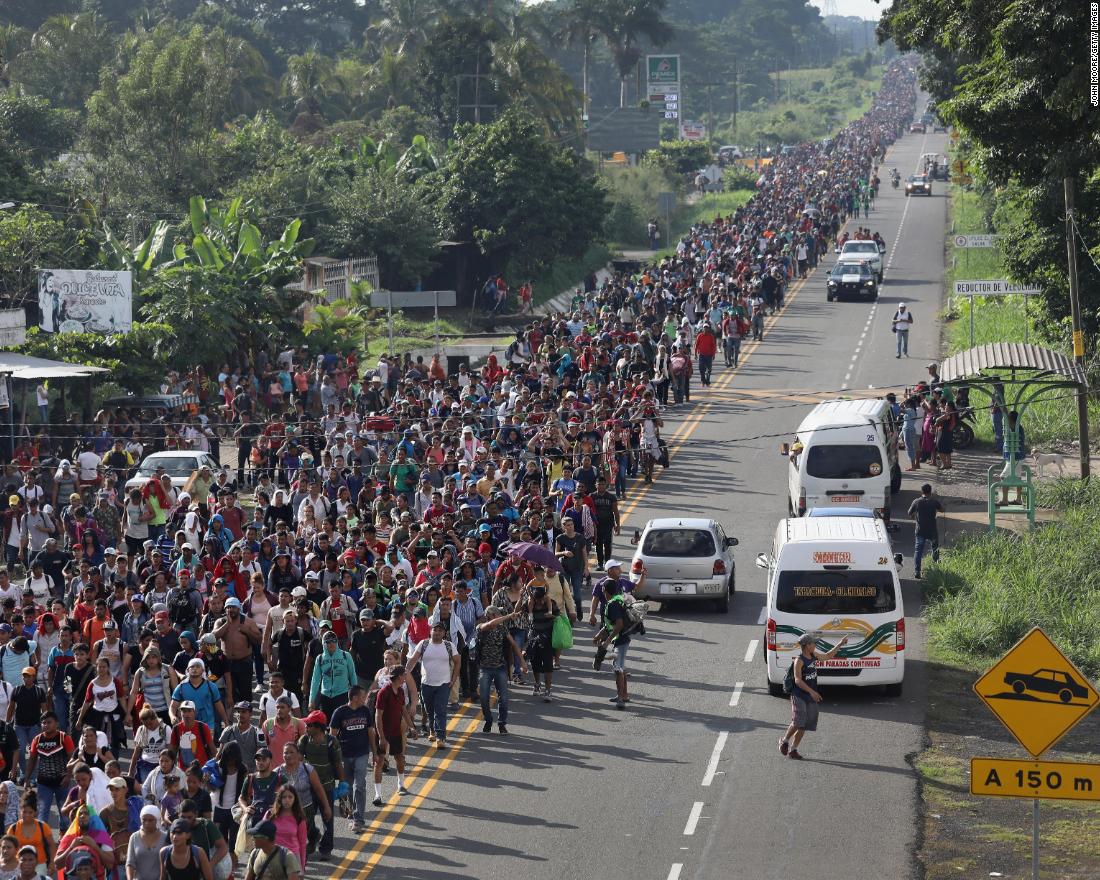
I think about being the Samaritan today, as the plight of thousands of refugees and immigrants is systematically weaponized and ignored in our media. The left, apparently, doesn't think immigration polls well and the right sees the thousands of desperate people trying to reach the unwelcoming, relative comfort of the US as something to be feared. I don't watch cable news, but CNN and Faux are next to HGTV and ESPN at the gym, so I can't help but catch the headlines for an hour or so 3-4 times a week.
I've struggled with how to address the issues beyond simply the religious approach. As a follower of Jesus Christ, I can't see the world through the eyes of an American citizen, but only as a citizen of the Kingdom of God. Thus, borders and documentation don't mean much to me. People are people and we all deserve the same treatment no matter where we are or how we got there. Immigration isn't really a "debate."
Not everyone begins from the same perspective, though. US civil religion has infiltrated our culture enough that many people see themselves as US citizens first (or, worse, no difference between being a Christian and being an American - maranatha). Is there a way to approach this situation that goes beyond legalities and borders and fear - fear is the key element, as always, that we fight. We're challenged to be afraid of the other, of the sacrifice that loving someone else might mean for us.

When we see desperate people fleeing for their lives - whether it be in Guatemala or Syria or those dark-skinned neighbors moving in from the city for a safer neighborhood and a better school district - our reaction cannot be "there might be a few bad apples mixed in, so I better avoid the whole lot." That's what our culture is doing right now. Better safe than sorry is an extreme reaction to fear. It might keep us physically safer, but it's killing our souls, diminishing our humanity, and literally costing thousands of vulnerable people their physical lives.
We must be moved with compassion - not just the heart-wrenching pain of seeing suffering. I suspect the left-leaning channels avoid the story because real relief for refugees in the US just isn't an immediate reality (not to mention it's a losing issue most places in the upcoming election). We don't like to feel sorry for people when there's not much we can do to alleviate the pain.
Compassion is something deeper - not just feeling another's pain, but identifying with the other in their pain. Until the plight of those refugees is our plight, until their future is inextricably tied up with our future, we are not truly seeing them, valuing them as humans of equal importance. I am guilty of this sin, of omission, or lack. I'm no better than CNN - "poor them; if only there was something we could do."
I don't think it's enough - not by far - but it's better than what we've been doing. Let's, all of us, people of faith or none at all, Democrats of Republican or those fed up with anything red and blue, let's pray or focus or meditate or whatever practice we employ to help form and shape ourselves into people different than we were this morning. Can we beg to be broken? Can we ask or strive to or be transformed into the kind of people who not just notice the plight of others, but internalize it?
We must see ourselves in the suffering, not on some superficial level, but deep down, intrinsically. They are us, not metaphorically, but quite literally. They are us; we are them. That is the hope for a bright and beautiful tomorrow. It seems impossible, but it is not.
May it be so.
Amen.

There had been a wave of immigration following the Civil War, which only increased at the end of the century. Most immigrants at least began their lives in the US in the cities, a fact that continues to be true today. There are just better support networks for immigrants in largely populated places. Part of the reaction to this fact in 1910 was a retrenchment from the cities. There was an intellectual rejection of science, education, and global engagement. The suburbs didn't explode until after WWII, but the movement out of the cities (largely by white folks) began earlier.
This is the same period that produced radical, protectionist, conservative politics and the fundamentalist movement in Christianity. New ideas, in general, were rejected because they challenged a largely homogeneous culture that develops when people spend a lot of time with each other. Rural places were familiar and predictable and it brought comfort.
In reading that development, I couldn't help but think about today's US culture. Immigration and "the other" have once again become bogeymen, scapegoats for the plight of white, working-class, largely rural citizens who've been left behind by economic and political changes in the last decade. I've been saying that's it's not really the fault of immigrants, but I've struggled to really articulate an underlying problem.
I don't know the data for our current situation, but I suspect that with the rise of technology and communications, it's becoming easier and easier for immigrants to survive in more rural and suburban areas. Cities are still a big draw, but no longer are a required jumping off point for a new life in the US. Perhaps the encroachment of new ideas, customs, and cultures into previously homogeneous and isolated areas is creating the same kind of fear-based backlash we saw a century ago?
Obviously, it's not really about immigrants, but the new and unpredicatability they present to largely settled communities with accepted ways of life. It's not an issue of "good" and "bad" or "right" and "wrong" so much as it's a necessary struggle to deal with "different." Fear is a natural reaction to different, especially when we're used to accepted and predictable habits - like when our house guests don't put silverware in the dishwasher in the right direction.* There's a real tension that needs to be resolved. It can only be ignored or endured for so long before a conversation needs to be had and an arrangement worked out.
It's the same kind of issues every community goes through, but for rural areas, where population hasn't changed much (in number of composition) those conversations are relics of the past with no immediate memory in the present. We need to get passed the surface fears of change and otherness and see the infusion of new people, ideas, and customs as not a "problem" at all, but a challenge that requires attention. Religious fundamentalists discovered you can only put off dealing with modern science and thought for so long. Yes, the communities and ideas persist, but they bleed off population with each generation, as some adherents fail to escape the necessity of navigating the larger world.
I've never, ever met or experienced anyone who genuinely and openly encountered an "other" with an open mind and ears, who didn't soften their stance on the person or their ideas, even if they continued firmly in their own beliefs. Different people might not (and need not) change our minds to truly change our hearts.
I hate change as much as anyone. I like to have a long runway and lots of time for preparation to do or think anything different, but even I know you can't give in to your fear of change. Other people might have to patient, but we also have to be willing. Change is scary and difficult, but it can't be avoided. If others are willing to give us time, we have to be willing to consider the possibility. All it takes is a little trust and a little grace.
I guess what I'm trying to say is that if I can change, and you can change, everybody can change!
*Knives and small spoons facing down, forks and large spoons facing up, obviously.
Yes, those people we love most often exasperate us and frustrate us and sometimes it seems like the investment in the relationship just isn't worth it - but at the end of the day, those relationships are usually important to us because we use them to help define us. It's still a reflection of us. A parent might be a bad parent, but the part of them that defines themselves as a parent is really strong. That's why its a serious thing to take someone's children from them and why it's the single most amazing thing for a parent to give their child up for adoption.
Co-dependency can become a real problem. We can so define ourselves by our relationships that we never find out who we are - then every relationship has disproportionate value and we can't afford to lose even one of them, even though we lack the ability to maintain any of them. That's real trouble. But we do have to define ourselves somewhat through our relationships. We're relational beings. A parent, a spouse, a child, a teacher, a doctor, a cashier - you can't really be any of those things without other people.*
I don't think any of this is wrong (unless, obviously, it becomes unhealthy) - I'm not sure we can transcend those natural inclinations and we certainly can't be detached, unconnected individuals and still be fully human. I do think, though, it's incomplete.
As I've been thinking about relationships, I've been especially pondering how some people can be so loving and selfless and compassionate towards some people and completely the opposite towards others. Those in a specific circle (let's say the circle of co-dependency, but in the nicest, most respectful way) are protected and served vehemently, while strangers or casual acquaintances are demeaned, devalued, or ignored (if not actively hated).
Because I'm a pastor, the first thing that came to mind was that this is the difference between love and Christian love. I probably should say "Christ-like" love, because Christian is a hairy word in this instance; Christians often love in very un-Christ-like ways, with some of the most restrictive circles imaginable. Some people love only those they know well and whose presence they value (usually for at least partly, and understandably, selfish reasons). Others have trained themselves to love unconditionally (or at least as close as we can get with our biology) - seeing the homeless man on the street with as much compassion as their own child.
Now we certainly don't always act the same towards these two groups - I imagine this comes partly from social conditioning and partly because relationships do matter and no matter how much love we may have for a person, we can only act within the context of the relationship we have - but there is clearly some division between those who seem to love regardless of context and those who have circled the wagons, so to speak, around a particular group.
Now I could be philosophical and say, those wise people with an unlimited love range have understood that everyone is part of our immediate circle - that the well being and health of every person directly affects me - and thus have just come to an enlightened understanding of co-dependency. I think there's some truth there, for sure, but it doesn't seem realistic. We might get to a place where we know that intellectually, but I don't think it can really penetrate our hearts enough to create emotional responses.
I think it's more likely in the compassion neighborhood. We can get to a place where we recognize the inherent value and dignity of every person and thus are able to love them the way we love our close friends and family. We see them as people - whether it's the guy at work who eats at his desk and never talks to anyone or the driver of a car stuck on the side of the road with a flat tire or maybe that neighbor lady who's only ever yelling at people.
Again, we act towards people based on the relationship we have with them (and this is smart), so there's only so much we can do in each scenario, but for me it's a good entry point for a discussion about what it means to be Christian. To paraphrase Jesus in the Sermon on the Mount: "Do you only love those who love you? Even the worst people in the world can do that. Are you proud of yourselves? There's more to love than that."
Maybe that is the call of Christianty (or should be). Do you want to love more and love better? Come and see.
I hope it's this journey towards loving more and loving better than I am dedicating my life to pursuing. I hope it's this journey to love more and love better that people see in me. I hope there are people out there longing to love more and love better that are willing to try and fail (and maybe succeed) along with me. I'm not sure there's anything more to life or faith than just that:
Love more, love better.
*Not that any of the people who are parents or children or doctors or cashiers necessarily define themselves that way, but some certainly do.
Disclaimer: I was given a free copy of this book for the purpose of review. My integrity is not for sale. Those who know me well are aware I would relish the chance to give a bad review in exchange for a free book. If I've failed to do so, it has nothing to do with the source of the material and only with the material itself.
I chose Hope Rising, by Scott C Todd, a VP with Compassion International, as a book to review mostly because I really enjoyed The Hole in Our Gospel by Rich Stearns. Stearns' book was a powerful, formative part of my life in recent years. As the President of World Vision and with the success of the book, I thought perhaps Hope Rising would be a similar attempt to connect with people by Compassion International.
*Another little disclaimer here: I know about half a dozen people who work for Compassion. I, myself, was an employee for about 16 months over the span of four years during and immediately after college.*
When I compare the two books, you can see the real reflection of the organizations behind them. While both are evangelical development organizations, Compassion was always known as the more conservative - not just in theology, but practice as well. World Vision partakes in a variety of different systems and avenues to alleviate all kids of different problems. They accept a lot of different funding sources and work with many different people, including government.
Compassion has kept a single-minded focus on children. They do primarily one-to-one sponsorship and all the extraneous programming revolves around the care and well-being of children and are administered through partnerships with local congregations around the world.
These do not represent a good way and less good way of working. They are different, but equally important and valuable. They're two of the absolute best charities in the world - but they are different.
Rich Stearns in a businessman; he understands the power of a story. His personal story is quite remarkable and his candor in sharing it is inspiring. Scott Todd is more of a scientist. He's a doctor or works in the medical field (it's not quite clear in the book). He's much more comfortable with numbers and explanations. That shows through.
I am a strong supporter of care for the poor. People say that, I suppose, to sound righteous and generous and all that, but relief and development is my thing. I am interested and committed. You do not have to do any convincing to get me to sign up to help. I am the kind of person Hope Rising was written to engage.
Still, I had a hard time getting through the book. I wouldn't have finished it if I didn't think reading the whole thing was important for this review, which I agreed to write. The first half of the book is the strongest part - it lays out some of the misconceptions about poverty within evangelicalism, builds a strong case for the need, and presents solid biblical foundations for action. It is, however, a bit repetitive. The same case could have been made better in about 40% the space.
The second half of the book is supposed to be the part laying out specific actions and concrete steps each person can take to participate in the elimination of extreme poverty. There are some steps, but they're rather vague or sparse. I finished the book with many of the same questions I had going in. It's great to show us how most congregations spend 96% of their income on themselves and to encourage us to do better, but outside of giving the Compassion website a few times, there isn't much in the way of guidance for going about it. I have similar issues with the personal engagement side of things.
Nothing Todd says in the book is wrong. I am not a huge fan of some of his biblical interpretation or his political assumptions, but I can recommend the book - at least given the critiques above. There's a lot of good stuff here and he represents an organization doing it well.
It's not the easiest book to read and it doesn't engage the imagination in profound ways, but I suppose I'd describe Compassion International the same way I'd describe Hope Rising - they're relentless. Nothing special, nothing overly emotional, but straight-forward efficient work towards a worthy goal.
Disclosure of Material Connection: I received this book free from the publisher through the BookSneeze.com® book review bloggers program. I was not required to write a positive review. The opinions I have expressed are my own. I am disclosing this in accordance with the Federal Trade Commission’s 16 CFR, Part 255: “Guides Concerning the Use of Endorsements and Testimonials in Advertising.”

This isn't going to be a diatribe against home schooling. We all know some people do that well and others do it poorly. It's not really against private education or charter schools or online school or any other alternative form of education. My wife was home schooled for half her education; I went to a private high school. I am all for people choosing the best course of action for their kids. I know a lot of people who have special circumstances or needs and make decisions accordingly. I don't want to disparage the choices other have made, but I wanted to lay down why we're committed to public education for our daughter.
First off, it's not because public education is great. It's not. The reason private schools and home schools and charter schools, even unschool, are so popular is because there are a often a lot better ways to educate the next generation than the way it's done in public school. That's just fact.
It's also not because my wife is a public school teacher. Although, having and supporting public schools is what keeps our family in food and clothing. My wife, while certainly not paid what she deserves for the time she puts in, is well compensated. The salary and benefits provided by the State of Delaware allow us to live comfortably. For that I'm really grateful.
For the most part, when it all comes down, we choose public schools because some kids don't have the option.
I spent some time in Kansas City, volunteering at a youth center that worked with what might be called "at risk" kids. More than anything, it gave a little peek into what had been (and maybe still is?) one of the more dysfunctional public school systems in this country. Oddly, though, their chosen method of redress, lots of charter schools, didn't seem to solve any problems. In fact, things kept getting worse.
I noticed that most every kid whose parents were in any way on the ball, were able to apply for and be admitted to a charter school of some kind. Yes, some are better than others and some are downright awful. But, over time, given the system, we could assume that the best schools would emerge and, if given enough space, could accommodate any kids whose family wanted them there.
One of the big reasons for such charter success, however, is the ability to turn kids down. Whether because of learning difficulties beyond the scope of the school, parents unwilling to be involved, or the downright lack of proper decorum from the student themselves, the really "tough" kids got funneled back into public school. Public schools that were then comprised almost entirely of students with no parental support.
I guess what it boils down to is our belief that we're (and this is the proverbial we, not just my wife and I) - we're not just responsible for the education of our own children, but for the education of all children. As unfair as it seems, we're not isolated individuals; we are necessarily interconnected.
The average cost of keeping someone in prison, even at its most favorable ratio*, is a little more than twice the cost of educating them. We pay for other people's kids one way or another.
Any large, public institution is going to have problems - and change is going to be difficult to come by. That's the nature of the beast. Public education has its own unique and often outrageous series of challenges. There are lots of good, honest, caring people who work tirelessly to improve our public education system, while also providing an alternative education for their own kids. That's an important choice and one I won't disparage in any way.
For us, though, we value having that skin in the game. I think it provides a bit more credibility to speak where speaking is needed. There's real value in true solidarity. It's easier to combat poverty if you live in the midst of it. It's more painful, for sure, but its a shared pain. And, not to bring theology into this (although I am a preacher), but if there's one thing that makes God truly worthy of worship it's God's decision to enter into our pain and suffer with us.
My daughter may not get the same depth and rigor in public school that she could get other places, but with active and involved parents, we're not really worried about her learning what she needs to learn to get into college. I'm even more excited about her being part of a flawed community that works together, for good and for ill, to try and live life well.
Our best efforts will not keep our daughter from pain and suffering - neither her's, nor others' - but we would like to instill in her the notion that there are no hopeless causes.
I recognize this post can sound like I view public schools as a terrible place in need of redemption. All things (and people) need redemption, of course. But for all its faults, there are a lot of dedicated people who give their lives to making public education the best it can be. My wife is one of those people - and she works with a lot of others.
There are lots of great public schools with great students who provide the kind of high class education that most alternatives can only dream of providing. It can be and is done well in a lot of places.
In the end, though, most people would be supportive of successful schools, those that provide a great education to everyone. In the end, though, there are kids who fall through the cracks - sometimes willfully, sometimes through no fault of their own - and we're committed to following them down those cracks and being present in any way we can.
Public education is where that happens and so it's where we need to be. We'll bring our daughter along because we want to be sure every child knows they are as important to us as she is.
*The highest average per pupil spending average I could find is around $11,500; the lowest average per inmate spending average I could find is around $25,000. Most estimates places the cost of incarceration between 7 and 10 times higher than the cost of education, but I want to be as fair as possible.

