
I appreciated the statement, though, because it speaks to an urgency that, to me, is the only hallmark of the evangelical movement. I know much has been made of the cultural, political, even theological benchmarks for such a title, but if we stay true to the word itself - which literally means "the bearing of good news." Granted, even the dictionary adds some rather partisan and particular details to the definition of the word, but I'm still willing to claim history on my side.
It's that urgency - not that the world is coming to an end and we need to covert as many as possible, but that this gospel, this good news, is important and there's an urgency to take it seriously in our decisions and lives - that appeals to me so greatly. I'm not sure there are any "official" evangelical groups who'd want me as a member after theological review, but I'll claim that affinity as long as I live (I hope) strictly for that reason: I seek to bear the Good News with not just my words, but with my actions, commitments, and decisions, with great seriousness.
I believe one of the hallmarks of that seriousness is the willingness to sacrifice, something perhaps many cultural evangelicals (and certainly the movement at large) has forgotten - with the general response to outrage being a demanding of rights rather than a surrender of comfort. I don't hear anyone deny that a life in imitation of Christ demands sacrifice, but see very few actively seeking ways to do so.
Granted, it might just be perspective. I can recount many intentional sacrifices me and my family have made in honest pursuit of embodying the gospel, but I could see strong critiques coming my way about the privilege and comfort with which we live. I don't mean my criticism of evangelicalism to be from a position of judgement, but I do spy a lack of intention. We, as a people (American evangelicals, for sure, but probable Western Christianity at large), are afraid to suffer for our beliefs. We might be prepared to preach or pray (although that could be less and less true as time goes on, probably no coincidence), but we are very reticent to die (even metaphorically).
I've been giving conservatives a bit of a hard time thus far, so it's time to turn the tables a bit. I was thinking of this statement a lot during our District Assembly, while also hearing many reports from the Young Clergy Conference that had taken place the week before. Over 100 Nazarene clergy under the age of forty had gathered in Oklahoma City to listen, learn, and dialogue in support of each other. It seems like a super cool event, one I am very sorry to have missed and hope to attend next year (also one I am very supportive of, please don't get me wrong). It's also a group, as is true of just about any "young" contingent from anywhere, tends to be more progressive (in the true sense of 'moving forward' and not the modern sense of 'a weasel word to replace liberal').
The most common description I heard of the conference was that it was a safe space for young clergy to discuss issues that might be problematic elsewhere. I agree and affirm that this is important - and, having been young once, understand the very real ramifications of such difficult talk on someone early in their career and with a tenuous grip on finances. The wrong reputation, earned or otherwise, can basically end a clergy career, at least in the Church of the Nazarene; it's career path without much of a safety net.
The second most common thing I heard from the event was the importance of a message from Jon Middendorf (the host pastor and someone who used to be the face of Nazarene young clergy, you know, when he was young). It was relayed to me that he challenged these young people not to leave the denomination when things got difficult, but to "stay and fight," but not with ways and means the world might associate with fighting, but fighting in imitation of Christ, with love and sacrifice.
It's a powerful message, but as I heard it and the rest of the event recounted, it struck me that many were not really making the connection between "fighting" and sacrifice. Issues discussed at that conference and the perspective of the younger generation in the Church of the Nazarene are vitally important, although perhaps uncomfortable for the denomination at large, often, despite rhetoric to the contrary, downright unwelcome. Making an evangelical stand might just cost us - maybe more than we're prepared or feel safe sacrificing.
This young generation (which, in this context is still the millenials, although the real "young" generation is probably already the one after that*) has grown up in a very security-conscious environment. It's second nature to triple check our protective measures before venturing any risk at all. This is great for surviving to adulthood without debilitating injury or unsightly scarring, but it makes sacrifice difficult. A generation told the world was their oyster only to grow up and become the first generation in US history to not have things better than their parents is difficult - even moreso when they were raised on safety.
What I'm saying is it's easy to retreat, to only risk and sacrifice manageable chunks of our lives (and this certainly applies to me, too). Today's future leaders need to hear that voice from today's former leaders that says "Always be prepared to pray, preach, or die," and we need to pay extra close attention to that last part and all of its implications for the world in which we live. Die might not mean martyrdom of our physical bodies, but it might just mean martyrdom of the life to which we've become accustomed.
*I should also say, in full disclosure, that I am NOT among this group. Most dating of millenials starts with January of 1982, which I missed by a month, but more importantly, I just don't fit any of the typical definitions culturally or in terms of mindset. I am part of what I tend to dub "the lost generation," a real brief transition time in between cultural groups, where we feel as unlike Generation X as we do millenials -
perhaps the best hallmark of which is the internet. We were fully formed adults before the internet really became a regular part of our lives,
but it happened early enough that we're generally native to the technology - although never in ways that millenials or the following generation tends to be. All that to say - I'm speaking critically of a group of which I, myself, am not a part, so please take what I have to say with appropriate levels of salt.
Maybe it's as simple as our difficult relationship with the word faith. Is it simply something we claim? Do we say the words, make intellectual assent, choose to join - is that all it takes?
Yes and no.
Certainly, being willing to claim Christianity with a gun to your head speaks to the importance of that association. Being identified as a Christian was really important to these people. I can't even begin to imagine the difficulty of that decision. I remember, as a child, being terrified that this might someday be a reality for me. I'm sure it wasn't constant, but it seemed like a constant challenge from people in the church - "is your faith strong enough to stand up to torture." I remember spending significant adolescent time worried about this (Lord, help us be better). I was worried mostly because I was pretty sure I'd wuss out. Now, as an adult, I don't worry. I know I'd wuss out and deny Christ. I'm not proud of it - but if all it took were saying a couple words to save my life - I'm pretty sure I'd say them (and I'm confident God would forgive me).
But it's not about the words, right? That's the whole point.
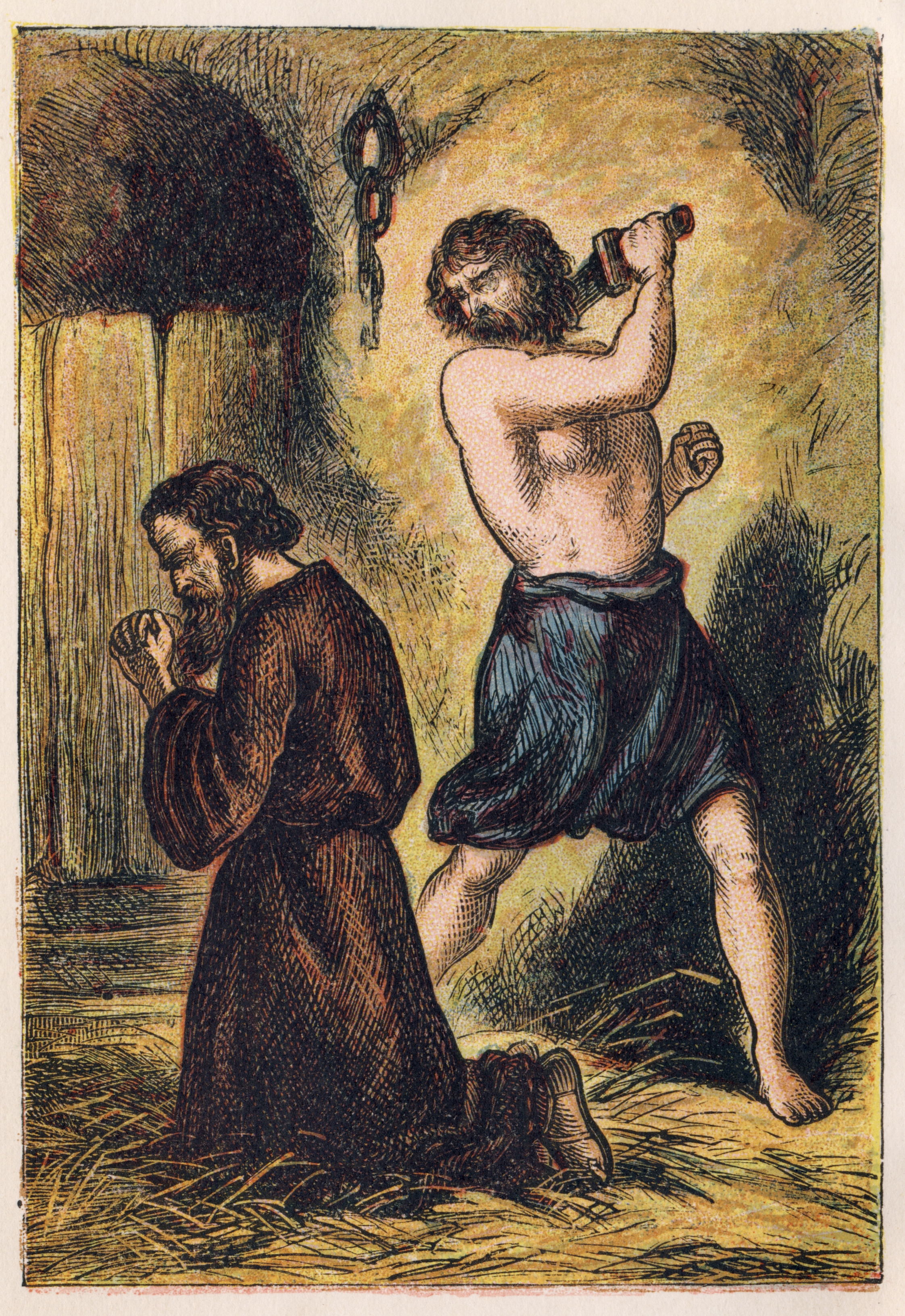
In Roman times, no magistrate would have to ask the Christians if they were Christian. Being a Christian was a very defined lifestyle - it was obvious to anyone who saw you interacting (or not interacting) in society. Christians did things differently. People knew it. When Christians were being killed, it wasn't for some statement they made or idea they professed; it wasn't even an important identity they assumed - it was a life they lead, choices they made. The original Christian martyrs were killed for a long period of faithfulness over time that rubbed against what was expected in society.
Yes, there might be a broad dictionary definition of "martyr" that includes this occurrence in Oregon, but it's a definition lacking real distinction and context.
Those who died in this most recent shooting certainly died because their Christian identity was important to them, but it wasn't martyrdom, it wasn't a religious killing. The shooter had no way of knowing the faith of these people, he could only ask how they identified. These people certainly showed more courage than I'd be able to muster in that situation and I hope they all died with the confidence of knowing God's peace and love, but this simply wasn't a religious statement. This was the terrible action of a sick man who'd clearly been hurt by Christians in his life.
We could say these victims died not for their faith, but for the lack of faith shown by others.
It doesn't undermine the faith of those who died - I don't know then anymore than the gunman did, so it's impossible to even speculate. It doesn't put into doubt their faith claims or the value of their lives. It doesn't even reduce the impact of such courageous testimony. I'm just not sure it qualifies as martyrdom. Martyrdom takes more than a moment.
The priest who's gunned down by gang members because he's pulling their runners off the streets and into afterschool programs is a martyr. The woman, beaten and killed for helping prostitutes to freedom is a martyr. Their words might be the impetus for the trigger to be pulled, but it was their actions that got them killed.
The other element that seems important is society's response. A martyr's death is typically cause for celebration or indifference among the general population. A martyr doesn't die to collective horror. Christians were martyred as entertainment in Rome, people bought tickets to cheer as they died. Many martyrs toil in obscurity around the world, giving their lives for a moment of solace amongst the suffering of the world's poor.
When that gunman opened fire on the Sikh temple, it wasn't because of the faith of the adherents. They died because some guy confused them with Muslims. Even if they'd been actual Muslims, it still wouldn't have been a death for their faith, but a death because someone else, somewhere else represented their faith in ways they wouldn't agree with.
If some Roman were hauled before the authorities by mistake - he'd be shouting at the top of his lungs, "I'm not a Christian," but those words certainly aren't enough. He'd have to prove his identity and he'd do it by pointing to his actions. This is what I do because I'm not one of those Christians. He'd get off, if he got off, because he proved his life looked differently than the Christian lives they were out to end.
Peter Rollins has a great, harrowing short story in his book, The Orthodox Heretic, where a man is acquitted of being a Christian and robbed of martyrdom despite his admission and attempts to prove his faithfulness. He's acquitted because his lifestyle doesn't show anything but church attendance and Bible reading. There's no evidence of a specifically Christian lifestyle.
What if the first person asked in Oregon hadn't been a Christian, but thought saying "yes," would save his life? Would that claim have made him a Christian? Likewise, what if the second person asked, knowing what answer meant life, had said, "no," despite a long life of faith and Christian action, would it have somehow invalidated her claim to Christ?
There's got to be something more.
This shouldn't discount the tragedy of events, but it, perhaps, should be an avenue of challenge for Christians. It does indeed take an incredible amount of courage to claim Christ, knowing it could mean your immediate death - in some ways, though, it takes as much, if not more, courage to live out your faith over the course of decades - to love the unlovable, to be on the side of the rejected, to move against culture and be labeled an oddball.
I'm not sure I have the courage to do either one. I do, know, though, I wouldn't want to be known as a martyr if I happen to die for the words that I say (or write). We need to be careful about how and when we use words like "martyr," because there really are people in this world who continue to face the kind of situation first century Christians faced - where their actions equate to a death sentence - their whole life is lived in danger.
We live in a world, specifically in a culture, that's become increasingly obsessed with masking political maneuverings in religious language. The evangelical subculture seems even more bent on using the language of religious war. We really need to push back against it, naming an condemning power games cloaked in religious language.
A shooting, like Columbine, like the one in Oregon, is tragic. It is a senseless loss of human life, a great tragedy for those families who lost loved ones and for the community and nation as a whole. It's a detriment to creation and something that should spur us to live differently. I'm just not comfortable calling it martyrdom. Making it religious seems almost a distraction from the realities involved. Let's call all killing tragedy and work to prevent it moving forward.
Disclaimer: I was given a free copy of this book for the purpose of review. My integrity is not for sale. Those who know me well are aware I would relish the chance to give a bad review in exchange for a free book. If I've failed to do so, it has nothing to do with the source of the material and only with the material itself.
This is, as the title indicates, an abridged version of Metaxas' monumental biography of theologian, pastor, and WWII Christian martyr, Dietrich Bonhoeffer. I had heard quite a bit about the book when it's original form was released. Metaxas is certainly a huge name and a respected scholar, but much of the criticism came from my friends in the peace movement, among whom Bonhoeffer is a sainted figure. The contention was that Metaxas glossed over some of the more radical and difficult teachings of Bonhoeffer, especially as they related to non-violence.
This is a difficult position since Bonhoeffer was, most definitely, eventually involved in the plot to overthrow (and assassinate Hitler), working as a double agent within the intelligence service. While Metaxas does a masterful job of illustrating the very confusing nature of elite German life during the war, at least in the abridged version of the book, I have to agree that Bonhoeffer has been, in some ways, domesticated - as a martyr for status quo Christianity more than a radical challenge to it.
The book is very much a history of the Third Reich. Beyond the obligatory early biographical information, the narrative simply retells the Nazi story from the inside and the ways in which this intersected with the life of those Christian pastors who attempted to maintain prophetic distance, led by Bonhoeffer. This is complicated precisely because of Bonhoeffer's social position within one of the leading families of the aristocracy. So many officers, intellectuals, and other leaders were against the manic aims of Hitler, but continued to work subversively within the German war machine. Perhaps the best contribution of Bonhoeffer Abridged is shedding light on the truly muddled nature of life in Nazi German (as opposed to the typical black and white treatment we so often get in the US).
Additionally, great pains are taken to portray Bonhoeffer as those around him understood him - a true man of God. The holy account of his final hours and the calm and peace which he maintained throughout as a real testament to the profound power of God in his life, overshadowing what is a scant treatment of his true beliefs about Christian ethics in human society. The final chapter is inspiring and emotional, but a poignant, appropriate tribute to a true hero of the faith.
That being said, I'm not sure the purpose of an abridged version (other than additional revenue). The audience likely to pick up a 200 page biography and not a 500 page one has got to be pretty small. This version is interesting enough to make me want to read the larger work, but it's also thorough and deep enough that I wonder if such a reading wouldn't be too repetitive. The writing is well done and the abridgment is noticeable in only one or two places (where there is clearly insufficient transition between paragraphs).
Bonhoeffer's life - a pacifist involved in killing Hitler - is a depressing contradiction to some. Metaxas attempts to use his personal piety and obvious holiness of heart to overcome the credibility gap here. I've found great comfort in the way Bonhoeffer spoke of himself. I tried (in vain) to find the quote I read once upon a time, wherein he deals specifically with his involvement in the conspiracy to remove Hitler and his own non-violent beliefs. Bonhoeffer refused to justify or condone the evil he supported, but instead explained it was the best option available to his limited vision and conscience. This perspective on Bonhoeffer is absent in Metaxas' work, but it does not make this biography any less important.
Bonhoeffer Abridged is a good book. If you are among those who would choose a 200 page biography over a longer, fuller version, by all means get this book. If nothing else, the abridged version may whet appetites enough to explore the actual writings of the man who's life and work has inspired deeply my own faith and those of countless others who find the status quo insufficient.
Disclosure of Material Connection: I received this book free from the publisher through the BookSneeze.com® book review bloggers program. I was not required to write a positive review. The opinions I have expressed are my own. I am disclosing this in accordance with the Federal Trade Commission’s 16 CFR, Part 255: “Guides Concerning the Use of Endorsements and Testimonials in Advertising.”

