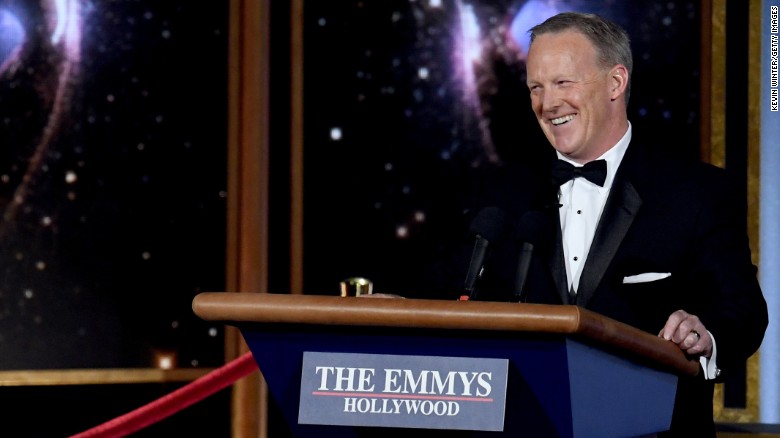
I enjoyed watching parts of the Emmys on Sunday. TV actors tend to make for better speech-makers, because they're a little less self-important and there's a lot of awards set aside for comedians. There are also a lot of awards - and writers sometimes get to receive them, which makes for better-written speeches. I like comedy, so this is a good awards show at which to laugh.
Stephen Colbert hosted the Emmys and one of his early gags was to joke about the size of the audience and then have Sean Spicer (one-time Trump spokesman) come out on a rolling podium (reminiscent of the Melissa McCarthy parody of Spicer on SNL) to joke about the size of the audience,
the way he once, very seriously, lectured the White House Press Corps about the size of the Presidential inauguration crowd.
I found this funny. I suspect lots and lots of the home audience found it funny. The attendees of the event and the pop culture press found it tasteless and inappropriate. All I've heard, in interviews with actors and writers, and in commentaries on the event, are critiques of this moment "in an otherwise great awards show."
I want to call BS.
This is the kind of hypocritical self-importance that plays directly into the hands of people the left tends to criticize for hypocritical self-importance. Is it totally absurd that Trump, and his administration, spent the better part of his first few days in office persisting with the obvious falsehood that his inauguration crows was the largest in history? Of course. That's hypocritical self-importance. Is it equally absurd to demonize a professional PR guy (a profession that basically gets paid to lie for a living - excuse me "massage the truth" or "accentuate the positive") because he worked (and got fired by) a guy you don't like?
I know, I know, "Trump is the antithesis of morality and decency, a dangerously incompetent President and the worst person alive" blah, blah,
blah. He's portrayed a Satan by a certain class of left-wing elitists and thus contaminates anyone in his orbit. By not taking a joke, Hollywood is sort of proving a point.
The left characterizes the right as a greedy, heartless mob of rich businessmen willing to sacrifice the lives of the poor for personal gain.
The right characterizes the left as sheltered intellectuals with no real grasp on how most people live. Each side calls those characterizations baseless. This is the message of the echo chamber - "am too," "are not."
The reality is both of those bogeymen do really and truly exist, but those aren't really characteristic of the majority of the opposition. I imagine most people, both democrats and republicans, can laugh at Sean Spicer making fun of himself. Stephen Colbert knows this, which is why he's a pretty popular guy (much to the bemusement of the head-scratching pop culture media). The guy understands regular people and they like watching him.
Ricky Gervais was the best Golden Globes host of all time, because he made fun of celebrities honestly. He played to the TV audience and not the one in the room. The actors hated him for it, but the ratings were fantastic.
Now what I'm not sure of - what has yet to be proven - is if this overemphasis on the echo chamber can really change reality. If all we're given is the propaganda of the extremes, will it, in turn, change the vast middle into a polarized confusion. I'm fairly certain Breitbart and DailyKos don't represent the majority of people they claim to represent; what I'm unsure of is whether that will always be true.
I'd like to think there will always be a sane middle, that can recognize the positives and negatives of whatever is presented to them, but I'm not entirely confident that's true. What causes me concern is the seeming inability of the extremes to admit their own absurdity. It's even more troubling if we're refusing to let the opposition laugh at theirs.
If we've really gotten to a place where we can laugh at you, but you can't laugh at yourself, then we may have moved beyond the place where we can even talk to one another. Don't let the caricature become the portrait. The best thing you can do to turn enemies into friends is agree with their critiques when they get them right and be willing to laugh at yourself.
I've watched most of Spicer's recent late night interviews. I still cringe and disagree with most of the things he says and the opinions he expresses. But I'm much happier about the guy who's stepped out of the echo chamber than all those who've double down and settled in (on both sides). At least we can talk to each other - and we should be able to laugh at each other, too.
Showing posts with label self-awareness. Show all posts
Thursday, September 21, 2017
Saturday, March 24, 2012
The Making of a Nerdling
This is Sigiriya, a large rock on an island nation that was once home to a local monarch who used slave labor to haul water to the top. That was all the information I had (along with a picture very similar this one) in the final round of the Vermont State Geography Bee in 1993. In fact I don't recall them even giving me the name of the rock; I just had to name the island nation.
The answer is Sri Lanka. I got it wrong. I can't remember what I actually said, although Indonesia seems most likely. I knew the rest of the questions asked in the competition, and the guy who won ended up on TV, in the top ten at the National Bee. On occasion, that crazy mountain still haunts me.
I've been reminiscing about my Geography Bee years since reading a chapter on it this morning from Ken Jennings' Maphead. The National Geography Bee was founded in 1988 by National Geographic Magazine as a response too poor geography knowledge among the nation's school children. Kids in 4th through 8th grade compete at the school level and the local winner takes a written test. The top 100 scores move on to the State Bee, which in turn sends its champion to Washington, DC, where the top ten competitors gets to play for a $25,000 scholarship on PBS in an event hosted by Alex Trebek.
The Gifted/Talented teacher at my elementary school let me participate in the school bee in 1990, as a third grader. The school was small, the bee was young; she probably wanted to make it seem more popular. I won. I remember the last question was "What is the only country in the world through which passes both the Equator and the Tropic of Capricorn. The other girl said Zaire, I picked Brazil. She still got to take the written test, as I was too young. I did manage to compete in the State Bee all five of me eligible years, but it was 6th grade that proved to be my best shot.
Jennings brings out what is the most surprising and important element of the Bee. It's not about memorizing capitals and rivers; the Bee does a fantastic job about testing a deeper, more thorough knowledge of geography. As evidenced by the Sri Lankan mountain above, most questions required an educated guess rather than a memorized fact. My knowledge of geography certainly isn't as sharp as it once was, even so, the 2009 Bee (that Jennings profiles) shows just how far the whole experience has come. The depth of knowledge required is insane. Every kid in DC would not only know what country that rock is in, but how tall it is, how many people visit it each year, and the middle name of the first white guy to see it.
One of my major flaws is that I tend to think I'm better at things than I really am. I'm good at trivial pursuit, but if I actually got on Jeopardy would I be able to blow everyone away? Probably not. I still believe I had a chance to win that Geography Bee had I just managed to come up with Sri Lanka, but I can in no way claim to have been as smart as the kids who win it these days.
I've often wondered if that outrageous sense of self-importance, one that tends to lack ego as much as it includes a basic ignorance of the world, is what breeds a nerd, dork, dweeb, geek or whatever you want to call us socially awkward intellectual types. Whether it's a type or just an subconscious attempt on my part to justify some seriously self-centered behavior, I've come to realize that this nerd quality, something I've used to positive define myself my entire life, might just be less important than actually helping and being present to other people.
Nothing ground breaking there. Lots of people realize as they mature that giving up selfish pursuits for the sake of meaningful relationships is a prerequisite for living in the world. Ir just feels good, now and then, to relive a little of that faded glory.
Subscribe to:
Posts (Atom)