Showing posts with label christianity. Show all posts

Friday, November 08, 2024

Political Theology


I believe deeply the Church of Jesus Christ is called to embody and alternative politic.  Politic defined as, simply, the way human beings live with each other.  The Christian politic needs to follow the example of Christ, who, borrowing liberally from Philippians 2, did not consider power something to be used, but lived in weakness, suffered, and died.  Through this counter-intuitive process, he was resurrected, vindicated, glorified.  Christians believe this model is the purpose and intention of creation.  Our politics must look like Christ.

It's also become pretty clear to me that Christians cannot faithfully critique any system they are trying to control.  That doesn't mean we can't participate in systems of power, but we must be very careful not to attempt to control those systems.

Practically, that means in deliberative bodies - places like local or federal parliaments of one kind or another - that are genuine attempts to seek consensus and work together, align well.  I'm comfortable voting for a representative of my community, if I feel they'll honestly engage this process and not seek to dominate or unduly influence the process.

When it comes to donating towards or working for the election of representatives from other constituencies, that's a clear attempt to control the process and, I don't believe, can be compatible with Christian ethics.  The same goes for participation in "party" politics, where blocs of like-minded representatives seeks to influence the process.  Any deliberative body must seek consensus - simple majorities overruling unwilling minorities are incompatible uses of power.

With regard to executive positions, where one person is expected to make unilateral decisions, I'm unable to envision a way to do this in imitation of Christ.  If you had a genuinely compassionate, selfless human being, they would either be corrupted or fail as a government executive.  Those jobs are not designed to be done in line with Christian ethics.  I can't, in good conscience, put any human in a position where they cannot succeed.

Now, all of this does not mean I'd advocate disengagement from the process.  Christians can and should still protest and express their views on how people should treat each other.  The line must be drawn, though, in using threats or coercion to convince others of our positions.  The example of our actions, we must believe, are capable of "winning converts," rather than the strength of our arguments.

It comes down to control.  Am I attempting to get my way against the will of another.  That's not how Christ operated; it's not how the Kingdom works; it's not how Christians can ethically engage in politics.

Our priority must be on the politics of the everyday.  How do we treat our neighbors?  Feed the hungry?  Advocate for justice - not with threats, but with pleas to our common humanity?

If the life, death, and resurrection of Jesus Christ has both showed us how and enabled us to be truly human, capable of reaching our creative purpose; we must believe a Church, living in imitation of Christ, can facilitate the same transformation for the world at large.

God is in the business of redeeming creation.  It does not come through force or coercion, but through humble, selfless love; a willingness to suffer; and a commitment to engage politics with an open hand and not a closed fist.  It may also come in refusing to exercise "rights" we've been given as citizens of the world, because they violate the duties of citizens of Christ's Kingdom.

Sunday, August 04, 2019

We Shouldn't Be Surprised

It's no secret there's a lot of mass violence in the US. We trot out the numbers every time another shooting happens, and those numbers are sickening. It's literally become a more-than-daily occurrence. One thing I don't agree with, though, is the rhetoric that seems to accompany it, especially among church people, that not reacting viscerally to such violence is a sign it's become routine, or that we've accepted the inevitability of such violence.

I mean, I get where that's coming from. We don't want to so forget the world God has promised us, the one Christ began to bring about, the one with no tears or sorrow, the culmination of which we look forward to each day and celebrate in our weekly gatherings, that we stop working and living into it. We don't want to say this is the world we live in and we just have to deal with it. We don't want to forget that there's something more. I get it.

The problem is, though, that the world we're rejecting, the one that's dying away and will ultimately parish still exists. It's not dead yet - and that world is one where violence is embraced and justified to gain and maintain power. Violence anywhere leads to violence anywhere. If you can justify any violence, someone will, in fact, justify any violence. The notion of good guys and bad guys is a fallacy from the pits of hell, but so long as we live in a world where it's still believed and lived out, this is the result.

I'm not saying you can't be saddened and heartbroken for the violence of our world, for the lives lost, and the lives forever changed by mass shootings, I just don't think we can be surprised that a world built on violence produces violence any more than we can be surprised that pulling the lever on the soft serve machine means ice cream comes out. It's cause and effect.

We don't have to live the effect, we don't have to be satisfied or complacent with it, but we shouldn't be surprised. Christians least of all. We should have a worldview that understands the problems inherent in the machinations of power, the complications that arise when love is not our response to absolutely everything. We should not be shocked by the world in which we live, even as we grieve it.

I get especially upset with this "don't be numb" rhetoric, because it's rarely accompanied by a full-throated, scripturally-based, Christ-like denunciation of violence. I recognize that the realities of the world mean we can't expect everyone to be 100% non-violent in every situation. That's not the issue, though - the issue is our inability to condemn ourselves, even as we recognize violence is sometimes the least bad choice we can make.

Just because violence is the best course of action we can come up with in a given moment, doesn't mean it's justified. If we, as Christians, resort to violence, we should be doing so with pleas of forgiveness and mercy on our lips. Taking life, even to protect life, is not a Christ-like virtue. When we make heroes out of people who do so, we contribute to a culture of violence whose byproducts are these senseless murders.

That's another thing: we call them senseless, because they make no sense to us. Often, though, perpetrators of societally condemned violence find great sense in their own actions. They plan them; they feel compelled that they are the best possible course of action, given the assumptions they hold.

Just because we disagree with those particular assumptions doesn't make them morally any different than the assumptions we use to justify the violence we deem (even regrettably) necessary. We live in a society where we're privileged to mostly outsource our violence to others - police, military, etc. Just because we're not perpetrating that violence, doesn't mean it's any less ours; it's done in our name, by people's whose actions we justify (at least passively).

Jesus said those who live by the sword will die by the sword. We can make our individual decisions - and I pray they are always to non-violence and love - but we're also communal people by nature; like it or not, we participate in a world that lives by the sword. Christians can be saddened by violent deaths, but we really shouldn't be surprised. Christians should know better.

People who grow up in a society where violence is the answer to evil have a right to be shocked and surprised when it's used to perpetuate evil. Christians, who've been exposed to the Kingdom of God, where violence is never the answer and always the enemy, just don't have an excuse. Gun laws are great and I'd support better ones. I don't believe any weapon should ever be directed at any human ever. Laws pushing us in that direction will likely save lives, but they won't solve the problem.

Violence is the problem. Until we name it and address it, nothing will change, and we shouldn't be surprised by anything.

Tuesday, February 19, 2019

Have We Given Up on Change

I was born and raised in a Christian environment, specifically a Wesleyan, evangelical environment. One thing for sure about us, we're all about change. Conversion and transformation is at the core of Wesleyan theology and evangelical faith practice. The idea that people can become fundamentally different than they were before is an assumed and accepted foundation of my life. This is the Saul/Paul story in the Bible - super hardcore Jewish purist, killing Christians one moment and becoming the leading voice of the movement the next (well, it took a couple decades, but it feels very immediate in scripture).

I had a realization, today, though, that this foundation is far from universal. I wonder if our society at large has given up on the notion of change. When I say that, I mean real change - from being one thing to being another. We're big on change in the sense that some facade we put up can come down to reveal our true selves on the inside. This is both the beauty and the tragedy of the movie Green Book. You've got an overtly racist guy who's really got a heart of gold underneath and this friendship, portrayed in the movie brings it out of him. He didn't change, he just got more comfortable with who he is.* We love those stories, I think, in part, because we don't actually believe in change. We believe people are who they are and that they're basically good. The only change is not substantive, but perspectival.

I got thinking about this because a guy at the gym today had a shirt on that said, "If you don't respect this flag I'll help you pack." I spent the rest of my hour on the elliptical playing out the conversation we'd have if we were able to unemotionally talk through that line of thought - if I went up to him and said, "Where am I supposed to go?" He might ask what country I'd rather live in and I'd reply that there isn't necessarily another one, I'd just like this country to be better.

At the core of this notion - like it or leave it - is the idea that change isn't possible. Reform might be possible - we can get slightly better or slightly worse based on hard work and circumstances, but deep down it is what it is.

We take this same approach to relationships, a lot of the time. This situation isn't working for me anymore, so I'm out. We don't expect another person to change, because we wouldn't accept them expecting us to change. What's more, we don't think change is possible - either for ourselves or someone else. We might have hope that our true selves can come out more clearly, but we may also be delusional about what our "true self" actually is.

In my marriage, some of the most difficult, important, and ultimately positive periods have been those where either myself or my wife says to the other, "this situation is untenable going forward; something has to change." Those are difficult conversations, because we're imperfect and self-conscious. We get defensive and we argue and feelings are felt and stepped on, but we come out the other side and we change. We had a brief argument yesterday where my wife reacted in a way that would've been appropriate ten years ago. She expected something out of me that would've been dead on in 2007 or 2009. My reply to her was, "Don't act like I haven't changed."

It didn't seem like much in the moment, but in retrospect, today, it was important. Both because I think she understood and accepted that response, but also because it's true. We're such different people than we were - not just because we've been married almost fifteen years, but because we've both changed (I'd say, demonstrably, in both cases, for the very much better). Yes, we're both more our true selves than we were before - which hopefully happens in any long-term relationship, but also because we've fundamentally changed.

I think a large part of that is the environment in which we were raised, where true transformation was not only possible, but expected. It sure creates a high bar in our minds for each other, but it also allows us to reach those expectations (once in a while). I'm not saying other people can't have these experiences, but I don't see a society that really believes in genuine change.

I see it in my daughter all the time. Part of it is because she's six - there's a lot of permanence built into her world view and a lot of black and white thinking. Somebody does something mean; they are always mean. I'm sure it's a failing on our part that we haven't done better to create that environment of change in her life, but it just seems like the messages she receives - not curricularly from school, but socially and relationally - is that the only real change is conformity: we act as we're expected to act, because that's how society works.

One of the hallmarks, they say, of millenials, is constant change. New job, new relationship, new city, new ideas, whatever. Young people are more comfortable outside routine. That's true in a lot of ways, but I also wonder if it's not a reality because they've been conditioned not to expect change. If things aren't going well here, they never will; let me find something else.

There's a sense of optimism there - that something better exists elsewhere - that isn't really present in older generations (I'm going to stick with this job/relationship/situation because nothing else is better), but I'm guessing both outlooks are ultimately joyless and fruitless without a real belief in change.

Can we say we'll invest in something because we believe it's possible to be different - like radically and substantially other than what it was before? I don't know that society has the tools to do that anymore and it's something I think the Church could offer, but if so, we've got to rid ourselves of our own Christian version of the same thing.

It's easy for us to fall into behavior modification as a default position. We don't expect people who come to Jesus to change substantially, we expect them to change behavior. It's our worst failing, for sure. We, as the Church, have largely give up on the idea of transformation and settled for a specific, comfortable sub-culture that's not fundamentally different than the rest of the world (just labeled with a cross).

It's not really an us vs them thing - at least from a Christian's perspective - it cuts across the kinds of dividing lines we like to put up. You can experience and believe in transformation regardless of your faith background, for sure, but I do think it's something that's fundamentally at the core of Christianity. Although I'm wondering if even the Church is losing that battle.

Like many other core elements of Christianity, people are picking up these ideas and championing them outside the traditional forms and labels of "the Church." That's where my real passion and interest lies - I want to be someone who champions what I'd call Jesus-values anywhere they exist, regardless of how we label them (and maybe without a real need to label at all).

So in the end, this isn't a celebration of Christian and denunciation of the world, but a reminder and advocacy of a firm belief in transformation wherever it manifests itself. This kind of hope is vital for any real meaning in life and any sense of a fulfilling future.


*It's a tragedy, because the other character is an African-American guy who seems to have everything altogether and it's revealed over time that he's just a lonely, broken individual deep down - which is fine, since we're all lonely and broken a lot of the time, but the racial component of the white guy being good at heart and the black guy being flawed is all sorts of problematic - especially since the movie was written by the white guy's son with no input from the black guy's family.

Tuesday, June 19, 2018

Christian or Citizen?

The very fact that some Christians call immigration "complicated" betrays the real problem. Christians cannot hold the flag in one hand and the cross in the other; it's just impossible. We (as American Christians) don't have any allegiance to the United States. It's not our job to supply answers to governance problems. We're part of a different nation and a different empire. When it comes to immigration, our policy is "y'all come;" everyone is welcome. There are no places for borders or nations or citizenship in God's empire. You can't have a Christian nation, because to govern as Christ is to eliminate national distinctions.

The ends cannot justify the means, because, for Christians, there is no "end." It doesn't matter what the "right" goal or outcome from a particular policy might be, if it's abusive or un-loving or harmful to peace, it's wrong. "We can't get to ________ without _________" is not a valid argument for doing the wrong thing.

I'm pretty sure I've written about this very thing recently, but I can't find it, so I assume it would be hard for you to track down as well. The idea that we have some obligation to offer alternatives for what the government is doing just flies in the face of Christian action. We're taught and trained to be "citizens" of the US from an early age - most of the time in ways we don't recognize. One of them, though, is this obligation we feel to provide a government solution to everything.

We must have an opinion not just on immigration or gun control or taxes, but on how the government can regulate these things within the Constitution. Why? Why do we feel that obligation? We're not elected officials? We don't have to pass laws or defend them in court? We feel an obligation because we've bought into the American narrative of democracy. A good Libertarian will always tell you, the US isn't actually a Democracy, but a Republic - which means we elect people to speak for us, rather than actually speaking for ourselves. We're not actually part of the process, as much as the narrative says otherwise. The only thing that keeps a Republic from becoming an Oligarchy is the consent of the people.

Outside of that, though, why does the government response to anything dictate our understanding of it. I believe people deserve healthcare and education and a warm place to sleep and nutritious food and meaningful work. I don't have to provide some blueprint for the US government to provide those things (if it even ever could), because politics is more than elections and laws. Politics is the way a society functions, the way people engage with each other. It encompasses everything. Yes, laws and government are part of that, but they are not "politics." Politics is much bigger.

The Bible is pretty clear that there's no special treatment for God's people - the "us" and the "them" are one and the same, in our attitudes and actions, at the very least. There is no argument from citizenship or safety in the Church of Jesus Christ, because citizenship in God's Kingdom doesn't come with any special rights or privileges; there is no promise of safety (in fact, actually a promise of the exact opposite).

I get that not everyone is a Christian and that citizens of the United States have different rights and expectations. I know no earthly government can or will operate on a Christian perspective. I would never argue for such a thing. Just because not everything a government does is inherently evil, though, doesn't mean, however, that Christians should compromise their beliefs or principles to accommodate or participate in the empires of the world. A "Christian nation" is just a myth and we've got to put myths to bed - you can't play both sides.

Immigration is only complicated if you're working from a Constitution or the electoral realities of a nation state. If you're a Christian, those things are quite simple. The problem only arises when you try to hold them together. Christians should have already made a choice - if you haven't, now's the time.

Applaud the good done by the nations of the world, oppose the bad; there is no obligation to offer a compromise - indeed, a compromise does not exist.

Tuesday, June 12, 2018

Swearing

I had an interesting conversation about Christians and swearing a while back. I don't quite recall with whom, so I can't give credit, but thanks, whoever you are/were. The idea brought forth was an examination of the purpose for Christians taking a strong stance against profanity. (Even the definition of what words are course, offensive, or "bad" is a pretty tough slog, but we'll just define them as however you would define them, for the purposes of this post.) Christians generally try to avoid needlessly offending people (so much so we've gotten squeamish about necessarily offending people, but that's a topic for another day) - and avoiding certain words was a way of ensuring we weren't lumped in with a particular, marginal group of people - you know, the proverbial sailors and skullduggers, the kind of people who had tattoos back when tattoos were something only a few, unwashed people had. It was a "set apart" kind of thing, an abstention from something that was generally seen as detrimental to society.

The question then emerges, what is the purposes of maintaining such abstention when the only people who are really offended by those words are the Christians themselves? I mean, in a world where you can't say "crud" because we all know you really want to say "crap" and crap is just a stand-in for "shit," which you can't even say on television (except you mostly can, now, because, by and large, don't care), is any of this verbal gymnastic even serving a purpose?

There's something to be said for a unique distinctive. Holy means to be set apart, after all, and there's lots of peculiar things Christians do because they're Christians. My question remains, though, is this one really saying anything of substance theologically? Does utter avoidance of certain words strengthen or enhance the cause of God's Kingdom in the world?

I'm not saying we go willy-nilly, say whatever the (circle one) heck/hell/
fuck you want, because that's just selfish and inconsiderate. I'm all about embracing situational appropriateness. There are times and places for every word just as there are, most assuredly, times and places where they don't belong. I'm not even saying we should abandon the worthwhile endeavor to avoid offense in our speech; I'm just saying that maybe we tone down the good/bad talk and treat every word in relation to context.

Christians should absolutely be an odd, marginal people in the world, but probably not because of the words we avoid.

There's a book that came out last year, one that I've been on the library waiting list for, called Swearing is Good for You by Emma Byrne. As I said, I've yet to read it, but I did catch a very short article by her, about the book, in TIME Magazine (link unavailable) where her basic argument is that "profanity" words have real power and should be reserved for appropriate times. (Funny how he brings up a book that agrees with the idea he just put forth. Hmmmm....) I'm looking forward to reading the book because she talks about how people develop positive associations with particular swear words. Research seems to indicate that positive connections only occur during adolescence and come from "a friend's laughter, parent's disappointment or an enemy's fury," to name some examples. It's a learned behavior.

Not learned so much as "someone taught me," more learned in that swearing induces pleasure when it makes someone uncomfortable, angry, or upset. In other words, parents lecturing their kids about swearing only make those same kids MORE likely to swear. It really does seem like a universal issue - abstinence and/or shame (because they're almost always the same) imbues a thing with greater power than it would otherwise possess.

As I said, twice, I've yet to read this book, but instinctually I took this tact with my (now six year old) daughter. I've never said a single thing to her about "good" or "bad" words. She's heard swear words on occasion - whether it's something slipped into a podcast or some neighbor on the street - I've tried really hard not to react in any way to those instances (other than perhaps repeated or gratuitous use, where I might make some comment about needed a broader vocabulary to vary one's word choice). I feel like it's worked out pretty well. Our kids learn their vocabulary from the words they hear us use, not from everyone word they hear anywhere. My daughter is going to learn to talk the way my wife and I talk - for better or worse. If we're using words in ways that are comfortable to us, she will, too.

I was just using some potentially faulty logic when I made that decision, but I'm glad to know science backs me up on this one.

I still cringe a bit (at least internally) when I think about the little mouth click/disapproval vocalization my dad made literally every time an even moderately offensive word was uttered in our presence (and outside our presence, for all I know). There was certainly no doubt which words were acceptable and which weren't - and what's more, I don't think I was harmed in any real way by that. I'm not sure it served the purpose for which it was intended, but I do appreciate growing up in an environment where I was taught to consider my words.

That's the other side of the coin on this one.

We all know people for whom "those words" make up a shockingly high percentage of their vocabulary - like where the 'f's outnumber the conjunctions. There's something a little off in those conversation - not because such a person is lesser in any way, but because words do, in fact, mean something. I've got a pet theory I'd love for sciency person to actually test out: I think people who swear so casually are more likely to be violent.

Hear me out on this. "Swear" words are those we generally save for our most emotionally intense situations - from the proverbial hitting on a thumb with a hammer, to hearing the news that a loved one has tragically and unexpectedly died - the moments when we feel our feels to the feeling-est degree are often those times when profanity is most understandably used. These are special words to express special emotions at special times. (That's the very definition of profanity, by the way, making sacred - or special - things ordinary.)

My theory is that people who use profanity casually, as placeholder or filler word, when they encounter those moments of extreme emotion - the places where profanity is most appropriate - they lack a vocabulary to properly express those emotions and there's nothing left but a physical response. If some guy hits my care out of sheer carelessness, I might say "what the _____ were you thinking" while we wait for the tow truck on the side of the road. But if that's my response to someone setting the table with forks on the right or bringing back an espresso instead of a macchiato, I may lack the ability to express myself appropriately after the car crash and just take a swing at the guy.

I'm not saying it has to happen that way, just that it makes sense that it would for some people. I'm suggesting correlation, not that individuals who swear a lot are more violent, just that collectively, people who swear a lot might be more violent. Obviously it's an unscientific hypothesis that's convenient in that it proves my point. Still, I think it's got some merit.

This brings me back around to where I started in the first place. How and why do Christians approach this topic? Maybe, since Christianity is profoundly non-violent, there is some real world, theological purpose for avoiding profanity. Maybe banning even the replacement words, like darn or gosh, really does help us learn to save the "bad" words for extreme moments. There's also an argument to made that Christians shouldn't be reacting out of anger anyway (and that's one I do agree with, by the way) - disciplining our use of profanity might actually be discipline, as in practices designed to control our use of those very words so can avoid them even when they might be warranted and overcome the kind of anger that leads us to act in un-Christian ways towards other people.

I guess I'm saying if we're going to call people to be really, really careful with the way they use words, we should also be really, really careful that we know why we're doing it (both calling people to greater consideration and avoiding certain words ourselves). "That sucks" might be a crude phrase I was discouraged from saying growing up, but, as a pastor, I've found it profoundly helpful as a response when someone tells me a parent has died, or they lost their job, or an engagement was called off. It's an expression of compassion and solidarity and truth, regardless of how it's judged socially - I've found it to be comforting and cathartic and appropriate in ways I never would've imagined.

Words are indeed just words... in the same way that people are just people. We can define them from afar, offer our value judgments, and put them into neat little boxes, but none of that can actually define who or what they are in the context of our relationship to them. The world would be a lot easier if people would just be happy being who we expect them to be - that's just not how things work. We need a language that's just as specific and unique and flexible as the world we use that language to create, describe, and engage.

Tuesday, May 29, 2018

Subcultural

A few weeks ago, at a pastor's meeting, we discussed the notion of "cul-de-sac" groups - specifically boards or committees and congregations. The cul-de-sac was a concept developed to impress upon people the idea of safety, security, and privacy (which never really materialized, to be honest). He had a great quote: "a committee is a cul-de-sac down which ideas are lured and then quietly strangled."

It is human nature to insulate ourselves. We want a predictable, familiar community of people - and when we find it, we want it to remain the same forever. Too often we've built these insular communities and called them "churches," when that couldn't be farther from the original design. Intimate, connected, familial - for sure - but closed and private, certainly not. The whole purpose of the Church is to live out a specific lifestyle in the midst of the public square, to be an example of an alternative way of life.

This brought to mind a distinction I ran across months ago (so long ago I've now forgotten who to properly credit) that Christians, especially American evangelicals, intend to be counter-cultural, but have actually constructed a subculture, separate and distinct from the culture at large. This is the distinction between living differently in the world and living in a different world altogether.

Conservative Christians in the US - what's become commonly known as "the evangelicals" - have created their own little world and, instead of engaging culture, reject it and recreate it separately, expecting people to take notice. What's worse: so much of this subculture has very little to do with Christianity; it's largely a generic moralism that's vaguely related to carefully curated scripture passages - often entirely devoid of context.

In a subculture, your primary concern is checking the right behavioral boxes to live in a way that will qualify you for the subculture. The colloquial expression growing up was "don't drink, smoke, or chew, or go with girls who do." It was an out-of-touch joke even then, but it betrays a reality. It's not even that a distinctive set of practices (either done or avoided) is a bad thing - a common rule of life is a community-defining practice and often vitally important, even for a counter-cultural presence. The problem really arises when you start to look at "why" those things are done (or not done). If it's simply to bodily identify with a specific group or to check off the boxes for heaven, you're in real trouble. If it's to embody a different set of principles, foundational assumptions for life, then it makes a lot more sense.

One of the real benefits, though, of American evangelicalism becoming and ever more exclusive subculture is that it has less and less presence in the real world. Not having been in a traditional ministry setting the last few years has woken me up to the fact that most everyone, even many people very involved in Christian ministry, just have no clue this evangelical subculture even exists. I hear pastor friends lamenting some preacher/author/conference that's embarrassing themselves and Christ and I gladly don't know what they're talking about.

As a subculture prefects its isolation, it disappears. The only time evangelical leaders pop up in mainstream culture is when they're saying ridiculous, usually deplorable things. It's a strange novelty - a bit more offensive than the Amish or a hippy commune, but equally as irrelevant in everyday life. I suspect (and hope) that by the time my daughter's grown up, the average American will know as much about Franklin Graham as they do about snakehandlers.

True counter-culture makes it's present felt simply by existing. Subcultures fade from consciousness as they reach their goals. Counter-culture is generally painful for the mainstream, but largely by asking difficult questions about relevant issues. Subcultures are annoying to the mainstream, because they feign relevancy by making a scene (almost literally the original definition of geek).

The gospel of Jesus Christ is wildly relevant to this (and every other) time and place. It is a counter-cultural message of suffering, unconditional love. It does not always provide the safety, security, or privacy of a cul-de-sac - but those very well may be illusions anyway.
There is no question of whether Christianity will survive the current upheaval of culture and human understanding, but whether the organizations and institutions we now associate with Christianity survive the change is entirely dependent on them rejecting the human desire for subculture and embracing a truly revolutionary counter-cultural presence.

Thursday, April 05, 2018

Rights and Religion

I continue to be fascinated with the intermingling of nationalism and Christianity; I suspect it's the number one issue at play in society for people of faith. In a nation that's more and more a religion unto itself (often with a Christian label), the way we navigate the waters of citizenship in two different Kingdoms is important and fraught.

I don't watch TV news - neither the six o'clock (do they still have that?) nor the twenty-four-hour varieties. I do occasionally catch a headline on one of the TVs at the gym, where FauxNews and CNN are right next to each other in my peripheral vision. Apparently two years ago there was a big kerfuffle about an Air Force veteran who was forcibly removed from a flag-folding ceremony, which was part of the retirement celebration for a friend, when he used a religiously-tinged and unapproved script. Apparently the guy had a history of inflammatory incidents and had been told he couldn't speak at the event, however the guest of honor insisted he go on. When asked to leave, the guy refused and continued to shout his words as he was forcibly removed from the proceedings. Basically everyone looked bad all around, the Air Force changed their policy and the guy's now suing (conveniently, I believe, right before the statute of limitations runs out).

This is a talking-head special if there ever was one. How do I know? Well, the only place you can get any coverage of this event or the lawsuit is on fringe (both right and left) and military-specific websites. I'm linking to the AirForceTimes which, amazingly, seems the least partisan. As you might expect, this has become a virtual hand-grenade where people are lobbing different notions of religious freedom/persecution at each other without really saying anything.

I'm all for peaceful protest, even vociferous and disruptive protest, should the situation call for it. Clearly the guy retiring wanted to make a statement by asking his friend to use a non-standard script. They were warned and continued and they should be free to do so. The Air Force is also free to remove the guy from the ceremony, as they did, and he's free to keep shouting as he's removed, which is what happened. I wouldn't say there was physical resistance, but everybody was sticking to their line pretty firmly.

What I don't get, though, is this lawsuit. The guy and his lawyer are all over the television demanding I'm not sure what - money, I guess - but the Air Force already changed the policy as a result of this incident. It seems like, if the guy was really standing up for his religious rights, that the battle was won.

That troubles me a bit, as a Christian, because it's downright offensive to the gospel to associate it with any nation or military, but that ship has sailed long ago, I'm afraid. Not only has Americanism become our default religion; it's getting labeled as Christianity. The use of power and force are antithetical to the message of Jesus Christ and we have another exhibit of that in this situation.

The purpose of the lawsuit is to get a court to admit the Air Force violated this man's rights. It's a move for dominance. Regardless of whether or not I agree with his actions (and I don't, although there are plenty of other times I do, and it still rubs me the wrong way), Christians can't demand "rights." We gave up the right to our "rights" when we accepted the way of the cross. In the way Jesus refused to argue for himself during his many trials, we're called to live out our understanding of right action and accept whatever response we receive.

It feels like this guy should be overjoyed that his actions produced change in the direction he wanted. To me, that's the ultimate victory. I don't understand how one could make a Christian argument to then essentially humiliate your opponent. Paul, on several occasions, used his Roman citizenship to call officials to follow their own laws; he didn't then return to rub it in their faces or embarrass them to their superiors. In the end, he took whatever judgment the law required and did so willingly, following the example of his savior.

This is why Christians can't hold a cross in one hand and a flag in the other; the two are diametrically opposed, not necessarily in the game of ideas, but in lifestyle and action. Too much of "religious" dialogue these days is an attempt to browbeat people into assenting to ideas we call Christian. It's about winning the intellectual assent of others, or at least their grudging tolerance. The gospel, though, is not really about theology, but about the lifestyle inspired by our understanding of God. If we do not act in accordance with our beliefs, we don't believe at all.

The national religion of the US tends to work backwards - seeking the best course of action (best defined as most beneficial to me and mine) and then inventing a theology to support it. This is the path of least resistance and people stumble into bad theology this way all the time (its not just the purview of nationalism or convenience). In the end, the gospel is absurd from the perspective of practicality. It's predicated on truth and reality not being readily apparent. The idea that weakness is strength and love leads to truth just doesn't fit with how we've constructed our world to work.

If you're pushing your own agenda through force or persuasion, you're not representing the gospel. The way you present your ideas is far more important than those ideas themselves. For Christians, winning society's games necessarily means losing your faith. It's great to stand up, with your body, and live your beliefs in the public square - I applaud those who do, even if I disagree with them; it's quite another to expect the public square to celebrate you. That's a game you can't win and shouldn't play.

Tuesday, November 07, 2017

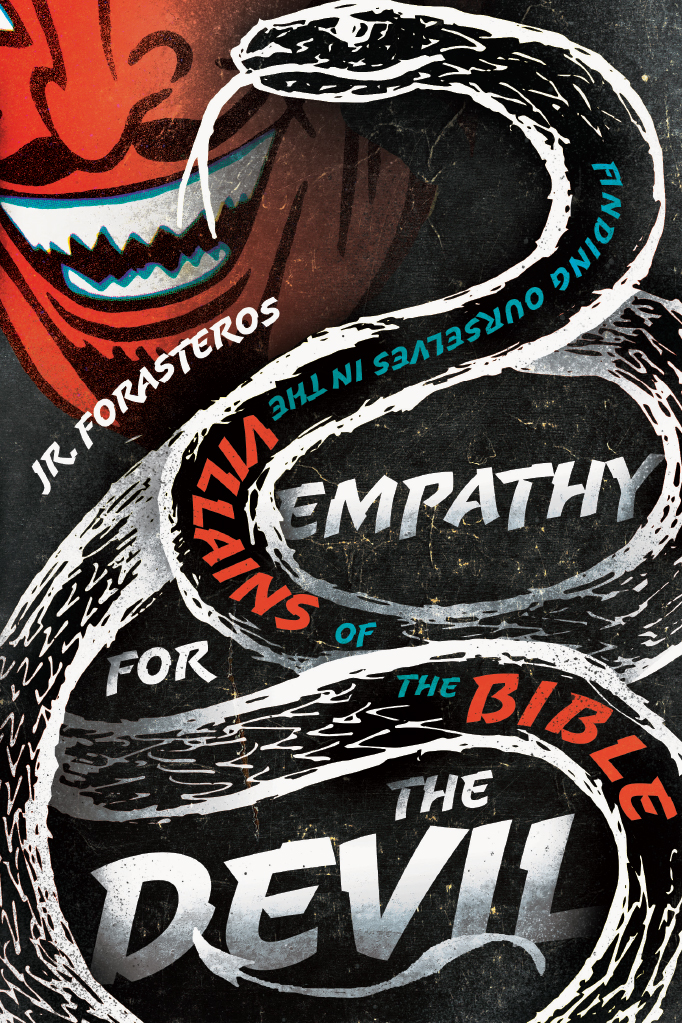
Empathy for the Devil

In the first ten minutes of reading Empathy for the Devil, I found myself in the midst of a real therapeutic breakthrough. JR Forasteros's take on the biblical Cain provides a great perspective on anger and the place it holds in our lives. This is just one of the seven biblical villains Forasteros examines - each with a narrative account and a chapter of practical contextualization - concluding with the devil himself. Each section brings to bear the realities of a gray world on characters we almost always view in black and white. By helping us to inhabit the lives and minds of these "others," we see ourselves in them and increase our empathy.

Each chapter contains really deft biblical analysis and the best of professional exegetical understanding, but also viscerally connects the reader to the people and places of the Bible. As a jaded seminary graduate, I'm well accustomed to reading books of this nature - putting a unique twist on an old story - with a bit of skepticism. They're often academically weak or oversimplified; Empathy for the Devil is neither. It's rigorous and challenging, while also providing space for the reader to ruminate and draw her own conclusions.

In full disclosure, I did receive a free advance copy of this book with a real implication (but not an actual request) that I review it. JR Forasteros is someone I know a little bit and like quite a lot - so, as much as I'd like to claim total neutrality, you'll have to take all of this with a grain of salt. I will say that our interactions have been largely online, along with one 90 minute conversation over coffee in the lobby of the Horizon League headquarters in Indianapolis.

That being said, this book provides the kind of practical invitation to conversation that could work well in any setting where people are comfortable enough to be honest and ask tough questions. From Intervarsity Press, it's likely to be marketed to a religious audience, but the cultural traction so many of these characters have even outside Christian faith should make it at least accessible to anyone interested in a hopeful, but sadly atypical perspective.

The final chapter, on Satan, is undoubtedly the best - which is saying something, since I was told as much about halfway through the book and was so enjoying myself I refused to believe it. Forasteros presents a difficult, tension-fraught subject with a calm and rational - even generous -
approach. It is indeed hard to empathize with the devil and not something any of us particularly wants to do. Yet Forasteros earns the benefit of the doubt with the preceding six chapters and narratively weaves a beautiful expression of grace and love into the midst of great tragedy in a way that both informs and engages.

I don't like to do these reviews without some critique, but there's not much really to pick at in Empathy for the Devil. If anything, though, this is the kind of book that requires a certain kind of audience. You could use it in a congregation, but you'd need an exceptionally open-minded, secure group of people to embrace it well. You could also bring it to book club, but it might dredge up some difficult subject matter if people don't know each other well enough (although, appropriately, one of the chapters talks about the different levels of interpersonal intimacy and how to navigate the awkward growth of community) - at the same time, it's just too rich and pertinent to ignore.

One of the most insidious problems in our world is the tendency we have to create "us" vs "them" dichotomies; Empathy for the Devil works against that it the most honest and grace-filled ways. I don't think there's any higher praise I could give it.

Tuesday, October 17, 2017

Click Bait with Depth

So, I've been sitting on this for a while. I clicked on some click bait a while back - I do that occasionally, I'm sad to admit. It was about a man who refused to take off his Marine Corps hat for his driver's license photo. You may have seen it around. Essentially, the story was that an older gentleman was asked to remove his hat for the photo, as is general practice, but he refused, pointing to a man allowed to keep his turban on. When told the only exemption is for religious items worn daily, he claimed his hat was such an item and, after a flurry of phone calls, was allowed to wear it for the photo.

We have no real way of knowing if this is true. Even Snopes says it's anybody's guess, although the details are plausible. I believe the quote from the story is that his marine corps oath was "to one nation under God, which makes it as good as religion." Whether fabricated or not, it's a pretty telling statement about the perception of nationalism and the ways in which Christianity has been distorted to serve powerful and violent interests. We've essentially sanctified "common sense," when the gospel is foolishness to the wisdom of the world.

What's more telling, perhaps, is that this was designed to get people clicking. It's popular. It's the kind of feel good story people are willing to read and share. I sure hope my Christian friends are uncomfortable with it, but I've also seen plenty defend this kind of analogy. I've long heard people say you can serve God and country as long as you have them in the right order. Those are often the same people who say its un-American to welcome immigrants, for example - without much thought to Biblical teaching on the matter; who choose war over peace.

It's a broad brush and perhaps the characterization doesn't fit you - for that I'm glad - but it's been true in enough of my conversations to warrant comment. We simply can't combine nationalism and Christianity - even if there is some purported "right" order of allegiance, in any conglomeration of the two, Christianity always loses. Power is a wily foe - it's why Jesus says a man cannot serve both God and Mammon. We typically take that to mean "money," and greed is probably the best translation, but it's not always about money. Greed speaks to accumulation, typically at the expense of others. This is a power game.

When we seek to be "the best country in the world," there's tacit implications that this means others are less good. Perhaps we could be the best country in the world while also helping the rest of the world to achieve what we have. However, our typical fallback for maintain "greatness" is not magnanimous generosity and sacrifice; it's military might, force, and power. We hoard those things and in doing so, give worship and honor to Mammon.

The guy in the click bait, if he really exists, has nobly given his life to a certain set of principles and assumptions. They're "noble" in every sense of our vernacular, but they're not Christian values and the Church can't continue to strain between two pillars moving in opposite directions. That edifice, of God and country, is simply unstable. Better for it to fall and us pick up the pieces than to kill ourselves in an unwinnable task.

That's not to say nationalism or American patriotism doesn't have elements of true virtue embedded within it - just that they're in service to a worldview that's dead and dying. The sooner we cut the cord, the better we're all going to be.

I still don't advocate giving in to the clickbait - it's the surest way for your to spread fake news or contract a computer virus - but here's one, at least, that speaks volumes beyond simply the words on the screen. Our lives are telling; they reveal information about us we may never have intended or known. Let's serve God and keep Mammon out of it.

Thursday, October 05, 2017

Christians and Guns

The Ten Commandments say "Do not kill;" Jesus said "turn the other cheek" and "love your enemies," and then he went out and did it - even when it cost him his life. We can parse all the various real-time possibilities where one might agree killing is the least bad of many terrible options, but those possibilities, in the grand scheme of things, are few and far between - far fewer and less likely than the attention we give to them - all so we don't have to feel the guilt of falling short of the ideal. There is a difference between justifying our weakness and apologizing for it. We need more of the latter.

I tell people my position on life is simple: it's precious; we should protect it. Don't kill. Don't do things that might endanger the lives of people. Be willing to give up your own life rather than take the life on another. The what ifs and the maybes are simply unlikely to matter in my life or yours. Thought experiments are far less important than real people - even enemies and those whose actions might make it harder to love and protect their lives.

Our typical answer to the problem of violence and killing is to make more laws. I'm not opposed to laws, especially when your job is to make them. A Congress doesn't do any good if it sits on its hands. Maybe you're one of those who'd rather they do nothing - which is fine by me - but then let's disband the system rather than stacking it with gridlock.

I don't believe laws will solve anything, though. Forcing people to do something will only result in rebellion. Radical freedom is the way to go. Some call it anarchy - where a society rises and falls on the health and strength of relationships between people. That's a scary proposition, but it's what the gospel of Jesus Christ is all about (I wrote about this the other day). When it comes to guns and violence, you can't outlaw them with integrity - as I tweeted after the Las Vegas massacre, who would enforce a ban on guns?

We've got to get beyond the notion than power and control are the way to run the world. If you want to stop something from happening, you need to stop doing it and let your example be the evidence for others to see and follow. Jesus' solution to violence was to not be violent. His solution for the abuse of power was not to use it. His very words were to take that slap in the face and then turn your cheek for another. If it takes your death, my death, to condemn the violence of another - so be it. A violent response to violence justifies the violence.


My denomination, the Church of the Nazarene, was founded on some basic principles - one of them, strangely and tangentially enough, was the prohibition of alcohol. Many early Nazarenes worked among the poor - drunks and prostitutes, among others - and knew firsthand the dangerous of alcohol. Many of them were caught up in the prohibitionist movement - a movement so forceful and persuasive that 2/3rds of the US House and Senate (with vast majorities in both parties) along with the legislatures of 46 states approved an amendment to the Constitution to that effect.

It was ultimately a practical failure and later repealed with another, similarly overwhelming series of votes - but the root causes of alcohol prohibition remained dominant in the Church of the Nazarene. My forefathers and foremothers saw the perils of alcohol use - not for every individual, of course, but for society as a whole - and moved strongly and willingly to abstain in solidarity and out of love for those hurt by alcohol.

It's still an issue for our denomination. Personally, I would love for us to have maintained the historic position - that we're simply a people who choose not to drink out of love for others. Christians can certainly make different choices and be just as obedient and faithful as us, but the Church of the Nazarene is a place where we don't - not because it's against the rules, but because we've made a particular choice.

We'd be a lot smaller if that were the case. At some point along the way we decided being bigger was better and went a little "don't ask, don't tell" on the alcohol thing. So now, we've got a lot of faithful Christians who choose to love and serve God and neighbor while also drinking responsibly from time to time that call themselves Nazarenes. And we've welcomed them into membership and ordained them and I certainly wouldn't want us to get rid of them.

Personally, I'd love for us to be clear and united and small - but we're not - at least on this issue - so we move forward together and in faith. We maintain our position of abstinence, because that's who we are. I hope we can do it with grace and freedom - not making rules, but choosing to abstain out of love for our brothers and sisters. I even authored a change to our official statement to that effect last summer - it wasn't passed, but it wasn't killed either. I have hope.

The key, I think, is the emphasis on freedom and grace. Prohibition is a bad idea. It's why laws will only ever control "bad" behavior and never eradicate it. People bristle at being told what to do. The Church of the Nazarene calls its members to abstain from alcohol - with lots of good, sound, biblical and theological support and a grand historic narrative that stems from our profound belief in self-giving love.

We do the same thing in other areas as well. Gambling is a big one. Maybe one I can speak to better, because I enjoy it. I'm an ordained minister in the Church of the Nazarene, so, for integrity's sake, my gambling days were over a long time ago - and were never much to begin with, because I'm inherently risk-averse and incredibly cheap. Still, a good poker game is a lot of fun. We abstain - and I join in - not because there's something wrong with gambling in the abstract, but because there's no real way to disconnect my actions from the larger gambling environment that ruins families and destroys lives.

We might say "there's nothing wrong with alcohol or gambling; it's the addiction that'll ruin you," and that's a true statement, but there's no such thing as the abstract in the real world. The five bucks my friend wins off me might end up being lost to a lottery or a casino when he's having fun over the weekend - that money used to entice the gambling of someone else who can't afford it or can't stop. As much as we third or fourth or fifth generation Nazarenes like to talk about the over-eager prohibitions of our past (which included, officially, movies, dancing, mixed-bathing, and circuses - along with unofficial prohibitions on jewelry, playing cards, and, sometimes, wearing the color red, among others) - the logic and the theology are sound.

We're called to give up good things that might harm others. I've spent several weeks studying, teaching, and preaching from Romans 14, and I've yet to figure out exactly where the line is - how much should I be willing to sacrifice for the good of others? I don't know the limit of my sacrifice, but I know there was no limit to the sacrifice of Jesus Christ and I'm certainly not better than him.


All this to say - whatever the lawmakers decide about gun laws (or alcohol or gambling) is their business - but what I'd like to do is call my fellow Christians, and especially my fellow Nazarenes, to just give up the guns - not because of some rule against them or even because they're bad on their own, but simply because our society can't handle guns responsibly and we're connected to that, whether we like it or not.

I'm not going to make it a campaign or a crusade and I won't (or at least it's not my intention to) shame anyone. People who make a different choice than me should have the same grace we show to people who make different choices about gambling or alcohol or anything else we tend to avoid. I'm just saying, for me, and I hope for others, this is an issue that's taking on a different tone.

It's a bit tricky for me, since I've never been a gun guy and don't own any. I do think, though, that hunting for food is a near universal good - something we should have more of, not less. I believe deeply we'd all be better off getting our meat at the end of a gun than out of a slaughterhouse. As much as I'm not a gun guy, the loss of that positive indeed feels like a sacrifice. I don't think guns are bad - any more than I think alcohol is bad (or gambling or marijuana or movies or the NFL, for that matter).

We draw lines all the time about when to do things responsibly and with limits and when to avoid them altogether. We make choices about our health and habits. For Nazarenes, we've sworn off gambling and alcohol for a long time. I'd like to suggest we add guns to that list - not maniacally or forcefully or with shame, but of our own free will, out of love for our neighbor.

Laws can control behavior, but they cannot eradicate problems - only sacrificial love can do that. I'm not opposed to the former, but I'm deeply committed to the latter. In fact I think it may be the only truly gospel means of responding to the tragedy of gun violence in all its forms: senseless murder, police shootings, war and whatever else we do to each other.

It may be more than we "should" have to sacrifice, but the world certainly doesn't work the way it "should," and there are no limits to what we're called to sacrifice out of love for each other.

Tuesday, October 03, 2017

Alternative Politics

The problem with having theological discussions of governance issues is that American Christians often feel a responsibility to govern. This is the toll participation in a democracy takes on us. When everyone gets a vote, when it's government by the people, we feel responsible for having a governing solution. This is why I'm so convinced we have to reclaim Christianity as an alternative politic. My responsibility, as a Christian, is not to a nation or a government (or even a form of government), it's a responsibility to love -
to love the people around me, to love my enemies, to love the whole of creation.

Christianity is an alternative form of politics that exists within, contrary to, and separate from the political machinations of the world. When I say, "all people deserve healthcare" or "borders and citizenship shouldn't dictate how people are treated," often the response is "how do we make a law to ensure that" or "how can we fit that within the constitutional framework." A Christian response really is - and should be - who cares?
It's not our responsibility to ensure the United States of America functions properly - or even exists. We're here to live into the Kingdom of God. To love people, to suffer patiently, to act like Jesus.

This is ultimately why I'd argue a Christian perspective on governance is anarchy. It's not the anarchy of Purge movies, but a place in which people aren't forced to do anything, but challenged to sacrifice for the other.Governments and forms of government come and go - there are always attempts by people to gain, seize, exercise, and maintain power. Christians are called to avoid power games - to renounce them and condemn them.

The Church is an alternative politic where those who have give willing to those who don't - where there is a race to the bottom, so to speak,
where people are glad to do with less and less so our neighbors can have enough.

I'm not sure you could ever run a government that way, but it's not really my concern.

I can say, "there should be no borders," because there shouldn't. All people are equal - race, creed, nationality, none of it matters - that's truth. People should have access to healthcare, food, education, work, a loving community. If that messes with your constitution or causes problems with your government, so be it - it doesn't make the truth any less true.

Governments are, at their core, attempts to isolate "us" from the problems that exist elsewhere. Christians are called to immerse themselves in those problems, to suffer with those who suffer. When we allow ourselves to be constrained by the laws or Constitutions of the governments in which we reside, we are putting those things above the core tenets of our faith.

Too often American Christians (and perhaps Christians around the world) really expect their faith to inform a reformed version of government -
this is certainly the perspective of many evangelicals who run for and/or are elected to office - but really Christianity was designed to be a way of life outside those manufactured human institutions. The gospel of Jesus ends religion itself; it ends government.

Our core belief is that the Spirit of God can and does change people, that God's love - expressed in and through us - can and will overcome whatever inevitable ugly reaction we get from sharing it unconditionally. The road isn't easy - Jesus said as much, if the whole crucifixion thing didn't prove it - but it's the only one worth living and suffering and dying for.

We need to reclaim the gospel as a true alternative and not the magic elixir that will fix the world we've created.

Thursday, September 28, 2017

Value and Validation

I was reading an interesting article about the place of Macklemore in the cultural conversation.* The article included a video from his new album - a song featuring Kesha. I thought the song was below average, in fact the only parts I enjoyed were the parts Kesha sings. It got me to thinking that she, herself, just put out a tremendously well-received album that I hadn't yet listened to. So I listened to it.

It's tremendous, by the way, ranging over a bunch of different styles and musical genres, all of which are pretty good. Kesha, herself, has an improbable story - the daughter of a semi-successful songwriter, she came to prominence as her family hosted Paris Hilton and Nicole Ritchie during their ill-fated reality show The Simple Life. She was soon after handpicked by mega-producer Dr. Luke and signed to a record deal. The Song Machine - a book about the manufactured pop sound of the last two decades - makes it seem like Dr. Luke (not a doctor) chose Kesha specifically as part of a project to literally create a pop star from scratch; it depicts her as more of a tool, from his perspective, than even an artist.

This all came to an ugly head when Kesha accused Dr. Luke of sexual and financial abuses and sued to be released from her recording contract. This request was denied and it was ruled that the statute of limitations on the rape allegations had expired. She was left to release her newest album, the one I listened to, through Dr. Luke's label, even though he had nothing to do with its production.

Kesha's carefully curated persona through most of her career had been as a drugged up, sexually adventurous, party queen - her songs were generally about drinking and laughing off disastrously bad decisions in a way that makes teenagers excited and parents concerned. Typical pop music to the extreme. With the new album Kesha is being more personal, exploring the depths and breadth of her actual reality, and dealing with all the crap in her life (of which the above description is just a tiny fragment).

We went from seeing this Kesha


To this one


It's a little jarring, both to see how pop culture is manipulated and to see what it can do to real people. Kesha's new album isn't polite - there are a bunch of tracks marked explicit and while there are some potential Top 40 hits there, it's mostly about an artist expressing herself. In other words, it's real art. I recommend the whole thing - it's not too long and it's insanely real, especially if your aware of Kesha's journey to making it.

One of the songs that really caught my attention is called "Hymn." I tend to enjoy music that uses religious language or overtones, especially the songs that challenge the staid assumptions of religiosity. This one, in particular, talks about being a "hymn for the hymnless," a song for "kids with no religion."

I got it, immediately; it really resonated with me. She's not talking about religion persay (and you can read a longer description of Kesha's thoughts on the song here), but about people who feel left out. It's a song for people who don't fit in.

I wouldn't say I've been an outcast in my life; I've rarely felt alone. I have, however, often felt like I don't fit in. I tend to challenge the status quo, mostly because I believe deeply that somebody should. I also tend to think differently. I like this song in particular because of the religious language. Christianity, a movement of outcasts, specifically designed to include and accept everyone, has become one of the most exclusive, homogeneous movements around. Even in the midst of our deep Christian divisions, we tend to be people who like to congregate with people like us.

I love that the very fact this song includes explicit profanities, it'll be rejected by many Christians as bad or troublesome or dangerous, when, to me, it seems downright prophetic. I get that it sounds like an unapologetic apology for all things hedonistic and sinful. It's got overt celebration of selfishness and individualism - generally things Christianity frowns upon. I think, though, above it all, "Hymn" is a declaration of human worth - that's something the Church could use more of.

We have theological statements about how grace and salvation is a free gift from God, but we tend to supplement those statements with actions that show we really do expect a specific standard of behavior to really belong. A lot of the things Kesha has done or sung about are not the kinds of things I want for myself or my children; they're not things I'd condone - and not because they're inherently bad, just that they tend to be harmful. However, when we hold the ideal up as the standard, we all end up falling short. It produces shame and guilt that only lead to a devaluation of self-worth and, often, a devaluation of someone else's worth in our eyes.

Yes, there's a balance between judgement and grace, especially when we actually have the kind of relationship with people where they can hear hard truths as love. The problem we run into is that almost everybody already knows their guilty, but almost nobody really believes they're loved (and lovable). The balance can't be 50-50, because we don't need to hear judgment in equal measure with love. We need a lot more of the latter. It is love and acceptance that's truly transformational.

I believe that. More lives are changed, more positive, healthy decisions are made, because people are loved and accepted in spite of their faults, than will ever be changed because those faults have been highlighted and condemned.

People aren't perfect and they certainly aren't all the same. The expectations we have for each other might be made with the best intentions, but if they're not true to who people are, they're not expressing the kind of value and validation we need to be loved - to be truly human. Just this week I heard and friend and mentor of mine say some powerful words. They perfectly express the reality of this seeming paradox and they fit perfectly with this post, that I'd already been constructing.

He said, "I don't mind the 'I'm okay, you're okay' culture we're in" - this is not what you'd expect from a pastor, for sure - "because what it's really saying is that I'm valuable and so are you."

This culture of acceptance - "I'm okay, you're okay" that's so often decried in religious circles is not meant to be a discussion of the individual merits of an opinion or action or belief - it's meant as the validation of someone's humanity. We're saying, "You are a human being, with experiences and insights that come from real living; you have the right to believe what you believe, even if we disagree."

There's no ability to even get to a discussion of our various views, until I accept your right to come to your own conclusions. That kind of fearless freedom is, truly, at the heart of human life as Jesus understands and explains it. It should be at the heart of Christianity - although it so rarely is - and it's definitely at the heart of Kesha's new album.

I may not agree with the content and substance of the words in these songs, but they express a fierce determination to prove personhood and value in the face of inexplicable tragedy. For someone who's been dehumanized and devalued in ways we can't fully understand to be able to stand up and produce such a strong statement in defiance of those circumstances is entirely worth celebrating.

This new album, Rainbows, is a triumph of the human spirit - and there's a particular, if unintentional, gospel lesson there, if we've got the ears to hear it.

May it be so.


*It's a pretty intriguing topic - a white rapper comes to prominence with culturally conscious and often challenging lyrics and takes the world by storm, winning Grammys with solid, but inferior material over a black rapper (Kendrick Lamar), who's essentially a better, more credible version of the archetype Macklemore was chosen to fill. It wasn't really a position Macklemore asked for, but one he really struggled with.

Thursday, October 13, 2016

Outlaw Christian by Jacqueline A Bussie


Disclaimer: I was given a free copy of this book for the purpose of review. My integrity is not for sale. Those who know me well are aware a free book isn't enough to assuage my cutting honesty. If I've failed to write a bad review, it has nothing to do with the source of the material and only with the material itself.


In many ways, Outlaw Christian is part of a recent trend - mainstream Christian books emphasizing the importance of doubt to faith. Don't get me wrong - this is a wonderful development, certainly better than the alternative. At the same time I'm a little skeptical when a challenging position becomes mainstream, almost as if the system is embracing the danger in order to denude it. I don't believe this is the author's purpose. Her writing is deeply personal and heartfelt; she is genuinely interested in sharing "good news" with people who might otherwise have given up on faith. At the same time, I'm not sure if the publisher has the same pure motives.

There are really two halves to Outlaw Christian - almost as if there are two books in one. The first half is very wordy, in many ways. There is a lot of explaining - about anger and doubt and theology and scripture and the ways in which Christian culture has tended to rob life of its complexity and joy. It's honest and I agree with it, but it sounds an awful lot like every other book about doubt and faith. This first half gives the impression of fighting a battle between co-option and co-operation in naming the relational sins of this culture and presenting alternatives. It's also wordy in that there are too many words. The writing is dense, a bit awkward, and repetitive; it was hard to find motivation to keep reading.

When you get about halfway through, though, it's a joyful ride to the finish. The second half of the book is less formulaic and more built around narrative. Bussie tells stories - her own, those of her students, and those of people around the world. The second half personalizing the more esoteric conversations of the first half into powerful examples of the kind of "outlaw" life she wants for those who need it. It is powerful, emotional, and vulnerable in ways that signify her authenticity and connection to the material.

I struggle with how to rate this book or even how to recommend it. I really did not like the first half - even though I agreed with most of what she presented and find it important information for Christians (and anyone else) in the world, it was boring and impersonal. It wasn't fun to read. The second half, though, was brilliant, poignant, and important in a whole different kind of way.

Maybe that's the point of a review, then - to present the whole picture and let the reader make up their mind. Do with this what you will (but if you start on chapter 5, I doubt you'll have any complaints).


Disclosure of Material Connection: I received this book free from the publisher through the BookSneeze.com® book review bloggers program. I was not required to write a positive review. The opinions I have expressed are my own. I am disclosing this in accordance with the Federal Trade Commission’s 16 CFR, Part 255: “Guides Concerning the Use of Endorsements and Testimonials in Advertising.”

Thursday, May 12, 2016

Segregation

Throughout history "That's the way things are" has been the rationale - socially, religiously, politically - for all segregation at all times. It's been the watchword of conservative thought. I hesitate to use that term, because it has such modern political overtones, but I mean it simply as the perspective some have of maintaining status quo. It's the definition of "That's the way things are," expressing an essential right-ness in the construction of society.

It likely began earlier, but we see this come to the forefront most easily with the divine right of kings. The party line was simple: God wanted society to function in tiers, so that's why it does. Kings are at the top because God wants them at the top. The nobility, same thing. The poor are poor because that's where they belong. People are handicapped or troubled or blessed or in charge precisely because that's where they deserve to be. It's nature.

That's the way things are.

This is the notion of social stratification that the founders of the United States were so upset with. We look at class today as largely economic - rich vs poor - but in the past it was very much a social distinction. Some people were common, no matter how much money they were able to amass. George Washington and company just didn't like being treated as country cousins and did something about it.

That's why we don't see real egalitarianism in the Constitution or in early American practice. That was a fight for later generations. Early America was still find with the rich/poor dynamic, because, after all, people are rich because they're inherently better and people are poor because they're inherently inferior. "That's the way things are."

No matter how often or how many of us benefit from the dispelling of this dictum, no matter how often we prove that "the way things are" doesn't have to be, we always revert back to it once the argument benefits us. Those same poor men who fought to get the vote themselves shut out women and minorities once they had it. You even see these problems in modern rights movements - the LG don't always treat the BT as equal partners in the equality movement - because power and position is super attractive.

We've seen these challenges over and over again in history. Women are physically inferior, right? They weren't even allowed to run marathons until the 1970's, because people thought it would literally kill them, that their bodies couldn't handle the same physical strain as a man (and every woman who's ever given birth laughs condescendingly). There was all this pseudo science invented to prove that the poor had physical traits that lead to their station, that Africans possessed smaller brains and needed the "guidance" of slave owners and colonial masters.

I wrote on Tuesday about our inherent human desire for division. We love having two groups so we can show how the one to which we belong is superior. It's a part of who we are. This is how we justify it. We appeal to some overarching structure. Hey, those are the rules. I didn't make them. "That's just the way things are."

Not to bring too much God into this (although you had to know it was coming), but this is why the Christian faith consistently calls its adherents to identify with the outcast - if we are constantly viewing ourselves as the forgotten, oppressed, and despised, then we'll not fall victim to the lie of "that's just the way things are;" we'll always be fighting to include people more fully. This is the position of God's people - or at least it should be. Part of being a Christian means that "the way things are" is that all people are loved and valued for who they are, not for any sum of their characteristics. "The way things are" is that we're designed to love and care for others in self-sacrificial ways. We're not just called, but designed as humans to reject the notion of self-preservation and work for the good of the other. Always.

We should never be happy with "that's the way things are."

We've come up with lots of ways to explain it away, but the apostle Paul outlines it plainly in scripture with his notion that "There is now no longer Jew or Gentile, slave or free, male or female, but all are one in Christ." We've used even this to establish a status quo - saying our group, "Christians" is somehow superior to others. We can claim we're debating belief systems, but that's not really true - we're debating identities. You know why? Because Christians are just as likely to make the same claims to right and wrong about other Christian groups in the absence of a bigger "other."

I'm right and you're wrong - because "that's the way things are."

It's the ultimate boogeyman. There's no real defense other than patience. Those people who disagree say, "no it's not," but they have to wait until people believe them. It always happens, too. History is the story of progress on this issue.

As much as "conservative" was a messy word in the first paragraph, so "progressive" is here at the end. Progress simply means change - a challenge to the "that's the way it is," mantra. Political conservatives and political progressives can certainly be both progressive and conservative depending on the situation, because the desire for power and control knows no bounds - and the lot of the left out has no political litmus test. For ever person who says, "It was better when..." there is another who can say, "not for me."

It is the call to sacrifice personal privilege and ease that is so important and so difficult. We must always be crossing that line of demarcation, moving over the place of the "other" and seeing the world through their eyes. It is the only way for us, who are always in a biases position, to truly understand whether "that's the way things are," is really true.

It's the only way we can conquer this cycle of segregation and begin to find some semblance of the world as it really is.

Tuesday, March 22, 2016

The Pledge and the Creed

I finished a book last week. It's a good one - Desiring the Kingdom, by James K A Smith - I'm probably a little late to the party there. It was a really cool look at how our practices shape us as people. Specifically from a Christian perspective, it was an exploration into how our cultural practices - economic, educational, governmental, even recreational activities - work against formation in the Christian tradition; and how many of the practices labeled "Christian" are really just re-formations of secular liturgies with a baptized name and vocabulary.

In some sense it was challenging, in another it was telling me things I was eager to hear.

One thing I did think about, with my daughter soon moving up to the next level of school, was about how we're formed so specifically to be citizens of a culture. Saying the Pledge of Allegiance every day is a big, seemingly innocuous part of that. Most everyone grew up doing it. It's more than just a patriotic thing, though, it's very much a cultural practice that connects us to a larger picture of America and makes it easier for us to appropriate the expected patriotism later on.

One of the biggest problems in contemporary American Christianity is the notion that our faith is one part of our identity - that we're people (specifically a free individual) and all the other things are added to it - nationality, race, religion, occupation, family, etc. Some of those we hold more closely than others, but generally we like to be able to pick and choose how closely we hold each of those.

This notion itself is a stark divide from classical Christian conceptions of identity - where one's allegiance to Christ becomes all-encompassing, in many ways completely overwriting individual identity, certainly becoming THE primary means of understanding one's self: in connection to the people of God and Christ himself.

She's only just turning four this spring, so I'm not sure when exactly they'll start teaching the Pledge in Eva's school. I do know I really don't want it to be part of her life. We start forming and shaping the people our children will be long before they can understand what exactly these practices mean or what they do to us. Shoot - most adults don't pause one second to contemplate how our ingrained and traditional cultural practices shape and form who we are throughout our lives.

And I think that's the point.

We're using thing like the Pledge to create a child's understanding of reality and identity and the world around her in ways that make it difficult to even question later on. This is what commercial brands try to do, as well. They want you to so identify with the spirit of Nike or Apple that you'll feel disconnected or misplaced or not "you" if you ever stray from the brand.

Smith argues that everything we do with some regularity, whether we know it or not, is shaping us in the same way. We're being branded by our actions. The book details how deeply each of these may affect us and the good and bad (and in-between) of it all, but this Pledge thing really stuck with me - mostly because he contrasted the Pledge of Allegiance with the Apostles' Creed. It's a relatively short statement that sums up the basic beliefs and commitments of a Christian. It's older even than scripture itself and defines citizenship in the Kingdom of God.

Very political language is used in scripture to talk about God's people. That's intentional, because it's very clear that God's people are a people, a political unit, set apart and separate from all other political units. There are no American Christians or German Christians or Bangladeshi Christians, just Christians who happen to find themselves in a particular country.

What that means for us is difficult. It's a road we have to walk intentionally and carefully, because we really can't be separated from the nations in which we live, but we do need to understand how we, as foreigners, must navigate life in these lands. I have trouble with the Pledge specifically because it denies this dichotomy. I remember questioning the Pledge as a kid for exactly this reason - we're not supposed to give allegiance to anyone but God. I remember being told, "the Pledge says 'under God,' so it's ok; if there's ever a conflict between America and God, we'll choose God."

That sounds nice in theory, but one look at our cultural and religious landscape today proves it doesn't work out so well in reality. You can't be of two minds - our brain can't handle it (I believe it's called a psychosis, but I might've gotten the technical term wrong). We're driven to either separate the two into distinct spheres, never overlapping; or we're driven to combine them in whatever Frankenstein-moster-y way we can manage (ruining both).

I worry, though, about how the other cultural practices will factor in. I don't think my daughter will have trouble with the concept of allegiance. Once you explain the word, it makes sense that you can only give allegiance to God. The harder thing will be working against our cultural conditioning to fit in, go along, and not stand out. If everyone else is doing something, then it must be right. We ask our kids, "If everyone else were jumping off a bridge..." but we typically teach them to jump - not intentionally and not with out words, but with these culturally conditioned practices that become second nature (first nature, really).

What I'm realizing this week is that while we'll try to teach our daughter why we don't say the Pledge, I haven't done a good job of replacing that practice with something else. I'm not sure I could recite the Apostle's Creed. I mean I could explain the three sections and their theological importance and name the essential elements of each, but I don't know that I could actually say it correctly.

I'm realizing it's not enough just to combat one cultural liturgy; it must be replaced with something life-giving and formative in the Christian tradition. so I'm going to work harder to make sure I've got it down and begin to teach it to my daughter. I don't know yet if I'll connect it to the Pledge as an alternative; I just don't know if pitting them against each other makes sense for a young child's brain development. I do want her to be formed in this way, though.

I hold out great hope, however, because although she usually refuses to say it when we ask (she's 3.5 after all), I know she memorized the Lord's Prayer quite a while ago and without prompting. We say it each week in worship and she picked it up on her own. That gives me great hope that we're forming her and shaping her with Christ-centered liturgies and the very fact I'm worried about it is, hopefully, a good sign that we'll be able to do the best we can.

I'll leave you today with, well, the Creed - may it form you and shape you into the kind of person who loves like Jesus:

I believe in God, the Father almighty, creator of heaven and earth.

I believe in Jesus Christ, God's only Son, our Lord, who was conceived by the Holy Spirit, born of the Virgin Mary, suffered under Pontius Pilate, was crucified, died, and was buried;
he descended to the dead.
On the third day he rose again;
he ascended into heaven, he is seated at the right hand of the Father, and he will come to judge the living and the dead.

I believe in the Holy Spirit, the holy catholic Church, the communion of saints, the forgiveness of sins, the resurrection of the body, and the life everlasting.

Amen.

Tuesday, March 08, 2016

A New Missiology

I've been thinking some about evangelism over the last few months. I like the name evangelical. I don't much like the way it's been used and appropriated in recent years, especially during the US election cycle, but I absolutely claim the title evangelical. Traditionally, the title has focused on transformation - most definitions use the term conversion - but that just means change. There's also an emphasis on faith impacting life - yes, this is often translated to legalism, but of course, it doesn't have to.

I like the term evangelical because, in essence, it means I believe the love of Christ can and should change people in real and long-lasting ways. Faith is not something we put in our shopping cart to enhance our experience of life. We can't just add Jesus to our collection the way a museum curator acquires a new Monet. An evangelical understands faith as taking an abandoned warehouse and turning it into a museum. For a Christian, this transformational element is the gospel, the good news of Christ - which, in short, is simply that God loves the world, each and every one of us and every part of creation, enough to die for us; and that this kind of love really and actually can and does change the world. It overcomes violence and hatred, even death (that's why Easter is kind of a big deal).

I'm glad to be an evangelical, especially when I confuse other people who've so narrowly defined in along political, legalistic, and irrational lines. I wouldn't know what else to be, quite honestly. In the same vein, evangelism is the means by which evangelicals share this gospel (good news) with other people. It's the method by which we communicate the love of God to others so they too can understand and be changed by this radical idea.

Now, I chose the word 'idea' very specifically... because it's the wrong word.

For a long time, we evangelicals have taken the notion of evangelism to be mostly an act of the mind. From the very roots of the Reformation, 500 years ago, we've been afraid of looking too "Catholic," which really just means we want to have a very strict division between what we believe and what we do. We're scared of people thinking they can find salvation through good works. Life is not a game of karma - that idea tends to make God's love less radical and more contingent (you know, upon us actually being good people).

So we got all caught up in "believing," in people giving intellectual assent to the idea that God loves them unconditionally and then teaching them a series of (mostly) well-thought-out rational propositions about God and life. We essentially commodified faith and put it through the modern ringer of mass production. The most efficient means of evangelism was then entirely a game of the mind (although we've never been beneath using emotions to open that door to the mind).

None of this was malicious, of course, but it was very influenced by the world in which it emerged - a modern construct heavily centered on truth. It's all about truth. In fact, if you really press people for the simplest definition of evangelism, in a moment where they're not concerned about political correctness or proper marketing, most evangelicals will probably tell you evangelism is all about teaching people the truth.

This is where my thoughts have been for a while - since I guess I'm thoroughly postmodern enough to be uncomfortable with that idea. I'm comfortable enough saying God is truth (absolute truth, if you must) and that Jesus Christ is the embodiment and image of God. I'm less comfortable with the notion that I can or do understand Jesus well enough to properly communicate truth to someone else - at least in the reductionist, definitive way it seems so often presented by evangelicals.

I'm uncomfortable also, that our efforts at evangelism are really attempts to convert someone to our religion, not produce an actual gospel transformation in their lives. All of this is very much intertwined with the way we've combined Christ and Christianity into one entity in recent years - something I've written on before and will certainly write on again (because it's important), but moving beyond that notion here, I want to focus specifically on what conversion means and why we might need a new way of approaching it through evangelism.

I titled this "a new missiology" partly because I hate click-bait titles and I felt like "What's Wrong With Evangelism" might mislead people or create unnecessary controversy. Missiology is, after all, simply the study of evangelism and how the gospel is translated from one people to another (usually across cultures, but not necessarily). Missiology is essentially the study and theory of evangelism. It's our approach to sharing our faith with the world.

I used to be very much in the camp (a very popular one these days) that maintains our evangelism should be that of example. We should live out the love of Christ in our lives and communities and allow this visual, relational embodiment of gospel to influence and transform. I still think this is right - at least far more right that trying to argue or convince someone to assent to a specific set of beliefs. I also think its a beautiful description of the Church - the definition of how Christians should live in the world. God called us to be examples, not converters.

At the same time, I've come to appreciate the purpose of evangelism and the notion of missiology. I just think we need a new way of doing it.

Now, my missiologist friends will probably read this and say, "there's nothing new here;" I'm guessing much of this post could've been reproduced from missiology work done decades ago. It's like old hat in the realm of theory; I doubt it's so well known and accepted in general practice and certainly not by the majority of my fellow evangelicals in the world today. We're still caught up in this notion of being right, finding truth, and communicating such to other people.

I'd like to propose, as we bring the gospel into the world, by all means making it a relational, immersive, and felt experience. Live the gospel; it is THE most effective way to be faithful to Christ and the calling of every Christian. At the same time, this shouldn't make us afraid of or embarrassed by a good conversation. We just need to do it differently.

I'd argue our missiology should be rooted around inviting others to evangelize us. The best spiritual conversations I've ever had are with people who will never be convinced they're wrong - at least not by me. The conversations that prove mutually beneficial to deepen both partis' understanding of truth are those where we focus on disagreements. I want to hear why someone comes to a different conclusion than I do, then dig down into the assumptions and decisions that led to those conclusions to see where we've diverged.

Ultimately, every capable, thinking person makes their own decisions about truth and faith and life. Some people may be persuaded, but it's not because we convince them we're right or properly countered an argument, but because they've seen a different perspective that makes sense. That's what I want - not only for other people, but for myself as well. I want more truth, deeper understanding, better introspection. I want as many perspectives on love and life and truth as possible to best follow the leading of God - to be further evangelized.

This is why I hate apologetics. I don't use the word 'hate' lightly. I think it does nothing by harm and sets back the gospel in the world. Apologetics is essentially the rational argument for faith - it's a tool meant to refute the reasons people have for not believing and to convert them to a specific way of understanding God. It worked well in the modern age of reason and rationality, but I think it's far more beneficial to growing a religion than it is to spreading the gospel.

People just don't work that way.

Listen, I am the most rational, least emotional person you are likely to find (I won't say "in the world" because that's not rational, but I think I'm far enough to the end of the spectrum you're unlikely to find someone farther) - all of that apologetics stuff makes rational sense if you're trying to win some head-counting contest or if you're convinced you've got a handle on absolute truth.

I've just come to realize, in all my rationalization, that you can't reason your way to truth. It's a journey that must, first and foremost, be felt - but also one that doesn't end. I like how Peter Rollins says (quoting from John Caputo, who might've gotten it from someone else) "truth doesn't exist, it insists." If truth existed, we could grasp it, find it, control it, master it. But truth insists - it is constantly pushing us to more and deeper understanding in a spiral that will never end. This is why eternity makes sense to me. There's a lot of rational reasons for not believing in eternity (especially eternal life), but this notion of truth being a destination that never fully arrives is certainly a persuasive argument for it.

I know Christians like to claim "All truth is God's truth" - which is our safe, orthodox, non-idolatrous way of saying the more mystical "God is Truth; Truth is God" - but we're not very good at living it out. Our need for certainty keeps us from engaging in the kind of missiology that, I think, is more honest to the gospel we're trying to communicate.

Ultimately the evangelism we need is not "us" telling "them" what to believe,* not "us" challenging "them" to something new and different - the evangelism we need is challenging ourselves to believe more deeply and thoroughly. By that I mean not us looking for arguments we can tear down to assuage our doubts, but us genuinely exploring those doubts and uncertainties in hopes of finding better and more compelling truth. We can and must do this communally, together. But because we're searching for genuine truth and not interested in winning debates or defending dogma, we can do it with genuinely diverse people. We can use our own search to spur others on to the same kind of introspection and development. In essence, our attempt to be better Christians (or more like Christ) will push Muslims to be better Muslims and Buddhists to be better Buddhists and atheists to be better atheists and in the end, any push toward further development and internal challenge will lead us toward truth - and truth transcends whatever religious system we build around ourselves.

Now, I know, this is going to sound to people like I'm saying all religions lead to God. If you read the blog at all, you know I don't believe that. I do, though, believe that Christ is the embodiment of truth and that all religions, if pursued honestly and with an eye toward truth, will lead to Christ (even if they don't necessarily lead to Christianity). I believe God is calling all people at all times by all means to a greater, deeper, and stronger understanding of this radical love we call gospel - and that we can never get gospel mixed up with doctrine or dogma.

If we can get over that scary notion, perhaps we'll be free to evangelize and be evangelized and maybe, just maybe we'll all become a little more evangelical in the process. And, contrary to the way it looks in the world today, that's a very good thing.


*This is one of, although by far not the only, reason why it incenses me when people call a sermon "teaching" or, even worse, make a sermon "teaching," but that is definitely something for another day.