
Anyway, I was hoping to get this piece done before Christmas started, since it's kinda topical, but we're not done with Christmas yet, so I made it under the wire. I'm not exactly sure where it happened, but I've developed a reputation as someone who's "not a hugger." As much as I despise categorizing people, we all sort of know the people who don't mind being touched and those people who really don't like being touched; it's often a pretty stark distinction.
I get that I've got some emotional disconnection and tend to entirely miss body language, social cues, and tone of voice, etc, which makes me more difficult to read and connect with - I get that. At the same time, I'm a little sad I'm lumped into that latter group, because hugging is something I genuinely appreciate. There is that love languages thing that was popular for a while and I always come up pretty high on the "physical touch" part of it - there's something about human connection that resonates deeply with me. In college, for good or for ill, I had a thing where I sort of just surprised people with random hugs at unexpected moments. In retrospect, I deeply hope it wasn't creepy and it really was a seldom and random thing. Anyway, all that to say, sometimes people just need a hug - either you or someone else - and I'm down with that.
It's most awkward at the holidays because that's when I tend to be around family. There's lots of hugging around family and that's cool. I think I've developed this reputation as not a hugger, though, since most of my wife's family, at least, has moved to the handshake with me. I get that I've encouraged this, because the welcome and farewell hug line is not something I've typically embraced.* They've sort of got the hint that it's difficult for me. Which is true, but not for the reason people seem to assume.
It's not that I'm not into hugging, it's that I'm really turned off by obligation. As someone who finds deep meaning in physical touch - a hand on the shoulder, a pat on the knee or a really good hug - I think I'm extra sensitive to when those moments are genuine. Some people do the handshake with an elbow grab as a power move, or put a hand on your shoulder to encourage positive vibes - with an ulterior motive, in other words, even if its not sinister or even conscious.
It feels the same way with hugs, a lot of the time. Our society says hugging is something you do - if you're the touchy type of person - most commonly as a greeting or farewell. It's the socially appropriate time to do such a thing. But that's my real problem. I struggle with those hugs precisely because it's an obligation - I can never be sure if the person on the other end really wants to hug me or is just doing it because it's what you're supposed to do. Even if someone is indifferent - like they genuinely don't care one way or another - that just seems wrong to me.
I'm all for hugs when someone needs one or thinks I do. I just don't like not knowing whether someone is really into it or not.
The same goes for gift-giving. My wife is always on me for not being the best gift-giver. I think I'm pretty good when I really set my mind to the hunt and make it work, but so much of our gift-giving feels like obligation. I'm more in the camp of, "If I see something this person would like, I get it, regardless of the time of year or lack of occasion," maybe even the "I'm really grateful for this person right now and want to show that gratitude with a gift," kind of thing - not so much the "this person mows my lawn on occasion and Christmas is a gift-giving holiday, so I better get them a gift," vibe.
Growing up, my aunts and uncles didn't send me Christmas gifts - not unless we were actually spending Christmas together under the same roof. They might've sent the family something, but it wasn't something I ever experienced or expected. Maybe part of that was because there were a lot of cousins and we didn't see each other all that often and it might've gotten expensive - I don't really know - but it makes a lot of sense to me that you get Christmas gifts for people you'll be with on Christmas and not for anyone else (unless you really want to do so).
It's the obligation part that I struggle with. It is a real struggle, though, because I get that this isn't a perfect science. If I want to get my brother something, but don't feel any real compulsion to get something for his wife or my other brother, that creates an awkwardness that's both real and problematic. Likewise, if remote family always sends me something and I never return the gift-giving favor, that creates real tension. As much as I believe a gift shouldn't require a reciprocal exchange, that's sort of humanity is wired - it's the same across cultures and throughout time, almost a sociological phenomenon.
I used to be an incredibly stingy person. That's was my real gift-giving conundrum early on - I just didn't want to spend money on things people really didn't need. I've never been the type to want gifts myself, really, either - I'd much rather get one really well-thought-out thing than a bunch of cool stuff that feels more obligatory. At this point, though, it's not about the money - we've even set an unspecified line item in our household budget for gifts, because we don't want to limit our generosity or stifle the desire to give to others (my wife and I are both frugal and cost-conscious enough that this works ok for us; I wouldn't recommend it for everyone).
I'm happy to give things to people, but I want to be able to give things that have real meaning and not simply out of obligation.
I do understand the opposite perspective, though, too - some people give because the act of giving itself shows care and selflessness. I'm genuinely thankful for people who give me things - I get and appreciate that the act itself says something important about the relationship - I just wonder, though, how much relationship plays into things and how much obligation and expectation has to do with it. That's my struggle.
The best gift-giving experiences I've ever had have been those situations where you're assigned one person - a secret santa kind of thing - everyone volunteers to participate and you have one person to buy for. It becomes a challenge to match the person to the gift. The larger the list of people to buy for, though, the higher chances you just won't find something meaningful for everyone. That's what really bums me out.
I know I'm one of those people who's hard to buy for and I genuinely would not care about getting nothing (I'm also easy, because a large volume of gummy candy makes me about as happy as humanly possibly, if all else fails) if the choice is between that and obligation. I wouldn't feel less loved or less cared about if everyone else got a gift and I got nothing. When I say that, people don't believe me, but I promise you it's true.
There's no real answer here. I've not come to any conclusion or revealed the answer to the mystery that is how my brain works. It's more of an explanation and exploration. If anything, maybe it's a challenge for us to step away from the world of obligation and perhaps treat people more as individuals, rather than social beings with whom we have to observe a common set of rules. If everyone is really unique, perhaps we can develop our own unique habits and interactions that don't follow a set course ascribed for and to all of humankind?
Or maybe it's all bunk and I'm just a jerk... either way, Merry Christmas!
*Pun intended

Advent is my favorite season of the year. I think it comes from my own psychological baggage. I’ve always felt deeply empty – my therapist might encourage me to say worthless. Oh I know I’m a beloved child of God and I’m not out there looking for abuse or anything. I know who I am; I just don’t always feel it.
I heard Ian Morgan Cron speak to Olivet Nazarene University chapel recently – he talked specifically about this lack, this need, this inner sense of emptiness. He called it a universal piece of the human condition and that made me feel better. Perhaps I’m not as alone or unusual as I might’ve thought. I suppose a sanctified Nazarene elder such as myself shouldn’t still be struggling with issues of worth and purpose, but here I am and I don’t think I’m alone.
That’s exactly why I like Advent. Advent is the season that provides impetus for Christmas. Christmas is the celebration of incarnation, of Christ coming to Earth as a cute little baby boy. But that begs the question: why? Love, of course - it’s always love - but more specifically why do we need the kind of amazing sacrificial godly love we see in the birth of Christ?
It’s because we’re in such a sorry spot.
The world is pretty messed up most of the time, and we, the people of God, are far too often in the middle of it. There is pain and violence and abuse and war, depression and divorce and greed and selfishness – and there’s just as much of it in the Church as there is outside. We’re all terribly inadequate, yet deserving of so much more.
It’s that distance, that great divide between who we are and who we are created to be that Christ comes to bridge. That’s Christmas. Advent is about measuring the gap and affirming its impossibility. In Advent we mourn, we lament, we confess, and we beg.
We mourn the great potential of God’s creation and the ways in which we’ve helped to mess it up. We lament the great terrors we human beings have wrought on the world and just how many of them have grown out of control. We confess our inadequacy to tackle even the simplest of tasks without the divine presence of God almighty. And we beg for mercy. Please, Lord, don’t let us go down with this ship!

Advent is the season where we remind each other of how far we have to go, but also of how much God loves us and the absolute, unquestionable salvation that is just around the bend. Yes, we are preparing to celebrate the coming of messiah, but also of his immanent return. We bask in the joy of God’s love – the love spoken of so eloquently in John 3:16 – but we also sit with baited breath, anticipating the culmination of the Kingdom that Christ ushered in with his presence and that we so desperately need.
I love Advent, I think, because this one time of year, in the midst of our holiness culture, there’s permission to be me. I know we like to say we’re not about sinless perfection anymore, but that idea is just such a part of our DNA its shadow always lingers. There’s an unspoken (hopefully) drive to be light years ahead of where we are. Always better. Never satisfied.
Honestly, I don’t think there’s anything wrong with that… in spurts, but we need a season to escape that pressure and be faulty human beings in need of a savior. It might not sound like Advent is a time for rejoicing, what with all the confessing, mourning, and lament, but Advent can be freeing for people who feel obligated to solve all the problems of the world most of the time.
Advent is our season to give up, to recognize the futility of our strivings, and place all the responsibility on God. The early cry of Advent was maranatha, “Come, Lord,” the only prayer possible when we’re at the end of our rope, when our only hope is THE only hope. It’s true that God meets every need, but we rarely see God’s way through the darkness of our desperation.
Salvation comes in unsuspecting ways: like a baby in a manger when it feels like we need an army.
Advent prepares the way for Christmas, like Lent for Easter. We need the struggle to appreciate the miracle. We need to live in the midst of who we really are before we can approach the awesome majesty of who we’re created to be.
Don’t skip Advent. Don’t make it just four weeks of advertisement for Christmas – Walmart does enough of that for everyone. Sit in the tension of the already and the not yet. Create anticipation for the glory yet to come by recognizing the profound sadness of a world not yet complete.
And when you get to Christmas, enjoy the whole thing. Those twelve days are not just an annoying song. The wisdom of our forebears knew we needed more than just one hectic morning of wrapping paper and pajamas to fully pay off the anticipation of our sorrow. We’ll be back in the midst of the world soon enough. Sing carols on New Year’s. Say “Merry Christmas” during the Rose Bowl parade.
It’s a long year and a long life. We need Advent. We need Christmas. They help us celebrate all of who we are: complex, oft-inferior, and entirely messed up; but also beautiful, beloved, lovingly crafted creations, in the very image of God.
The world isn’t going to hell in a handbasket, but it’s ok to think that it is once in a while. That’s called Advent, and it’s my favorite season of the year.

I've been thinking about that story this morning, because I resonate with the desperation of the man. I'm not sure how to say this without coming off holier than thou (anyone who's read my twitter feed in the last 24 hours knows that's certainly not true), but part of claiming the title "evangelical" means one cares an awful lot about proclaimed truth. Instead of trying to herd a flock of birds into a barn, picture a man trying to guide trapped birds out of the barn to safety and freedom.
I believe with all my heart that the Kingdom of God is bigger, bolder, freer, more beautiful, and more expansive than any candidate, country, or campaign. I believe the good news of Jesus is that we don't have to get caught up in the machinations of power, choosing between flawed rulers and making due the best we can. When we're caught in this system is feels like birds bouncing back and forth between the walls of a barn they think encompasses the whole world, but is really a cage. Whatever floundering I do, waving my proverbial hands with exasperated one-liners, sub-par attempts at critique and satire, or wildly irresponsible mock presidential campaigns, is a desperate attempt to get the attention of my people who seem lost and unaware of it.
I know it makes me extreme and radical, but I do truly believe we shouldn't vote - not as Christians and at least not for President. As much as we try to hem and hedge and make excuses (and I'm just as guilty as anyone, see aforementioned twitter feed) our participation in that system is idolatry. It is a statement that the Kingdom of God is not enough for us, we must also have the kingdoms of this world.
When Dietrich Bonheoffer joined the plot to kill Adolf Hitler, he wrote, essentially, that he believed his actions were sinful and that they might earn him an eternity in hell, yet he willingly committed them anyway because he could stomach no other option. I try to take this perspective to heart when dealing with difficult issues (especially the taking of life), recognizing that we do not always possess the "right" solution in every instance. Similarly I recognize my tendency to do nothing over an imperfect something has not and does not always prove beneficial to me, my faith, or those around me.
At the same time, it feels as though Bonhoeffer's position is the only one that makes sense for Christian voters. If you're there, I might disagree, but I can understand. I just think we shouldn't be voting if we can, at all, help ourselves. There's nothing good in our preoccupation with power. It's dirty and messy and wreaks of lack of faith. We can't play pretend, saying we believe in a Kingdom ushered in by the life, death, and resurrection of Jesus Christ, then invest ourselves and our future in kingdoms that operate on an entirely different foundation.
I've written this before, but I know it gets trickier on a local level - since we have to get along with our neighbors. If there weren't a town council, we'd have to invent one, right? Or maybe we really could just live sacrificially for the good of the other? Maybe I'm just as trapped in the barn as everyone else, none of us really believing the door exists, or, if we do, not really believing we can ever find it.
I don't mean not voting for one person or another, but exempting ourselves from the conversation of us vs them (or even them vs them, with some obligation to choose sides). There is just us. As much as we'd like to say we can be loyal to our first allegiance and also take sides as Republicans or Democrats, we're fooling ourselves. Those identities in some way hinder us from being who we were created to be. The same is true for our identities as American or Arabian, Ugandan or Dutch. They seem convenient, but they just get in the way. Paul said neither Jew nor Greek, slave nor free, male nor female (boy, is it hard to let go of that one!), and I'm even starting to wonder if even our identity as "Christians" gets in the way of our identity in Christ.
I don't think I've handled myself well in this flailing attempt to point our attention towards the door. I sure hope I've not come off as demonizing "them" who might think differently than me. My genuine desire is to caution "us" about the dangers we have embarked upon - and they are quite likely the exact same dangers we'd've encountered if 80% of us had voted the other direction.
I think it's an emotional over-reaction to say last night's vote was similar to the ancient Church's embrace of Constantine, but that's how it feels. In the US, people who most overtly name themselves the people of God have sided with amoral people in an amoral system we are desperate to sanctify. No, I don't think the other outcome would have produced a different result. Hence my reluctant call to give up voting.
I recognize the great sacrifices that have been paid to secure voting rights for people - and I admonish us to continue that work. Every person deserves the right to voice their opinion through the ballot box, but, as people following in the wake of Christ Jesus, I suggest we give up those rights in favor of living out an alternative.
That same Bonhoeffer proposed the idea of religionless Christianity, but died before he could flesh out his vision. I believe the most promising path forward, for the Church and for the world, is to explore together what that means: namely a life free of dogma and power and being "right;" a life of love in imitation of Christ, trying, as hard as the Holy Spirit will empower us, to avoid sacrificing our vision of the Kingdom to the kingdoms of the world.
I can't say I've done this well in recent days. Certainly many of you have felt less than loved. I don't know what to say. I'm sorry. I'll try to be better. But I have to keep trying. Somehow, we've got to get out of the barn.
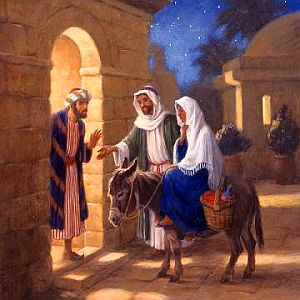
There's no innkeeper. He doesn't exist. I know we see him in all the children's plays around this time of year - and he's become the unofficial scapegoat of Christmas, turning away a pregnant woman in the middle of winter - but there's no innkeeper. There's probably no stable either, but there's definitely no innkeeper. The Bible doesn't mention an innkeeper; we infer that because Luke Chapter 2 says "there was no room in the inn," or at least it says that in English, anyway.
The innkeeper doesn't exist, though, because the inn doesn't exist. That's the real problem. We make a poor inference because the translation makes no sense to us. People simply did not stay in hotels in Jesus' time. There were places we might call inns, but they were for the rare merchant or perhaps a military detachment headed some place without barracks. In Jesus' time, if people were traveling, they made personal connections. You arranged to stay with family or family of friends. You knew someone, who knew someone, who had a place. Often people would just show up at a relative's house unannounced - this kind of hospitality was infused into Jewish culture from the very beginning. The Torah even calls people to welcome strangers. If your cousin doesn't have room in his house, try the neighbor's, they might have room.
So what of the inn? Well, that's the tricky part. There was no inn. We're not just crossing language barriers, but cultural barriers, plus barriers of time (and we're doing it twice - once between Jesus' birth and 1611, when the King James Version came out, and another between 1611 and today). The King James Version twice translates a Greek word as "inn." Both instances are in Luke (very convenient for comparative purposes), but they're two different Greek words. In the Parable of the Good Samaritan, the Samaritan takes the injured man to an inn, promising the innkeeper he'd pay for the man's care. In that instance, there is a word used which means "public lodgings." That's an inn, any way you cut it. The word used in chapter two, though, really means "guest quarters." The very fact that the same book uses two different words in what are really two different circumstances is good evidence that they're not meant to imply the same thing.
Here's where a nerdy working knowledge of traditional lodgings comes in handy. Most families, at the time, lived in one room, essentially. They had a kitchen or sorts, perhaps, with a work space, and some area where they could lay a mat out at night (the family would likely all huddle together as they slept). As the family grew - subsequent generations, cousins, uncles, parents, whatever, they would add rooms onto the home. In the cities, they'd build up (they still do in Jerusalem today), or, if there way space, maybe out. Then each nuclear family would have a place of their own.
Since homes were designed to be added on to at a later date, most reserved the roof for guests. If the family had some money, they might have a designated guest room, but there's not a ton of rain in Israel, so the roof would do. If they had my mother's manners, they might kick someone out of the "good room," so guests could use it and extra people would cram into the first floor (or main room, depending on construction).
So this leads us back to the scripture text - likely Joseph and Mary showed up at a relative's house, perhaps someone distant cousin or what-have-you, and requested hospitality. In reply, they were told the roof was full and there was no space for guests. This is where, if there was genuinely no room, they likely would have hopped next door or moved down the list of distant relatives who lived nearby and tried another place. They didn't, though (another pet peeve is when it's portrayed that Joseph and Mary tried a lot of hoteliers with no success), because they were offered an alternative.
While it's entirely possible the relative they visited had a barn out back, it's extremely unlikely. Those families with livestock (and almost everyone had livestock of one kind of another - eggs and milk and such didn't grow at Safeway, after all) would use them during the day for work (pulling carts and whatnot) or leave them outside to graze. At night, the animals were brought into the house, where they'd bed down on the other side of the main room from the family. Other rooms were guest quarters or the living spaces of older relatives because it was polite to not make people you wished to honor sleep with the goats.
Joseph and Mary likely found a relative with a full house, but one generous enough to offer space with his own wife and kids for this distant cousin and his poor, pregnant betrothed. The Bible mentions Jesus being laid in a manger (a feeding trough for animals), but there's no mention of a stable or a barn - I think, because there wasn't one.
So, if this is true (and while I think it makes sense, I might be entirely wrong), how did this inaccurate portrayal of the event get passed down so thoroughly through the years? I have no proof of this at all, but I suspect it has something to do with how these words might translate to seventeenth century England.
The King James Version came about at a time when scripture in the common language was just emerging. It was written for the common people (if you had money, you were educated, and thus could read scripture in Latin, if you so desired), and I'm guessing "guest quarters" would have been entirely foreign to the common people. People of the time rarely traveled - most would never get more than six or seven miles from the house in which they were born FOR THEIR ENTIRE LIVES! Houses were hovels - and anyone you knew lived nearby and could stay at their own house. Inn - a public housing option for travelers without the means to call upon the local noble - was likely the best they could do to convey the message to the people at the time.
Subsequent English translations were loathe to change the words, which had become so familiar to people in such a familiar story (although the newest version of the NIV does say "guest room," as Luke intended). Today, we all just assume, I guess, that there was a Motel 6 on every corner in Jerusalem and Joseph didn't have the money to spring for an Embassy Suites.
I'm not sure what the point of this whole thing was, really, other than to explain my frustration with the way we tell this story.* Perhaps it's simple to illustrate the importance of further questions, of not taking everything at face value. Investigation is good for the soul - and, at the very least, it may keep some of us from perpetuating the tale of the anachronistic innkeeper to another generation. Merry Christmas!
Just be thankful we didn't delve into the historicity of the census that drives this journey in the first place - you do not want to go there!


