
I do want to write this, though, because I think it's important. Black Panther is coming out this week and what the world needs most is another anonymous white guy's opinion of it. I'm excited to see this movie. I've been excited to see this movie since the director was announced and even moreso as the casting came to light. This is a big time movie with a higher level of talent than any superhero movie before it. Robert Downey, Jr is a fantastic actor, but that's not why he was cast in Ironman.* I've been excited for this movie because I like movies.
TIME has a great piece by Jamil Smith on the movie and it's place in history. It's short and by no means exhaustive, but it does juxtapose the movie with Stokley Carmichael and the Black Power movement. As a white person, I'd been blissfully unaware of the connotations this movie presents of an un-colonized African nation with both the power and technology to take over the world.
It's a radical idea and a scary one for most white people - even those who recognize that it's a bit shameful to be scared. White people don't want black people to have real power because we're afraid black people will use that power in the same way white people have used it for the last 4,000+ years.
That's the long and short of it.
I won't claim to be "woke" or even entirely sure what that means, but I do think I'm more in tune with the sad realities of race than most white people (not that this is a high bar). I've been race-issue-adjacent on occasion, which feels embarrassing to even say - and I only do so to point out that I've at least spent some considerable time thinking about issues of race, even though I'll never be able to even approach the barest glimpse of what it means to be black in this world and I often entirely miss the point.
I see the joys expressed that Black Panther represents black people as heroes in ways that young black kids rarely get to see in society. I can recognize the truth of that statement and the ubiquitousness of people who look like me in pop culture, but I'll never get it. I can't. You just can't experience something you can't experience. The very fact that there's an experience we can't have is enough to make white people angry and expose our entitlement.
This is supposed to be an introduction, but it's already too long. I meant to simply say people with power tend to use it badly and when we use our power badly, it tends to work out better for people who look like us than for people who don't. This is the crux of what I want to say. Ceding power to people who look different from you is rightfully scary - not because people who look different are, in fact different, but precisely because they're the same.
The biggest privilege that comes with white privilege in the privilege to be human. Robert Downey Jr turned his life around and he got the opportunity to do that largely because he's part of the privileged class - he gets to make mistakes and be forgiven. Chadwick Boseman, titular star of Black Panther, also played Jackie Robinson in a movie, a guy who was picked to break baseball's color barrier because he was deemed least human - that is, most able to endure punishing, racist abuse without reacting in completely justified anger.
I prefer the philosophy of Martin Luther King to the philosophy of Stokley Carmichael largely for theological reasons. King was a minister of the gospel and preached an idealized version of humanity because he believed that it is the inevitable future of humanity and our best course of action is to live into that coming future reality as best and as soon as possible. Regardless of race, justice, or equality, this is the concept to which I've dedicated my life.
Carmichael saw the world as it is - a massive power game - and advocating playing that game by the established rules. If skin color were removed from this argument, we'd call it a civil war, memorialize the combatants on both sides and erect nostalgic statues to the losers out of respect for their commitment to their ideals. Why? Because we expect humans to make mistakes. We expect human beings to be wrong. We have grace when people mess up, because we're also people and we also mess up.
We have grace if they look like us or think like us or have some connection to us, anyway. If they don't, we make them a villain, removing their humanity, and raising the bar of acceptable behavior inhumanly high.
The "rights" and the "wrongs" of the black power movement are no different in kind than the "rights" and the "wrongs" of the US response to 9/11; the one difference is that one of them is an "us" and the other is a "them." Tribal identification makes all the difference.
We like to say that we're all the same, that we're all human - that all lives matter, perhaps - but as correct and self-congratulatory as those statements are in theory, they're just not true in practice. We like having good guys and bad guys and it's pretty easy to write off the flaws of one and the positive traits of the other simply because we've got more affinity for the former than the latter.
I do believe that white critique of whatever we describe as "black empowerment" today is largely valid, but what makes it unfair is that those same critics refuse to hold "white empowerment" (or maybe better named "continued white entrenchment") to the same standards of critique. This hypocrisy simply cannot recognize whatever part of "black empowerment"** is actually valid without revealing said hypocrisy. It's a Catch-22 that has almost no repercussions for those in power and far too many for those without.
I genuinely don't believe we need another white voice chiming in on Black Panther or Black Power, but I also feel some obligation as a white person to say what so many white people simply won't. Theory is all that matters to those in power, because we've got reality locked down. Theory matters very little for the unempowered, because reality is all they've got.
So there's a movie coming out, with a largely black cast and a black director that represents real progress on a lot of fronts. It's worthy of support, even if it's not Citizen Kane or The Dark Knight or even all that good. It doesn't have to be the perfect statement on black power or identity or experience to be a valid celebration of those things.
Some white people are afraid of this movie, I guess because it's symbolic of the societal power we're increasingly being asked to give up? We're understandably nervous because we'd like to be sure the "new" world is better than the old one, before we really commit to it. Guess what, white people? A world in which we're not entirely in charge will not feel "better" than one where we run the show. Here is where we have to take our own advice and trust the theory to come through for us, even if reality seems a bit uncertain.
Equality on our own terms is not equality. We've had thousands of years to learn that lesson. We learned it the hard way and other people paid the price. I believe every person has a right to their fear, but I also believe we have a responsibility to reject acting out of fear. That costs us something; it has to. But I don't think any world worth having comes without sacrifice and we've not yet done our fair share.
I don't particularly like that reality any more than anyone else, but I also can't ignore it.^
*We forget this now because he's pretty respectable and super rich, but, at the time, Robert Downey Jr was coming off yet another sobriety slip and literally could not be insured on a movie set. He basically had no other options, but, fortunately, he was talented and white, so second chances abound.
**I recognize that this looks (and feels) a bit condescending as a term, but I don't know any other way to name what I'm trying to name that will be apparent to everyone reading this. It's too easy to get sidetracked by arguments over terminology that we miss the larger point. I do apologize if it's offensive and fully admit my white privilege is primarily why I can get away with it.
^Apologies to anyone who feels like this post is condescending or inappropriate. I feel like just about anything I have to say about race is probably both of those things - I just don't know how else to process and progress without communicating actual thoughts and ideas.

I got to thinking, though, that I seem to remember some small hubbub before Christmas, where a media outlet tried to embroil the Gaines' in controversy over their membership in a congregation where the pastor expressed very typical American Evangelical views on homosexuality. Maybe it was the timing - things getting lost in the holiday shuffle and people not wanting to be part of a witch hunt for Christmas - or maybe it was imply that people like them and their show so much, but it seemed to die off.
I went back to google to learn about what went down and found some interesting stuff. Chip and Joanna Gaines made a very specific effort NOT to make any statement about gay marriage or homosexuality. Yeah, maybe you can still infer that because they're part of a congregation with strong opinions that perhaps that's how they feel - BUT, they went out of their way not to say anything. The response was: "we love everyone," and "we'd rather be wrong than unloving." Those are great statements, as far as I'm concerned, especially given what was likely an uncomfortable and unwelcome situation with pretty big stakes for them financially.
However, I realized that this only became a story because of manufactured news. Yes, a story came out about their pastor in such a way the Gaines' were all but forced to say something. Outside of the Gaines' actual statement (to which almost no one linked), there was no coverage outside of spin. The larger public was really only aware of any of this because websites that are specifically in favor of one opinion used these statements to slyly move the conversation over to their "side."
Coverage from one "side" was typically something along the lines of "HGTV stars refuse to denounce hate-filled pastor," but the other "side," led with stuff like "HGTV Stars Show How to Stand Up For Marriage." This is the real problem. Everything is fodder for some culture war and nothing can be taken at face value. Christians are happy to cheer an honest and loving response, but, if their media is any measure, are completely unwilling to live it.
I'm reminded of Hacksaw Ridge, the Mel Gibson movie that was out recently. It's a powerful story about non-violence and one man's commitment to it in the midst of war. It's a tremendously inspiring story of lives saved in the midst of death and death-dealing, but it left me very conflicted. I'm just not sure how to reconcile a movie that celebrates violence and non-violence at the same time. It's almost as if our society says, "Non-violence is great, just don't ask me to do it." As a Christian - that feels as much like rejection as it does like acceptance.
TIME magazine just ran a cover story about how this next generation emerging doesn't understand gender as binary or even something worth using to distinguish between people. It talked about how both "traditional" and "LGBTQ" activists are thrown off by the notion that younger people don't want to be defined. The whole conversation around pinning down an identity seems foreign to the next generation. It's like looking at penicillin and trying to figure out how to weaponize it.
This is at the heart of every major societal argument we're currently having: the desire to control the narrative, to define "normal.
Don't criticize the President, respect the office. Be upset with the country, but don't protest the flag. Pick a bathroom and stick with it. Take a side. Stake a claim. Define yourself, then defend yourself. It just doesn't make sense. We've some how entered a war where the battlefield is our ability to define each other. I get that one of the core biological traits of humanity is our inherent desire to compare new things to things we've seen or experienced before - that's where notions of race and gender and definition come from - but we've risen about our base instincts in so many ways (or at least we aspire to do so), why can't we add one more?
I don't know Chip and Joanna Gaines - I like the TV show, when I've seen it - but taking what they said at face value, it seems like they're trying to say: "the normal is love." People seem to have a hard time with that, but I suspect that's pretty close to the gospel.
This isn't (or doesn't have to be; I don't know their intentions) a political strike in the midst of a battle. People seem to want to see someone play the rules of the game well, but what if they're just trying to change the rules or play a different game altogether?
I don't know where its visible or if anyone will see it, but I changed my gender on Facebook to "human" today. It's entirely inconsequential, I'm sure, but it feels good. People are people before (or in spite of) whatever else they might be. If we started there, it might save us a whole lot of anger, stress, and heartache down the line.
There is no "normal," and that is the New Normal.

He actually said something like, "If the last endangered white rhino stood between me and the lives of my wife and kids, of course I'd kill it," which is a little over-dramatic for the point he was making - which is that human life comes before animal life. I suppose, in individual situations I don't disagree - I mean, if the gorilla had really hurt or killed that kid, they'd've had to put it down anyway.
I'm not so sure the sentiment hold true for me as a guiding principle, though - at least as it appeared in the TIME article.* I reject the notion that humanity is the primary concern of the world. Theologically it's all wrong - God created humans to care and tend to the Earth. Yes, one might say that the Earth can't be cared for or tended if it's caretakers are extinct, but this idea seems an extreme argument and, ultimately, someone else's problem. If God creates a universe, puts us in it specifically to care for that world, calls us to live sacrificially in service of creation, then also allows us to do so to our own extinction, that's either poor planning or part of the plan all along.
I tend to think our science and theology pushes us to see humanity as something different than what's been before. Humans are really the only creatures capable of analyzing our own instincts and rejecting our natural inclinations. We're capable not just of making choices, but analyzing those choices, even before they're made. I'd say we're different enough to really affect the whole of creation, either positively or negatively.
Of course, as the "pinnacle of creation" (or evolution) it makes a lot of sense for us to think this way - and we'll probably continue to think this way right up until some other, more evolutionarily advanced creation takes our place and makes us irrelevant (and if you scoff at that, ask your friendly, neighborhood neanderthal what they think... oh, right).
Now I'm not going to argue that we're NOT responsible for humanity - after all we're a big part of this world in which we live - but I would argue that we're more responsible for making the whole work well than we are for maintaining any part within it. Creation is a system - one Christians especially believe humans play an integral part in maintaining - it should be understood and approached that way.
This is sort of what I was saying the other day: are we merely a collection of individuals, or are we individuals who've submitted ourselves to the whole? It sounds like simple talk, but it makes a real difference in how we view our purpose in the world.
Yes, if the world's last remaining white rhino somehow stood between me and my family's life, I'd probably kill it. I hope not, but let's be honest (although I have no real clue as to how one might go about killing a white rhino, especially in an emergency - I don't usually carry around high powered hunting rifles and somehow I don't think my bare hands are going to cut it - or a knife; I'm not sure a knife would cut it -rhinos have very thick skin). Would it be the right thing to do? I doubt it.
Like any issue of life, the question, though, isn't about one moment, it's about setting up a system that addresses the issue well beyond any individual moment. So, as an example, we could say sacrificing acres of rainforest is worth it if lives are saved - some would even argue that faith in science and progress leads them to believe we'll figure out solutions down the road. I'd prefer to figure out the best solution now.
Yeah, I'd rather sacrifice my own life over someone else's - at least then I'd get a choice - but I think the idea of sacrificing our lives for something more noble than just an individual life is pretty important to the way the world works. I believe in non-violence, but making a stand for non-violence usually means suffering violence - often for quite a while - before the message takes effect.
I'm not sure the big issues of environmental stewardship are really life or death for too many of us just yet, but they do call for sacrifice, for giving up pleasures or conveniences or things we might've otherwise considered needs, to create a world that's ordered and sustainable for all.
There's nothing wrong with making humans a big part of our sacrificial environmental actions, but we need to make sure we've got a more generous end in mind.
*It was called "Engineered food holds our future" by Hope Jahren, but it doesn't appear to be online anywhere yet.

But it touched something deeper inside of me - real grieving - something beyond just sympathy or sorrow or regret. It hurt. Deep down. It's why I wanted my daughter to be a part of our local rally for peace on Thursday. We couldn't stay the whole time and I doubt she'll even remember what happened, but she saw and heard perhaps the most racially diverse religious gathering in the history of this town. She was there and that's important to me.
Now I'm scared this will sound callous, but, amazingly, the events of the last two weeks have given me some measure of hope. Obviously a lot of people have lost lives - far too many - but the reality is that terrible violence has been done to black people in this country since even before it was a country. We can lament over the loss of life - any life; and we can lament over the slow pace of progress. No but - we can and should lament. Things look really bad.
I have some hope, though, because from my perspective, this time is different. TIME magazine reports that 61% of white people think racial equality is a real issue - a sadly low number, but the highest it's ever been. Further, white people, especially young white people, have been the majority of those engaged in protest following the most recent spate of events. So long as white people remain the majority in this country and control the levers of power and influence, white people need to be on board with solving racial inequality. It's been the indifference of me and people like me over the past 400 years that have left us at this point.
Maybe the perspective of black Americans in black neighborhoods is far from optimistic, but from my perspective, I've never seen so many white people engaged, willing to listen, and seeking to understand. I haven't felt my speaking up about my experiences, witnessing racially disparate treatment by police against black people, as being rejected or unwelcome. That's a first.
I've felt slightly emboldened, but mostly challenged by Rembert Browne in this piece from the New York Times - he calls on white people to speak up to other white people - to come out as sympathetic towards the plight of African-Americans. As much as I hate to admit it, he nails white culture pretty well (and, having gone to Dartmouth, the guy is in a pretty good position to really understand white culture from the outside). The strange thing, though, is that it doesn't feel difficult or unwelcome anymore. Yes, there were a few of the typical retorts, trying to explain away these police killings by impugning the victim, but those faded pretty quickly (at least more quickly than they have in the past). Shoot, freaking Newt Gingrich came out with a strong statement:
It took me a long time, and a number of people talking to me through the years to get a sense of this. If you are a normal, white American, the truth is you don’t understand being black in America and you instinctively under-estimate the level of discrimination and the level of additional risk.
Newt Gingrich! There's some hope when an issue like this has moved from a partisan issue, to one infecting the "other" side in profound ways, it has to be seen as progress. The progress is embarrassingly slow. It's unacceptable that we've gotten to this point, but gotten to this point we have, and wringing our hands over it will not solve anything.
We have to avoid saying, "yeah, us; we care now," as that's beyond patronizing; it's insulting. I can't be the white guy saying, "hold on, we'll get there." That might be the only thing we can say, but it's as helpful as saying "All Lives Matter" at this point. Frankly, I'm not sure we have the right to claim any life matters until we can show that literally any life matters.
I'm particularly broken by the claim, oft repeated this week, that we've left too many problems for the police to solve. I hear the same complaint from school teachers, literally almost every day. The problems of our society are our problems, even if we've segregated ourselves in communities where we're insulated and isolated from those issues we rue. It's not somebody else's problem and it's not somebody else's fault. I can clearly say no one's done as much as they can to make the world a better place - save for those who've literally given their lives on the altar of our societal shortcomings.
Yes, do something rather than nothing, but do more than some thing, commit. Be a difference in your community - and that might just mean getting out of your community and into one you wish were better, not telling "them" how to be, but becoming "us" in the midst of the mess. We won't overcome our fear and obsession with safety until we have a world that's fear-free and safe for all. We can't look at a gash on our arm and say, "that's my arm's problem." My arm's problem is my problem; black America's problem is America's problem. I think more white people are starting to see this. I think that's a droplet of good news in a flood of bad, but it's enough for me to keep going and I pray its enough for others, for those really hurting in the midst of this outrageous reality, to keep going too.
I experienced something I first mistook for guilt. It's easy to see how guilt at the relative ease of life in the West compared to rape and hunger and war and abandonment makes sense - but it really wasn't guilt. It was more a sadness - yes, sad for these people, but as I said the emotions didn't really get through - it was a sadness at the realization that my life will provide me with only the narrowest picture of the human experience. Even the most adventurous and well-traveled among us will barely scrape the surface of what it means to be human - for good and for ill.
It's not just the horror of child rape as a weapon of war, but the whole gamut of emotions and experiences that will just never be an option for me. I guess this is sort of like someone staring at the night sky, depressed about their own insignificance. We (or at least me) like to cling to the illusion that I'm a "normal" or "average" person - at the very least "representative." I want to believe that my life is, give or take a few particulars, just about like everyone else's life. That's simply not true.
I wonder if this is why individualism is so attractive, because it makes us completely representative, because there is nothing "real" outside ourselves. We can never be insignificant, unless we choose to be. We can never be below average or strange unless we choose to be. It's a far cry from understanding ourselves as but incomplete portions of the larger whole. As a human, I am barely discernible compared to the grand scheme. Theologically I might argue I'm completely complementary to the whole of creation - there is no such thing as an individual human any more than there is an individual cell. Yes, they can be delineated and even survive on their own, but that existence is nothing, really, compared the the beauty and complexity of the society in which they reside.
I still can't get my head around rape as a weapon of war and the dehumanizing that precedes it. This is one of those horrors that seems beyond comprehension, let along solution. We Christians like to put these most difficult ones on God - "you take care of that, because I just can't deal with it." As real as that inability to deal is, it's also a little cop out.
But the cop out has two sides. In one sense, it helps to preserve the illusion that we matter - again, I'm not saying that individuals don't matter; they do, but not in the way we like to pretend. It makes us think we can solve our own problems, that just maybe if we get some of the smaller ones figured out, we can work up to the real horrors.
On the other hand, it just lets us draw a comfortable line between the possible and the impossible. We can put that line wherever we choose and convince ourselves that there's nothing we can do about it - that the line exists outside ourselves.
I don't know what to do with this. There's no conclusion here. I've just been thinking about it a lot - and hopefully it will change the way I approach hope and the world itself. Ultimately, it help me internalize the notion that we're not in control - human selfishness and greed have set free the kind of pain and horror we cannot easily rewind. To think otherwise is really just fooling ourselves.

TIME Magazine had a fascinating story about how millennials are prioritizing friendships over romantic relationships. This is likely easier in the age of hookup culture, where the temporary satisfaction of our physical desires is divorced from relationship, but it provides a great launching pad for discussion nonetheless.
The bottom line was simply: Our friends know who we are; we have to meet the ideals of a date. There is an inherent dichotomy in the competitive nature of our romantic life. We have to compete with every other girl/guy out there for the affection of our date. We have to live up to some expectation. (It's a system which doesn't work out long term - eventually we'll be who we are and our partner better appreciate that - but that's another post altogether.)
This plays out on Facebook, where people have to work to balance an accurate portrayal of themselves with the kind of person they wish to project themselves as. In the end, we have to learn that we can't just whitewash out image. We are who we are. This is wise counsel for matters of faith - well, for life in general (Tim Suttle talks about this well), but specifically when it comes to faith.
We want people to be doctrinally sound (we want people to believe the right things) because our beliefs shape our actions and our actions are important. But this priority inadvertently demotes the importance of genuine faith. We don't intend for people to claim things they don't believe, but that is how it too often comes across. It's like faith dating. People like us and want us to like them, so they put on the image we want to see, whether it reflects reality or not.
It's this sort of attitude (again, usually with the best of intentions) that keeps people from asking questions (and when they get answers elsewhere, they right you off as a source of authority). It is the reason we keep secrets - not just that we have done disappointing things, but that we are disappointing (or it appears that way if we're not the people our loved ones want us to be).
I guess I'm advocating a sort of open acceptance that I usually feel is weak and unhelpful. I think the difference is it must be paired with ongoing, honest dialogue - relationship. If you and I disagree about the value of factory farm beef, we can discuss it, learn about each other's thought processes and decisions and come to an understanding, even if we continue to disagree. We're ultimately looking for people to be earnest.
The difficulty comes when we don't believe the other person is earnest. That's tough. I suppose what's required them is real relationship, not just dialogue. We have to trust one another.
It can't just be about prohibition and lines of demarcation.
If everything is about a prohibition, rather than a specific rule of life (in which we voluntarily adopt and avoid certain practices), there is no freedom, value, or individuality. WE are not respected as individuals, but only so far as our individuality matches that of the other or the authority. Peter Rollins talks about this in a number of his books - and illustrates it well in a hilarious story about duck hunting and kicks to the crotch.
It's a natural reaction to defy authority - to want to do something other people tell you can't be done (or shouldn't). It's a sign of maturity to recognize the value of another opinion and change your mind. The whole thing is easier to navigate when there's no ironclad prohibition hanging over our heads (which is how, often, relationships with disagreements - vocal or internal - end up operating).
Yes, it may lead to more mistakes and heartbreak than we'd like to see - but there's that trust thing again. We might save our friends and loved ones some heartbreak if we could just convince them of our correctness, but I think we've got a better chance of getting them where they need to be if we let them figure it out on their own. (Again, not remaining silent, but also not demanding or insisting on our own correctness anywhere but in our own heads.)
So often we try to make blanket statements applicable to all people at all times - and we get into fights. Whereas, if we focus on ourselves and our situations - if we enter into relationship with the people around us and discuss real scenarios and real options, we can address real life. We can work together to figure life out (and maybe live with disagreements).
My last post was received more graciously than I expected. I think you for that. At the same time, Peter Clarke pointed out an important element:
For me, your statement "Scripture is not a list of rules and laws, but an authoritative narrative pointing to relationship with God." sets the direction of your whole case. If a person does not truely understand the implications of that statement, they will not (probably cannot) come to the faith-mature position you've come to. I think most people would agree with the statement, but thinking it all the way to the end, admitting the limits of our perspective as you have, standing up for those with the purest desire to become like Christ despite whatever internal struggle they have found themselves with, takes a lot of courage.
This is exactly the point. Do we trust God (or conscience, if that's your thing) to work in the lives and hearts of people or do we assume, if they don't agree with us, that they're somehow refusing to hear God (or reason)? I prefer to assume the best and continue in conversation about our different beliefs and the reasons behind them.
We can only do this if we're willing to both be really ourselves and accept people the same way. No preconceptions. No conditions.
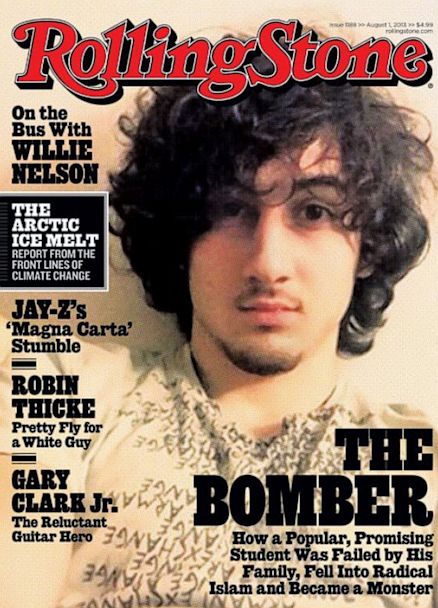
It might be that I'm from nowhere. I'll give you that. But if I am from somewhere, that place is Boston. Still, I'll admit, I'm having a lot of trouble with the furor over the upcoming Rolling Stone cover with Dzhokhar Tsarnaev on the cover. I've read TIME Magazines and Newsweeks (RIP) with Osama Bin Laden featured prominently. Is the issue more because it's a flattering picture and not dirty, bearded Saddam Hussein?
I read the arguments about not validating horrible acts with fame, although they're silly. Famously bad people get famous; you refuse to reward them by making sure they deal with the consequences of their famously bad acts.
I suspect it has more to do with the notion that Rolling Stone will feature a story, not about a cold-blooded killer, but about a confused kid that in way over his head. We're outraged by the sympathy - as if sympathy itself is finite and any sympathy given to "the bad guy" is sympathy taken from his innocent victims. I haven't read the story; I've not even read an account of anyone who's read the story. It may very well make Tsarnaev a victim alongside those people he hurt. I'm not sure what's wrong with that.
Not every victim is innocent. Not every terrorist is evil.
To be sure, there are plenty of innocent victims here. People were killed, maimed, injured, traumatized by the senseless, stupid actions of two disillusioned brothers. That's not up for debate. No matter how righteous our perceived cause or how serious our perceived indignities (and our causes and indignities are always perceived), violence is never the right choice. It just isn't. Ever.
But I'm troubled that our society so quickly condemns anyone willing to explore the depths of a complicated situation. We like simplicity. We like it a lot. But then again, simplicity is not real life (the same can be said for Trayvon and George).
We want to categorize people good and bad, usually so we can distinguish "us" from "them." We like the fantasy that some human beings are downright evil. It keeps us from facing the reality that, as humans, we're all capable, under the right circumstances, of all the evil any of us are capable of.
None of us should be defined by our actions. We can certainly be described by our actions, but that's a far cry from defining us that way. I've known people who grew up with absentee fathers who've really struggled with this distinction. When you've got a Dad incapable of anything good, it's tough to realize that this dispicability isn't genetic. They have to differentiate between the actions of their father (which are bad) and the person of their father (who is dad). The same applies to all our heroes and villains.
The homeless man with the golden voice, who made headlines, reunited with his family, and went on all the feel-good morning talk shows - he relapsed shortly thereafter, then again a few months later. He's got a job and a home and a future, but he's not perfect. He's a man chock full of good and bad; neither define him. They describe him.
Don't get me wrong, description is still important. People who have done a lot of stealing are likely not the best to hire as house-sitters. We must all live with the consequences of our actions. Those are real. I hope the Rolling Stone piece doesn't gloss over the tragedy that brought Tsarnaev to our attention. It would be unconscionable.
But actually exploring the forces in a person's life that lead them to evil (or to good) is interesting and valuable and far too rare in our world today.
It's way better than just guessing, which is how it normally works. We judge people based on gut instinct and any variety of subjective criteria. Howard Dean gets excited during a campaign speech, yells crazily, like Slim Pickins riding the bomb, and his political career is over. Anthony Weiner texts a picture of his junk to a woman who's not his wife and he becomes the next mayor of New York. Capricious.
We want to hate Dzhokhar Tsarnaev. He's done some bad stuff. The consequence of which is that his life ends at 19 years old, whether he's executed or not. Does that make him a tragic figure? I don't know, but I think it's fantastic that someone is trying to find out.

TIME Magazine had a feature story a few weeks back entitled "Can Service Save Us?" I was immediately intrigued, as you may know, I'm a big proponent of serving others. I believe it's the key to life. That, ironically, the only way we can appease that insatiable drive to please ourselves is by forsaking our own needs and serving others. I figured the article would be about national service and the drive of a younger generation to be more intimately involved in tangible change.
I was blown away to see that the article was about all that, but even more, it was set in the context of combat veterans. While the article focused on some specifics of various groups, their history and future, I was blown away by the clear an concise message.
Combat veterans need some place to relax with people who don't treat them like heroes or villains and they need some continued connection to mission.
I posted a long way back about my conflicted feelings towards military service. This article, perhaps only by implication, helped parse those feelings a bit. There is a dichotomy between the ugliness of war and the valiance of those willing to wage it. Often, those element of the job are conflated. It seemed like this article took pains to keep them separate.
I think it's begun to hit on the core of our human longing for purpose. We search for it in any number of different ways, some healthy, others not so much. In the end, we want to be connected to others in ways that make us feel alive.
Many young people join the military because they don't have a sense of purpose or even much self-awareness. Often they find these things, but they're too closely connected to their job. When Soldiers leave the military, they have a lot of skills and abilities, but they often encounter the same personal issues they had going in. I love the idea of connecting people to a mission, not only one bigger than themselves, but bigger than their past and their position.
I do believe service will save us. I think it's a key component to salvation of every kind. I am ecstatic to see the quality skills and abilities earned in the military put to use for some purpose other than fighting.
The military does one thing the Church has lost - connecting people to mission. Perhaps the military falls short in too closely connecting that mission to military and diplomatic aims, but the Church often limits mission to preconceived religious boxes itself.
What we need is a broader, more open understanding of mission - something outside our job description or our religious preference our own personal identity - something that unites us in our common humanity and perhaps, in the doing, somehow makes us more human.

I have no experience in combat or as a soldier so anything I say here is more speculation, hypothesizing and questioning. I hope those experienced soldiers who read this will be able to bring their informed opinions to my thoughts.
Obviously the question is why?
I don't know. I have a couple of questions. Could it have something to do with the changing cultural understanding of war? It seems like war, combat, killing was once something people did out of perceived necessity - it remained "bad," regrettable, and terrible. People knew the "evils" of war, so to speak, and what men did in battle stayed there.
Over time we, out of patriotic fervor (especially those who never go, serve, or sacrifice) made such combat service into something admirable. It wasn't the nastiness of war anymore, at least in the public realm, it was good and noble. Something that had to be difficult when the realities of combat are relatively unchanged. We had a whole generation of veterans whose experiences in war didn't line up with the descriptions of such by people who hadn't been there.
Is it more difficult to deal with the realities of combat when people treat soldiers like heroes for killing people? I don't know. Just a thought.
Of course that doesn't address, at all, those soldiers who kill themselves while never having seen a war zone. TIME profiled a doctor, stationed in Hawaii, who cited the difficulties meeting responsibilities to his family and to his comrades. Is there an issue with priorities? The military does a great job breeding brotherhood - bringing people together in such tight-knit ways that they become family. Does this familial bond end up trumping a soldiers spouse and kids? Is too much emphasis placed on the connection to fellow soldiers? I don't know.
I did think about potential comparisons to ministry - something with which I am familiar. Often, pastors were trained to give everything to their ministry assignment - the people in their pastoral care became such a priority that their spouse and kids suffered because of it. I use the past tense because things are improving; it's not a conquered problem, though.
Because of these pressures, you see a lot of depression, burnout, and relational problems in pastors. Thousands of pastors quit each month because of these or similar pressures. As a whole, ministry preparation did not include the proper understanding of priorities for family and ministry.
I don't know if this is analogous to the military or not. It sure seems like it from the outside. Are there better ways to train soldiers to maintain proper perspective - or are the requirements of the job too demanding to make this work?
Certainly there is more each of us can do to support combat troops as they return home, but the Pentagon isn't sitting on its hands either - 4% of the budget goes to mental health and most of the active duty suicides had counseling and other preventative services.
If trends continue, in a few years suicide will be a greater cause of military deaths than combat. We owe it to our our soldiers and ourselves to keep this from moving to the back burner.

On page 68, #4 in the list of ten was entitled, "The Rise of the Nones." It focused mostly on surprising poll numbers in the US that show a drastic increase in the number of people who claim no religious affiliation and at the same time only 4% of people claim to be atheist or agnostic. What this means is that people are being turned off by organized religion, but not so much with the idea of God. In fact, the article cites that "40% of unaffiliated people are fairly religious" in belief and practice.
There was a focus on one small community of US ex-pats in Mexico, led by an ordained Presbyterian minister, who have formed "Not Church." Not Church is a community of people who share life together under the umbrella of Christian faith, but without the trappings of ecclesiastical hierarchy and theological disputes.
I immediately thought of the "belong, believe, behave" debates that have happened in recent years. The old model was convincing people to behave a certain way (stop drinking, smoking, sleeping around, etc), which would open them up to belief in God, which in turn would allow them to belong to the congregation. Recently things have been switched up. People are desperately seeking ways to connect to other people. Congregations like "Not Church" provide a place for people to belong, exploring the ideas presented and developing belief, wherein they use this belief to make decisions about behavior.
People need relationship, trust, before they're willing to evaluate beliefs and behaviors. Quite honestly, people need relationship and community to wrestle with the "big questions" in life. It's not something we're meant to do alone. This provision of a community should also not be conceived as a means to evangelism, but as an end in itself. Providing such a community gives people space to explore their own lives; it's not a tool for building attendance or religious structures (at least it shouldn't be, although I suspect it's already being commodified for use toward those purposes anyway).
As we've been discussing our new adventure, people have had some difficulty understanding what exactly we're intending to do. I'm not sure we know exactly, but these issues are some we feel called to engage. We hope to find and provide a safe, loving community that can live life together as we explore God's creative purpose for our lives.

