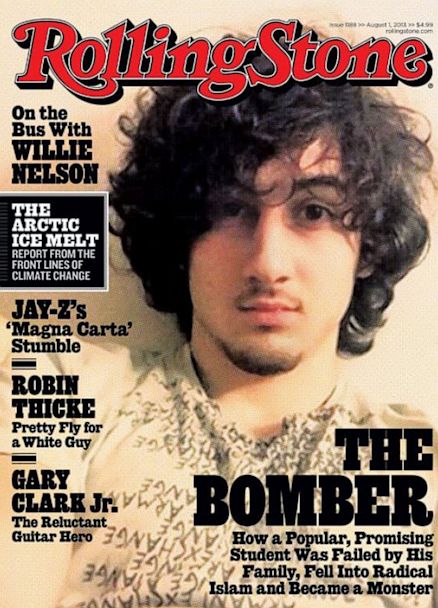
It might be that I'm from nowhere. I'll give you that. But if I am from somewhere, that place is Boston. Still, I'll admit, I'm having a lot of trouble with the furor over the upcoming Rolling Stone cover with Dzhokhar Tsarnaev on the cover. I've read TIME Magazines and Newsweeks (RIP) with Osama Bin Laden featured prominently. Is the issue more because it's a flattering picture and not dirty, bearded Saddam Hussein?
I read the arguments about not validating horrible acts with fame, although they're silly. Famously bad people get famous; you refuse to reward them by making sure they deal with the consequences of their famously bad acts.
I suspect it has more to do with the notion that Rolling Stone will feature a story, not about a cold-blooded killer, but about a confused kid that in way over his head. We're outraged by the sympathy - as if sympathy itself is finite and any sympathy given to "the bad guy" is sympathy taken from his innocent victims. I haven't read the story; I've not even read an account of anyone who's read the story. It may very well make Tsarnaev a victim alongside those people he hurt. I'm not sure what's wrong with that.
Not every victim is innocent. Not every terrorist is evil.
To be sure, there are plenty of innocent victims here. People were killed, maimed, injured, traumatized by the senseless, stupid actions of two disillusioned brothers. That's not up for debate. No matter how righteous our perceived cause or how serious our perceived indignities (and our causes and indignities are always perceived), violence is never the right choice. It just isn't. Ever.
But I'm troubled that our society so quickly condemns anyone willing to explore the depths of a complicated situation. We like simplicity. We like it a lot. But then again, simplicity is not real life (the same can be said for Trayvon and George).
We want to categorize people good and bad, usually so we can distinguish "us" from "them." We like the fantasy that some human beings are downright evil. It keeps us from facing the reality that, as humans, we're all capable, under the right circumstances, of all the evil any of us are capable of.
None of us should be defined by our actions. We can certainly be described by our actions, but that's a far cry from defining us that way. I've known people who grew up with absentee fathers who've really struggled with this distinction. When you've got a Dad incapable of anything good, it's tough to realize that this dispicability isn't genetic. They have to differentiate between the actions of their father (which are bad) and the person of their father (who is dad). The same applies to all our heroes and villains.
The homeless man with the golden voice, who made headlines, reunited with his family, and went on all the feel-good morning talk shows - he relapsed shortly thereafter, then again a few months later. He's got a job and a home and a future, but he's not perfect. He's a man chock full of good and bad; neither define him. They describe him.
Don't get me wrong, description is still important. People who have done a lot of stealing are likely not the best to hire as house-sitters. We must all live with the consequences of our actions. Those are real. I hope the Rolling Stone piece doesn't gloss over the tragedy that brought Tsarnaev to our attention. It would be unconscionable.
But actually exploring the forces in a person's life that lead them to evil (or to good) is interesting and valuable and far too rare in our world today.
It's way better than just guessing, which is how it normally works. We judge people based on gut instinct and any variety of subjective criteria. Howard Dean gets excited during a campaign speech, yells crazily, like Slim Pickins riding the bomb, and his political career is over. Anthony Weiner texts a picture of his junk to a woman who's not his wife and he becomes the next mayor of New York. Capricious.
We want to hate Dzhokhar Tsarnaev. He's done some bad stuff. The consequence of which is that his life ends at 19 years old, whether he's executed or not. Does that make him a tragic figure? I don't know, but I think it's fantastic that someone is trying to find out.

A tale has been told of a young boy, we’ll call him Amir, playing with some sticks he’s fashioned into toys and eavesdropping on his father, entertaining guests in a small house in the mountains of Afghanistan. Suddenly, there’s a bright light, a loud noise and everything goes black. When Amir awakes, he finds his home in ruins and all his family dead. At seven, he is the lone survivor and he is on his own.
The neighbors tell him it was a drone attack, that foreign invaders bomb their country to make the people afraid and take their resources. Amir has made an enemy. His journey begins slowly, running errands and cooking food. Soon he becomes a look-out, and a very good one. His stealth earns him a promotion and he begins planting roadside bombs, then helping to build them, then deciding where they will be placed.
A decade later, he is a man, even though he’s been an adult far longer than children should have to be. He’s moving along a mountain road from one village to another when he comes upon the remains of a recent ambush. A foreign soldier lies on the side of the road ahead, he must have been thrown from his vehicle during the chaos.
Amir ducks behind some rubble as the soldier’s unit returns, running quickly. They glance at their fallen comrade and then back at their pursuers and hurry on. Later, an investigative team arrives, checking the road for clues and unexploded devices. They too ignore the soldier on the side of the road.
Finally, when the coast is clear, Amir ventures out. This is a profound moment for him. Despite all of his experience, he’s never met an invader up close. Surely the soldier is dead or the others would have helped him. Amir will take no chances. The images of his parents, his siblings, their bodies broken, their funerals dance in his head. He gripes the knife inside his cloak. He will make sure this soldier is dead.
As he approaches, the man moans and begins to roll over, clearly badly injured, but alive. They make eye contact. Amir gasps, drops his knife and staggers backwards. The image in his head has been transformed. As he stares at the soldier, he see’s something familiar. The blood, running down his face, sticking in his beard, the pain in his eyes. Quickly, those eyes become the eyes of Amir’s father, the blood, his blood, the pain, his pain. Amir’s heart melts.
Amir could do nothing as a young boy, but he could do something now, as a man. Quickly his mind begins to assess the damage. He looks around – there’s a village not far, with some friends. He could hide the soldier in a back room until his wounds heal enough. His reputation and authority should keep the soldier hidden well enough. There is money and medical supplies stashed away. They should do. If not he could find more. This man must not die.
As Amir regained his bearing and approached the soldier, he saw the pistol. The soldier had retrieved it, with great effort, and was pointing it in Amir’s direction. The soldier was in no position to fight and his wounds demanded hurry. So Amir kept coming. The shot rang out and echoed through the valley, then another. Neither had hit Amir, but the look in the soldier’s eye had changed from pain to fear.
Amir did all he could to assuage that notion. But he spoke only his native tongue and there was really not much time. With his injuries, the soldier’s aim was terrible, but at close range it would be good enough. In the end, his bullets held out longer than his heart and by the time Amir was able to reach him, he was gone.
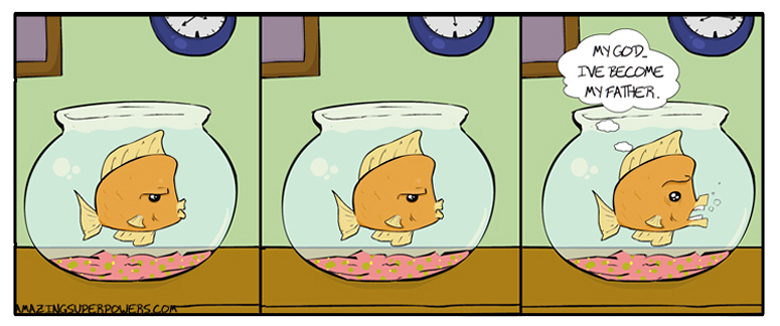
We're all special, right? We're all unique individuals with something to offer the world that no one else can offer. At least, that's what everyone in my generation and those following have been told by everyone for their entire lives.
Obviously, most of us realize at some point that we're not that special. Yes, we're unique in that no one is exactly like us, which is great and good and important; but we figure out at some point that we're not special the way we were told we were special.
I think that point is when adulthood begins.
Those nine-year-olds who carry a briefcase and stay at the dinner table talking to the adults when the rest of the kids are off playing - they're not strange, they just figured out reality a bit sooner than their peers. I have a lot of respect for those kids.
Of course there is another side to the equation. Those nine-year-olds who stay at the table talking with the adults because they think what makes them special is how much smarter and more mature they are than other kids.
This kid was me.
I wasn't like a super genius. I didn't learn to read before any of the other kids in school. I can't do complex math in my head and I don't have a photographic memory. I was, however, pretty good at a lot of things. Looking back now, I realize this was mostly because I don't forget much. Like I said, I don't have a photographic memory with perfect, instant recall, but, for the most part, the facts that do wedge themselves into my brain stay there for a long time - and I'm pretty good at recalling them quickly when need be.
This skill helped me do well in things, but it wasn't anything special. I'm an above-average intellect with a talent for remembering random facts (but no talent for remembering when to take out the trash or what to get at the grocery store).
For the longest time, I clung to the notion that there was something about me truly special. I had something so unique that I would one-day find that one thing in life I was better at than anyone else. I didn't and still don't have great self-esteem, but so long as I could prove myself in trivial pursuit or finishing the math test first, it helped to feed the delusion.
I spent a lot of my life calculating. Calculating what would be a reasonable challenge and what would be a miserable failure. I was very competitive (for those of you who only know me as an adult, this is nothing). I took pride in being the best at those few things in which I was the best and I avoided doing anything else at all. I still have a hard time doing something just because it's fun.
However, I've discovered something since having a child. I'm really, definitely way too excited about seeing what she can do. After all this time attempting to negate the notion that anyone else could be as smart or as talented as me, I'm really, really hopeful that my daughter can do the same things - or maybe more and better.
She's got one of those shape toys, where you fit the plastic shapes into corresponding holes. It teaches problem solving and manual dexterity, matching, etc. Eva is 14 months old. She can, like 70% of the time, identify a circle, square or triangle - and also identify the corresponding hole in the toy. She even manages, maybe 30% of the time, to actually get them in. She's probably doing pretty well for her age.
I can't tell you how much I want her to be better at it. I know there are some parental-pressure issues that can easily arise here, and I know I'll likely struggle with them as any parent does. More than that, I'm just hoping beyond hope to have a kid I can relate to. I'm not sure I'd wish my faults and foibles on another human being, but at the same time, I can't imagine how great it would be to live in the same house with someone who understands me.
I have developed some good friends over the years, friends who get who I am and value me in all my unsualness. Most of them don't understand me. My wife sure doesn't. I can think of maybe two or three people in my entire life I felt I could really relate to completely. I'm used to being an odd duck.
I don't really want an odd-duck for a daughter. Of course, I am going to get one. Whether she's odd like me or odd in some other way, she's going to be different. One of the biggest traumas we inflict on each other is our continued presumption that there is such a thing as "normal." I knew early on that whatever normal was, I was never going to be it, which brings with it it's own set of challenges. However, I've spent my whole life watching people who had a fighter's chance of being normal try to do just that. It seems painful.
It would be selfish to wish my daughter were just like me. It would be equally selfish to wish she were normal, whatever that is. It would be borderline abusive to push her in either direction.
At the same time, I fight the drive within me to find my one world-beating talent. Even though I recognize that the quest is futile, it's still there within me. Having a child brings hope that maybe, even if I can't figure it out, the next generation can continue the quest.
It's about pride. I struggle to find things in myself about which I can be proud. I have a hard time seeing and defining myself as important apart from the things I can do. Maybe my desire for another someone like me is an attempt to reassure myself that who I am is acceptable? I really mourn the difficulty I have in doing something that makes me look foolish (even if it's only foolish in my own eyes). I certainly don't want to pass that on to my daughter.
It's also a vicious cycle. If you're not proud, you seek out those things you can be proud of. When/if you find them, you have reason to be proud. Pride doesn't help us. Those times I've really felt accomplished haven't been because I did something great, but because I did something that felt true to myself.
I don't know how to pass on the good and hold back the bad. I'm not even sure I know enough to say all of what's good or bad to pass on. I do know that having a daughter has changed me. I spend much more time thinking outside of myself than I ever have before. I know, deep down, that's a good thing.
I'm going to love her and tell her she's special - not because of what she knows or does or says - just because she is.

TIME Magazine had a feature story a few weeks back entitled "Can Service Save Us?" I was immediately intrigued, as you may know, I'm a big proponent of serving others. I believe it's the key to life. That, ironically, the only way we can appease that insatiable drive to please ourselves is by forsaking our own needs and serving others. I figured the article would be about national service and the drive of a younger generation to be more intimately involved in tangible change.
I was blown away to see that the article was about all that, but even more, it was set in the context of combat veterans. While the article focused on some specifics of various groups, their history and future, I was blown away by the clear an concise message.
Combat veterans need some place to relax with people who don't treat them like heroes or villains and they need some continued connection to mission.
I posted a long way back about my conflicted feelings towards military service. This article, perhaps only by implication, helped parse those feelings a bit. There is a dichotomy between the ugliness of war and the valiance of those willing to wage it. Often, those element of the job are conflated. It seemed like this article took pains to keep them separate.
I think it's begun to hit on the core of our human longing for purpose. We search for it in any number of different ways, some healthy, others not so much. In the end, we want to be connected to others in ways that make us feel alive.
Many young people join the military because they don't have a sense of purpose or even much self-awareness. Often they find these things, but they're too closely connected to their job. When Soldiers leave the military, they have a lot of skills and abilities, but they often encounter the same personal issues they had going in. I love the idea of connecting people to a mission, not only one bigger than themselves, but bigger than their past and their position.
I do believe service will save us. I think it's a key component to salvation of every kind. I am ecstatic to see the quality skills and abilities earned in the military put to use for some purpose other than fighting.
The military does one thing the Church has lost - connecting people to mission. Perhaps the military falls short in too closely connecting that mission to military and diplomatic aims, but the Church often limits mission to preconceived religious boxes itself.
What we need is a broader, more open understanding of mission - something outside our job description or our religious preference our own personal identity - something that unites us in our common humanity and perhaps, in the doing, somehow makes us more human.

So, most mornings my daughter and I listen to the local Top40 station during breakfast. We do this partly because she loves music and this is the only station we can get in our kitchen. We also do it because they have a pop-culture trivia contest every day at about 8:15 and I loves me some pop culture.
One morning last week, I happen to catch a lyric that intrigued me. The new single from Mumford rip-off and American Idol winner, Phillip Phillips (amazing any creativity at all runs in that family), is basically a straightforward love song about undying devotion and co-dependency that makes young girls swoon and fills out a catchy tune. However, one line, likely accidental, says "When your hope is dangling by a string/I'll share your suffering/To make you well, to make you well."
Sharing suffering is certainly a gospel buzzword for me. Our modern culture isn't usually a big proponent of things that make us sad, especially unnecessarily. With all this talk about marriage these days (most of it without actually addressing marriage at all), the line sparked something in me.
I looked up the lyrics, and yes, by the end, they do devolve into "I can't live without you" co-dependency, that sort of takes the poignancy of commitment out of the beginning. Regardless, it's a good example.
Rarely do we approach anyone with the notion of suffering with. Perhaps if we're getting something out of the arrangement (alleviation of guilt, feelings of superiority, a warm fuzzy charity high, or perhaps steamy sex) then it makes sense to up the level of commitment.
I'll say again, so you know I'm aware, these lyrics are probably just filler that fit the rhyme scheme and meter necessary for the catchy tune. At the same time, millions of people are hearing them and processing them, even if it's subconscious.
Sharing in suffering is not just for romantic commitments, it is a staple of Christian life and purpose. Obviously marriage becomes the pinnacle of this, because married people commit to each other for life. There is some semblance of that all-in commitment in the song as well.
The final intriguing piece, though, as it relates to marriage is the throwaway tag - "Give me reason to believe/That you would do the same for me."
That's Christian marriage in its simplest form, isn't it? Making a lifelong commitment, of mutual suffering if necessary. It doesn't sound that glamorous. Of course marriage really isn't that glamorous - maybe that's why people spend so much on their weddings, to keep the allure of glamour as long as possible?
When I give advice about marriage, I give the long spiel about Christian commitment - that our marriages are modeled on the relationship of God to God's people and that we must be willing to give up everything, even our own happiness, for the sake of the other. But I also tell people, if you're going to get married, look for two things:
1. Someone who is worth that kind of sacrifice.
2. Someone you're reasonably sure is capable of making the same commitment to you.
God plays a part in marriage, a big part, but hopefully before two Christians get this far, they've already well incorporated a relationship of total dependence on God into their lives.
We've exhausted even the last remnants of gravity in the song now, but I think there's still one more thing to be said. Phillip Phillips' lyrics devolve into co-dependency, like most love songs, and frankly, it's a pretty easy place to go in real life. I'll admit, more than anything, what I value from my marriage is its ability to support me and keep me sane. I rely on this element perhaps too much at times.
In the end, in real life, I think what keeps any marriage from devolving in the same way is a third principle - not one you look for in the other, but one you seek out together.
3. Before you commit to each other, be absolutely sure that the Kingdom of God, the gospel, God's redemptive purposes in the world, will be better off with you together than it would with you apart.
This idea had never crossed my mind before I got married. I think I had #1 and #2 down pretty well. I'd never, though, thought about marriage as something that was "for" anyone else. It is, though. At the core, marriage has a purpose beyond bearing children and providing security. It must, at least for those committed to Christ, further the mission of God in the world.
I think we lucked into that one. My wife and I are so vastly different that we force each other, painfully most of the time, to adapt and be different - to be more well rounded people, especially in areas we'd otherwise neglect. I can see, in her and in myself, many ways God has worked for good in the world through us that would never have been possible without our marriage.
So, that song (Gone, Gone, Gone) might be musically derivative and lyrically predictable - but I sure appreciate it as a reminder to be conscious of the ways we serve others and the value of relationship in the world.

