
Anyway, I got the book from the library and I was more than pleasantly surprised. It's the first time I've ever read a book where the forward/prologue/pre-chapter-one-author's-note (preface - that's the word I'm looking for) added any real value to the book. Dunham's totally defines her's. She wanted to write a book about life (in the vein of those plasticy-stepford-wives type women's guides of the '80's) the sort teaching women how to be perfect and have it all, Dunham just wanted hers to reflect real life. She truly does lay out her mistakes, failures, regrets, non-regrets, lessons, problems, and lack of solutions for all to see. It's exceptionally honest and mostly humble.
What was most intriguing (and refreshing) to me, was her early essays on sex. Granted, Dunham's perspective on sex and the rules by which she governs her sexual life are quite distinct from mine (as an evangelical minister), but I think they reflect some real truth, which is important for anyone to hear. Maybe I'm totally wrong here, but the message I got was that she'd had good experiences and bad experiences, but ultimately sex isn't something that should be used to define yourself or prove anything or learn anything - everything she needed to know she already knew.
That got me thinking about the Church and the ways in which we talk (or don't talk) about sex. Dunham's essay would never be acceptable discussion fodder in most churches because she only views some of the sex she's had as mistakes. The Church tends to take a pretty firm line on abstinence. We're pretty terrified of putting it into our children's heads that some sex isn't regrettable, even if it isn't wise. If they get the notion that sex might not be the entryway to hell, they might have sex.
This is not to downplay the importance of chastity and fidelity. Not at all. I believe that sex works best the more committed the relationship. I just think you're going to have less problems with the intricacies and nuances of sex if you're married to a mostly sane person who's committed to you beyond their own personal comfort. It's no guarantee things will work well, but, as I said, I think things generally work better the more committed the relationship.
I'm generally loathe to tell people what to do, but I certainly don't shy away from my conservative position on the matter. Conservative, in this instance, meaning that while there may be benefits to sex outside of marriage, generally the negative possibilities outweigh the positives. I don't believe things are necessarily cut and dry (even theologically), but I do tend to favor caution over risk where sex is concerned.
That's not a position most adolescents find very attractive (caution in general) and thus it terrifies the adults with impressionable youngsters around us whom we love. We all want our kids (or anyone we care about) to learn from our mistakes (or anyone's really), but in all honesty, most all of us need to make mistakes, even mistakes everyone was telling us about for years, in order to really decide for ourselves. Some warnings will go heeded. Others will go tested (sometimes repeatedly). That shouldn't stop us from sharing our perspective on things - giving the lessons anyway. They might not work the way we intend, but they'll work for someone, in some way - and those people will be grateful. Even then people who don't believe us and make the same mistakes themselves will thank us for caring enough to share with them (and might, possibly, if we're really lucky) listen to us more intently in the future.
What I think Lena Dunham was saying is that she didn't need to make sexual mistakes to know what she needed to know, but she did need to make them to know that she already knew it. She's got a liberal position on sex. Sex can be good, if it serves to celebrate the worth and value of both people involved, if it humanizes people rather than dehumanizing them. It's not a hedonistic, pleasure-hound kind of position (but I've never heard a defense of hedonism that wasn't entirely nihilistic at its core), but certainly one with more risk involved.
Choosing one position over another is not going to guarantee you anything. It's not as though the categories of "right" and "wrong" even make sense here. I've read too many of those articles with people bemoaning that what the Church taught them about sex really messed them up. People make different choices; people are both happy and unhappy with the choices they make, no matter what choice it is. Life works out well for some people and others get messed up. For church people, it might be a conservative messing up over a liberal one, but I hope we can all agree that it doesn't matter if the wind is blowing west or east when you spit into it.
It's the kind of dialogue that can deal honestly with real experience that will benefit people in the long run. I don't agree with everything Lena Dunham has to say about sex, but I applaud her honesty, her sincerity, and her willingness to speak against common perception and cultural norms.
The Church tends to teach kids sex is bad. We don't set out to do it, but it usually ends up that way. We say sex is good when you're married, but bad any other time, which becomes more confusing than explanatory. What we mean to say is that sex is important - when you have sex there are real emotional, social, spiritual, physical consequences. Some of those can be very good, others can be very bad. All in all it's pretty complicated and not necessarily something people can make sound judgments about during these later stages of human maturation.
Which means we want our kids to wait until they've got a better foundation in the world and are far enough beyond the hormonal catastrophe of their teenage years to form some general opinions about how they want their life to go. We want to spare our kids some mistakes. This is a worthy goal. What we often fail to do is speak honestly enough to give them tools for making decisions. The odds of making mistakes tend to multiply exponentially when we don't have accurate information.
It's good to assume it's possible to go through life without making sexual choices you'll later regret. It's that kind of hope which infuses our faith with something vital and formative. At the same time, we fail to acknowledge the reality that regrettable situations will arise. I think, ultimately, we're afraid that in telling kids there's a chance (even if it's a small one) they can have sex and not suffer any life-altering consequences, we're giving them carte blanche to explore their desires. We refrain from discussing sex rationally or theologically because we feel young people are utterly incapable of controlling themselves and thus scare tactics are more effective.
We tell our kids to avoid alcohol. We give them plenty of reasons why it's not a smart thing to do at this stage of life. We explain, both rationally and (hopefully) theologically, why the Church takes the position it does. Some kids heed the warning, others find out for themselves how they feel. In either event, we don't tell kids their lives will be irreparably damaged if they make the wrong choice because we recognize the importance of redemption and restoration.
So why doesn't it work the same way with sex?
It's probably generational. No one is ever completely comfortable talking about sex in ways it needs to be talked about. We're also not always sure exactly what we believe or why, so it's far easier to walk an either/or black/white divide and pray our kid isn't the one who gets pregnant. We've drawn a line of risk, ironically, at one of the things most likely to actually have a huge impact on people's lives.
Even stranger, the conversations about sex from liberal and conservative positions aren't all that different from one another. The range of opinion and conversation isn't so starkly divergent as to be unbridgeable. Whether one advocates abstinence or exploration, pretty much everyone cautions people to make healthy choices that reflect both your own worth and the value of the other, while keeping hormones and emotions in check well enough to make smart choices. In the end, it's not really about the sex - it's about what we believe about ourselves and what our actions say about our understanding of the world. Most people agree there.
As the Church, we can't just confine our understanding of sex to marriage. It's fine and honorable to believe and teach sex belongs only in marriage, but we can't (or shouldn't) arrive at that conclusion without a long sojourn through the fields of grey. You want to have an interesting discussion - talk sex and marriage and scripture and the terminally ill teenagers of The Fault in Our Stars. That's a veritable minefield of grey on the way to black and white.
I'm not sure why us "church people" keep saying getting a handle on sex is easy or straightforward when it just simply is not. Things are complicated and confusing, even if they're not ultimately fluid and undefinable. Perhaps the answer for the Church is not in saying what we already say better, but in saying some things we often just refuse to say. What's wrong with being honest and trusting the relationships we've built with young people who actually care what we have to say? Teenagers may be pretty stupid sometimes*, but they're a lot smarter than we give them credit for.
*Aren't we all?
Disclaimer: I was given a free copy of this book for the purpose of review. My integrity is not for sale. Those who know me well are aware I would relish the chance to give a bad review in exchange for a free book. If I've failed to do so, it has nothing to do with the source of the material and only with the material itself.
This new book by Jon Twitchell is a revelation. A small, humble work of theology and practicality, helps pastors approach funerals, death, and grief from the experience of one who's officiated many hundreds of funerals in a variety of settings. I know Jon. We're friends, but even I was blown away with how well done the book is. Divided into four sections, covering context, theology, practics, and preparation, Presence contains much more than its subtitle suggests.
It is indeed a pastors guide and the audience is clear, but there is enough coverage of grief, mourning, and ministry to those in pain that anyone having to deal with such things could benefit. It is distinctly Christian, but in a way that can be universally applicable to funerals for all kinds of people. The writing style is careful and professional, but clear and mostly concise.
What shocked and impressed me most was the sheer volume of relevant, important information packed into just a few short pages. There are some sections I would have liked to be shorter and others I would have preferred to be longer, but all were useful and thought-provoking. The formatting was easy to use - short chapters, with associated pull-quotes from a variety of sources sprinkled throughout.
Frankly, I expected to provide a calm, quiet review of a mostly useful book. In the end, I am giving a more-than-ringing endorsement for a truly valuable tool. No pastor should go without having and reading this volume - even more so because it will only take an hour or two to read. Presence is not a how-to with lists of liturgies, prayers, and hymns (although there are some helpful appendices along these lines), it is a book of presence, as the title implies, helping pastors to find a place alongside grief as a representative of God.
Get it. Read it. Time well spent.

Producers have always won awards. The Grammys and Oscars for Best Album and Best Picture go to the producers of those works, the people who put the team together and guided the process. For a long time (and maybe still), they are not necessarily seen as part of the creative team, if anything they are the glue that holds the creative types together. Producers form the structure.
Lately, though, producers are becoming the artists - or perhaps they always were. This is more common with movies - Brad Pitt, Ben Affleck, and Reese Witherspoon all have successful production companies (it doesn't hurt that there's lots of money to be made there) - but it's happening more and more in music. Daft Punk won the Best Album Grammy last year for a record they essentially produced. Nearly every track has guest performers and much of the construction was collaborative, but they're given credit. EDM artists are doing the same thing - think Calvin Harris or Avicii - artists whose major work is compiling a track, often by sampling or combining the work of others. Sometimes the named artist on an album doesn't sing or play any instruments.
It's a different world, but there's also something viscerally familiar about it.
I had the opportunity to write for a book done collaboratively. A friend of mine started a publishing company, conceived of a book written by many authors, working in concert. This is not just a book pieced together from disparate chapters, but something with which each of us was involved from the very beginning. It was (and is) very much Keith's baby - he designed the parameter, the skeleton upon which we added our prose and editorial opinions - but it's certainly not his alone.
The publishing world hasn't quite figured out how to label something like this. They're still working in the real of authors and editors. The music business hasn't gotten it either, although there are enough rules about how to credit various contributors and the creative people themselves are fluid enough that recognition generally finds its way to the right people.
I am, from time to time, creative. I like to write. There is a real sense in which what I create is entirely mine (save perhaps the occasional divine inspiration). At the same time, my creativity belongs almost entirely to the people who, through relationships and shared experiences, have shaped who I am. I see the world in the way I do because of the people around me. I may individually express and nurture my ability to express myself creatively, but it would be foolish to claim any of that for my own.
This takes on a much deeper aspect when we consider our creation alongside the creation of the world. I'll never begin to grasp the intricacies of the universe or the ways in which it came to be what it is. I believe God created, although my understanding of scripture leads me to believe God involved the creation itself as collaborator almost from the very beginning. This tracks well with both our best understanding of creation from science and also from our own experience in life.
Creation is a collaborative endeavor. Even if we create just for ourselves, there is an added dimension which arises when others interact with what we've done. Creation is a form of communication. Help us to recognize the creative value of those around us. Help us also to recognize the importance those around us have in the ongoing creation of our lives.
Disclaimer: I was given a free copy of this book for the purpose of review. My integrity is not for sale. Those who know me well are aware I would relish the chance to give a bad review in exchange for a free book. If I've failed to do so, it has nothing to do with the source of the material and only with the material itself.
I think I read this book wrong. Marks of the Missional Church was written by three friends of mine for a publishing company with whom I've previously worked. Therefore, it's pretty difficult to say less than exemplary things about it. I wasn't super excited with the book. I didn't think the writing was particularly crisp and the chapters seemed to blend into one another pretty heavily.
About four fifths of the way through (how long it took my dense mind to process all of this), I realized I was reading the book wrong. It's not particularly (or generally) geared towards me reading it by myself on the couch in two or three sittings. It's not that kind of book. Marks of the Missional Church is meant to be read slowly and in community. The entire purpose is for people to come together, read the relatively short chapters together and then live with the material for a while, before coming back to repeat the process.
Organized around the characteristic marks of the Church from the Nicene Creed (one, holy, catholic, apostolic), the book explores each in depth as it relates to the life of a faith community. This is a book for the Church, but perhaps not for the churches we most commonly see. There is an understanding of the need to recapture the kind of Church which Nicea defined (1700 years ago) as a means of reclaiming purpose, place, and value within our society at large.
Many of the chapters use stories - both imaginative narratives and real life examples of faith communities - to illustrate the direction to which the authors intend to push the audience. It is a great book to work through in a congregation struggling to understand exactly what "missional" means in real life. The book is rooted in worship, with prayers provided to bookend each chapter and guiding questions for reflection and study. It's not going to go over the head of most parishioners (although the reading level seems a bit higher than most similar books - and that's a good thing), but it should also be a difficult read, in that it challenges us to think beyond the typical church answers that so often allow us to forget the real necessity of uncomfortable growth.
I wish there were more stories. It was impossible for those chapters to run together, even when reading the book incorrectly. I wish some of the language was a little less formal and a little more conversational; sometimes it sounds academic, even if the content isn't so much. It's not as good as perhaps I'd hoped for, and I'm not sure I can give it as ringing an endorsement as I'd liek, but it's a great format for Storian Press to embark upon and I hope to see other, similar titles in the future. Marks of the Missional Church is a unique work that should at least be considered by pastors and those responsible for leadership and guidance in faith communities seeking to make and be a real difference in the world.
Just remember, make sure to read it right.
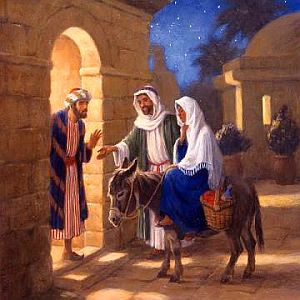
There's no innkeeper. He doesn't exist. I know we see him in all the children's plays around this time of year - and he's become the unofficial scapegoat of Christmas, turning away a pregnant woman in the middle of winter - but there's no innkeeper. There's probably no stable either, but there's definitely no innkeeper. The Bible doesn't mention an innkeeper; we infer that because Luke Chapter 2 says "there was no room in the inn," or at least it says that in English, anyway.
The innkeeper doesn't exist, though, because the inn doesn't exist. That's the real problem. We make a poor inference because the translation makes no sense to us. People simply did not stay in hotels in Jesus' time. There were places we might call inns, but they were for the rare merchant or perhaps a military detachment headed some place without barracks. In Jesus' time, if people were traveling, they made personal connections. You arranged to stay with family or family of friends. You knew someone, who knew someone, who had a place. Often people would just show up at a relative's house unannounced - this kind of hospitality was infused into Jewish culture from the very beginning. The Torah even calls people to welcome strangers. If your cousin doesn't have room in his house, try the neighbor's, they might have room.
So what of the inn? Well, that's the tricky part. There was no inn. We're not just crossing language barriers, but cultural barriers, plus barriers of time (and we're doing it twice - once between Jesus' birth and 1611, when the King James Version came out, and another between 1611 and today). The King James Version twice translates a Greek word as "inn." Both instances are in Luke (very convenient for comparative purposes), but they're two different Greek words. In the Parable of the Good Samaritan, the Samaritan takes the injured man to an inn, promising the innkeeper he'd pay for the man's care. In that instance, there is a word used which means "public lodgings." That's an inn, any way you cut it. The word used in chapter two, though, really means "guest quarters." The very fact that the same book uses two different words in what are really two different circumstances is good evidence that they're not meant to imply the same thing.
Here's where a nerdy working knowledge of traditional lodgings comes in handy. Most families, at the time, lived in one room, essentially. They had a kitchen or sorts, perhaps, with a work space, and some area where they could lay a mat out at night (the family would likely all huddle together as they slept). As the family grew - subsequent generations, cousins, uncles, parents, whatever, they would add rooms onto the home. In the cities, they'd build up (they still do in Jerusalem today), or, if there way space, maybe out. Then each nuclear family would have a place of their own.
Since homes were designed to be added on to at a later date, most reserved the roof for guests. If the family had some money, they might have a designated guest room, but there's not a ton of rain in Israel, so the roof would do. If they had my mother's manners, they might kick someone out of the "good room," so guests could use it and extra people would cram into the first floor (or main room, depending on construction).
So this leads us back to the scripture text - likely Joseph and Mary showed up at a relative's house, perhaps someone distant cousin or what-have-you, and requested hospitality. In reply, they were told the roof was full and there was no space for guests. This is where, if there was genuinely no room, they likely would have hopped next door or moved down the list of distant relatives who lived nearby and tried another place. They didn't, though (another pet peeve is when it's portrayed that Joseph and Mary tried a lot of hoteliers with no success), because they were offered an alternative.
While it's entirely possible the relative they visited had a barn out back, it's extremely unlikely. Those families with livestock (and almost everyone had livestock of one kind of another - eggs and milk and such didn't grow at Safeway, after all) would use them during the day for work (pulling carts and whatnot) or leave them outside to graze. At night, the animals were brought into the house, where they'd bed down on the other side of the main room from the family. Other rooms were guest quarters or the living spaces of older relatives because it was polite to not make people you wished to honor sleep with the goats.
Joseph and Mary likely found a relative with a full house, but one generous enough to offer space with his own wife and kids for this distant cousin and his poor, pregnant betrothed. The Bible mentions Jesus being laid in a manger (a feeding trough for animals), but there's no mention of a stable or a barn - I think, because there wasn't one.
So, if this is true (and while I think it makes sense, I might be entirely wrong), how did this inaccurate portrayal of the event get passed down so thoroughly through the years? I have no proof of this at all, but I suspect it has something to do with how these words might translate to seventeenth century England.
The King James Version came about at a time when scripture in the common language was just emerging. It was written for the common people (if you had money, you were educated, and thus could read scripture in Latin, if you so desired), and I'm guessing "guest quarters" would have been entirely foreign to the common people. People of the time rarely traveled - most would never get more than six or seven miles from the house in which they were born FOR THEIR ENTIRE LIVES! Houses were hovels - and anyone you knew lived nearby and could stay at their own house. Inn - a public housing option for travelers without the means to call upon the local noble - was likely the best they could do to convey the message to the people at the time.
Subsequent English translations were loathe to change the words, which had become so familiar to people in such a familiar story (although the newest version of the NIV does say "guest room," as Luke intended). Today, we all just assume, I guess, that there was a Motel 6 on every corner in Jerusalem and Joseph didn't have the money to spring for an Embassy Suites.
I'm not sure what the point of this whole thing was, really, other than to explain my frustration with the way we tell this story.* Perhaps it's simple to illustrate the importance of further questions, of not taking everything at face value. Investigation is good for the soul - and, at the very least, it may keep some of us from perpetuating the tale of the anachronistic innkeeper to another generation. Merry Christmas!
Just be thankful we didn't delve into the historicity of the census that drives this journey in the first place - you do not want to go there!


